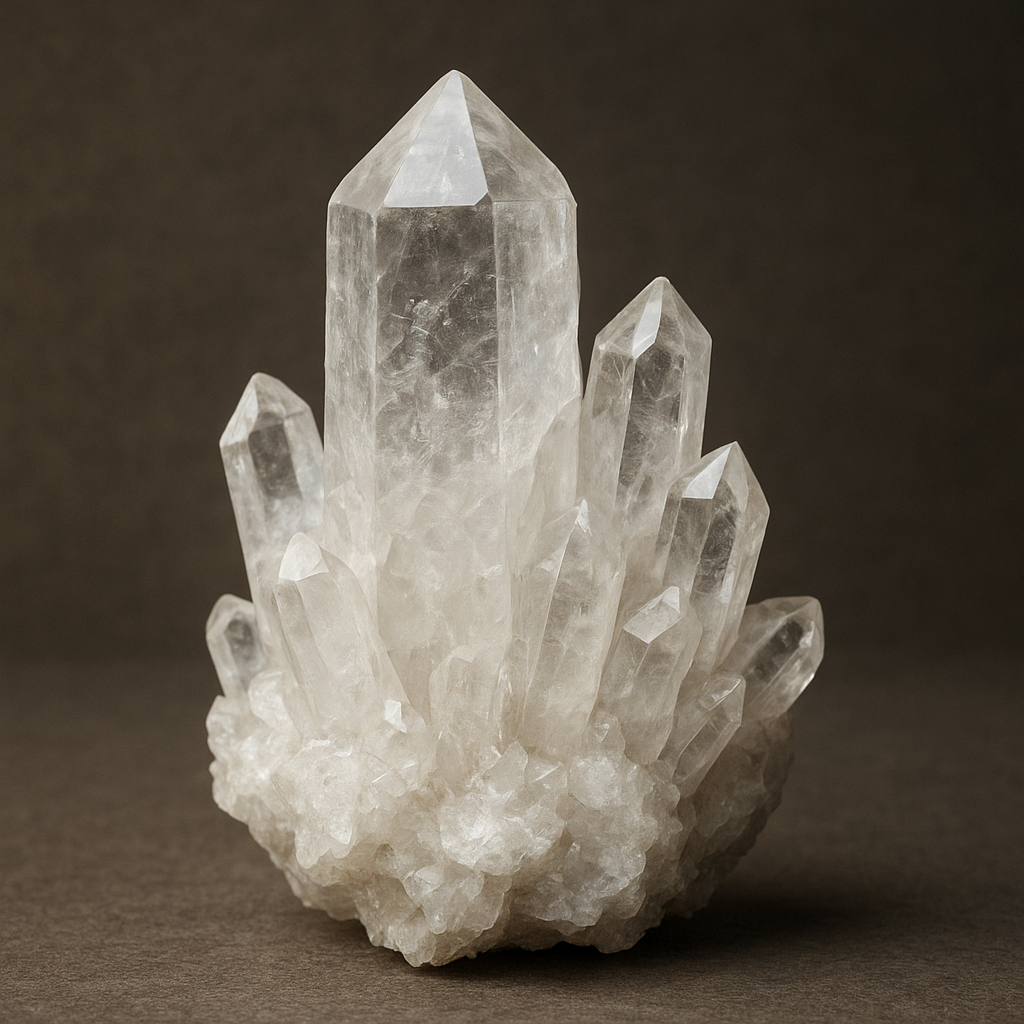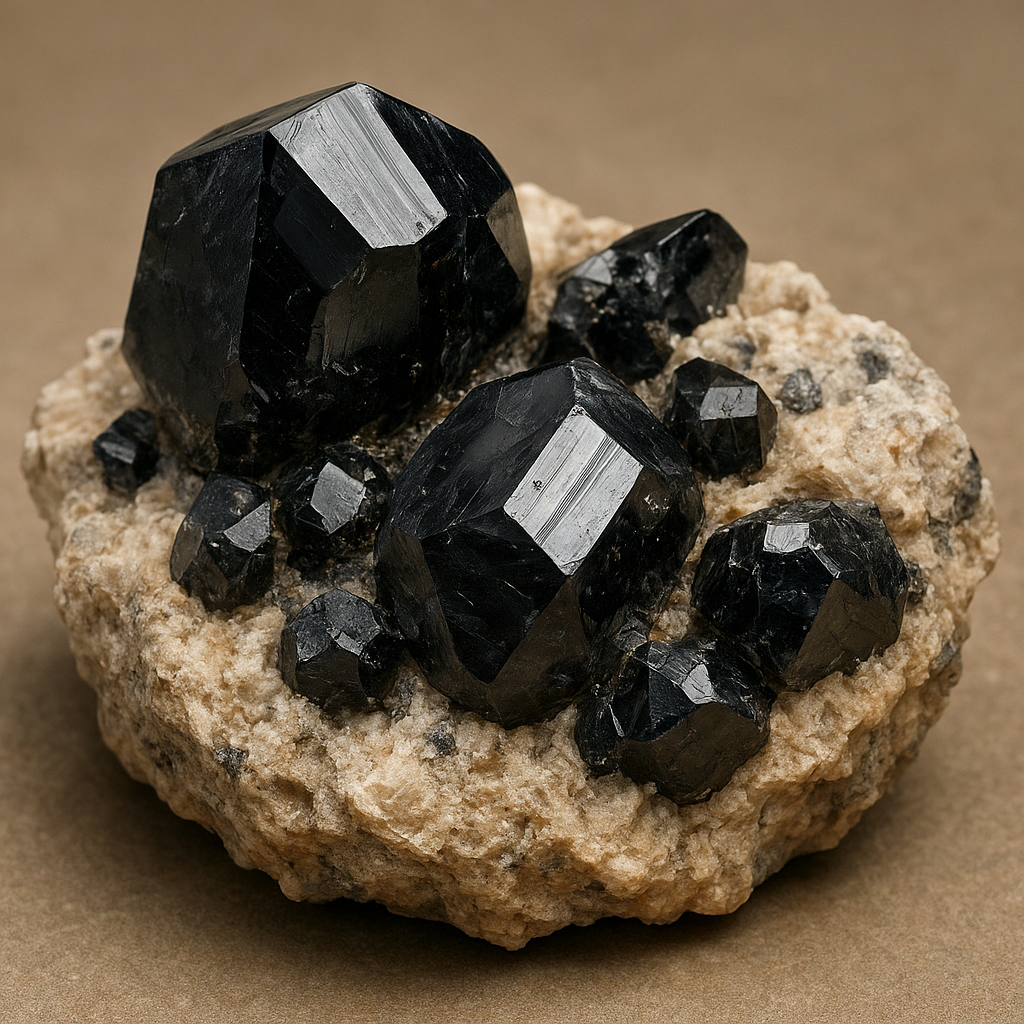
Cassiterite is the primary source of metallic tin, a metal that has shaped human technology from the Bronze Age to modern electronics. Chemically known as SnO2, cassiterite is valued both as a mineral specimen and as an industrial raw material. This article examines its mineralogical characteristics, geological settings, global distribution, methods of recovery and processing, industrial and technological uses, and the broader social and environmental issues linked to tin production. Along the way, some lesser-known but intriguing facts about the mineral’s properties and modern applications will be highlighted.
Formation and Mineralogy
Cassiterite is a tin oxide mineral with a tetragonal crystal structure. Crystals may be prismatic, short and stubby, or rounded and compact; they commonly display an adamantine to metallic luster. The mineral’s hardness ranges from about 6 to 7 on the Mohs scale and its specific gravity is notably high (approximately 6.8–7.1), a property that heavily influences how it is concentrated in placer deposits. Color ranges from brown to black, though transparent to translucent honey-yellow or reddish-brown crystals are sometimes found and prized by collectors.
Crystal habits and physical properties
- System: tetragonal; typical forms include dipyramids and prismatic faces.
- Hardness: 6–7 Mohs, making it relatively resistant to abrasion.
- Density: high specific gravity facilitates mechanical separation in mining.
- Luster and color: adamantine to submetallic; brown-black is common; gemmy varieties exist.
- Optical behavior: submetallic sheen in coarse grains, birefringence and pleochroism in transparent specimens.
The mineral often forms in hydrothermal veins, granite-associated greisens and pegmatites. It is also abundant in secondary alluvial deposits known as placers, where mechanical weathering and erosion accumulate heavy cassiterite grains in riverbeds and coastal sands. The abundance of cassiterite in placers is a direct consequence of its durability and high density compared with many host rocks.
Where Cassiterite Occurs
Although cassiterite is widely distributed, economic concentrations are geographically clustered. Classic historical and modern producers include islands and regions where primary tin-bearing granites are common or where long-term erosion has generated rich placers.
Major geographic sources
- South East Asia: Indonesia (notably Bangka and Belitung), Malaysia and Myanmar have been dominant producers of cassiterite, particularly from alluvial deposits.
- South America: Bolivia and Brazil have long histories of tin mining; Bolivian tin ores were crucial to 20th-century supply chains.
- Africa: Democratic Republic of Congo, Rwanda and Nigeria host both primary and secondary cassiterite deposits; East African artisanal mining is significant.
- Europe: Cornwall (England) and regions in Spain and Portugal were important historical producers. Cornish streamworks and old lodes are classic localities for specimen-quality crystals.
- Oceania: Tasmania in Australia and some Pacific islands also yield cassiterite.
Primary deposits are typically associated with high-temperature hydrothermal systems related to granitic intrusions. In such environments, tin-bearing hydrothermal fluids deposit cassiterite in veins, greisens (altered granite), and sometimes in skarn zones where granites interact with carbonate rocks. Secondary deposits form when these primary ores are weathered and liberated, with the dense cassiterite grains concentrated by flowing water.
Associated minerals and geological indicators
Cassiterite is frequently found with minerals such as wolframite, scheelite, topaz, tourmaline and quartz in vein systems. In greisenized granites, it is commonly accompanied by mica, fluorite and various tin-bearing sulphides. Geochemically, tin anomalies in stream sediments and fractionated granites can be important exploration indicators.
Extraction, Beneficiation and Processing
Mining of cassiterite ranges from small-scale artisanal operations to large industrial mines. Extraction techniques depend on whether the deposit is primary or alluvial and on local economic and environmental factors.
Alluvial (placer) mining
Because cassiterite is dense and resistant, traditional placer mining methods remain effective. These include sluicing, panning and the use of shaking tables or jigs. Modern operations may use hydraulic monitors, dredges and more mechanized gravity concentration plants. Gravity-based methods are favored because they exploit the large density contrast between cassiterite and gangue minerals.
Hard-rock mining
Primary vein and greisen deposits are mined with conventional underground or open-pit methods. Ore is crushed and then subjected to gravity separation, sometimes combined with flotation if sulfide-associated tin is present. Cassiterite’s resistance to chemical attack means that gravity concentration remains a core process; heavy media separation and spiral concentrators may also be used. For refractory or extremely fine-grained tin, more complex flowsheets are sometimes required.
Smelting and refining
After beneficiation yields a tin concentrate (often 60–70% Sn), smelting reduces cassiterite to metallic tin. This typically involves carburization or reduction with carbon in a reverberatory furnace or electric furnace, producing crude tin that is then refined by blowing and electrolysis to remove impurities. The refined metal is cast into ingots or further fabricated into specialized products.
Environmental and social aspects of processing
Tailings from tin mills and open-pit operations can be extensive and contain silts and heavy particles that alter riverine and coastal environments. In some regions, artisanal mining lacks formal oversight, producing social issues such as unsafe working conditions and conflicts over land or resources. Additionally, because tin is critical to electronics, pressure on supply chains has led to scrutiny of mining practices and calls for improved traceability and responsible sourcing.
Uses and Applications
The industrial importance of cassiterite stems from its role as the principal ore of tin. Tin is versatile: it alloys easily, resists corrosion in many environments, and forms compounds useful in diverse technologies.
Metallurgical uses
- Solder: The largest modern use of tin is in solder for electronics; tin-based solders provide excellent electrical connections and melting properties.
- Alloys: Bronze (copper-tin) was historically transformative; today tin is used in various alloys (including bearing alloys and white metals) to improve properties such as corrosion resistance and machinability.
- Tinning: Tin plating of steel (tinplate) provides corrosion protection for food cans and other containers.
Technological and chemical applications
Beyond metallurgy, tin compounds and tin oxide have specialized roles:
- SnO2 itself, when doped (e.g., fluorine-doped tin oxide, sometimes shortened to FTO), is a transparent conductive oxide used in solar cells, flat panels and as coatings on glass. Its combination of transparency and conductivity makes it a valuable component in optoelectronic devices.
- Tin oxides and organotin compounds have been used as catalysts, glass fining agents and stabilizers in PVC; however, some organotin varieties are now restricted due to toxicity concerns.
- Gas sensors: Tin oxide is a widely studied material for semiconductor gas sensors because its electrical resistance changes in response to reducing gases such as carbon monoxide; nanostructured SnO2 materials improve sensitivity and selectivity.
Gem and collector uses
Transparent and gemmy cassiterite crystals can be faceted into gemstones, though their high density makes them heavier than many other gems of comparable size. Collectors prize well-formed lustrous crystals from classical localities such as Cornwall, Bolivia and Bolivia’s historic mines. Because cassiterite is brittle and has strong cleavage, lapidary work is specialized and gems are relatively rare.
Historical, Economic and Environmental Context
Across history, cassiterite and tin have had outsized influence. The adoption of bronze—an alloy of copper with a small percentage of tin—was a technological leap that depended on access to tin sources. In many regions, the location of tin deposits shaped trade routes, colonial interests and local economies.
Historical importance
Cornwall’s tin mines supported local economies and maritime trade for centuries. In Southeast Asia, island placers supplied ancient seafaring peoples who traded tin across wide distances. During the 19th and 20th centuries, Bolivian and Southeast Asian production fed industrializing nations.
Modern supply chains and criticality
Today tin is considered a critical metal for electronics and renewable technologies. Global supply is concentrated in a relatively small number of countries, which creates vulnerability to geopolitical disruption, price volatility and concerns about conflict or illegal mining. This has driven interest in recycling tin from electronic waste and in developing improved traceability systems to ensure responsible sourcing.
Environmental and social challenges
Tin mining can cause deforestation, soil erosion and sedimentation of rivers. In artisanal and small-scale mining sectors, lack of regulation can lead to hazardous working conditions, child labor and community displacement. Conversely, when well-managed, tin mining can deliver livelihoods and infrastructure. International efforts and industry initiatives seek to improve environmental standards, reduce illegal mining and ensure that tin entering the global market is conflict-free.
Interesting Properties and Modern Research
Beyond its economic role, cassiterite and tin oxide are subjects of scientific interest. Nanoscale SnO2 exhibits electronic and catalytic properties not present in bulk material, opening research avenues in sensors, energy devices and catalysis. Some notable areas of research and application include:
- Nanostructured gas sensors: SnO2 nanowires and nanoparticles improve sensitivity to low concentrations of toxic gases and may enable compact, low-power devices for environmental monitoring.
- Transparent conductive films: Improvements in FTO deposition and durability bolster its use in photovoltaics and smart windows.
- Battery and energy storage research: Tin and tin oxides are studied as potential anode materials for lithium-ion and sodium-ion batteries, due to high theoretical capacities, though volume change on cycling remains a challenge.
- Environmental remediation: Tin oxide catalysts can participate in oxidation reactions to degrade pollutants under certain conditions.
Crystal twinning and paragenesis
Cassiterite commonly displays complex twinning and intergrowth patterns that are of interest to mineralogists studying crystallography and the physicochemical conditions of mineral formation. The sequence of mineralization—what forms first and what follows—can reveal the evolution of hydrothermal fluids, temperature gradients and the role of associated metals such as tungsten and copper.
Practical Considerations for Prospectors and Collectors
Prospectors looking for cassiterite should target areas with granite intrusives, greisen zones and old stream systems in tin-bearing terrains. Because of its high density, sampling and panning remain straightforward first steps. For collectors, locality, crystal habit and luster determine the specimen’s value; well-formed crystals with transparency from classical mines command high prices.
Identification tips
- High specific gravity is a diagnostic feature—dense black-brown grains that sink rapidly in panning are often cassiterite.
- Streak is typically white to light brown; this can help distinguish it from darker heavy minerals.
- Under magnification, twinning and characteristic crystal faces or fractures aid identification.
Ongoing developments in refining, recycling and responsible sourcing will shape cassiterite’s role in future technologies. The interplay of geology, metallurgy, economics and environmental stewardship makes this mineral an enduring subject of practical importance and scientific curiosity.