
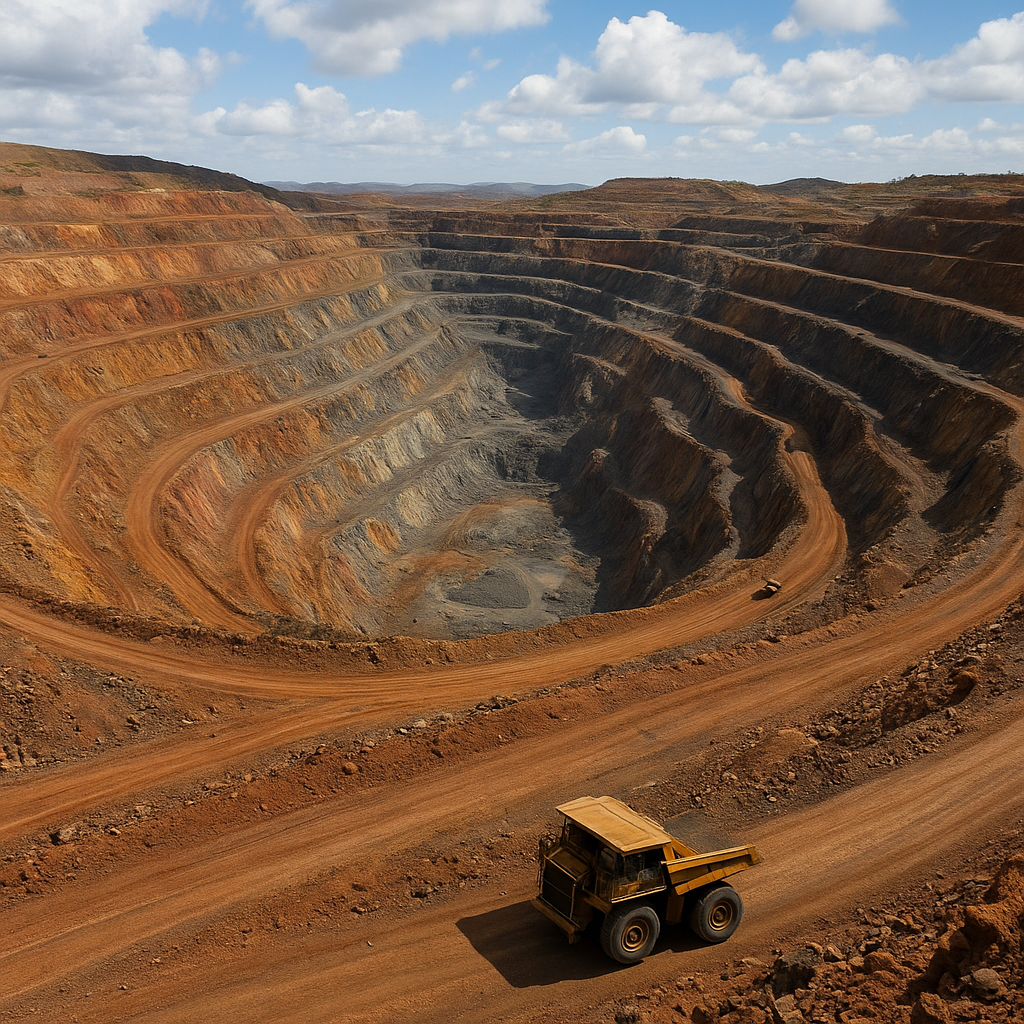
The Cadia East Mine is one of Australia’s most important modern mining operations, combining enormous physical scale with advanced underground techniques to recover valuable minerals. Located in central New South Wales near the regional centre of Orange, the operation focuses on extracting both gold and copper from a large porphyry system. Its influence reaches beyond metallurgy: Cadia East shapes regional economies, supports national export earnings, and serves as a testing ground for new mining technologies and environmental management approaches. This article explores where Cadia East is, what is mined there, its economic importance, and several notable technical and social aspects that make the project remarkable.
Location and Geological Setting
The Cadia East deposit sits in the Cadia Valley within the central west of New South Wales, approximately 20–30 kilometres from the city of Orange. The site occupies a landscape of rolling agricultural country and is accessible by a network of rural roads that connect the mine to regional and national transport routes. Its proximity to a skilled regional workforce has helped the operation develop into a significant local employer.
Geologically, Cadia East is hosted within a large, low-grade, but high-tonnage porphyry copper–gold system that formed in the context of ancient tectonic and magmatic processes. Porphyry deposits are characterized by large volumes of mineralized rock with disseminated sulfide minerals, which typically contain both copper and gold in economically recoverable quantities. The deposit’s geometry and continuity make it especially well-suited to bulk underground mining methods, enabling operators to move large volumes of ore at relatively low unit cost.
Mining Methods and Mineral Processing
Cadia East is principally an underground operation that employs the block-cave mining method. Block caving is ideal for large, massive orebodies where gravity can be exploited to allow the rock mass to break and flow into draw points for continuous extraction. The method offers high production rates and relatively low operating costs per tonne, but it requires significant upfront capital, careful geotechnical planning, and sophisticated draw control to manage cave propagation and surface impacts.
Ore mined at Cadia East contains both gold and copper as primary economic metals. After extraction, ore is transported to a surface processing complex where it undergoes a sequence of crushing and grinding stages to liberate the valuable minerals. Concentration processes, typically flotation, separate metal-bearing sulfide minerals from waste rock, producing a copper–gold concentrate that can be shipped to smelters or further refined. In parallel, some streams of ore are processed to produce gold doré via cyanide leaching and carbon-in-leach (CIL) circuits, depending on ore type and metallurgy.
Efficiency in concentrator design, reagent use, and water recycling are crucial to operation performance. Modern plants at Cadia East incorporate energy-efficient motors and grinding circuits, advanced process control systems, and tailings thickening to reduce water losses. These systems support a high throughput of ore and optimise metal recovery while minimising the environmental footprint of metallurgical operations.
Economic Importance and Regional Impact
Cadia East ranks among Australia’s most economically significant mines because it produces two of the world’s in-demand commodities: gold and copper. Gold contributes to national earnings, investor returns, and financial stability for the operator, while copper underpins global electrification, renewable energy technologies, and infrastructure development. The combined production stream enhances the mine’s resilience to commodity price cycles: when gold prices are strong, revenue streams buffer periods of lower copper prices, and vice versa.
At a regional scale, Cadia East is a major employer and a catalyst for local industry. The mine supports direct jobs in operations, engineering, and geology, as well as indirect employment in contracting, transport, equipment supply, and hospitality. Local procurement policies and long-term contractor relationships have fostered a network of businesses that supply goods and services to the mine, strengthening the economic base of the Orange region.
Beyond employment, the operation generates substantial public revenue through corporate taxes, royalties, and local rates. These funds contribute to regional infrastructure, schools, and community programs. The mine’s presence also spurs investments in roads, communications, and utilities that benefit broader regional development.
Environmental Management and Community Relations
Large-scale mining inevitably generates environmental and social responsibilities. Cadia East operates under strict regulatory oversight and industry best practices to manage water, waste, and biodiversity. Water management is a central focus, with systems designed to capture and recycle process water, reduce freshwater consumption, and prevent uncontrolled releases. Tailings and waste rock are managed through engineered storage facilities, progressive rehabilitation, and monitoring regimes to reduce the risk of contamination.
Community relations and stakeholder engagement are embedded in the mine’s social licence to operate. Regular consultation with local landholders, Indigenous groups, and regional authorities helps to address concerns related to noise, dust, traffic, and cultural heritage. Social investment programs often focus on education, healthcare, and small-business development, while impacts on local infrastructure are managed through collaborative planning and investment.
Increasingly, sustainability has become a central pillar of the operation’s strategy. Operators aim to reduce greenhouse gas emissions through energy efficiency, procurement of cleaner power sources, and continuous improvement in mine and mill energy performance. Rehabilitation plans set out long-term land-use objectives that aim to return disturbed areas to productive or natural states over time.
Technology, Innovation and Operational Challenges
Cadia East has evolved into a hub for mining innovation. The scale of the block-cave operation demands solutions for material handling, automation, and subsidence monitoring. Automated draw control, remote monitoring systems, and predictive maintenance tools have increased productivity and improved safety by reducing the need for personnel in hazardous areas. The integration of geotechnical monitoring networks helps engineers track cave propagation and manage ground movements in real time.
One of the enduring technical challenges for block caving is managing induced seismicity and surface subsidence. As the cave propagates, stresses within the rock mass change, sometimes causing rockbursts or small seismic events. Rigorous geotechnical modelling, continuous seismic monitoring, and operational adjustments are necessary to keep risks at acceptable levels and ensure the safety of workers and local infrastructure.
Another operational challenge is maintaining consistent metallurgical performance across variable ore domains. Porphyry deposits can display heterogeneity in mineralogy and sulphide content, requiring flexible processing strategies and ongoing metallurgical testwork to optimise recoveries. Process optimisation teams focus on reagent selection, flotation parameter tuning, and contingency plans for handling different ore types.
Notable Facts and Broader Significance
- Scale: Cadia East is notable for the sheer size of its orebody and the large tonnages handled by underground methods; such scale translates to long mine life and steady production.
- Integration: The operation is an integrated complex combining underground mining, concentrator circuits, tailings management, and regional logistics—demonstrating the modern mining value chain in one location.
- Innovation: The use of advanced geotechnical monitoring, remote operations, and process optimisation at Cadia East represents a microcosm of the broader industry shift toward digital and autonomous technologies.
- Sustainability: Significant investments in water recycling, rehabilitation planning, and emissions reductions reflect an increasing emphasis on environmentally responsible mining.
- Economic leverage: The mine’s dual-gold–copper production profile gives it strategic importance for both precious metals markets and industrial metal supply chains, reinforcing Australia’s position in global mineral markets.
Scientific and Educational Connections
Cadia East contributes to scientific understanding of porphyry systems and mine engineering. Universities and research organisations often collaborate with operations to study ore formation, rock mechanics, and process metallurgy. These partnerships yield improvements in recovery techniques, geophysical imaging, and environmental technologies, and they help to train the next generation of mining and geoscience professionals.
Regional Identity and Cultural Dimensions
The mine’s presence has influenced the cultural and economic identity of surrounding communities. Local festivals, sponsorships, and philanthropic initiatives often involve mine employees and companies, creating social bonds and shared investments in regional futures. Respectful engagement with Indigenous knowledge holders and cultural heritage custodians is an ongoing priority, particularly where mining interfaces with sites of cultural significance.
Future Prospects and Strategic Outlook
Looking ahead, the long-term viability of Cadia East depends on continued resource conversion, operational excellence, and responsiveness to market and regulatory changes. Exploration programs in the region aim to extend the resource base and identify satellite deposits that could feed the existing processing infrastructure. Technological uptake—such as further automation, electrification of mobile fleets, and advanced analytics—can lower operating costs and environmental impacts.
Market dynamics for copper remain favourable over the long term due to demand from electrification, renewable energy, and infrastructure development. Simultaneously, the enduring value of gold as a financial asset and hedge sustains its strategic importance to mining operations. These complementary market drivers suggest that mines like Cadia East will remain central to Australia’s mining sector for decades, provided they continue to adapt and manage environmental and social responsibilities effectively.
Conclusion
The Cadia East Mine illustrates the convergence of geology, engineering, economics, and community engagement that defines contemporary large-scale mining. As an operation that produces both gold and copper, it plays a multifaceted role: supplying critical metals to global markets, supporting regional development and employment, and driving technological and environmental advances within the industry. Its ongoing evolution will reflect broader trends in resource demand, technological capability, and society’s expectations of responsible resource development.

