Bustamite is a fascinating and sometimes overlooked mineral that occupies a special place among the manganese-bearing silicates. It is valued by geologists for what it reveals about rock-forming processes, by mineral collectors for its often attractive pinkish tones, and occasionally by lapidaries as a material for decorative stones. In the following sections I will describe what bustamite is, the geological environments where it forms, how to recognize it, its uses and significance, and some intriguing facts and research applications connected to this mineral.
Overview and Composition
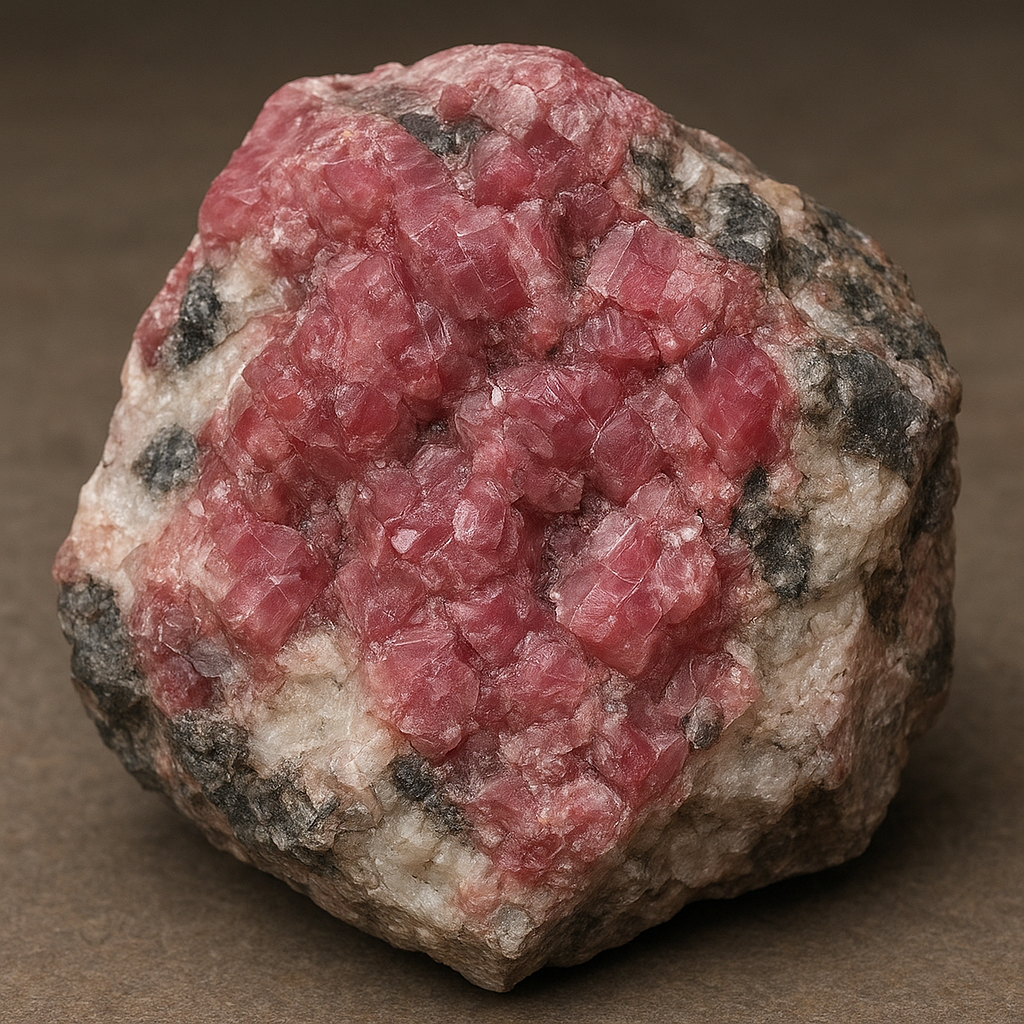
Bustamite is a calcium‑manganese chain silicate, commonly written with the simplified formula (Ca,Mn)Si2O6. It belongs to the broader family of pyroxenoid minerals, which are structurally related to pyroxenes but possess different repeat periods in their tetrahedral chains. Bustamite typically forms as a product of metamorphic or metasomatic processes that concentrate manganese and calcium in the host rock. The mineral ranges in color from pale pink to reddish‑brown, and the pink varieties are often mistaken for or associated with rhodonite, another manganese silicate. Its crystal habit is usually tabular to massive rather than well‑formed euhedral crystals, which contributes to its relative rarity in gem‑quality forms.
Formation and Geological Context
Bustamite most commonly forms in skarn environments and in manganese‑rich metamorphosed carbonate rocks. Skarns are products of contact metamorphism and metasomatism where igneous intrusions interact with carbonate country rocks. The heat and fluid‑rock interaction mobilize elements such as calcium, iron, manganese, and silica, enabling minerals like bustamite to crystallize along with a suite of other calcium‑ and manganese‑bearing species.
Typical reaction pathways involve the breakdown of manganese carbonates and silicates under elevated temperatures, followed by reprecipitation as chain silicates. Bustamite can occur in low to medium‑grade metamorphic terranes and in contact aureoles adjacent to intrusions. It is commonly found together with minerals like rhodonite, manganosite, tephroite, spessartine garnet, calcite, and various silicates. The specific assemblage provides petrologists with clues about the pressure–temperature–fluid conditions during mineral formation.
Physical and Optical Properties
For practical identification, bustamite’s most notable visible characteristic is its range of pink to brownish hues. The mineral typically displays a vitreous to greasy luster and a white streak. Its fracture and habit are often uneven to splintery, reflecting the fibrous or granular aggregates in which it commonly occurs. Although crystal faces are uncommon, microscopic and X‑ray studies reveal the complex chain‑silicate structure that distinguishes bustamite from true pyroxenes and from minerals such as wollastonite.
Optical properties under polarized light and measurements of refractive indices are useful in distinguishing bustamite from similar manganese silicates. It can show pleochroism in thin section, and its optical orientation helps mineralogists separate it from rhodonite and related phases. When well crystallized and translucent, bustamite may be faceted or cabochon‑cut, though this is rare compared with more common gemstones.
Where Bustamite Occurs
Bustamite is a global, though not ubiquitous, mineral. It is most often encountered in regions with known manganese deposits or where carbonate rocks have been subjected to contact metamorphism. Classic and notable localities include skarn and metamorphic manganese occurrences. Collectors and regional geological reports frequently list bustamite among the mineral suites of these environments.
Prominent manganese‑rich mining districts and contact metamorphic belts around the world have produced bustamite specimens. These include (but are not limited to) historic manganese mines and skarn occurrences in North America, parts of Europe, and Asia. Localities that have yielded fine or noteworthy specimens are often prized by museums and private mineral collections. Because bustamite is commonly intergrown with other manganese silicates, careful sample preparation and analysis are sometimes required to confirm its presence.
Uses and Economic Importance
Unlike major ore minerals, bustamite does not usually serve as a primary industrial source of manganese or calcium. Its economic importance is generally limited and indirect: when present, bustamite is part of assemblages that indicate manganese concentration, and such deposits can be targets for manganese extraction. However, in a broader sense, the presence of bustamite and its textural relationships in rocks can inform exploration strategies by pointing to metasomatic or contact metamorphic processes that concentrate economically valuable elements.
From a non‑industrial perspective, bustamite has modest use in lapidary arts. The most attractive pink specimens, when sufficiently translucent and hard enough, may be cut into cabochons or ornamental pieces. These uses are niche and mainly of interest to collectors and artisans who specialize in rare or colorful manganese stones. More commonly, bustamite is a collector’s mineral; good quality and well‑documented specimens can be sold to museums, private collectors, and educational institutions.
Collecting, Identification, and Care
Collectors seeking bustamite should look in classic skarn occurrences and in collections catalogues of manganese mineral localities. Identifying bustamite in the field often relies on color, association with manganese minerals, and knowledge of the geology; laboratory techniques such as X‑ray diffraction (XRD), scanning electron microscopy (SEM), and electron microprobe analysis are frequently used to confirm composition and structure.
When preparing bustamite specimens, curators and collectors must be mindful that manganese silicates can be sensitive to surface alteration under humid or polluted atmospheres. Proper storage in a stable, low‑humidity environment helps preserve color and luster. For lapidary use, cutters should evaluate the stone for cleavage, porosity, and inclusions. Polishing can reveal attractive pink to salmon tones, but toughness and the presence of intergrowths with other minerals affect how a piece can be worked.
Scientific Significance and Research Applications
Bustamite plays a role in academic research that extends beyond simple descriptive mineralogy. Because it forms under specific metamorphic and metasomatic conditions, its presence and chemical composition can be used in studies of element mobility, fluid composition, and reaction pathways in skarn and contact metamorphic systems. Geochemists analyze the trace element content and isotopic signatures of bustamite and coexisting phases to reconstruct thermal histories and fluid evolution.
Petrologists also use bustamite-bearing assemblages in basic and applied research such as thermobarometry, where mineral equilibria provide pressure and temperature estimates for metamorphic events. Experimental petrology may synthesize bustamite analogues under controlled laboratory conditions to probe stability fields and to investigate how manganese partitions among silicates, oxides, and carbonates during metamorphism.
Mineralogical Relationships and Distinctions
Understanding bustamite often involves comparing it to chemically and visually similar minerals. For example, rhodonite (a manganese inosilicate of different chain structure) and wollastonite (a calcium silicate) can occur in similar environments and exhibit overlapping colors and habits. Distinguishing between these requires attention to structural features, optical behavior, and sometimes chemical analysis. Bustamite’s pyroxenoid structure gives it distinct lattice parameters that are diagnostic by XRD.
Substitutions in the crystal lattice are common, so natural bustamite compositions show variability. Minor amounts of iron, magnesium, or other transition metals can enter the structure, altering color, density, and other physical properties. These solid‑solution behaviors are of interest to mineralogists because they inform the thermodynamic modeling of silicate systems and the partitioning behavior of geochemically important elements.
Curiosities, Historical Notes, and Cultural Context
Although not as famous as some other pink gemstones, bustamite has an understated charm. Its association with manganese gives it a place in the longer history of manganese mining and its many industrial uses (from steel alloys to pigments). Historical collections and museum records sometimes point to bustamite specimens that were mistaken for other manganese minerals until modern analytical techniques clarified their identity.
In the lapidary and mineral‑collecting communities, bustamite is appreciated for its subtle coloration and its role in diverse mineral assemblages. Educationally, it serves as a useful example when teaching about metasomatism, mineral paragenesis, and the complexity of manganese geochemistry. For the curious collector, tracking down well‑documented specimens with clear locality information provides an enriching window into regional geology and the processes that concentrate manganese.
Practical Tips for Enthusiasts and Researchers
- When sampling in the field, document the geological setting carefully: note whether the rock is a skarn, marble, or a contact aureole—this contextual information is invaluable.
- Use hand‑lens observations to record color, habit, and associations; take photographs in natural light for later comparison.
- For confirmation, request or perform XRD or microprobe analyses; these techniques reliably separate bustamite from visually similar minerals.
- Store specimens in a stable humidity and temperature environment to avoid surface alteration, especially when manganese oxides or carbonates are nearby.
- If working with bustamite in the gem trade, disclose the stone’s identity and any treatments; transparency helps maintain trust among collectors and buyers.
Final Thoughts
Bustamite may not be a household name, but it occupies an important niche in mineralogy and geology. As a recorder of metasomatic and metamorphic processes involving manganese, it helps scientists unravel aspects of crustal fluid flow and element distribution. For collectors and lapidaries, its attractive hues and geological stories make it a compelling subject. Whether encountered in a museum drawer or a field outcrop, bustamite invites closer study and appreciation for the dynamic processes that shape the mineral world.