
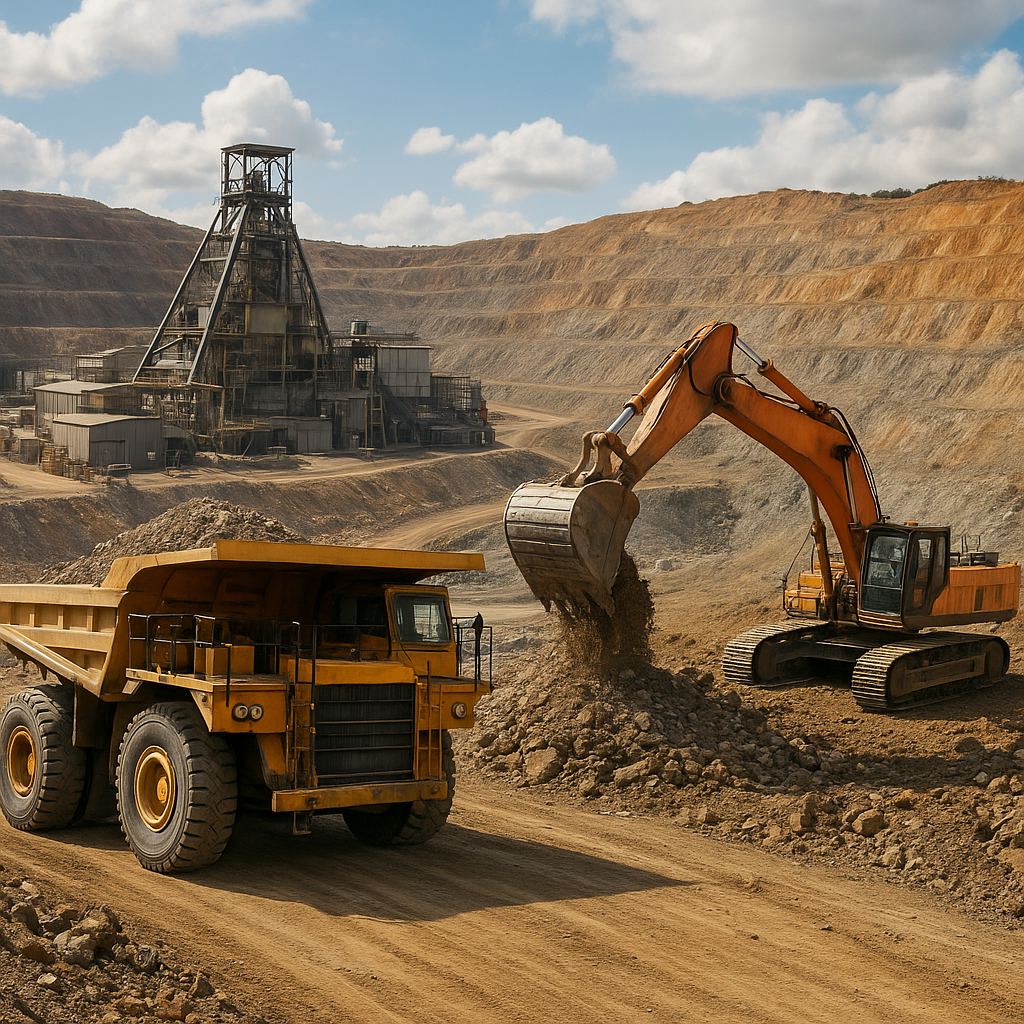
Bulyanhulu Mine is one of Tanzania’s most prominent gold operations, located in the northwest of the country. This long-standing mining complex has drawn global attention for its high-grade underground deposits, its role in the regional economy, and the complex social, environmental, and political issues that have accompanied large-scale mineral extraction in East Africa. The following article outlines where Bulyanhulu is situated, what is produced there, the mine’s economic importance, and several facts and features that make it notable.
Location and geological setting
The Bulyanhulu deposit sits in the Shinyanga Region of northwestern Tanzania, near the town of Kahama and within the mineral-rich greenstone belts that fringe Lake Victoria. These belts are part of the wider Lake Victoria Goldfields, a prolific structural and metamorphic terrain that hosts numerous gold deposits across Tanzania, Uganda and Kenya. Bulyanhulu lies inland from the lake and is accessible via a network of regional roads linking it to Mwanza and other urban centers.
Geologically, the area is characterized by ancient metavolcanic and metasedimentary rocks that have undergone multiple deformation and mineralizing events. Gold at Bulyanhulu is typically associated with sulfide-rich quartz veins and disseminated sulfide mineralization, a form of occurrence that commonly requires underground mining and concentrated processing. The deposit’s continuity at depth and the presence of multiple structural controls have allowed operators to develop deeper underground workings rather than relying solely on open-pit methods.
Production, mining methods and processing
Bulyanhulu is primarily an underground gold mine. From early feasibility studies and through its operational history, mining at Bulyanhulu has emphasized mechanized, conventional underground techniques—declines, haulage ramps, development drives and stoping of high-grade vein systems. Processing typically involves crushing and milling of ore, followed by chemical recovery circuits designed to extract gold from sulfide-rich material.
The technical choices at Bulyanhulu reflect the mineralogy of the ore: sulfide-associated gold often requires robust comminution and gravity/CIL (carbon-in-leach) or flotation-based circuits, sometimes supplemented by pressure oxidation or roasting if refractory characteristics are present. The site’s infrastructure includes ore handling systems, process plants, tailings facilities and water-management systems designed to support continuous underground production and to mitigate environmental risk.
Economic significance for Tanzania and the region
Bulyanhulu is an important asset in Tanzania’s mining sector, which is a major pillar of the national economy. The mine contributes to export earnings, government revenue through taxes and royalties, and direct employment. For many years, large gold operations such as Bulyanhulu accounted for a substantial portion of Tanzania’s foreign exchange inflows and were central to local development planning.
Economic impacts can be grouped into several categories:
- Employment: The mine provides both skilled and unskilled jobs, supporting not only onsite workers but also contractors, service providers and local suppliers.
- Investment: Large capital expenditures on underground development, processing plants and infrastructure create demand for engineering, construction and technical services.
- Government revenue: Taxes, royalties and permitting fees from mining companies form a significant revenue stream for regional and national governments.
- Infrastructure and procurement: Roads, power connections and social-service investments built to support the mine often have spillover benefits for nearby communities.
Beyond direct impacts, the presence of Bulyanhulu and similar projects has helped to attract foreign direct investment to Tanzania’s extractive sector. The mine’s operations have supported local businesses—transport, catering, equipment maintenance—and have stimulated secondary employment in service industries. At the same time, the distribution of benefits has been a point of public debate, making transparency in payments and community engagement central to assessments of the mine’s long-term economic legacy.
Social and community aspects
Mining projects of Bulyanhulu’s scale invariably interact deeply with local communities. Operators have historically run a range of community development programs designed to improve health, education, and livelihoods. Typical initiatives include clinics, boreholes and clean-water projects, school construction and scholarship schemes, vocational training and small-business support. Such programs aim to enhance local capacity and to provide alternatives to artisanal and small-scale mining.
However, community relations are complex. Large mines can cause displacement, alter land use, and generate grievances over environmental impacts or perceived inequities in benefit sharing. Bulyanhulu’s history includes tensions common to resource-rich settings—negotiations over land access, employment prioritization, and the handling of environmental incidents. In response, operators and regulators have often emphasized stakeholder consultations, grievance mechanisms and community investment plans, though the effectiveness of these measures varies with implementation and oversight.
Environmental management and challenges
Mining inevitably brings environmental challenges. At Bulyanhulu, key issues include water management, tailings disposal, dust and noise control, and the handling of sulfide-rich mine waste that can generate acid rock drainage if not properly managed. The mine’s design and operational practices include engineered tailings facilities, water-treatment systems and progressive rehabilitation efforts aimed at minimizing long-term impacts.
Regulatory oversight by Tanzanian authorities and international standards from financiers and operators play roles in shaping these practices. Environmental monitoring programs tend to focus on surface- and groundwater quality, biodiversity impacts, and dust. Moreover, the mine’s ability to manage waste rock and tailings safely is critical to local ecosystem health and the livelihoods of downstream agricultural and fishing communities. Community scrutiny and civil-society engagement have helped to highlight areas needing continual improvement.
Political and regulatory context
The operating environment for Bulyanhulu has at times been influenced by national-level policy and legal changes affecting the mining sector. In recent years, Tanzania revised mining legislation and implemented new fiscal and regulatory measures that increased state oversight and altered the fiscal terms for foreign miners. These changes prompted negotiations and, at times, disputes between operators and government authorities over royalties, export procedures and taxes.
Such regulatory shifts reflect broader debates about how resource wealth should be shared and managed. For Tanzania, the goal has been to capture more value from mineral resources while ensuring responsible environmental stewardship and local development. For mining companies, regulatory certainty is key to attracting investment and planning long-life projects. The Bulyanhulu case has thus been emblematic of the balancing act between sovereign control and investor confidence.
Interesting aspects and lesser-known facts
Bulyanhulu is notable for several features that go beyond simple production statistics:
- Depth and complexity: The deposit is accessed via extensive underground workings, and mining at depth requires sophisticated ventilation, dewatering and ground-support systems to operate safely and effectively.
- Technical evolution: Over time, the mine has adopted modern mechanized techniques and processing innovations to deal with sulfide-rich ores and to improve recovery and efficiency.
- Local economic networks: Many small and medium enterprises in the region provide services to the mine, creating an ecosystem of local contractors and suppliers that continue to evolve.
- Heritage of artisanal mining: The broader Lake Victoria goldfields have long histories of artisanal and small-scale mining; interactions between artisanal miners and large-scale operations pose social, environmental and regulatory challenges.
- Role in national debates: Bulyanhulu has featured prominently in national discussions about taxation, mining contracts, and the distribution of mining benefits—conversations that influence policy across the country.
Future prospects and long-term considerations
The long-term prospects for Bulyanhulu depend on several interlinked factors: the extent of remaining economically recoverable reserves, the price of gold, technological advances in ore processing, and the regulatory and fiscal framework established by the Tanzanian government. Reinvestment in underground development and plant upgrades can extend operational life, while exploration in the surrounding greenstone belt may identify further satellite deposits that can be mined economically.
From a sustainability perspective, the mine’s legacy will be judged not only by ounces produced but also by how well it has managed environmental risks, delivered tangible benefits to local communities, and supported local economic diversification. Strategic investment in training, local procurement and post-mining land use planning can help ensure that benefits endure after closure.
Concluding notes on significance
Bulyanhulu stands as a prominent example of modern gold mining in East Africa: a technically sophisticated underground operation set within a resource-rich geological province, with wide-ranging economic and social implications. Its presence has shaped local infrastructure, contributed to national revenue, and stimulated ongoing discussions about how best to manage mineral wealth for broad-based development. For observers of mining in Africa, Bulyanhulu offers lessons in geology, engineering, community relations and the complex interplay between multinational investment and national aspirations.

