Bronzite is a distinctive mineral belonging to the orthopyroxene group, valued by geologists and collectors for its characteristic bronze-like sheen and its geological significance. Its name evokes the metallic lustre that many specimens display, making it both a scientific interest and an attractive ornamental stone. This article explores the mineral’s identity, how and where it forms, its uses in various fields, and other fascinating aspects that illuminate why bronzite remains an object of curiosity in mineralogy and lapidary arts.
What bronzite is: composition and physical properties
At its core, bronzite is a variety of the orthopyroxene solid-solution series that spans between enstatite (MgSiO3) and ferrosilite (FeSiO3). Its composition typically reflects a significant proportion of both magnesium and iron, with the iron content responsible for darker tones and the characteristic metallic sheen. The mineral commonly occurs as coarse to fine-grained crystals or as massive aggregates embedded in ultramafic and metamorphic rocks.
Key physical and optical characteristics include:
- Color: brown to greenish-brown, sometimes grayish or blackish in more iron-rich varieties.
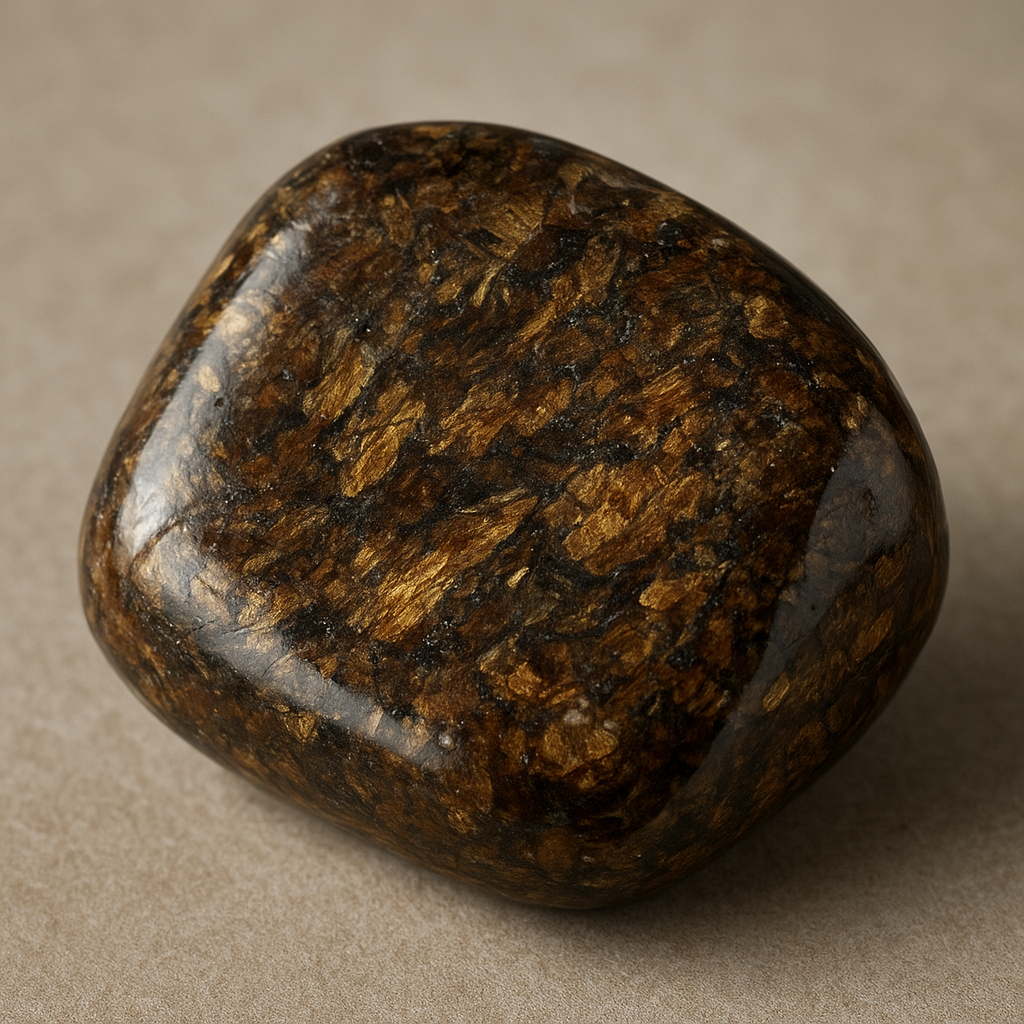
- luster: a distinctive metallic to submetallic sheen (bronze-like) on polished surfaces caused by microscopic inclusions or structural features.
- Hardness: roughly 5.5–6 on the Mohs scale, making it moderately hard but softer than many silicate gems.
- Cleavage and fracture: two distinct cleavages typical of pyroxenes, with an uneven or conchoidal fracture where cleavage is not expressed.
- Specific gravity: usually in the range of 3.2–3.6, depending on iron content.
- Optical properties: under polarized light microscopy, orthopyroxenes show characteristic extinction angles and birefringence values useful for petrographic identification; some show weak pleochroism.
Historically, the name “bronzite” has been applied to specimens of orthopyroxene that display this bronze-like sheen; modern mineralogical practice may refer to composition more precisely (e.g., “iron-bearing enstatite”). Nevertheless, “bronzite” persists as a practical and descriptive term in gemology and collecting.
Geological occurrence and formation processes
Bronzite most commonly forms in mafic to ultramafic igneous rocks and in high-temperature metamorphic rocks. Its distribution offers insights into mantle and crustal processes because it is stable under a range of pressures and temperatures typical of such environments.
Primary igneous environments
In igneous settings, bronzite crystallizes from magmas that are rich in magnesium and relatively low in silica, typical of ultramafic compositions. It is often a constituent of:
- peridotite and dunite bodies derived from the upper mantle;
- pyroxenites and other ultramafic cumulates in layered mafic-ultramafic intrusions;
- mantle-derived xenoliths carried to the surface by mafic volcanic rocks and kimberlites.
These settings preserve information about mantle composition and magmatic differentiation. Bronzite’s chemistry can be used by petrologists to reconstruct the thermal and chemical history of igneous provinces.
Metamorphic and tectonic contexts
Bronzite also forms in metamorphosed ultramafic rocks—such as those found in ophiolite complexes where oceanic mantle and crust have been thrust onto continental margins. In these contexts, orthopyroxene-bearing rocks can be altered by hydration and metamorphism to produce assemblages of serpentine, talc, and chlorite, yet relics of bronzite provide clues to the pre-metamorphic mineralogy and metamorphic conditions. The association with ophiolite belts makes bronzite a useful marker in studies of past plate tectonic processes.
Textural and alteration features
The bronze effect often arises from submicroscopic exsolution lamellae, inclusions of iron oxides (such as magnetite or chromite), or from surface weathering producing a reflective sheen. In some rocks bronzite occurs as pseudomorphs after olivine, where the original olivine crystal has been replaced chemically yet preserved in external shape. Such textures are of special interest in unraveling alteration histories of ultramafic rocks.
Major localities and global distribution
Bronzite is widespread where ultramafic and high-temperature metamorphic rocks occur. Rather than being extraordinarily rare, it is a frequent mineral in mantle-derived rocks; however, high-quality, gemmable specimens are more localized. Typical regional contexts include:
- Scandinavian shield and ultramafic complexes in Sweden, Norway, and Finland, where ancient mantle or lower crustal rocks are exposed.
- The Alpine and Apennine ophiolite belts of southern and central Europe, where oceanic slices have been obducted onto continents.
- Layered intrusions and ultramafic massifs in places such as southern Africa (e.g., Bushveld Complex) and parts of North America, where cumulate pyroxenes are found.
- Kimberlite-hosted mantle xenoliths in various volcanic fields worldwide, from which small bronzite grains can be recovered.
Collectors often seek out specimens from specific mines or outcrops that yield well-polished bronzite cabochons or decorative slabs, but academic studies frequently sample bronzite from a broad suite of localities to map compositional variations across tectonic settings.
Uses: lapidary, scientific, and cultural
Bronzite has found a range of uses that reflect both its physical beauty and its scientific utility.
Gemstone and ornamentation
In the lapidary world, bronzite is valued for its warm, metallic sheen and earthy tones. When cut and polished, bronzite can be fashioned into cabochons, beads, tumbled stones, and small ornamental objects. Its relative softness compared to quartz or corundum limits its use in rings and everyday jewelry, but it is popular for pendants, brooches, and collector pieces.
- Polishing reveals the characteristic bronze-like sheen that gives the mineral its name; thin sectioning and careful orientation can maximize aesthetic effects.
- Because natural bronzite can show attractive banding and mottling, it is sometimes used in inlays and small decorative panels.
Scientific and industrial relevance
Geologists use bronzite as a petrogenetic indicator. Its composition — particularly Fe/Mg ratios and trace element content — helps reconstruct mantle melting, magma evolution, and metamorphic histories. Analytical techniques such as electron microprobe analyses, X-ray diffraction, and stable isotope studies frequently include orthopyroxenes for constraining temperatures and pressures of rock formation.
Industrially, bronzite itself is not a major ore mineral; however, its presence can signal associated deposits. For example, ultramafic rocks containing bronzite often host chromite and, in some settings, nickel and platinum-group element mineralization. Therefore, identification of orthopyroxene-bearing rocks can guide exploration geologists.
Cultural and metaphysical use
In metaphysical and crystal-healing circles, bronzite is attributed grounding and protective qualities. Practitioners may use bronzite tumbled stones, palm stones, or worry beads for stress reduction and to promote assertiveness. These applications are cultural and anecdotal rather than scientifically proven, yet they contribute to the stone’s popularity among lapidary collectors.
Identification in hand sample and under the microscope
Being able to identify bronzite in the field and the lab is useful for both collectors and professional geologists. Several diagnostic traits can help distinguish it from other minerals:
- Color and sheen: the bronze-like metallic luster on cleavage surfaces and polished faces is a strong visual cue.
- Hardness: moderate hardness that resists scratching by a knife but is softer than quartz.
- Cleavage: two ~90° cleavages typical for pyroxenes; cleavage surfaces sometimes show the metallic lustre.
- Associated minerals: its presence alongside olivine, peridotite, and spinels supports identification as an orthopyroxene.
Under the petrographic microscope, bronzite and other orthopyroxenes display characteristic optical orientations, extinction angles, and low birefringence. Microprobe analyses that yield the Mg-Fe ratio are definitive for classifying the mineral along the enstatite-ferrosilite join.
Care, cutting, and collecting tips
For lapidaries and collectors, handling bronzite requires some attention to its physical limits. Practical tips include:
- Avoid exposure to strong acids or prolonged high temperatures which can alter the surface or sheen.
- Use appropriate cutting wheels and laps; because of its moderate hardness, abrasives used for quartz are suitable but gentler grit progression preserves polish.
- For cabochons, orient the piece to maximize the reflective sheen; often a flat or slightly domed polish highlights the metallic shimmer.
- Store bronzite separately from harder gems to reduce risk of scratching.
When collecting in the field, look for ultramafic outcrops, mantle xenolith deposits, and ophiolite sequences. Specimens with attractive polish should be slabbed and tested to ascertain whether the metallic sheen is a surface effect or an intrinsic property of the crystal.
Associated minerals and alteration products
Bronzite is commonly associated with a suite of minerals that reflect its formation environment. In fresh ultramafic rocks it is found with:
- olivine and other pyroxenes
- chromite and magnetite
- garnet in some metamorphic variants
Upon hydration and retrograde metamorphism, bronzite-bearing rocks may be altered to serpentine, talc, and chlorite. Such alteration can mask original textures but may also preserve relics of the bronzite that are informative for reconstructing metamorphic pathways.
Interesting scientific perspectives and research applications
Beyond its lapidary appeal, bronzite offers windows into deep Earth processes. Some notable scientific applications include:
- Thermobarometry: composition of orthopyroxenes like bronzite can be modeled to estimate crystallization or equilibration temperatures and pressures.
- Trace element and isotopic studies: orthopyroxene may retain signatures of mantle metasomatism, melt-rock interaction, and early differentiation.
- Meteorite studies: pyroxenes in meteorites (orthopyroxene analogs) help interpret planetary differentiation and thermal histories; comparing terrestrial bronzite chemistry with extraterrestrial pyroxenes is a productive research avenue.
Ongoing advances in microanalytical tools — laser ablation ICP-MS, NanoSIMS, and high-resolution electron microscopy — continue to refine our understanding of how bronzite records geological processes at fine spatial scales.
Collecting and ethical considerations
As with many minerals, responsible collecting of bronzite involves respecting local regulations, minimizing environmental impact, and acknowledging provenance. Specimens sourced from active mines should carry accurate locality information, which is essential for both scientific and collector value. In regions where ultramafic rocks are associated with critical metal exploration (e.g., nickel or chromium), collectors should follow local guidelines and avoid trespass on exploration or mining sites.
High-quality bronzite cabochons and decorative pieces often command interest in the gem market. Authenticity and treatment disclosure are important: buyers should confirm whether stones have been dyed, stabilized, or otherwise enhanced, and reputable sellers provide certificates or clear provenance when possible.
Final remarks on the appeal of bronzite
Bronzite occupies a unique space between scientific importance and aesthetic charm. Its presence in mantle and ophiolite settings makes it an informative mineral for petrologists, while its warm, metallic sheen has made it a favorite among lapidaries and collectors. Whether studied in thin section to decode geological history or polished into a pendant to highlight its reflective beauty, bronzite continues to fascinate and reward those who seek to understand both Earth’s deep processes and the small-scale artistry of mineral specimens.