
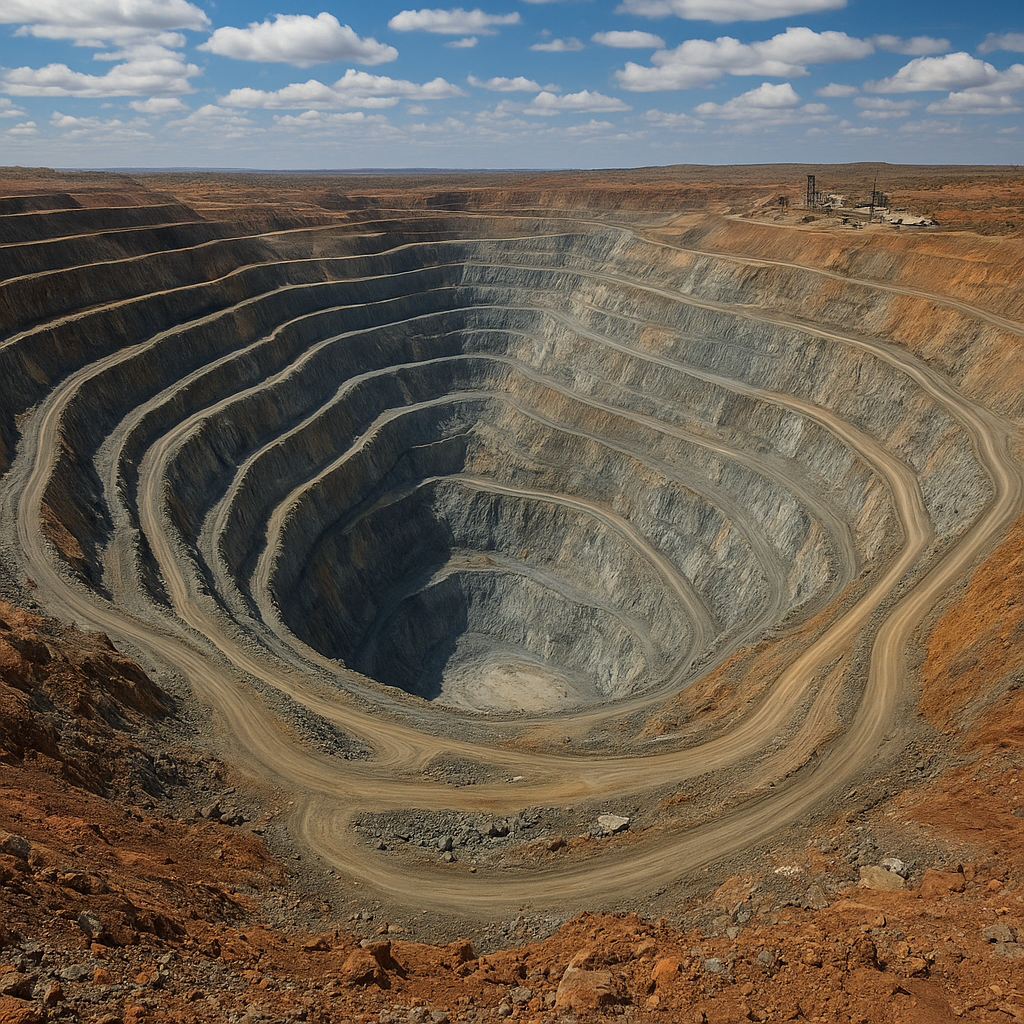
The Broken Hill mine, set in the arid interior of Australia, is one of the planet’s most storied mineral districts. For more than a century it has produced vast quantities of silver, lead and zinc from a unique and exceptionally rich orebody. The town that grew around the deposit became the birthplace of one of Australia’s most important mining companies and helped shape the nation’s industrial development. This article explores where the mine is located, what minerals are extracted, its economic role and a selection of compelling historical, geological and social aspects that make Broken Hill remarkable.
Location and regional setting
The Broken Hill deposit sits in the far west of New South Wales, roughly halfway between Adelaide and Sydney but much closer to the South Australian border. The town of Broken Hill functions as the logistical and social hub for the mining area. The region is characterized by an arid climate, wide plains and a backdrop of ancient, strongly metamorphosed rocks that host the mineralization. The mine itself is centered on a distinctive, elongated sulphide body exposed by long-term mining and weathering.
Access and infrastructure
- Road and rail connections link Broken Hill with larger urban centres and ports, providing routes for concentrate and refined material transport.
- Local infrastructure supports mining operations, including processing plants, smelters historically, and modern concentrators or ore handling facilities.
- The town’s workforce, services and cultural institutions developed directly from the mining industry and remain intertwined with mining activity.
What is mined: minerals and ore characteristics
Mining around Broken Hill targets an extraordinary polymetallic orebody. The chief commodities are silver, lead and zinc, often occurring together in massive sulphide lenses. The classic Broken Hill mineral assemblage includes galena (lead sulfide), sphalerite (zinc sulfide) and argentiferous galena or native silver occurrences, along with accessory minerals such as pyrite, chalcopyrite and various gangue minerals.
Orebody type and geology
Broken Hill is a textbook example of a distinctive deposit type now often referred to as Broken Hill-type (BHT) or stratiform polymetallic sulphide mineralization. The ore formed during deep geological processes over a billion years ago and was later metamorphosed and structurally modified. The deposit is remarkable both for its continuity over long distances and for the exceptionally high grades that were encountered near the surface during early mining.
- Host rocks: metamorphosed sedimentary sequences, frequently highly folded and faulted.
- Geometry: elongated, lens-like sulphide bodies that can be continuous over many hundreds of metres.
- Age: Precambrian/Proterozoic origins, with mineralization that predates much younger continental processes.
History of discovery and development
Broken Hill’s discovery and exploitation is one of Australia’s great mining narratives. Prospectors working in the late 19th century recognized mineralized outcrops, and systematic development soon followed. The mine’s development accelerated after syndicates and companies formed to exploit the rich surface and near-surface ore. One of the companies that originated from Broken Hill later evolved into the industrial giant known internationally, linking the site to a broader corporate history.
Key historical milestones
- Initial discoveries led to rapid small-scale mining and then to more organized operations as infrastructure and capital were brought in.
- The formation of major mining companies and the opening up of deep underground workings allowed access to the high-grade orebody at depth.
- Through successive ownerships and phases of technology, production methods and processing evolved from simple crushing and hand-sorting to mechanized underground mining and ore processing plants.
Economic significance
Broken Hill’s contribution to regional and national economies has been multifaceted. The mine provided raw materials crucial to industrial development, generated employment in a remote area, stimulated transport and service industries, and supported local government revenues. Beyond direct mining income, the deposits contributed to the foundations of metal processing industries and export earnings. During boom periods the mine sustained entire communities and underpinned investment in regional infrastructure.
Regional development and employment
The mine’s long-term operation created a stable employment base for generations of miners, engineers and service providers. Town amenities, hospitals and schools in Broken Hill exist largely because of its mining heritage. Local businesses supplying equipment, consumables and logistics found continuous demand, and the town developed a resilience tied to mineral cycles.
National and global impacts
- Exports of lead, zinc and silver from Broken Hill helped supply markets for base metals and precious metals, supporting manufacturing and monetary uses.
- Technological innovations and corporate structures that evolved from the Broken Hill operations influenced mining practice across Australia and abroad.
- Broken Hill’s status as an important ore source contributed to Australia’s reputation as a major mineral exporter.
Mining methods and processing
Over more than a century of operation, mining methods at Broken Hill evolved significantly. Early open cuts and shallow workings gave way to extensive underground operations, with multiple shafts, drives and stopes. Modern operations combine mechanized drilling, blasting, and systematic ground control to extract ore safely and efficiently.
Processing and metallurgy
Processing at Broken Hill historically involved crushing, gravity concentration and flotation to separate the lead-, zinc- and silver-bearing minerals from gangue. Smelting and refining for lead and silver were often performed either locally or at nearby smelters. Advances in metallurgy enabled improving recoveries and better separation of metals, increasing the economic viability of lower-grade orezones and facilitating environmental controls for dust, emissions and tailings management.
Environmental and social considerations
No long-lived mining district is without environmental legacy issues. Broken Hill has faced challenges typical of historic mining centres: tailings management, heavy-metal contamination, subsidence and the need to rehabilitate disturbed land. Contemporary operations and regulators place greater emphasis on environmental monitoring, progressive rehabilitation and community engagement.
- Tailings and legacy contamination have required remediation programs and ongoing monitoring of groundwater and soil quality.
- Modern operations incorporate dust and emissions controls, water recycling and stricter waste handling protocols.
- Community programs aim to ensure that mining benefits are shared and that local health and heritage concerns are addressed.
Cultural and human dimensions
Broken Hill is not only a mining site but also a cultural icon. The town’s character has been shaped by generations of mining families, and it developed a vibrant arts and cultural scene. Its striking landscapes, historic buildings and mining artifacts have inspired artists, filmmakers and writers. The connection between community identity and the mine is palpable: festivals, museums and public art celebrate the shared mining heritage.
Museums and tourism
Heritage museums and preserved workings attract visitors interested in industrial history. Educational programs interpret the geology, mining technology and social stories associated with the site. Tourism provides a complementary economic stream and helps maintain awareness of the mine’s historical importance.
Interesting facts and less-known details
- Broken Hill’s orebody type has become a class name in economic geology — the phrase Broken Hill-type describes similar stratiform polymetallic deposits worldwide.
- The area produced exceptionally high-grade ore early in its history, which helped finance rapid expansion and the growth of mining companies that later diversified nationally and internationally.
- The interplay of mining, art and culture in Broken Hill is unusual: a remote mining town with a disproportionate cultural footprint.
- Because of the intense folding and metamorphism, the ore lenses often appear in complex orientations, demanding sophisticated geological interpretation to follow them underground.
- Long operational history has made Broken Hill an important training ground for mining professionals, geologists and metallurgists.
Contemporary status and future prospects
Although the nature of operations and ownership has changed through the decades, the Broken Hill mineral district remains of interest to mining companies, explorers and the local community. Advances in exploration techniques, geometallurgy and ore-processing technology can extend the productive life of older mines by enabling the extraction of lower-grade material and by improving recoveries. The interplay of commodity prices, environmental regulation and social license will determine the pace and scale of future activity.
Exploration and resource management
Exploration in the broader Broken Hill area continues to focus on extensions of known orebodies, satellite lenses and deeper targets that were previously uneconomic. Improvements in geophysical imaging, 3D modelling and metallurgical testwork support targeted drilling and more efficient resource conversion. Superior resource stewardship and community engagement are now integral to planning new phases of development.
Why Broken Hill still matters
The story of Broken Hill is both geological and human: an ancient concentration of metals that has powered economic development, created community life in a remote landscape and left a layered legacy of industry, culture and science. Its name endures in technical geology, its history is woven into Australia’s industrial narrative, and its ores continue to remind us how concentrated pockets of Earth’s crust can shape societies. As new technologies and environmental expectations shape modern mining, Broken Hill offers lessons in adaptation, resilience and the long-term relationships between resource places and people.
Among the many elements that make Broken Hill compelling are its role in spawning major industry, the distinctive orebody characteristics that provide a geological benchmark, and the continuing social imprint of mining in a regional community. The site remains an instructive example of how geology, technology and human endeavour intersect over time to produce outcomes that reach far beyond the mine itself.

