Bournonite is a striking and scientifically interesting mineral that has attracted the attention of mineralogists, collectors and materials scientists alike. Known for its characteristic metallic luster and often elaborate twinned crystals, it is a sulfosalt whose composition and structure link it to both classic ore-mineral parageneses and modern research into chalcogenide materials. This article surveys its mineralogy, typical geological settings and occurrences, practical uses (both historical and prospective), and several thematic points that make bournonite a subject worth exploring.
Characteristics and mineralogy
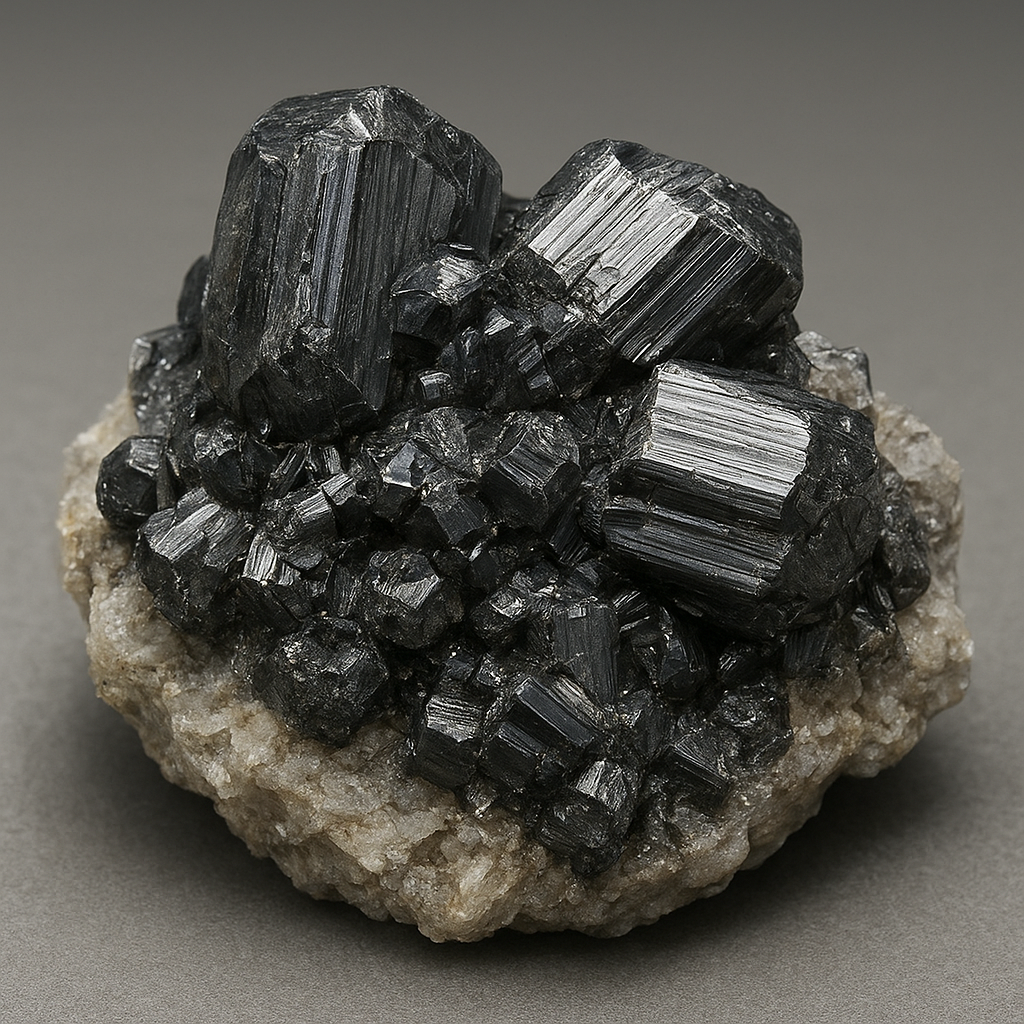
Bournonite is a lead–copper–antimony sulfosalt with the idealized chemical formula PbCuSbS3. It belongs to the broader family of sulfosalt minerals, a chemically and structurally diverse group in which semimetals such as antimony, arsenic or bismuth substitute for metals in sulfur-rich frameworks. Physically, bournonite typically presents a metallic to submetallic luster and a steel- to lead-gray color. Its crystals can be prismatic, tabular or commonly exhibit complex twinning that produces distinctive shapes.
Some of the most diagnostic features of bournonite include:
- Twinning: bournonite is famed for its repeated, often radial or “cog-wheel” twinned crystals. These twinned forms are highly prized by collectors for their aesthetic geometry.
- Opacity and metallic lustre, with surfaces that may show iridescent tarnish in weathered specimens.
- Streak typically dark gray to black, and a brittle tenacity.
- Relative softness compared to many rock-forming minerals; hardness commonly in the low single digits on the Mohs scale (often given approximately around 2.5–3.5 in field references).
- Relatively high specific gravity because of the heavy lead and antimony content — typical values are notably higher than many non-ore minerals (commonly in the vicinity of ~5.5–5.9).
Crystallographically, bournonite is structurally complex; it often appears pseudo-orthorhombic or displays lower symmetry in detailed studies. Because it is a sulfosalt, its internal bonding and structure differ substantially from simple sulfides, giving rise to unique crystallographic behavior and a propensity for repeated twinning.
Occurrence and geological settings
Bournonite forms primarily in hydrothermal environments where sulfur-rich, metal-bearing fluids precipitate sulfide and sulfosalt mineral assemblages. These environments typically include low- to medium-temperature hydrothermal veins, replacement zones in carbonate rocks, and stringer veins within metamorphosed ore bodies. The mineral is commonly associated with a typical suite of sulfides and sulfosalts that reflects the chemistry of the ore-forming fluids.
Typical mineral associations
- Galena (PbS)
- Chalcopyrite (CuFeS2)
- Sphalerite (ZnS)
- Jamesonite and other lead antimony sulfides
- Stibnite where antimony is abundant
- Pyrite and various sulfosalts such as tetrahedrite–tennantite groups
Because of this association, the presence of bournonite in a vein or replacement body can be an indicator of a metal-rich, sulfur-dominated hydrothermal event. Geologists use such mineralogical assemblages to reconstruct fluid compositions, temperatures and redox conditions during ore formation.
Notable localities
Bournonite is a widely distributed but typically minor ore mineral. Classic and well-known occurrences include historic European mining districts and rich New World deposits. Important localities that have produced fine specimens or significant amounts of bournonite include parts of Cornwall and other British metalliferous districts, central Europe (notably regions around Freiberg and other historic mining districts), South America (Bolivia and Peru), Mexico, Spain, and various localities in the United States (e.g., Colorado and Idaho). These places are also well known for associated sulfosalt and sulfide mineralization.
At many of these sites, bournonite occurs in well-formed crystals that appeal to collectors; in others, it is present as granular or massive material within the gangue of a larger ore body and contributes to the overall metal content rather than being a primary target for extraction.
Uses, economic importance and practical considerations
From an economic standpoint, bournonite is usually a minor ore rather than a primary commodity. Because its composition contains appreciable amounts of lead, copper and antimony, it can contribute to the metal yield of an ore deposit; however, it is often intermixed with other sulfides such as galena or chalcopyrite, which are the principal extractive targets. Antimony-bearing minerals are less common than lead or copper ores, so any antimony in bournonite can be of value where antimony recovery is part of the deposit’s processing plan.
Practical uses and values of bournonite include:
- As an ore contributor: in some deposits it is milled together with other sulfides to recover lead, copper and antimony during smelting and refining.
- Collector and museum specimens: its well-formed, twinned crystals and attractive metallic appearance make it desirable to mineral collectors and institutions.
- Scientific study: mineralogists study bournonite to understand sulfosalt chemistry, twinning mechanisms and ore paragenesis.
- Research potential: recent decades have seen renewed interest in complex chalcogenides for technological applications, and bournonite-type compositions occasionally appear in exploratory research into novel semiconducting or thermoelectric materials.
Because bournonite contains toxic elements (particularly lead and antimony), specimens and ores must be handled with appropriate care during mining, processing and when handled by collectors. Washing hands after handling and avoiding inhalation of dust are basic precautions. In an industrial context, lead and antimony require controlled processing and environmental safeguards to prevent contamination.
Crystallography, twinning and the collector’s attraction
One of the most visually and scientifically interesting aspects of bournonite is its propensity to form complex twinned crystals. Twinning occurs when two or more crystal segments grow together in a symmetrical orientation; in bournonite, repeated twinning often produces radial or wheel-like aggregates that have been described as “cog-wheel” twins. Such specimens can be not only beautiful but informative: the geometry of the twinning provides clues about the crystal symmetry, growth conditions, and any post-growth deformation.
Collectors prize specimens that show complete crystal faces, well-developed twins, and intact, untarnished surfaces. Because bournonite often occurs with other lustrous sulfides, specimens that juxtapose contrasting mineral habits (for example, bournonite twinning adjacent to cubic galena or bladed stibnite) are particularly sought after. In museums and private collections, bournonite often features as a showpiece mineral precisely because of this blend of crystallographic interest and visual appeal.
Lapidary and decorative uses
Bournonite is rarely used in jewelry or as a gemstone. Its relative softness, brittleness, and the presence of toxic metals make it unsuitable for typical wear. Occasionally, polished slices or classic cabinet specimens are set into display pieces or mounted as decorative objects, but such uses are niche and primarily for display rather than wearable adornment.
Analytical techniques, research directions and modern interest
Modern mineralogical research relies on a suite of analytical tools to characterize bournonite. Standard methods include:
- X-ray diffraction (XRD) to resolve crystallographic symmetry and unit cell parameters.
- Electron microprobe and SEM-EDS analyses to quantify chemical composition and zoning at a micrometer scale.
- Raman spectroscopy and infrared techniques to probe vibrational properties of the sulfide lattice.
- Transmission electron microscopy (TEM) for high-resolution studies of defects and twinning interfaces.
Beyond classical mineralogy, there is a modest but growing research interest in the electronic and optical properties of ternary chalcogenides with bournonite-like stoichiometries. Some synthetic analogues and thin films with compositions related to PbCuSbS3 have been evaluated as candidate absorber layers for photovoltaic devices or as thermoelectric materials because their composition contains elements that can give rise to favorable band structures and strong carrier interactions. While bournonite itself is not yet a commercial electronic material and faces challenges (availability, toxicity of lead, and difficulties in processing), the structural motifs and bonding environments it exemplifies inform materials scientists exploring earth-abundant and lead-reduced alternatives.
Identification in the field and safety
For geologists and collectors in the field, recognizing bournonite involves combining visual, physical and contextual clues:
- Metallic, steel-gray appearance and high density compared with common rock-forming minerals.
- Association with other sulfides (galena, chalcopyrite, sphalerite) in hydrothermal veins.
- Characteristic twinned or radiating crystal aggregates when well crystallized.
- Dark gray to black streak on unglazed porcelain.
Given the presence of lead and antimony, safety precautions are important. Avoid generating or inhaling dust from specimens, wash hands after handling, and store specimens out of reach of children and pets. In an industrial or mining setting, established environmental and occupational health controls apply: dust suppression, proper ventilation, personal protective equipment, and regulated disposal of processing wastes.
Why bournonite matters: broader themes and curiosities
Multiple aspects make bournonite an intriguing mineral beyond its immediate chemistry:
- Historical connections: named in honor of early mineralogists and connected to classic mining districts, bournonite links modern science with the history of ore discovery and mineral collecting.
- Crystallographic puzzles: its twinning and structural complexity provide rich case studies for crystallographers studying growth mechanisms, symmetry-breaking and interface energetics.
- Indicator mineral: in ore geology, bournonite’s presence can help reconstruct hydrothermal fluid evolution and metal transport mechanisms in a deposit.
- Material inspiration: even if not directly exploitable as an electronic material, the chemistry of bournonite inspires exploration of related compounds that might be engineered for desirable optical or thermoelectric properties.
For those who study or collect minerals, bournonite sits at the intersection of aesthetic beauty and scientific value — a mineral whose distinctive crystals tell stories about geological processes deep within the Earth while offering curiosities that continue to interest researchers working at the interface of geology, crystallography and materials science.