Boulder Opal is a striking and uniquely Australian variety of opal that captures attention with its vivid flashes of color against a natural ironstone matrix. Often admired for its durability and dramatic contrast, this gemstone has carved out a special place in both the gem trade and in cultural lore. This article explores the geological origins, geographical distribution, physical characteristics, practical applications, and cultural significance of boulder opal, along with practical guidance for collectors, jewelers, and enthusiasts.
Geology and Formation
The formation of boulder opal is a fascinating geological process that requires a specific set of conditions over millions of years. At the core of boulder opal formation is silica-rich solution that deposits microscopic spheres of silica into cavities and cracks within host rock. In the case of boulder opal, that host rock is typically ironstone — a dense, brown to reddish sedimentary rock rich in iron minerals. The silica spheres, when packed with regular spacing, diffract light and produce the characteristic play-of-color that identifies precious opal.
How silica becomes opal
Silica is transported by groundwater and deposited in voids, fissures, and seams inside sedimentary rocks. Over long periods, as water evaporates or flows away, the silica particles consolidate and form an amorphous gel that eventually hardens into opal. The size and uniformity of the silica spheres determine the wavelengths of light diffracted and therefore the colors that appear. Boulder opal is special because the opalized material remains intimately associated with the ironstone, often forming thin seams or layers that are cut and polished with the host rock still attached. This natural backing can enhance the visual impact of the colors and improves the gem’s mechanical stability.
Unique structural features
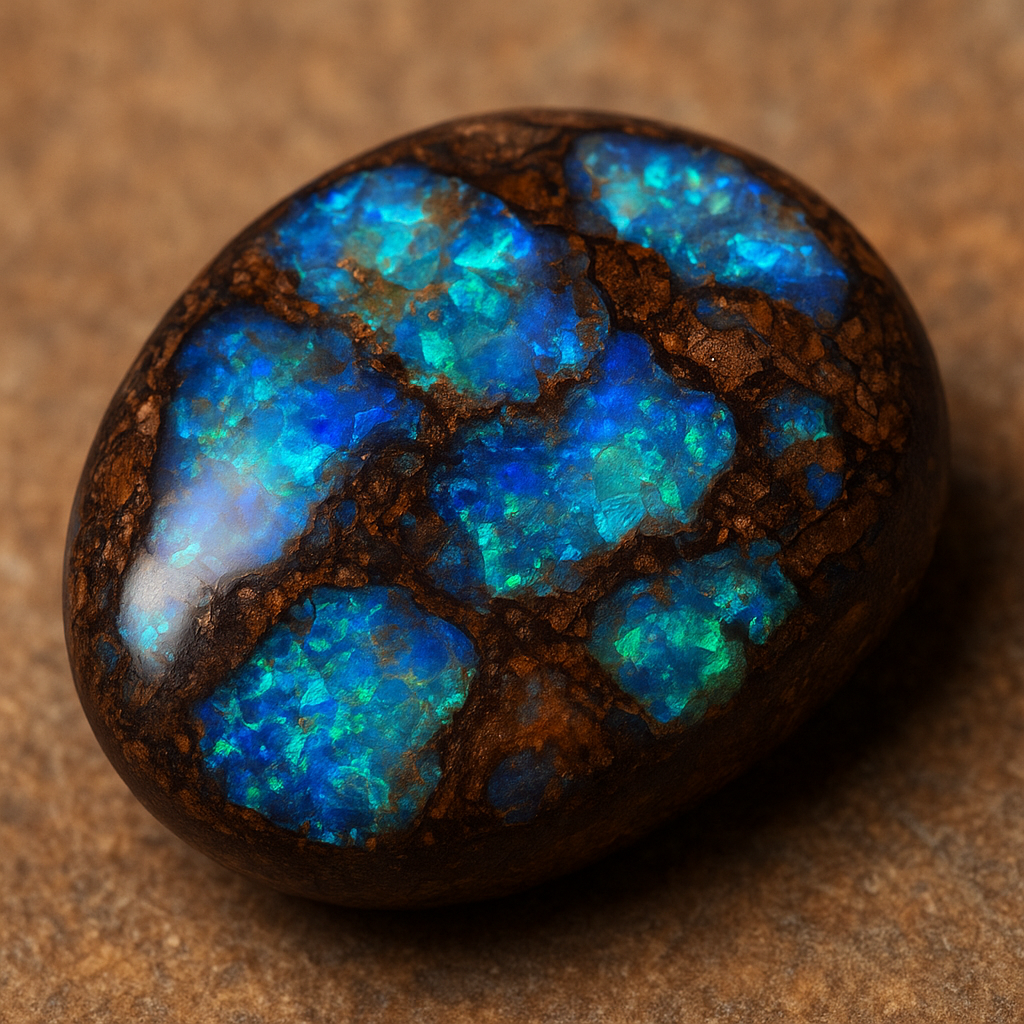
Unlike freeform or “noble” opal that is mined as seams or lumps of nearly pure silica, boulder opal is intergrown with its matrix. This creates patterns and textures not commonly found in other opal types: veins, patches, and sheets of opal within a darker ironstone background. The interplay between the pitcher-black or brown ironstone and the opalescent material creates a dramatic contrast that often increases the gemstone’s visual appeal.
Where Boulder Opal Occurs
Boulder opal is overwhelmingly associated with Australia, and more specifically the state of Queensland. The opal fields in Queensland are famed for producing high-quality boulder opal with strong, vibrant color and interesting natural patterns. Notable localities include the regions around Winton, Quilpie, Yowah, and Koroit.
Major mining districts
- Quilpie — Known for producing large stones and varied color spectrums; often contains broad flashes and bold patterns.
- Koroit — Famous for intricate matrix patterns and ribbon-like opal seams within the ironstone.
- Yowah — Renowned for “Yowah nuts,” rounded ironstone concretions that contain vivid opal centers; collectors prize these for their rarity and striking appearance.
- Winton — Produces attractive boulder opal with a mix of bright colors and irregular patterns.
While Australia is by far the main source, small occurrences of opal embedded in ironstone can be found in other parts of the world, but these are rare and usually do not match Queensland boulder opal in terms of commercial importance or aesthetic quality.
Physical and Optical Properties
Boulder opal presents a set of physical properties that distinguish it from other gemstones and other opal types. Its attachment to ironstone gives it a natural backing which increases toughness and reduces the risk of breakage at thin edges. The optical beauty of boulder opal comes from its opalescence — the interaction of light with the internal structure of silica spheres.
Optical phenomena
The hallmark of precious opal is play-of-color, a shifting spectral display that changes with the angle of observation and the angle of illumination. In addition to play-of-color, boulder opal can show:
- Pattern: Harlequin, ribbon, flash, and pinfire arrangements are common patterns that influence value.
- Body tone: The darkness of the host rock and the opal’s background color can range from light to very dark; darker backgrounds often enhance perceived color intensity.
- Brilliance: The brightness of the color flashes is a key determinant in desirability.
Physical characteristics
Opal has a relatively low Mohs hardness (about 5.5 to 6.5), but the ironstone matrix of boulder opal often results in a more durable overall gem. The presence of ironstone gives a weight and solidity that freeform opal lacks, and allows jewelers to cut thin slices or freeform shapes without as much risk of structural failure. Nevertheless, care is required because opal can be sensitive to sudden temperature changes and certain chemicals.
Uses and Applications
Boulder opal’s striking appearance and relative durability make it a popular choice for various applications, most notably in fine jewelry and decorative art. Its tendency to occur in slab-like formations with attached ironstone allows for creative cuts and settings that emphasize contrast and natural patterning.
Jewelry design
Designers and craftsmen appreciate boulder opal because it often requires minimal backing or mounting due to the natural ironstone. Common uses include:
- Cabochons for rings, pendants, and earrings — the most common form, where the stone’s color and pattern are showcased.
- Inlays — thin opal seams set into metal or wood inlaid jewelry, often used in bespoke pieces.
- Statement pieces — large polished slabs set as pendants or brooches where the natural matrix and pattern are displayed almost like a landscape painting.
Decorative and artistic uses
Boulder opal slabs and slices are sometimes used in objets d’art, such as small sculptures, watch faces, and decorative boxes. Their natural contrasts can be combined with precious metals and other gemstones to create unique works that emphasize the organic nature of the material.
Mining, Cutting, and Treatment
The life of a boulder opal from ore to finished gem involves several specialized steps: exploration and mining, sorting and rough grading, cutting and polishing, and sometimes stabilization. Each phase affects the final appearance and value.
Mining methods
Mining for boulder opal ranges from small-scale artisanal operations to more organized open-cut and shallow underground mining. Miners often look for ironstone outcrops and then follow seams and cracks where opalization has occurred. Because boulder opal can occur as thin layers, careful extraction is required to preserve the opal within the matrix.
Cutting and polishing
Cutters typically follow the veining and patterns in the ironstone to maximize the display of color. Many gem cutters favor cabochon shapes that allow the play-of-color to be viewed across the surface. The natural ironstone backing is often left intact; this technique not only preserves the stone but also creates strong contrast and a unique aesthetic that cannot be replicated in doublets and triplets.
Treatments and enhancements
Most natural boulder opals are sold untreated, but there are treatments and assembled stones in the opal market that buyers should be aware of:
- Doublets and triplets — assembled stones where thin opal slices are glued to a dark backing (doublet) and sometimes capped with a clear layer (triplet) to enhance durability and color. These are less valuable than solid boulder opal.
- Stabilization — in rare cases, porous opal material may be consolidated with resins; disclosure is required but such treatments can alter value.
Care, Handling, and Longevity
While boulder opal is more robust than many other opal types because of its ironstone backing, owners still need to exercise care to ensure longevity. The organic and hydrated nature of opal makes it susceptible to certain environmental stresses.
Practical care tips
- Avoid extreme temperature changes, which can cause micro-fractures.
- Keep away from harsh chemicals, including household cleaners and strong acids.
- Clean gently with a soft cloth and mild soapy water; avoid ultrasonic cleaners.
- Store separately from harder gemstones to prevent scratching of the opal surface.
Longevity
With reasonable care, boulder opal jewelry can last generations. Its natural ironstone support makes it less prone to chipping, and when properly set, boulder opal rings and pendants can withstand daily wear better than many free-standing opals.
Valuation and Market Considerations
Determining the value of a boulder opal involves several interconnected factors. Unlike diamonds, opal valuation relies heavily on subjective qualities such as pattern, color, and aesthetic impact.
Key value drivers
- Color intensity — Bright, vivid colors command premiums, especially reds and multi-color flashes.
- Pattern — Rare and desirable patterns like harlequin or broad flash are highly sought after.
- Coverage — The amount of opal surface relative to the host rock affects price: larger areas of color are more valuable.
- Cut and polish quality — A well-cut cabochon that maximizes color will fetch a higher price.
- Rarity — Unusual specimens, such as large Yowah nut opals, can be exceedingly valuable to collectors.
Buyers and collectors
Buyers range from fashion-conscious consumers seeking unique jewelry to serious collectors and investors who prize unusual patterns or historical provenance. When purchasing boulder opal, consumers should request certification or a reputable seller’s guarantee about whether a stone is a solid piece of opal within ironstone, a doublet, or a triplet.
Cultural, Historical, and Metaphysical Context
Opal has long held cultural significance in various societies, and boulder opal contributes to that narrative with unique regional identity. Australian opal, in general, has been woven into national identity and folklore.
Australian heritage
Boulder opal mining communities in Queensland have deep roots, with generations of families involved in prospecting and cutting. Local festivals and gem shows celebrate the stone, and many small museums and galleries display notable specimens. The stone’s strong visual ties to the landscape have inspired artists and jewelers who emphasize the connection between the gemstone and the Australian outback.
Metaphysical beliefs
Though not scientifically proven, many people assign metaphysical properties to opal. Boulder opal is often associated with grounding energy due to its ironstone matrix and is said by some to enhance emotional stability and creativity. Whether taken as spiritual belief or artistic metaphor, such associations contribute to the gemstone’s appeal and usage in bespoke pieces aimed at personal meaning.
Fakes, Synthetics, and How to Tell the Difference
Because opal can be valuable, the market includes natural, synthetic, and assembled stones. Being able to distinguish among them protects buyers and preserves trust in the trade.
Assembled opals (doublets and triplets)
Doublets are made by gluing a thin slice of opal onto a dark backing (often ironstone or black potch) to simulate the appearance of a thicker opal. Triplets add a transparent cap (usually quartz or glass) to protect and magnify the opal. While legitimate and useful for certain price points, assembled stones should be disclosed and are generally less valuable than natural boulder opal.
Laboratory-grown opal
Synthetic opal is produced in laboratories and can exhibit play-of-color similar to natural opal. However, synthetic opals often show distinctive columnar patterns and lack the irregularities of natural formation. Forgeries and imitations can also be dyed or stabilized material made to look similar to boulder opal; buyers should rely on reputable gemological testing when in doubt.
Collecting Tips and Interesting Facts
For collectors and enthusiasts, boulder opal offers endless fascination. Below are practical tips and a few surprising facts that highlight the stone’s special qualities.
Collecting tips
- Buy from reputable dealers who provide clear information on whether a piece is solid boulder opal or an assembled stone.
- Inspect stones under different lighting conditions — natural daylight, incandescent, and LED — to see the full range of play-of-color.
- Consider the setting: bezel settings can protect the edges of opal cabochons while allowing the matrix to be visible.
- Preserve provenance when possible; documented origin (e.g., Yowah, Koroit) can add historical and collector value.
Interesting facts
- Boulder Opal often displays dramatic contrast because the opal is naturally backed by ironstone, enhancing color visibility.
- Yowah nuts are geological curiosities: small concretions that when cut reveal a colorful opal nucleus, sometimes resembling a miniature planet.
- Because of its matrix, boulder opal is commonly cut into shapes that celebrate the natural pattern, making each piece essentially one-of-a-kind.
- Large, high-quality boulder opals are among the most sought-after Australian gemstones and can command significant prices at auction.
Conclusion
Boulder opal stands out in the gem world for its combination of striking visual phenomena and rugged natural backing. From the ironstone-lined seams of Queensland to highly crafted jewelry and unique collector pieces, boulder opal offers a rich tapestry of geological wonder, aesthetic appeal, and human craftsmanship. Whether you are a jeweler seeking a distinctive centerpiece, a collector drawn to rare patterns, or someone curious about the natural world, boulder opal rewards attention with beauty, history, and a direct link to the earth’s deep-time processes.