
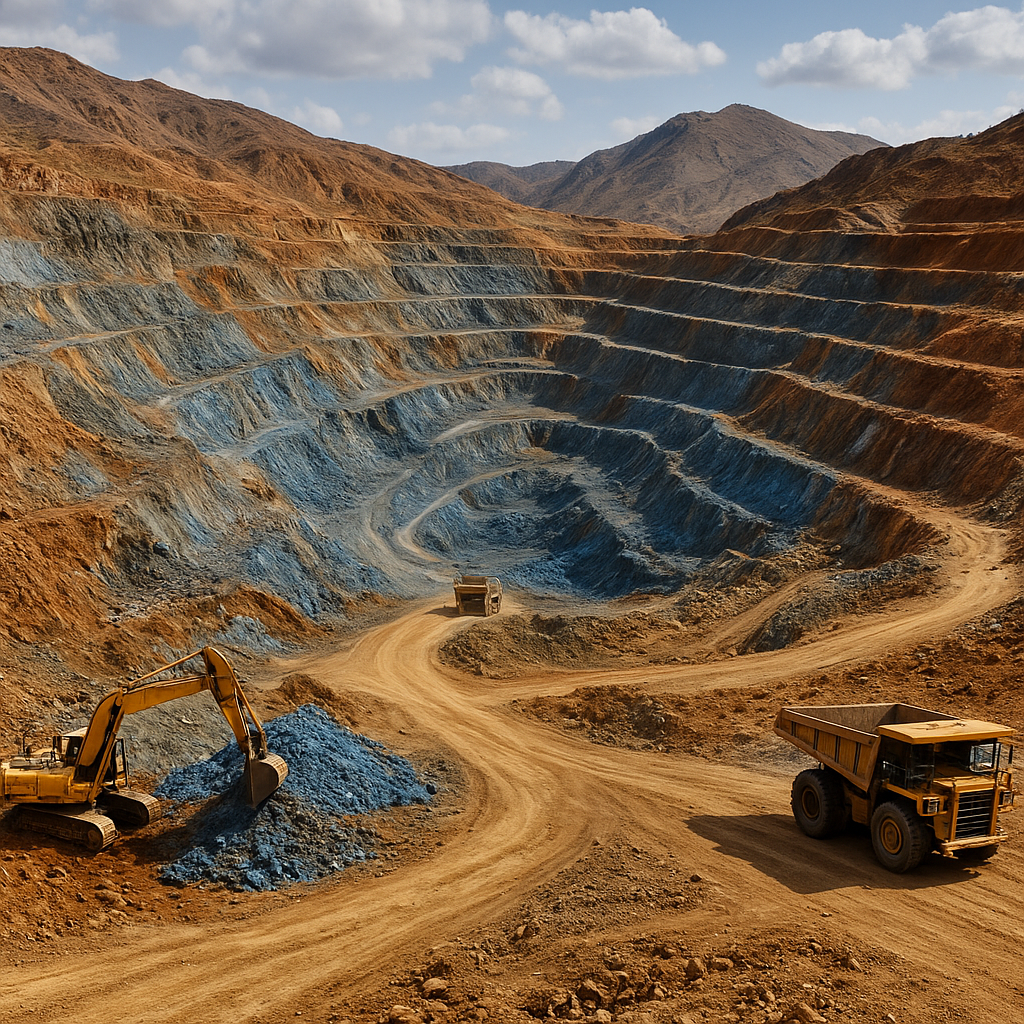
The Bou Azzer mining district in south-central Morocco stands out as one of the planet’s most remarkable localities for cobalt-rich mineralization. Located in an often rugged portion of the Anti-Atlas, Bou Azzer has drawn generations of miners, geologists and collectors not only for its economic contribution but also for its exceptional variety of rare cobalt minerals and unusual geological setting. This article examines where the mine is, what is — and has been — extracted there, the site’s economic role, and several geological and cultural features that make Bou Azzer compelling to both industry and science.
Location and geological setting
Bou Azzer lies in the Anti-Atlas mountain chain of Morocco, roughly within the broad region between the towns of Tazenakht and Akka, in an intramontane belt of ancient rocks. The district occupies a structurally complex area formed during Precambrian to early Paleozoic tectonic events. The mineralization is intimately associated with ophiolitic and ultramafic rock sequences that were tectonically juxtaposed during regional deformation.
Ophiolite-hosted mineralization
The host rocks of Bou Azzer are dominated by serpentinized ultramafics and associated sheared and metamorphosed sequences derived from oceanic lithosphere, often described as an ophiolite suite in the regional literature. Hydrothermal fluids circulating along faults and fractures within these units produced concentrated veins and lenses of metallic sulfides and arsenides. The physical and chemical conditions that prevailed favored the deposition of cobalt-rich arsenide and sulfide assemblages rather than the more common copper-dominant sulfides found in many other deposits.
Structural controls and alteration
Vein systems at Bou Azzer follow a range of structural orientations and are often localized in zones of intense shearing and alteration. The interaction between ultramafic host rocks and metal-bearing fluids generated distinct alteration halos, including carbonate and talc-serpentine zones, which served as geochemical traps for metals. This combination of host lithology, permeability structures and fluid composition is central to understanding the unique mineralization at Bou Azzer.
Minerals and resources extracted
The Bou Azzer district is best known for its cobalt-dominant ores, but the mineralogy is exceptionally varied and includes several rare and collectible species. Much of the economic value historically derived from ores comprising cobalt arsenides and cobalt sulfides, accompanied by significant silver and occasional nickel and copper values.
- Primary commodity: cobalt — present in various metallic, arsenide and sulfide minerals and often the primary target of mining operations.
- Associated metals: silver, nickel, copper — with silver frequently reported as a valuable by-product in high-grade veins.
- Notable minerals: cobaltite, skutterudite, safflorite and a range of arsenide species. Bou Azzer is also the type locality for several rare minerals, including bouazzerite, and is famous for striking secondary minerals such as erythrite (a vivid cobalt arsenate) that form attractive coatings on specimens.
- Mineral collectors’ appeal: specimens from Bou Azzer are prized by collectors for their rarity, crystal forms and striking colors — qualities that enhance the district’s cultural and scientific value beyond simple tonnage.
The ore typically occurs as vein-hosted mineralization, sometimes in steeply dipping shoots and lenses. Mineral processing historically separated cobalt-bearing minerals using a combination of crushing, grinding and flotation, followed by smelting or hydrometallurgical treatment to recover cobalt and associated precious metals. Because many cobalt-bearing minerals at Bou Azzer are arsenides, metallurgical processing required special treatment to manage arsenic-bearing material safely.
Economic importance and mining history
Bou Azzer’s economic importance is twofold: as a historical source of strategic metal production for the region and as a geological exemplar for specialized cobalt deposits worldwide. The district was discovered and developed in the 20th century and, at various times, provided a significant fraction of Morocco’s cobalt output. Although global cobalt supply today is dominated by large producers in other regions, Bou Azzer played a key role in establishing Morocco’s presence in the strategic metals sector.
Local and national impacts
At the local level, Bou Azzer has been a source of employment, infrastructure development and modest economic stimulus in an otherwise semi-arid and sparsely populated part of the country. Roads, small towns and service networks expanded in response to mining activity. Nationally, revenues and industrial experience derived from Bou Azzer and similar mines helped build expertise in mineral exploration, processing and regulatory oversight within Morocco’s mining sector.
Market context and modern relevance
The demand for cobalt has changed markedly over recent decades because of its critical role in high-strength superalloys, catalysts and, most importantly, rechargeable lithium-ion batteries used in portable electronics and electric vehicles. While Bou Azzer did not become a giant supplier on the scale of some modern producers, its cobalt-rich ores illustrate the diversity of geological sources for cobalt and remain strategically interesting. Periods of high cobalt prices historically prompted renewed exploration and intermittent production at Bou Azzer, while price declines and the complexity of processing arsenide-rich ores have sometimes led to operational pauses.
Scientific, mineralogical and cultural interest
Bou Azzer ranks high among the world’s fascinating mineral localities for several reasons: its role as a type locality for rare minerals, the unusual cobalt-arsenide assemblages, and the superb specimen quality produced for collectors and researchers. The district is frequently visited by mineralogists investigating ore formation under ultramafic-hosted conditions and by collectors seeking fine samples of cobalt minerals and colorful secondary coatings such as erythrite.
- Type locality and rare species: Several mineral species were described first from Bou Azzer, giving the mine an enduring scientific identity. Minerals named for the locality serve as a lasting record of the district’s uniqueness.
- Collector and museum specimens: High-quality crystals and colorful specimens from Bou Azzer are found in public and private collections worldwide, aiding both education and research.
- Research contributions: Studies of Bou Azzer’s mineral chemistry, paragenesis and stable isotopes have provided insight into how cobalt concentrates in ultramafic-hosted contexts, information that helps guide exploration elsewhere.
- Cultural narratives: The mine’s history intersects with local communities and traditional mining practices, forming part of regional heritage. Mineral shows and academic symposia often highlight Bou Azzer as a classic field example.
Mining methods, processing and environmental considerations
Typical mining at Bou Azzer involved underground workings rather than large open pits, reflecting the vein- and shoot-style nature of the ore. Underground development accessed mineralized structures with stopes, raises and inclined adits. Because ores are often high in arsenic and occur as fine-grained arsenide phases, processing required careful planning to manage toxic by-products.
Processing challenges
Arsenide-rich cobalt ores can present metallurgical difficulties: arsenic removal is costly and creates residues that must be stabilized to prevent environmental release. Processing routes ranged from flotation and smelting to hydrometallurgical extraction with arsenic fixation. Each method involves trade-offs between recovery, cost and environmental control.
Environmental management
Environmental concerns at Bou Azzer include the potential release of arsenic and heavy metals from waste rock, tailings and mine drainage. Modern best practice calls for detailed geochemical characterization of wastes, encapsulation or stabilization of arsenic-bearing residues, controlled water management, and long-term monitoring. In recent decades there has been growing attention to reclamation, community engagement and legacy site remediation in former mining districts like Bou Azzer.
Why Bou Azzer remains compelling
Beyond raw production figures, Bou Azzer’s enduring significance rests on several intersecting themes. It is a natural laboratory where the interactions between ultramafic rocks and hydrothermal fluids produced a rare and concentrated suite of cobalt minerals; it is a cultural landmark whose mineral specimens have traveled to collections and museums internationally; and it is an economic case study in the complexities of mining metals that are both strategically important and metallurgically challenging.
- Scientific intrigue: The deposit’s formation processes continue to attract geoscientists seeking to understand how mineralization concentrates in such settings.
- Specimen legacy: For collectors and museums, Bou Azzer specimens remain highly sought-after, ensuring the locale’s name persists in mineralogical literature.
- Strategic metals awareness: As global attention on critical minerals grows, Bou Azzer serves as a reminder that valuable cobalt sources exist beyond the most publicized producing regions — and that diversity of supply can be important for resilience.
- Local identity: The mine forms part of local history and economy; its presence influenced settlement patterns and livelihoods in the surrounding communities.
Future perspectives and exploration potential
Looking ahead, the Bou Azzer district offers several potential pathways of renewed interest. Rising demand for cobalt-bearing materials for energy technologies could justify fresh exploration, particularly with improved metallurgical approaches to treat arsenide-rich ores more safely and cost-effectively. Advances in ore-processing, stricter environmental controls, and more sustainable mine planning might allow limited, high-value mining to resume in ways that minimize community and ecological impacts.
Exploration science also benefits from revisiting classic localities: modern analytical techniques such as high-resolution geochemistry, microstructural analysis and isotopic studies can refine models of how the Bou Azzer ores formed, pointing explorationists to overlooked targets in similar terrains both in Morocco and internationally. Moreover, the district’s rich mineralogical record means that new, previously undescribed species could still be recognized by careful collectors and researchers working in the field.

