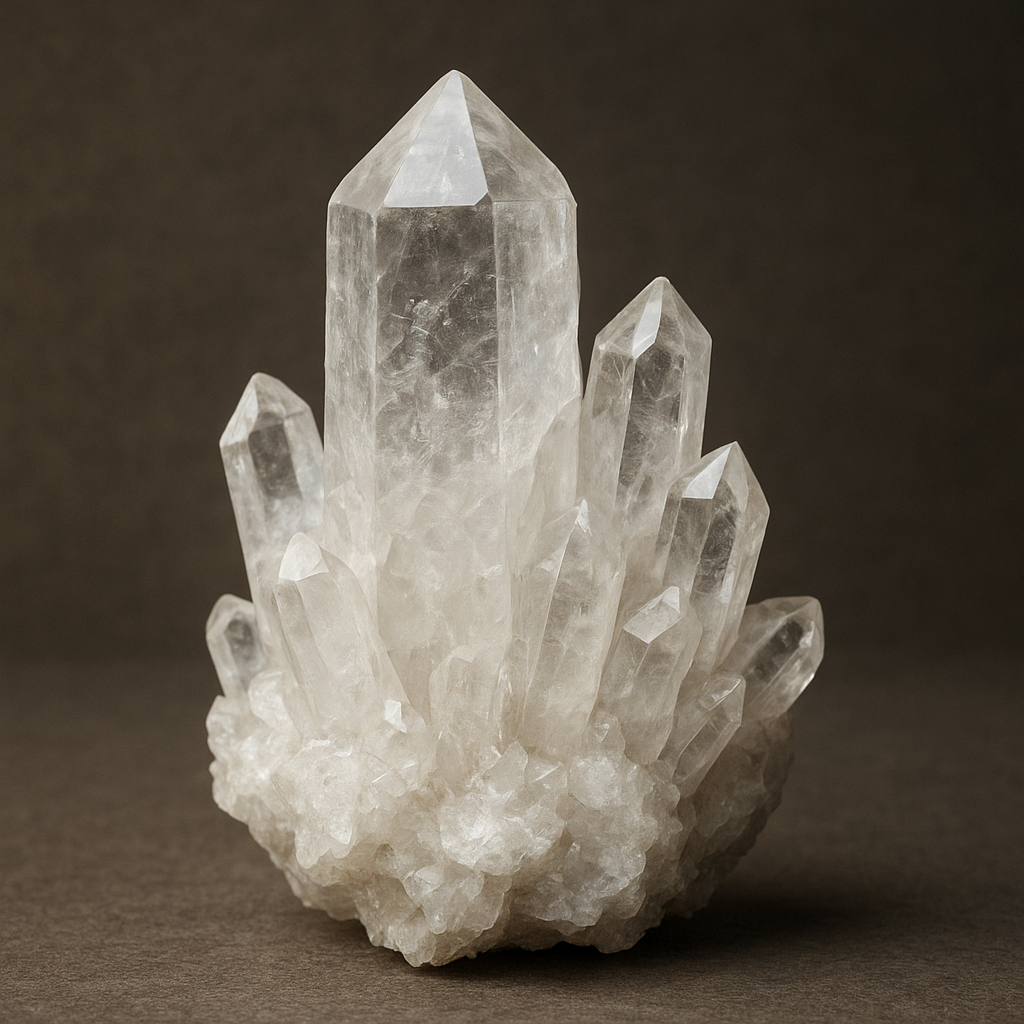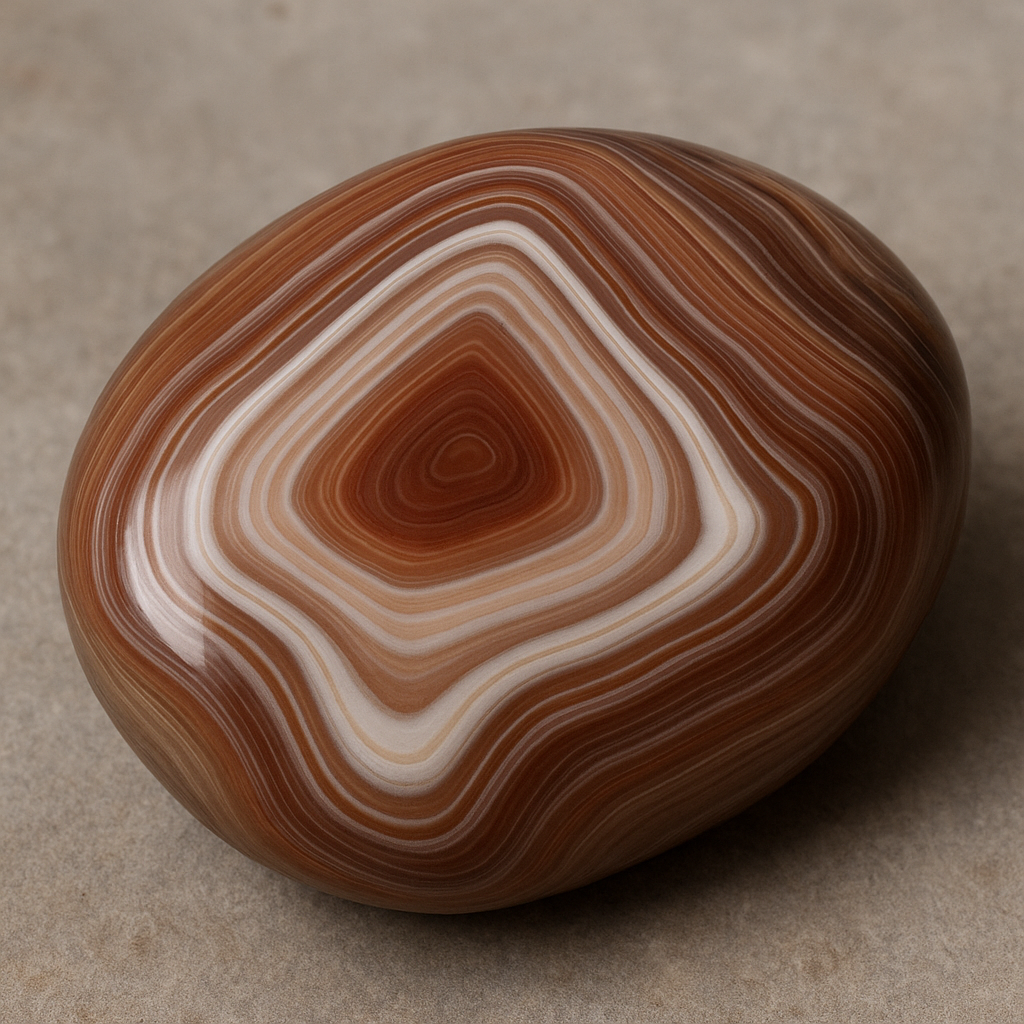
Botswana Agate is one of the most admired varieties of banded chalcedony, prized for its delicate concentric lines, subtle pastel tones and striking “fortification” patterns. This article explores its geology, natural occurrence, practical uses, lapidary treatment, market role and some lesser-known facts that make it a favorite among collectors and artisans. You will find descriptions of how it forms, how to identify authentic pieces, where to look for them, and how this stone is applied in both jewelry and metaphysical contexts.
Formation and Geology
At its core Botswana Agate is a variety of chalcedony, a microcrystalline form of silica composed of fine quartz fibers. Like other agates, it forms when silica-rich fluids fill cavities in host rocks—most often volcanic rocks or old lavas. Over time, alternating pulses of solution chemistry, pressure and temperature cause successive deposition of silica layers, producing the characteristic banding. These bands can be remarkably regular, producing the thin alternating lines and curved “fortification” structures that make Botswana material so distinct.
The microstructure is responsible for the stone’s unique optical behavior: while the overall material is translucent to opaque, the fine banding can show striking contrasts under light and in polished slices. The colors—typically soft greys, browns, creams and pinks—come from trace impurities such as iron oxides and minute inclusions, and sometimes from microscopic changes in the crystal habits during deposition. In Botswana Agate, the bands are frequently extremely fine and parallel, often creating a layered, photographic effect when cut.
Typical Geological Settings
- Silica-saturated solutions in gas cavities of volcanic flows or tuffs.
- Replacement of organic or mineral matter within sedimentary sequences by silica.
- Weathering and secondary deposition in alluvial or colluvial deposits where nodules and pebbles are transported by seasonal rivers.
Where Botswana Agate Occurs
As the name indicates, the principal and classic source is the country of Botswana in southern Africa. The most commercially known finds come from regions within the Kalahari basin and surrounding terrains where nodules and fragments are recovered from seasonal riverbeds, gravel beds and small-scale excavation sites. Specimens reach the market as whole nodules, sawn slabs, or finished cabochons used in jewelry.
Although the archetypal material is from Botswana, similar banded agate patterns occur elsewhere in Africa and the world, but the combination of extremely fine banding and the muted pastel palette is what sets genuine Botswana material apart. Because agates are formed in cavities associated with volcanic activity, areas with an ancient volcanic history are the most promising. In Botswana itself the occurrences are relatively local and historically depended upon small miners rather than industrial operations, which helps explain why high-quality pieces are prized.
Appearance, Varieties and Identifying Features
Botswana Agate is often identified by several diagnostic features:
- Fine, parallel banding—extremely thin, regular layers that may curve into concentric shapes or display fortification patterns.
- Soft, muted colors—shades of gray, brown, cream and rose-pink produced by subtle mineral impurities.
- High polishability—when cut and polished, the stone presents a smooth, often silky luster and a translucent edge allowing light to pass through thin sections.
- Typical hardness near 7 on the Mohs scale, consistent with other chalcedony varieties.
Some varieties carry local names based on pattern: “fortification” agates show clearly stepped band edges, while “wavy” or “whiplash” patterns have freer, undulating lines. Botswana examples are celebrated for both their visual delicacy and durability when used in wearable pieces.
Uses in Jewelry, Lapidary and Design
Botswana Agate is exceptionally popular with lapidaries because its banding displays so well when sawn, sliced or cabbed. Common uses include:
- Cabochons—domed, polished stones for rings, pendants and earrings that showcase the pattern.
- Thin slices framed in bezel settings to emphasize translucency and layered color.
- Beads and carved beads for necklaces and bracelets, where repeated patterning can create rhythmic visual effects.
- Collectors’ slabs and display pieces, often polished on both sides to reveal internal banding.
From a design perspective, Botswana Agate’s muted palette makes it versatile: it complements both minimalist modern settings and ornate, vintage styles. The stone’s toughness means it holds up to daily wear, and its banding can be oriented by the cutter to produce dramatic focal elements in a piece of jewelry.
Metaphysical, Cultural and Historical Context
Throughout modern crystal communities, Botswana Agate has been associated with emotional stabilization, grounding and healing practices. Practitioners value it for its calming tonal palette and are said to use it to assist with grief, to soothe anxiety and to foster pragmatic decision-making. While these uses are cultural and spiritual rather than scientific, they have certainly increased demand and shaped the stone’s contemporary reputation.
Culturally, the stone has not been tied to ancient ritual use in the same way as some other gem materials, but within regional lapidary and jewelry markets it has become a signature product associated with Botswana’s contribution to the gem trade.
Care, Treatment and Imitations
Care for Botswana Agate is straightforward but worth noting. As a form of quartz, it resists scratches better than softer gemstones but can be damaged by hard knocks. Guidelines include:
- Avoid strong acids or prolonged exposure to household chemicals.
- Use mild soap and warm water for cleaning; most pieces tolerate a soft brush.
- Be cautious with ultrasonic cleaners if the stone has fractures or dyed enhancements.
- Keep away from extreme heat which may alter color or cause cracking of filled fractures.
Common treatments and imitations to be aware of:
- Dyeing—cheaper agates may be dyed to intensify colors; look for uneven color concentration at edges or drill holes.
- Stabilization or filling—to improve the look of fractured material; often detectable under magnification.
- Glass or synthetic counterparts—glass can imitate banding but lacks the microcrystalline texture; specific gravity and magnification help differentiate.
Identification tips include checking the stone’s translucency, observing the natural, often irregular banding (not perfectly printed patterns), and verifying hardness. Experienced gem cutters and gemological labs can perform tests such as refractive index and microscopy to confirm authenticity.
Market, Collecting and Ethical Considerations
Botswana Agate occupies an interesting niche in the gemstone market: it is affordable enough for widespread use yet prized by collectors for exceptional specimens. Factors that influence value include:
- Clarity and translucency of the bands.
- Uniqueness and harmony of pattern—especially dramatic fortification banding.
- Color balance and the presence of rare pink or lavender hues.
- Size and quality of the polish or cut.
Because much of the production has historically come from artisanal or small-scale operations, ethical sourcing is an important consideration. Buyers should ask about provenance and support dealers who provide transparency. Environmental impacts are typically modest compared to large-scale mining, but any extraction changes local landscapes and should be monitored for responsible practices.
Collecting Tips
- Buy whole slabs or slices from reputable dealers to ensure authenticity.
- Look for specimens that display the pattern well when held to light; thin slices often reveal the most delicate banding.
- Beware of overly vivid colors that suggest dyeing; natural Botswana pieces are usually more subtle.
Interesting Facts and Lesser-Known Details
Some points that enthusiasts find intriguing:
- Because its banding is so fine, Botswana Agate slices can resemble geological cross-sections or abstract art; artists and designers sometimes use them as inspiration.
- The stone’s muted hues blend exceptionally well with metals like oxidized silver and rose gold, offering contemporary jewelry designers a versatile tool.
- In addition to jewelry, thin polished slabs are used in interior accents—cabinet inlays, decorative tiles and bespoke objects—when larger, attractive pieces are available.
- Collectors prize “paired” slabs—two slices cut from the same nodule—to create mirrored effects in earrings or diptychs.
Practical Advice for Buyers and Enthusiasts
If you are considering adding Botswana Agate to your collection or design palette, remember these practical points:
- Request information about source and cutting methods; origin can add cultural value.
- Check for treatments and ask for disclosure—ethical sellers will be transparent.
- Consider the intended use: stable, untreated nodules are preferable for heirloom pieces; thin, decorative slices work well for display and art.
- Experiment with orientation during design—band direction changes the narrative of a piece dramatically.
Botswana Agate combines technical interest for geologists and lapidaries with broad aesthetic appeal for jewelers, designers and spiritual practitioners. Whether appreciated for its geological story, its calming palette or its artisanal potential, this variety of agate remains a distinctive and enduring stone in the world of gems.