Bornite is a striking and scientifically important copper iron sulfide mineral that has fascinated miners, collectors, and researchers for centuries. Known for its vivid surface colors and role as a primary copper ore, bornite sits at the intersection of geology, metallurgy, mineralogy, and even aesthetics. This article explores its composition and properties, geological settings and global occurrences, industrial extraction and uses, and several intriguing aspects that make bornite more than just another sulfide mineral.
Composition and physical properties
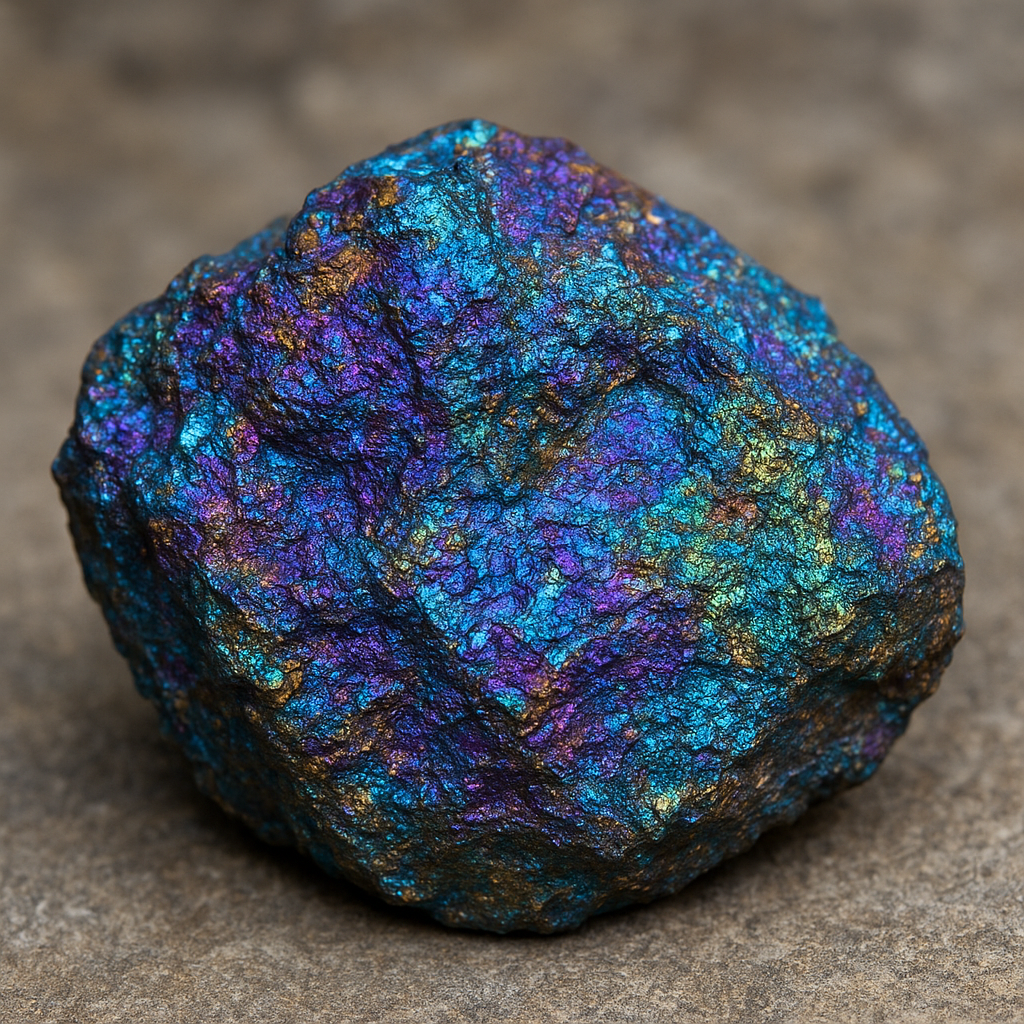
At its core, bornite is a sulfide mineral with the chemical formula Cu5FeS4. Fresh, unweathered bornite typically appears as a brownish-bronze metallic material, but what most people notice first is its tendency to develop colorful tarnish—purples, blues, and greens—that give it the popular nickname peacock ore. The iridescent hues arise when the surface oxidizes and a thin layer of alteration products forms, producing optical interference effects.
Key physical parameters
- Hardness: around 3 on the Mohs scale, which makes bornite relatively soft compared with many rock-forming minerals.
- Specific gravity: approximately 4.9–5.3, reflecting its copper and iron content.
- Luster: metallic on fresh surfaces; tarnished surfaces can appear submetallic to dull depending on the oxide films.
- Streak: a grayish-black streak is typical when the mineral is powdered.
- Crystal habit: most commonly massive or granular; true crystals are uncommon and usually appear as pseudo-cubic or irregular forms.
Structurally, bornite can be described as having a high-temperature cubic arrangement that becomes more ordered on cooling, producing a complex, lower-symmetry superstructure. The transition and disorder in the copper/iron sublattice contribute to some of the mineral’s distinctive physical and electrical behaviors. Because of its metal-rich composition, bornite is electrically conductive and behaves like a metallic mineral in many contexts.
Formation processes and geological occurrence
Bornite forms in a variety of geological environments wherever copper-rich hydrothermal fluids interact with sulfur and iron-bearing rocks. Its formation pathways include primary magmatic-hydrothermal deposition, replacement of earlier sulfide minerals in high-temperature systems, and supergene enrichment processes near the surface. It is especially prominent as an ore mineral in certain major deposit types.
Typical deposit environments
- Porphyry copper systems: These large, low- to medium-grade deposits are among the world’s most important sources of copper. Bornite commonly occurs in porphyry systems together with chalcopyrite, chalcocite, and other copper sulfides.
- Hydrothermal vein and replacement deposits: Bornite can precipitate from metal-rich fluids that form veins, breccia fillings, or metamorphic replacements (e.g., skarn deposits at contacts between intrusions and carbonate rocks).
- Skarns and contact-metasomatic zones: Where intrusive rocks chemically alter carbonate country rocks, bornite and associated copper minerals can form during high-temperature metasomatism.
- Supergene enrichment zones: Near-surface weathering of copper sulfides often redistributes copper into enriched layers where bornite may be altered into secondary copper minerals like chalcocite, covellite, malachite, and chrysocolla.
Global localities and notable occurrences
Bornite is widely distributed worldwide. Significant occurrences and mining districts where bornite is found include parts of North and South America, Africa, Europe, and Australia. Examples include historic and modern mining districts in the western United States (such as Butte, Montana and other copper provinces), Chile and Peru in South America, the Central African Copperbelt, Australian copper fields, and classic European localities associated with historic metalliferous mines. In many large porphyry and skarn systems, bornite contributes to the copper resource alongside other sulfides.
Economic importance and extraction methods
As a copper-bearing sulfide, bornite has been mined principally for its copper content. It may occur either as a significant ore mineral in a deposit or as one of several copper sulfides contributing to an orebody’s overall grade. The economic value of bornite is therefore closely tied to copper prices, deposit size, and the ease of processing.
Mining and beneficiation
- Extraction: Bornite-containing ores are extracted by conventional open-pit or underground mining methods depending on deposit depth, geometry, and economics.
- Comminution: Ores are crushed and ground to liberate sulfide minerals from gangue.
- Concentration: Froth flotation is the dominant method for concentrating sulfide copper minerals, including bornite. Reagents and process parameters are tailored to separate copper sulfides from other sulfides and silicate gangue.
- Smelting and refining: Concentrates are typically smelted to produce copper matte, which is then converted and refined (electrorefined or fire-refined) to produce market-grade copper metal.
Bornite behaves differently during beneficiation and smelting than other copper sulfides like chalcopyrite and chalcocite, so metallurgists pay careful attention to the mineralogy of concentrates. For example, bornite can alter during storage or processing, affecting recoveries; understanding the textural relationships and amounts of bornite helps optimize reagent schemes and thermal treatments.
By-products and processing challenges
Bornite ores sometimes contain other metals (silver, gold, cobalt) or gangue phases that complicate processing. Careful mineralogical characterization—using microscopy, X-ray diffraction, and automated mineralogy—is often necessary to design efficient flowsheets. Additionally, bornite-rich concentrates can produce sulfur dioxide and other emissions during smelting, so modern facilities require gas capture and acid plants to convert SO2 to useful products and reduce environmental impact.
Applications and uses beyond ore
Although bornite’s primary role is as a copper ore, it has several secondary uses and points of interest:
- Collector and ornamental specimens: Because of its flamboyant tarnish colors, bornite is prized by collectors and sometimes used in decorative objects. However, its softness limits its use in jewelry that is subjected to wear.
- Educational specimens: Bornite is commonly used in teaching to demonstrate sulfide mineralogy, oxidation effects, and ore textures in hand samples.
- Research and materials science: Scientists study copper iron sulfides for their electronic and catalytic properties. Research topics include potential optoelectronic applications, thermoelectric behavior, and catalytic activity for reactions like hydrogen evolution. These are active research areas rather than established commercial applications.
Because bornite is an abundant source of copper where it occurs, any improvement in the efficiency of recovering and refining copper from bornite-bearing ores has direct economic significance for the mining industry.
Associations, alteration, and environmental aspects
Bornite rarely occurs in isolation; it is typically found alongside a range of other sulfide and oxide minerals. Common associates include chalcopyrite, chalcocite, covellite, pyrite, sphalerite, and various gangue silicates and carbonates. In oxidizing environments, bornite weathers to a range of secondary minerals such as malachite, azurite, chrysocolla, and iron oxides.
Supergene alteration and enrichment
Weathering of primary sulfides often mobilizes copper downward in the rock column where it reprecipitates to form enrichment zones. These supergene processes can significantly upgrade the copper grade of an orebody. In such zones, bornite may be a primary precursor to secondary copper minerals or can itself be a target where it remains relatively unaltered.
Environmental considerations
Mining and processing bornite-bearing ore carry environmental risks similar to other sulfide mining operations. Key concerns include:
- Acid mine drainage: Oxidation of sulfide minerals during exposure to air and water can produce sulfuric acid, mobilizing metals and harming aquatic ecosystems.
- Metal contamination: Copper and associated trace metals can be toxic to plants and aquatic organisms at elevated concentrations.
- Air emissions: Smelting sulfide concentrates produces sulfur dioxide, which must be controlled to prevent acid rain and health impacts.
Modern mining operations mitigate these issues through careful waste management, water treatment, containment of tailings, sulfur capture systems at smelters, and progressive reclamation practices. Research into bioremediation, phytoremediation, and improved tailings technologies continues to reduce the environmental footprint of sulfide mining.
Identification, handling, and specimen care
For geologists and collectors, identifying bornite in hand samples involves a combination of visual cues and simple tests. The metallic luster, brownish-bronze fresh color, and characteristic grayish-black streak provide initial clues. The brilliant tarnish colors on exposed surfaces are often the most diagnostic feature when present. Microscopic examination and geochemical tests (such as elemental analysis) confirm the mineral’s composition.
Practical tips for collectors
- Avoid polishing specimens that exhibit colorful tarnish—polishing can remove the thin oxide films that produce the desirable colors.
- Store bornite in a dry environment to slow further oxidation; a stable display or storage box with silica gel can help preserve appearance.
- Handle specimens minimally and with clean hands or gloves to prevent oils and salts from accelerating surface alteration.
- For study, a small fresh fracture may reveal untarnished metallic surfaces useful for identification.
Historical, cultural, and scientific interest
The name bornite honors the Austrian mineralogist and metallurgist Ignaz von Born, reflecting the mineral’s long association with mining and metallurgy in Europe. Historically, bornite and similar copper sulfides were among the first minerals to attract systematic study because of their economic importance.
Beyond economics, bornite has captured imaginations because of its striking appearance. The nickname peacock ore is a testament to its popularity among collectors and decorative uses. In many local mining communities, specimens of bornite and other colorful sulfides were displayed as curiosities and small tokens of regional mineral wealth.
Contemporary scientific directions
Contemporary research touches several fronts:
- Materials science investigations into the electronic structure and transport properties of copper iron sulfides for possible use in novel semiconductors or thermoelectric materials.
- Mineralogical studies that probe ordering phenomena in the copper-iron sublattice and how temperature and composition affect bornite’s structure.
- Environmental and remediation research focused on how bornite-bearing wastes weather and how to immobilize or recover metals from tailings and drainage waters.
Interesting facts and surprising connections
Many details about bornite are unexpectedly rich and informative for people beyond mineral collectors and miners alike:
- The colorful tarnish often attributed to bornite is an example of thin-film interference and surface chemistry at work—tiny changes in oxide thickness can shift perceived color dramatically.
- Bornite’s variable structure illustrates how atomic ordering and disorder in a mineral can influence macroscopic properties; such phenomena are relevant across solid-state chemistry and materials science.
- Because bornite is often associated with large porphyry systems, its presence in exploration cores can be an important indicator of a potentially economic copper deposit at depth.
- Specimens can act as a gateway into environmental education—studying bornite weathering demonstrates processes that control metal mobility in the surface environment.
Note: Bornite itself is not commonly used as a gemstone because of its softness and tendency to flake and tarnish, but its aesthetic appeal has still found a niche among collectors and artisans who incorporate stabilized specimens into decorative pieces.
Resources and further reading
For those who want to pursue bornite more deeply, standard mineralogy textbooks, peer-reviewed articles on sulfide mineral processing, and mine geology reports from major copper districts provide detailed, authoritative information. Museum collections and university geology departments often house high-quality bornite specimens suitable for study or public viewing.
Bornite occupies a unique place in the mineral world: it is both practically important as a copper ore and visually captivating as a collector’s gem. Whether encountered in the field, in a laboratory, or as a display piece, bornite offers a vivid example of the connections between geology, chemistry, industry, and culture.