
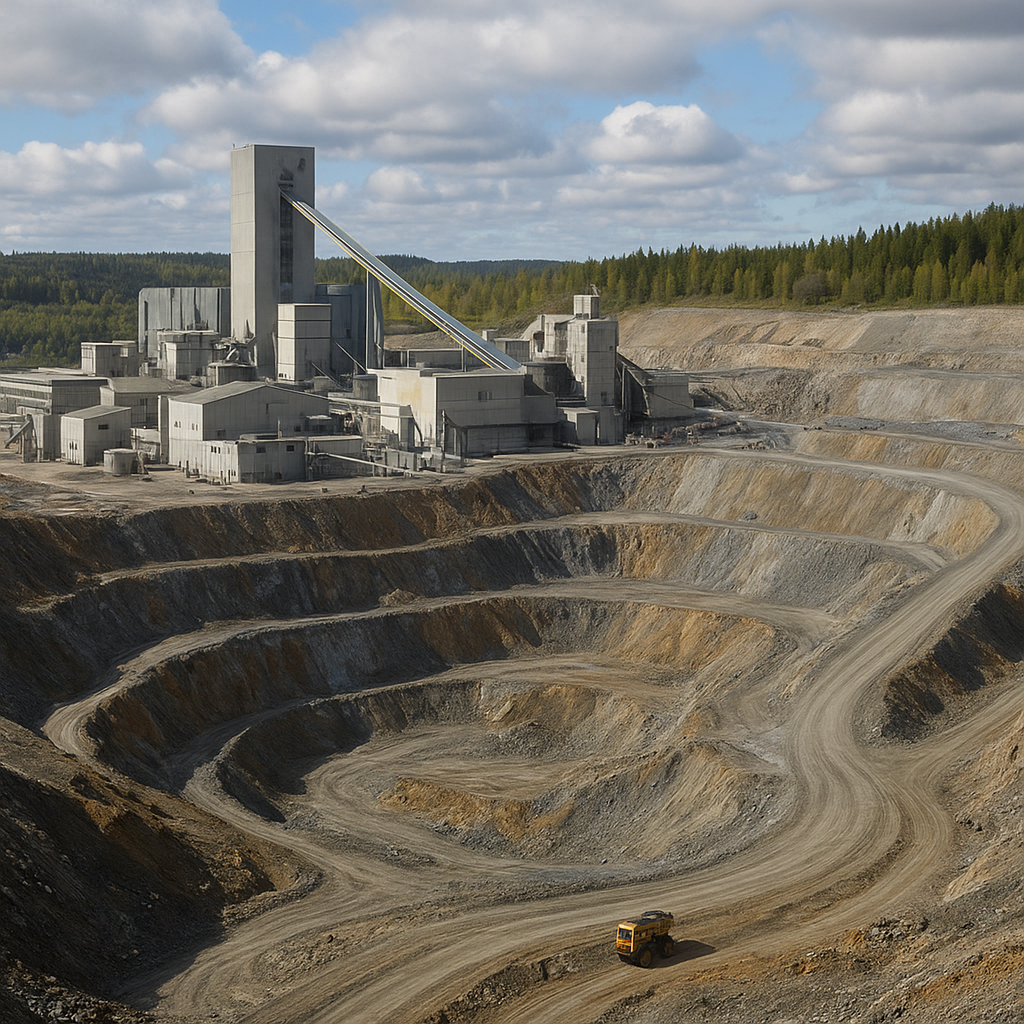
The Boliden Garpenberg operation stands as one of Europe’s most important and long-lived underground metal mines. Nestled in the heart of central Sweden, it extracts a suite of valuable metals that feed both local industry and international supply chains. This article explores where the mine is located, what is mined there, its broader economic importance, and several aspects that make it particularly noteworthy in the modern mining landscape.
Location and Geological Setting
Located in the province of Dalarna, approximately within the administrative boundaries of Hedemora Municipality, the Garpenberg deposit lies in central Sweden. The site sits amid a landscape of forests and lakes, typical of the region, yet beneath its tranquil surface there is a dense network of tunnels and infrastructure supporting deep underground extraction.
The deposit itself is a polymetallic sulphide system containing significant concentrations of zinc, lead and silver, along with smaller quantities of other metals. Geologically, it is characterized by complex mineralized lenses and shoots that have required detailed exploration and careful mine planning to develop. Over time, mining has moved both laterally and to increasing depths, following the ore bodies and adapting to evolving geological knowledge.
Mining Operations and Production
Operated by Boliden, the Garpenberg mine functions as a modern, large-scale underground mining complex. The operation includes extensive underground workings with multiple levels, a milling and concentration plant, and surface infrastructure for handling ore, waste rock, and water treatment.
Extraction Methods
- Underground mining — The mine employs contemporary underground mining methods adapted to the geometry of the ore bodies. This typically involves a combination of drifting, stoping and backfilling to maximize ore recovery while maintaining stability.
- Ore transport and processing — Ore is transported to an on-site concentrator where processes such as crushing, grinding and flotation separate metal-bearing concentrates from waste material.
- Product streams — The main concentrates produced are rich in zinc and lead, with silver recovered as a by-product. Smaller quantities of other valuable metals may also be present in concentrates and refined streams.
Concentrates are typically sent for smelting and refining, often within Boliden’s integrated value chain, providing refined metals for use in multiple industries. The integration of mining, concentrating and downstream refining enhances value capture and supply reliability.
Economic Significance
At local, national and international levels, Garpenberg plays several important economic roles.
Regional Employment and Local Economy
- Jobs — The mine provides direct employment for a substantial number of people in mining, processing, technical services and administration, and supports many indirect jobs in services, transport and supply industries in the region.
- Local procurement — Many goods and services are procured locally or regionally, supporting small and medium-sized enterprises and helping sustain rural economies.
- Infrastructure investment — Investment in roads, utilities and community services associated with the mine improves local infrastructure and can have long-term community benefits.
National and International Impact
On a national level, revenues from the mine contribute to Sweden’s mining sector performance and export profile. Metals produced at Garpenberg feed into European and global markets; for example, zinc and lead are essential for construction, automotive, electronics and other industrial applications. The presence of silver as a by-product adds monetary value and diversifies the mine’s revenue streams.
Strategically, the mine contributes to the supply of base and precious metals at a time when Europe is increasingly focused on securing resilience in critical raw materials. Such domestic and regional sources reduce reliance on imports from distant markets and support manufacturing supply chains aligned with European sustainability and circular economy goals.
Technological Innovation and Sustainability
Garpenberg has been at the forefront of incorporating modern technology into underground mining operations. Investments in technology have been driven by both economic efficiency and environmental objectives.
Automation and Digitalization
- Automation — The mine has adopted automated and remotely operated equipment where appropriate, improving safety by reducing personnel exposure to hazardous underground tasks and increasing operational precision.
- Digitalization — Advanced geological modelling, real-time monitoring and data-driven mine planning are used to optimize extraction, reduce dilution and improve recovery.
Environmental Management
Environmental performance is a priority. Efforts include water treatment systems to manage mining-affected water, careful handling and storage of tailings and waste rock, and measures to limit emissions. The operation has also been exploring reduced carbon options such as electrification of mobile fleets and energy efficiency measures in processing plants.
Because the mine produces metals used in corrosion protection, electrical components and renewable technologies, its existence has an interesting juxtaposition: while mining has environmental impacts, the metals it provides enable the manufacture of products that support longer life cycles, improved efficiency and green technologies.
Historical Context and Development
The Garpenberg area has a lengthy mining tradition. Mining activity in the region spans many centuries, reflecting the long-term value of the deposit and its capacity to adapt to different mining eras and technologies. Over time, the site evolved from early small-scale extraction to a modern underground operation under major corporate ownership and investment.
Continuous exploration around the deposit has extended mine life by identifying new mineralized zones and optimizing existing resources. Periodic reinvestment has included the refurbishment of underground workings, modernization of processing facilities and expansion projects to access new ore at depth.
Interesting Features and Lesser-Known Aspects
Beyond the economic and technical dimensions, Garpenberg has characteristics that contribute to its uniqueness.
Long Lifespan and Adaptive Mining
- Longevity — The fact that the deposit has been mined over many generations demonstrates its high-grade nature and the adaptability of mining techniques to extract value from challenging geometries.
- Exploration success — Ongoing exploration has repeatedly extended the mine’s life, illustrating how modern geoscience and drilling techniques can reinterpret and expand older deposits.
Community and Cultural Links
The mine’s presence has shaped local communities in terms of employment patterns and local identity. Mines such as Garpenberg often become focal points for regional heritage, including historical records, local craftsmanship and skills related to mining trades.
Role in Raw Material Security
In a broader geopolitical context, operations like Garpenberg contribute to the security and diversification of raw material supplies. As many industries seek to “reshore” or regionalize supply chains for critical metals, European base metal mines are receiving renewed attention for their strategic value.
Challenges and Future Directions
Like all mining operations, Garpenberg faces challenges: the technical difficulty of deep underground extraction, fluctuating metal prices, and increasing expectations for environmental and social performance. The future of the mine will likely hinge on continued investment in technical solutions that reduce costs and environmental impacts, smart exploration to find new resources, and dialogue with stakeholders including local communities and regulators.
Future directions may include deeper shafts or development of new production panels, further electrification of the fleet to lower emissions, and enhanced automation to improve safety and productivity. Additionally, advances in metallurgical processing or the discovery of new mineralized zones could reshape the mine’s product mix and economic profile.
Key Takeaways about Boliden Garpenberg
- The mine is a major underground operation in central Sweden producing primarily zinc, lead and silver.
- Owned and operated by Boliden, it integrates mining and processing activities, supplying concentrates for further refining.
- Its economic importance spans local employment, regional supply chains and contributions to national exports and industrial inputs.
- Garpenberg is notable for its long mining history, adoption of modern automation and digital technologies, and initiatives in sustainability.
- The mine exemplifies how a mature mineral deposit can remain relevant through investment, exploration and adaptation to contemporary environmental and economic expectations.
Further reading and exploration
For those interested in more technical details such as resource figures, production statistics and specific environmental performance metrics, company publications and technical reports published by the operator provide the most up-to-date, verified data. Geological surveys and academic publications also offer deeper insights into the deposit type and regional geology. Together, these sources can illuminate both the technical and human stories behind one of Europe’s enduring mining sites.

