Biotite is a common, dark, sheet silicate mineral that belongs to the mica group and plays a central role in many branches of Earth science. Its presence in igneous, metamorphic, and even sedimentary environments makes it an important mineral for interpreting the history and conditions of rock formation. Beyond its value to petrologists and geochemists, biotite has implications for soil chemistry, industrial applications, and geochronological research. This article explores where biotite occurs, how it is used, and some interesting scientific and practical aspects associated with it.
Basic mineralogy and physical characteristics
At its simplest, biotite is a phyllosilicate—a sheet silicate—whose idealized chemical formula can be written as K(Mg,Fe)3AlSi3O10(OH,F)2. This formula reflects the fact that the mineral is a solid-solution series dominated by substitutions between iron and magnesium, and often contains small amounts of aluminum and fluorine. Biotite is one of several mica-group minerals; its common counterparts include muscovite, phlogopite, and lepidolite.
Key physical properties of biotite include:
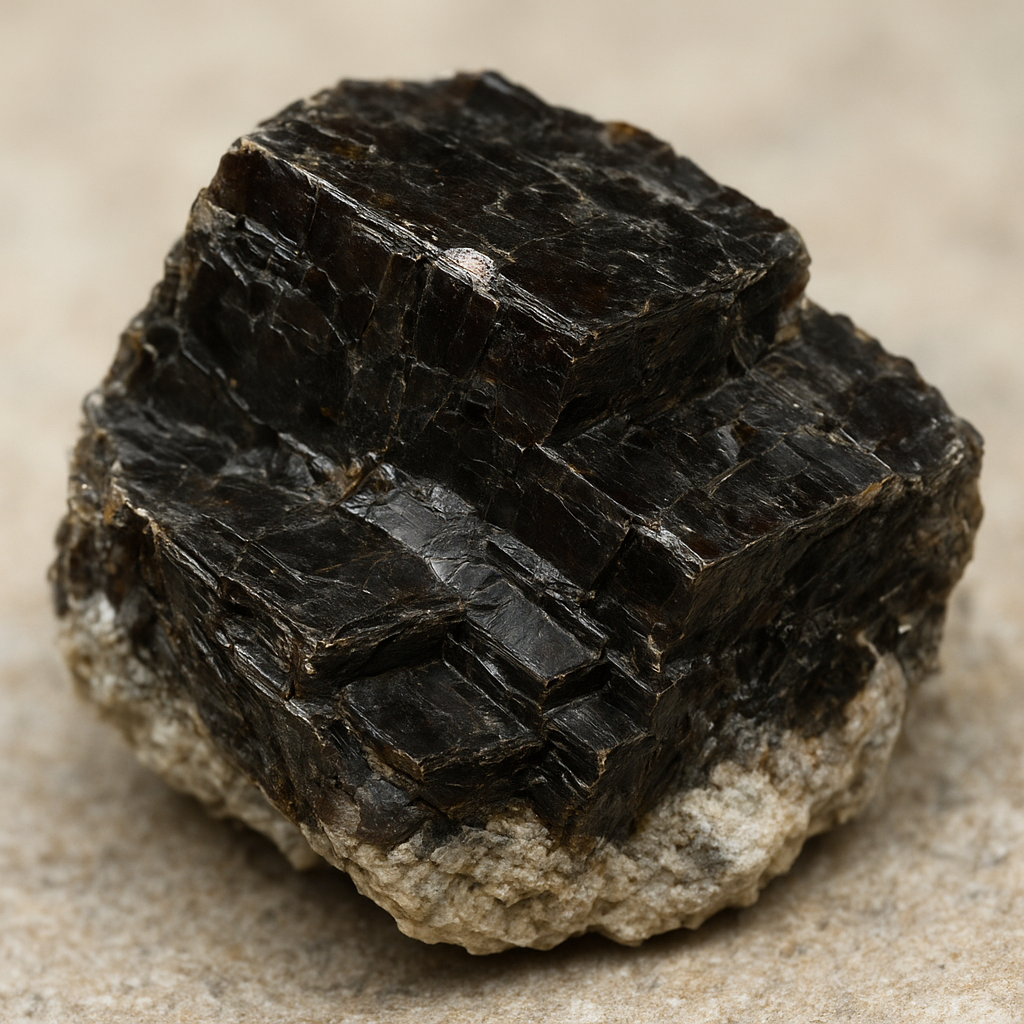
- Color: typically dark brown to black, sometimes greenish-brown depending on Fe/Mg ratio.
- Luster: vitreous to pearly on cleavage surfaces.
- Cleavage: excellent basal cleavage; thin sheets can be peeled off like other micas—this characteristic arises from the strong two-dimensional bonding within sheets and weak bonding between them.
- Hardness: about 2.5–3 on the Mohs scale.
- Specific gravity: variable, commonly around 2.7–3.1 depending on iron content.
- Optical properties: biaxial negative with notable pleochroism in thin sections—colors shift from brown to yellow-brown or greenish hues as the incident light direction changes.
Crystal chemistry and solid solution
The structure of biotite comprises tetrahedral silica sheets coupled to octahedral sheets that host metal cations (Fe2+, Mg2+, Al3+). Interlayer potassium ions balance charge and give rise to the characteristic cleavage planes. Because Fe and Mg substitute freely, biotite forms continuous solid solutions between the iron-rich endmember (annite) and the magnesium-rich endmember (phlogopite), with intermediate compositions commonly encountered. Small amounts of Ti, Mn, and F can also occur. The mineral’s composition affects color, density, and many geochemical behaviors.
Geological occurrence and environments
Biotite is widely distributed in the Earth’s crust and is typically found in:
- Granites, granodiorites and other felsic to intermediate igneous rocks, where it forms as a primary magmatic mineral.
- Pegmatites, where large crystals may develop due to slow cooling and fluid-rich conditions.
- Metamorphic rocks such as schists and gneisses, where biotite forms or recrystallizes under medium-grade metamorphic conditions.
- Hydrothermally altered rocks and some contact-metamorphosed zones where fluids enable growth or replacement reactions.
Igneous settings
In igneous rocks, biotite commonly crystallizes from hydrous, potassium-bearing magmas. It may appear as euhedral to subhedral crystals embedded in a groundmass and often occurs together with potassium-feldspar, quartz, and plagioclase. Because biotite incorporates volatile components (OH, F) and water-bearing species during crystallization, its presence is often an indicator of a slightly higher volatile content in the parental magma. Large biotite crystals in pegmatites can reach centimeter scale and are prized for study and as mineral specimens.
Metamorphic settings and reaction pathways
During regional metamorphism, biotite commonly forms during the breakdown of Al- and K-rich precursor minerals (e.g., muscovite in certain reactions). It is an important mineral in typical greenschist to amphibolite facies rocks. Under prograde conditions, biotite reactions provide buffers for P-T (pressure-temperature) evolution and release or absorb components such as water and potassium. During retrograde metamorphism or weathering, biotite readily alters to chlorite, vermiculite, or mixed-layer clays, processes that influence soil formation and element mobility.
Analytical and applied uses
Biotite is a versatile mineral in analytical geoscience. Its chemistry and physical behavior make it a tool for reconstructing magmatic and metamorphic conditions and for dating geological events.
Thermobarometry and petrology
Because biotite composition is sensitive to temperature and pressure, it is widely used in mineral thermobarometry. Exchange reactions between biotite and other minerals (e.g., garnet, hornblende) allow petrologists to estimate the P-T conditions of rock formation and metamorphism. Compositional parameters—such as Fe/Mg ratio and Ti content—can be calibrated to infer crystallization temperatures. The mineral is also used to interpret magmatic differentiation: depletion or enrichment of biotite can signal volatile exsolution, fractional crystallization, or contamination processes.
Geochronology: 40Ar/39Ar and K-Ar dating
One of the most important practical applications of biotite is in radiometric dating. Because biotite contains interlayer potassium, it can be dated using the K-Ar or the more refined 40Ar/39Ar method. Biotite is especially valuable for dating cooling ages: it retains Argon well up to certain temperatures (closure temperature often around ~300–350 °C, depending on grain size and composition), enabling constraints on the timing of cooling after metamorphism or igneous intrusion. This makes biotite a staple in studies of tectonic exhumation, thermal histories, and the timing of igneous events.
Geochemical tracers and element reservoirs
Biotite acts as a reservoir for transition metals and large-ion lithophile elements (LILEs), particularly K, Fe, Mg, Ti, and sometimes trace elements like Rb and Cs. The partitioning behavior of these elements between biotite and melt or coexisting minerals is used to trace magmatic differentiation and fluid-rock interactions. For instance, elevated Rb/Sr in biotite relative to coexisting minerals can influence whole-rock isotope systems used in petrogenetic models.
Environmental and industrial relevance
Although mica industries favor clear, light-colored micas like muscovite for many applications (electrical insulators, fillers, and ornamental use), biotite has several indirect and direct impacts beyond pure academia.
Soil chemistry and nutrient cycling
As biotite weathers, it releases K, Fe, and Mg into soils, contributing to plant nutrient availability and to the geochemical evolution of surface environments. The weathering of biotite is often a multi-stage process: oxidation of Fe2+ to Fe3+ in the octahedral sites accelerates structural breakdown, promoting the formation of secondary minerals such as chlorite, expandable clays (vermiculite), and iron oxides. In agricultural and ecological contexts, the potassium released from biotite-bearing rocks can be an important long-term K source for soils.
Industrial and technological aspects
Direct industrial uses for biotite are limited compared with other micas. Dark color and iron content make it less desirable for applications requiring electrically insulating, non-conductive, or transparent sheets. Nonetheless, biotite-bearing rocks may be quarried for aggregate and decorative stone, and weathered biotite contributes clay minerals used in ceramics and drilling muds. In a laboratory setting, thin biotite cleavage sheets are sometimes used in optical experiments or as a cheap substitute for experiments requiring flexible sheet minerals.
Methods of study and identification
Identifying and characterizing biotite draws on a suite of field and laboratory techniques that reveal its mineral chemistry, structure, and role in rock histories.
- Polarized light microscopy: thin sections reveal pleochroism, cleavage, and optical orientation; extinction angles and interference colors help distinguish biotite from other micas.
- X-ray diffraction (XRD): used to confirm crystal structure and to detect mixed-layer clays formed from biotite alteration.
- Electron microprobe and SEM-EDS: provide precise iron/Mg ratios and trace element concentrations used in thermobarometry and petrogenetic modeling.
- Mössbauer spectroscopy and Raman spectroscopy: useful for investigating Fe oxidation state and local structural disorder.
- Stable and radiogenic isotope analysis: biotite can be analyzed for O, H isotopes (in some cases) and for K-Ar/40Ar/39Ar dating to constrain timing.
Remote sensing and spectral detection
In remote sensing, micas including biotite can be identified in the shortwave infrared (SWIR) region because of characteristic OH and metal-OH absorption features. The iron in biotite often creates distinctive absorption patterns in visible and near-infrared wavelengths, allowing mapping of mica-bearing lithologies and alteration zones on both regional and outcrop scales. Such spectral methods are valuable for mineral exploration and mapping hydrothermal alteration in ore systems.
Interesting scientific facets and ongoing research
Several aspects of biotite continue to interest researchers because they reveal broader processes in Earth systems:
- Diffusion and closure temperatures: The retention or loss of argon from biotite provides constraints on cooling histories. Current research refines how chemical zoning, grain size, and deformation affect argon diffusion.
- Oxidation and element mobility: Oxidation of Fe within biotite during weathering and metamorphism alters its stability, affecting Fe cycling and the formation of iron oxides and clay minerals.
- Role as a fluid recorder: Fluid inclusions and chemical zoning in biotite can record magmatic and metamorphic fluid compositions, providing clues to volatile budgets and ore-forming processes.
- Mixed-layer and alteration products: The progressive transformation of biotite to chlorite or smectite-vermiculite layers is an area of active study because of implications for rock strength, permeability, and landscape evolution.
Biotite’s behavior during high-temperature and low-temperature processes links deep magmatic systems with surface environments. For example, understanding how biotite loses potassium during hydrothermal alteration affects models for ore deposit formation, while its breakdown during exhumation can inform seismic anisotropy and mechanical weakening of the crust.
Field recognition and collecting tips
In the field, biotite is often recognizable by its dark, flaky appearance and perfect basal cleavage. Hand samples of granite or schist with shiny, dark plates that peel off in flexible sheets are good candidates. In metamorphic rocks, biotite commonly forms aligned foliation giving rocks a schistose texture. Collectors should note:
- Biotite sheets are flexible but not elastic like muscovite; handling large, Fe-rich flakes often results in brittle breakage.
- Fresh cleavage surfaces show a characteristic vitreous to pearly sheen.
- Weathered biotite may appear greenish or dull; secondary iron oxides can stain adjacent rock surfaces.
For scientific collecting, preserving fresh, unaltered samples in dry conditions and documenting field relations (host rock, orientation, associated minerals) maximizes the value of specimens for later chemical and isotopic analysis.
Concluding remarks on significance
Biotite is more than a common dark mica: it is a mineral that records magmatic, metamorphic, and surface processes across a wide range of scales. From the role of potassium in radiometric dating to its function in nutrient release during weathering, biotite connects deep Earth processes with surface environments. Its variable chemistry and layered structure continue to provide fodder for research, making it a persistent subject of interest in mineralogy, petrology, geochemistry, and environmental geology.