
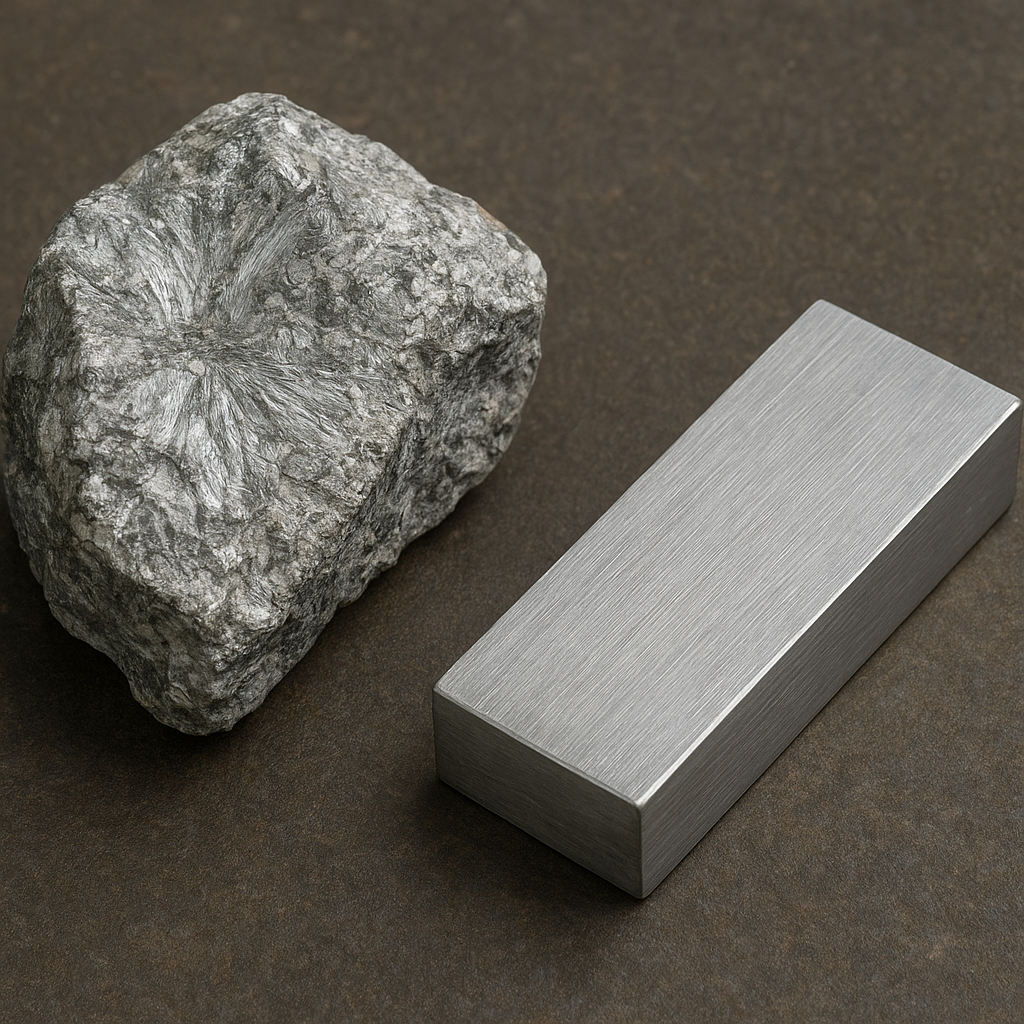
Beryllium is a small but remarkably influential element that occupies an outsized role in modern technology, science and industry. Light yet stiff, fragile yet resilient under particular conditions, it appears in nature in a handful of minerals and has found its way into specialized alloys, high-performance ceramics and critical components of nuclear and aerospace systems. This article explores where beryllium occurs, how it is produced and processed, the many applications that exploit its unusual combination of properties, and the safety and environmental issues that surround its use. Along the way, several lesser-known and fascinating aspects of this element — from gemstone relatives to roles in fusion research — are highlighted.
Occurrence and geological context
In Earth’s crust, beryllium is relatively rare compared with common metals such as iron or aluminum. It typically occurs in chemically resistant minerals that concentrate it during late-stage magmatic and hydrothermal processes. Two of the best-known beryllium-bearing minerals are beryl and chrysoberyl. Beryl, a silicate mineral (Be3Al2Si6O18), is the host for valued gemstones such as emerald and aquamarine; chrysoberyl (BeAl2O4) yields yellow-green stones when gem-quality.
Other economically important beryllium minerals include bertrandite and phenakite. Bertrandite (a beryllium silicate hydroxide) is an important ore mineral for modern beryllium production; significant deposits have been mined in places like the United States. Global production has historically been geographically concentrated: traditional producers have included the United States (especially Utah), China, Kazakhstan and Brazil, though the relative importance of sources has shifted over time. Beryllium is dispersed at trace levels — typically a few parts per million — in many igneous and metamorphic rocks, and it tends to concentrate in pegmatites and other evolved igneous environments.
From a cosmochemical perspective, beryllium is produced in trace amounts by cosmic-ray spallation and is not produced in large quantities by stellar nucleosynthesis. Its presence in the solar system and in certain minerals carries clues about the processes that formed the host rocks and the history of fluid and magmatic activity in a region.
Physical and chemical properties that make beryllium unique
Beryllium, atomic number 4, is the lightest of the alkaline earth metals. Several of its intrinsic properties are striking and underpin many of its technological uses:
- Low density: at about 1.85 g/cm3, beryllium is significantly lighter than aluminum and many structural metals, enabling weight-sensitive designs in aerospace and instrumentation.
- High stiffness: beryllium has an exceptionally high Young’s modulus for a light metal, giving it great rigidity relative to its weight.
- High melting point and thermal stability: with a melting point near 1287°C, beryllium maintains mechanical integrity at elevated temperatures better than many light metals.
- High thermal conductivity: this allows efficient heat spreading in specific designs.
- Low atomic number (Z = 4): this property makes thin beryllium windows highly transparent to X-rays and certain radiations, while still offering mechanical support.
- Chemical behavior: beryllium forms strongly covalent bonds in many compounds, and its oxide (BeO) has ceramic properties, combining high thermal conductivity with electrical insulation.
These properties, considered together, are unusual: few elements combine low mass, high stiffness and favorable thermal and X-ray transmission characteristics. That combination sets beryllium apart for niche but critical applications.
Major industrial applications
Because pure beryllium metal is expensive and difficult to shape, much of its industrial utility comes from alloys and compounds that harness its best attributes. Below are the major application areas and why beryllium is chosen.
Alloys and mechanical parts
Alloying beryllium with copper produces materials with a remarkable mix of strength, electrical and thermal conductivity, fatigue resistance and non-magnetic properties. Copper-beryllium alloys (typically containing around 0.4–2% beryllium) are used for:
- Electrical connectors and spring contacts that require both good conductivity and consistent mechanical performance over many cycles.
- Non-sparking tools and fittings used in hazardous environments.
- High-stress mechanical parts in aerospace, telecommunications and precision instruments where wear resistance and springiness are required.
Other beryllium-based alloys and metal matrix composites can be engineered for specialized structural roles where stiffness-to-weight ratio is critical. Components made from beryllium and beryllium-structured composites have been employed in satellites, mirrors for telescopes and precision gyroscopes.
Nuclear and fusion technologies
Beryllium serves several purposes in nuclear systems owing to its nuclear properties. It is relatively transparent to neutrons for certain energies, and it can act as a neutron reflector or moderator under specific conditions. These characteristics have led to its historical use in:
- Neutron reflectors surrounding reactor cores to improve neutron economy.
- Neutron multipliers in some fusion research concepts, where reactions among energetic particles are managed to sustain fusion conditions.
- Structural and diagnostic components in research reactors and experimental fusion devices, where low atomic number and mechanical performance are both needed.
Use in nuclear applications must be carefully managed because beryllium can form radioactive isotopes when irradiated and is chemically reactive at high temperatures.
Electronics, optics and X-ray technology
Thin foils and windows of beryllium are invaluable in X-ray equipment because of the element’s low atomic number. A thin beryllium window transmits X-rays and other low-energy radiation while providing mechanical protection for vacuum or controlled-atmosphere environments. Typical uses include:
- X-ray tube windows
- Detectors and spectrometers
- Synchrotron beamline components
In electronics, beryllium oxide (beryllium oxide, BeO) is a high-thermal-conductivity ceramic used as a substrate in high-power semiconductor packaging because it efficiently removes heat while electrically insulating components. Its thermal properties rival some metals while preserving dielectric characteristics, making it useful in demanding microwave and RF applications.
Aerospace, defense and precision instruments
The exceptional stiffness-to-weight ratio of beryllium makes it attractive for spacecraft and aerospace structures where mass savings are paramount. Examples include:
- Primary mirrors in space telescopes (historically some telescope mirrors have used beryllium for its thermal stability and stiffness).
- Structural components in satellites and instruments where dimensional stability across temperature swings is critical.
- Guidance and control components in some high-performance systems.
Although many uses of beryllium are now approached with alternatives due to cost and safety concerns, in some advanced aerospace optics and instruments the performance advantages remain compelling.
Production, processing and recycling
Commercial beryllium typically originates from ore minerals such as bertrandite and beryl. The general pathway for producing metallic beryllium involves several steps:
- Mining and beneficiation of ore to concentrate beryllium-bearing minerals.
- Chemical processing to extract beryllium as soluble salts (for example, conversion to beryllium hydroxide or beryllium fluoride).
- Conversion to a suitable precursor (e.g., beryllium fluoride or chloride) and then reduction (often using magnesium) to produce metallic beryllium powder.
- Consolidation and fabrication methods such as powder metallurgy, hot pressing and machining to produce bulk forms and components.
Because machining beryllium (and especially beryllium-containing alloys) generates hazardous dust, industrial processes are highly controlled with specialized ventilation, filtration and waste-management systems. Recycling of beryllium-containing scrap — e.g., copper-beryllium alloy scrap — is practiced to recover a valuable and limited resource and to reduce environmental and health risks associated with disposal. Reclaimed material is typically refined and blended to meet alloy specifications.
Health, safety and environmental considerations
One of the most important aspects of beryllium use is its health risk when inhaled as particulates or fumes. Toxicity to humans is a central concern and shapes regulations and industrial practice worldwide. Key points:
- Inhalation of beryllium-containing dust or aerosols can cause sensitization in a fraction of exposed individuals. Sensitized persons may develop an immune-mediated lung disease known as chronic beryllium disease (CBD), or berylliosis, which can be debilitating and sometimes fatal.
- Acute high-dose exposures (rare in modern regulated workplaces) can cause chemical pneumonitis.
- Skin contact with beryllium dust can lead to dermatitis or sensitization in susceptible individuals.
- There is ongoing scientific work to understand genetic and immunological factors that influence susceptibility to beryllium sensitization.
Because of these risks, occupational exposure limits and careful industrial hygiene practices exist in many countries. Typical control measures include local exhaust ventilation, enclosed processes, respiratory protection where necessary, medical surveillance of workers, and strict housekeeping to prevent accumulation of dust. Disposal and recycling are also regulated to prevent environmental release of beryllium-containing materials.
Historical highlights and cultural connections
The discovery of beryllium is often credited to the French chemist Louis-Nicolas Vauquelin, who in the late 18th and early 19th century recognized a new oxide in certain minerals. The element’s name derives from the mineral beryl, which in gem-quality forms gave rise to emeralds and aquamarine, prized across cultures for millennia. Although the pure metal and many applications are products of 20th-century industrial chemistry and metallurgy, the gemstone legacy remains a human-scale reminder of the element’s presence in natural beauty.
During the 20th century, beryllium became strategically important in defense, aerospace and nuclear technology, prompting development of specialized processing infrastructure and occupational safety standards. Over time, public awareness of health risks has grown, prompting tighter regulation and substitution of alternatives where feasible.
Research frontiers and interesting niche uses
Beyond the established commercial uses, beryllium continues to be of interest in several research and high-technology domains:
- Advanced optics: the combination of low density and thermal stability keeps beryllium attractive for certain high-performance telescope mirrors and precision optical benches, especially where active cooling or rapid temperature changes are expected.
- Fusion research: beryllium surfaces and components are studied in magnetic confinement fusion devices as plasma-facing materials and neutron multipliers — research focuses on erosion, tritium retention and radiation effects.
- High-performance electronics: research into improved BeO ceramics and composites aims to balance thermal management with environmental and safety constraints.
- Material science: the unusual combination of mechanical and thermal properties of beryllium and its compounds continues to inspire work on lightweight structural materials and high-conductivity ceramics.
There are also quirky and less-expected facts worth noting. For example, thin sheets of beryllium were once used in precision instrument frames not only for mechanical reasons but because their low atomic number minimized interference in certain particle-detection experiments. In some historical nuclear assemblies and research prototypes, beryllium’s neutron-affecting properties made it a material of choice despite the engineering and health challenges involved.
Alternatives and substitution pressures
Given the cost, rarity and health concerns associated with beryllium, many industries actively seek alternatives where feasible. For electrical contacts and springs, advanced copper alloys, phosphor bronze and certain engineered polymers can replace copper-beryllium in many applications. In optics, silicon carbide and certain carbon-fiber composites offer competitive stiffness-to-weight ratios and can often be produced more safely and at lower cost than beryllium components.
However, in a few high-end niches — particularly where extreme dimensional stability under variable thermal loads and radiation transparency are simultaneously required — beryllium remains difficult to fully replace. The balance between performance benefit and health/environmental cost continues to shape choices in research and industry.
Practical notes on handling and regulation
Where beryllium is used, regulations typically mandate strict controls. Employers and researchers manage risk through:
- Engineering controls (ventilation, enclosed processes)
- Personal protective equipment and respirators where appropriate
- Medical screening and worker education
- Strict waste handling and recycling protocols
Regulatory agencies set exposure limits and reporting requirements for beryllium production and use. These measures reflect decades of occupational health experience and ongoing research into the mechanisms of sensitization and disease.
Concluding observations and why beryllium still matters
Beryllium is a paradigmatic example of an element that is simultaneously precious for certain capabilities and challenging for health and environmental reasons. Its combination of low mass, high stiffness, thermal conductivity and transparency to X-rays and certain radiation makes it uniquely valuable in specialized applications ranging from satellite optics to nuclear research. At the same time, its toxicity enforces stringent controls that influence choices about where and how it is used. As materials science advances and regulatory frameworks evolve, the story of beryllium highlights the complex trade-offs that drive modern technology: performance, cost, safety and sustainability.