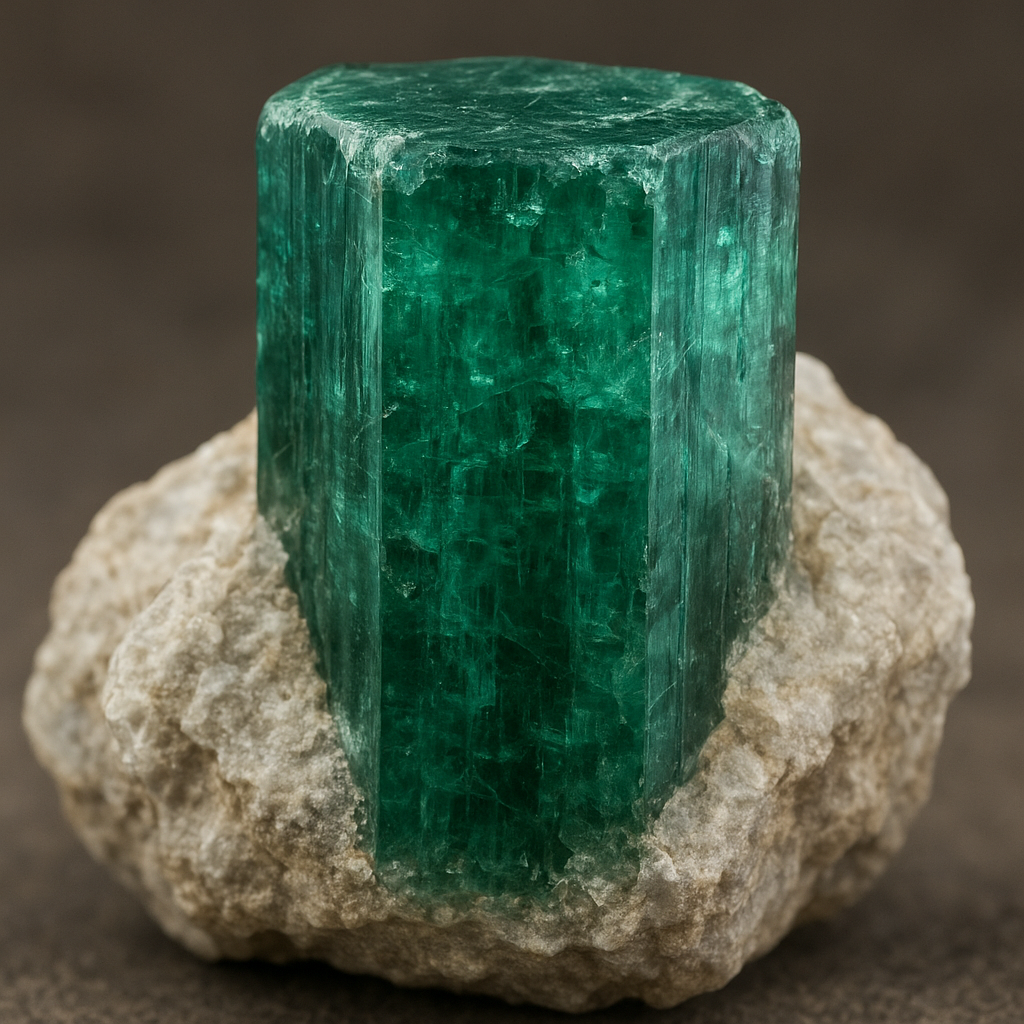
Beryl Green is a subtle and often underappreciated member of the beryl family, occupying a niche between the faint pastel greens of common beryl and the intense hues of emerald. Although it lacks the blockbuster name recognition of its verdant cousin, it combines the solid physical qualities that make beryl a desirable material for both collectors and industry. This article explores the mineralogical characteristics of green beryl, its global occurrences, practical and industrial uses connected to its chemistry, gemological treatments, safety considerations around mining and processing, and a selection of curious and lesser-known facts that illuminate why this mineral matters to geologists, jewelers, and engineers alike.
Mineralogy and Physical Properties
The mineral that gives rise to green beryl is fundamentally the same structural species as all beryls: beryl with the formula Be3Al2(Si6O18). Beryl belongs to the hexagonal crystal system and typically forms elongated, prismatic crystal habits with well-developed vertical striations. The crystal lattice contains rings of six silica tetrahedra stacked along the c-axis, and channels within this framework can host various ions and molecules. These substitutions and inclusions are responsible for the range of colors seen across beryl varieties.
Key physical and optical properties of green beryl:
- Hardness: 7.5–8 on the Mohs scale, giving beryl good resistance to abrasion and suitability for jewelry in many forms.
- Specific gravity: commonly around 2.63–2.80, depending on impurities and inclusions.
- Refractive index: typically in the range of ~1.568–1.602, with modest birefringence that gemologists use to identify beryl.
- Crystal system: hexagonal, often forming long prismatic crystals with flat terminations or pyramidal ends.
- Cleavage: imperfect basal cleavage that can make lapidary work more challenging in some orientations.
Color in green beryl is most often the result of trace amounts of iron (Fe2+ and Fe3+), and in some cases low concentrations of chromium and vanadium contribute to greener tones. Unlike emerald — which owes its intense green to higher levels of chromium and vanadium and is often more heavily included — green beryl tends to show paler, more transparent greens, from mint to sea-green. The depth and tone of the green can vary with locality and with subsequent treatments such as heat or irradiation (used in limited cases to alter color).
Geological Occurrence and Major Localities
Green beryl is commonly associated with granitic pegmatites, though it can also form in mica schists, hydrothermal veins and greisens where beryllium-rich fluids interact with host rocks. Pegmatites are particularly fertile environments for large, gem-quality beryl crystals because of the slow cooling of volatile-rich magmas that concentrate rare elements, including beryllium.
Significant occurrences and producing regions include:
- Brazil (notably Minas Gerais): famous for large, gem-quality beryl crystals in a variety of colors. Brazil remains one of the most prolific sources for both collector specimens and gem material.
- Madagascar: known for producing attractive, transparent green beryl, often from pegmatites and alluvial deposits.
- Pakistan and Afghanistan: high-altitude pegmatites in the Himalaya and adjacent ranges yield fine beryl crystals, occasionally in green shades.
- Russia (the Ural Mountains): historical source of beryl, including pale green forms; the Urals have a long mining tradition for gem minerals.
- United States (California, Utah, and Maine; also North Carolina): various pegmatite fields produce beryl of differing colors, including green tones.
- Colombia: globally famous for emeralds (intense green beryl) but also yields lesser-known green beryl specimens.
Within pegmatites, beryl is typically found alongside minerals such as quartz, feldspar, muscovite, tourmaline, and topaz. Greisenized granites and hydrothermal alteration zones, where fluorine and other volatiles concentrate, can also host beryl-bearing pockets. The size of crystals can be dramatic in pegmatites—some of the largest gem-quality beryl crystals ever found originated in Brazil.
Gemological Characteristics and Market Use
Green beryl occupies an interesting market niche between common beryl and emerald. Where emerald commands premium prices for intense, vivid green with high chroma (and even then is often included), green beryl appeals to buyers seeking a durable, attractive green gemstone at a more accessible price point. Being relatively hard and stable, green beryl can be cut into a wide variety of shapes and is suitable for rings, pendants, and other jewelry.
Important gemological notes:
- Clarity: Green beryl often offers better clarity than emerald, with fewer fractures and inclusions, making it more straightforward to cut and polish.
- Color treatments: Unlike some gems, green beryl is not commonly subjected to extensive treatments. Heat treatment and irradiation have been applied in select instances to enhance or modify color, but these are less widespread than with other gem types. Synthetic analogs of beryl (including synthetic emerald) are produced by hydrothermal methods, and gemologists rely on inclusion patterns and advanced spectroscopy to distinguish natural from synthetic material.
- Cutting: The mineral’s hardness and crystal habit make it amenable to faceting. Care must be taken because beryl can display perfect cleavage in certain directions; an experienced lapidary will orient the cut to minimize the visibility of that cleavage plane.
In the gem trade, descriptors such as “mint beryl” or “sea-green beryl” are sometimes used to differentiate shades from pale apple green to bluish-green. Pricing is heavily influenced by color saturation and clarity: intensely colored, clean stones command the highest prices. Treatments, origin (e.g., Brazilian vs. Madagascar), and size also play crucial roles in valuation.
Industrial Importance and the Link to Beryllium
While gem and collector markets are one side of beryl’s value, the mineral’s industrial importance stems from being a major ore of beryllium. Beryllium extracted from beryl ores enables a range of high-performance applications because of the metal’s exceptional combination of low density, high stiffness, thermal stability, and ability to moderate or reflect neutrons.
Key industrial uses of beryllium and its compounds include:
- Aerospace and defense components that benefit from beryllium’s high strength-to-weight ratio and thermal stability.
- Precision instruments and structural materials where stiffness and thermal stability are critical.
- Electronic and telecommunications equipment, where beryllium copper alloys provide excellent electrical conductivity, strength, and wear resistance.
- X-ray windows: thin sheets of metallic beryllium allow transmission of X-rays and are used in certain analytical instruments.
- Nuclear applications: beryllium can function as a reflector or moderator and is used in some reactor designs, though this use is specialized and tightly regulated.
It is important to note that not all beryl deposits are economically viable as beryllium ores. Gem-quality beryl is often selectively mined for gemstones, whereas lower-grade beryl-bearing pegmatites or rock-hosted beryl may be processed for beryllium production. The extraction and refining pipeline for beryllium demand significant technical infrastructure and environmental safeguards.
Mining, Health and Environmental Considerations
Work with beryl-bearing ores raises occupational and environmental concerns due to the toxicity of elemental beryllium and some of its compounds. Fine dust from crushing, grinding, or polishing can pose inhalation hazards. Chronic inhalation of beryllium compounds can lead to chronic beryllium disease (CBD), a serious respiratory condition characterized by immune-mediated granulomatous inflammation. Consequently, modern mining and processing operations implement strict dust-control measures, respiratory protection, and medical surveillance.
Important safety points:
- Dust control and wet processing reduce airborne particulate generation during ore crushing and lapidary work.
- Personal protective equipment (PPE) and ventilation are standard in industrial settings where beryllium exposure may occur.
- Regulation and monitoring: many jurisdictions impose limits on workplace exposure to beryllium and mandate health surveillance for exposed workers.
- Environmental management requires careful handling of tailings and effluents to avoid soil and water contamination in mining districts.
Collectors and jewelry hobbyists should be mindful that while handling finished, polished gemstones poses minimal risk, aggressive mechanical processing on beryl-bearing rock (sawing, grinding) generates dust that should be controlled. In historic mining contexts, poor controls sometimes led to long-term health impacts among workers and nearby communities. Modern best practices emphasize containment, monitoring, and remediation where necessary.
Treatments, Synthetic Counterparts and Identification
A few technical approaches are relevant when distinguishing natural green beryl from related materials and synthetics. Because beryl has specific optical and physical fingerprints, gemologists use refractive indices, birefringence, specific gravity, and inclusion types to identify specimens. Advanced spectroscopy and chemical analysis, such as energy-dispersive X-ray fluorescence (EDXRF) or laser-ablation inductively coupled plasma mass spectrometry (LA-ICP-MS), can quantify trace elements like iron, chromium and vanadium that inform color origin.
Treatments and synthetic production:
- Heat treatment: modest application in certain beryl types to improve tone or reduce unwanted hues, though not as commonly practiced for green beryl as for some other gemstones.
- Irradiation: can modify color in some beryl specimens; subsequent heat treatments may stabilize the color.
- Synthetic emeralds and beryl produced hydrothermally are present in the market. These grow in controlled environments with specific inclusion signatures that gemologists can detect.
Identification of green beryl versus emerald often hinges on color intensity and trace-element chemistry. Where chromium or vanadium content is high enough to produce the vivid, saturated green associated with emerald, the gem is classified as an emerald. Less intense green hues lacking the same trace-element signature are typically termed green beryl.
Cultural, Historical and Interesting Facts
Beryl has a long cultural pedigree. The word itself is derived from the Greek beryllos, a term used for precious blue-green stones. Over centuries, many cultures attributed metaphysical properties to beryl family stones — from protection to clarity of vision — a tradition that survives in modern crystal-healing communities, although such uses are metaphysical rather than scientific.
Other interesting notes:
- Versatility: Beryl spans a broad color palette (green, blue, pink, yellow) and thus occupies multiple gem categories — from the highly prized emerald to the popular aquamarine and morganite.
- Large crystal finds: Pegmatites have produced spectacularly large beryl crystals, sometimes weighing hundreds of kilograms, though gem-quality facetable material is rarer within those massive crystals.
- Mineralogical relatives: Beryl is often found with tourmaline, spodumene and other rare-element pegmatite minerals, making certain pegmatite districts especially attractive for mineral collectors.
- Modern technological relevance: The same mineral that yields attractive gemstones also provides a path to high-performance beryllium alloys used in aerospace and electronics — a striking example of a mineral serving both aesthetic and technical worlds.
Practical Advice for Collectors and Consumers
If you are considering acquiring green beryl — as a collector, investor, or jewelry buyer — keep several practical points in mind:
- Ask for reliable provenance and, when possible, laboratory reports that document treatment history and whether the stone is natural or synthetic.
- Consider color and clarity: for green beryl, attractive color saturation and good transparency increase visual appeal and market value.
- Inspect the stone for cleavage planes or fractures which can complicate setting and long-term durability.
- For hobbyists working with rough material, observe proper dust-control practices and avoid generating airborne particulates without suitable protection.
Concluding Thoughts
Green beryl may not always dominate headlines the way emeralds or aquamarines do, but it occupies an important and multifaceted role among gemstones and industrial minerals. With a balance of attractive optical properties, robust physical characteristics, and an industrial connection to the strategic metal beryllium, green beryl sits at the crossroads of geology, gemology, and technology. Whether appreciated in a finely cut gem, displayed as a museum-quality crystal, or processed as an ore for advanced materials, this mineral illustrates how a single species can bridge aesthetics and utility across diverse human endeavors.