
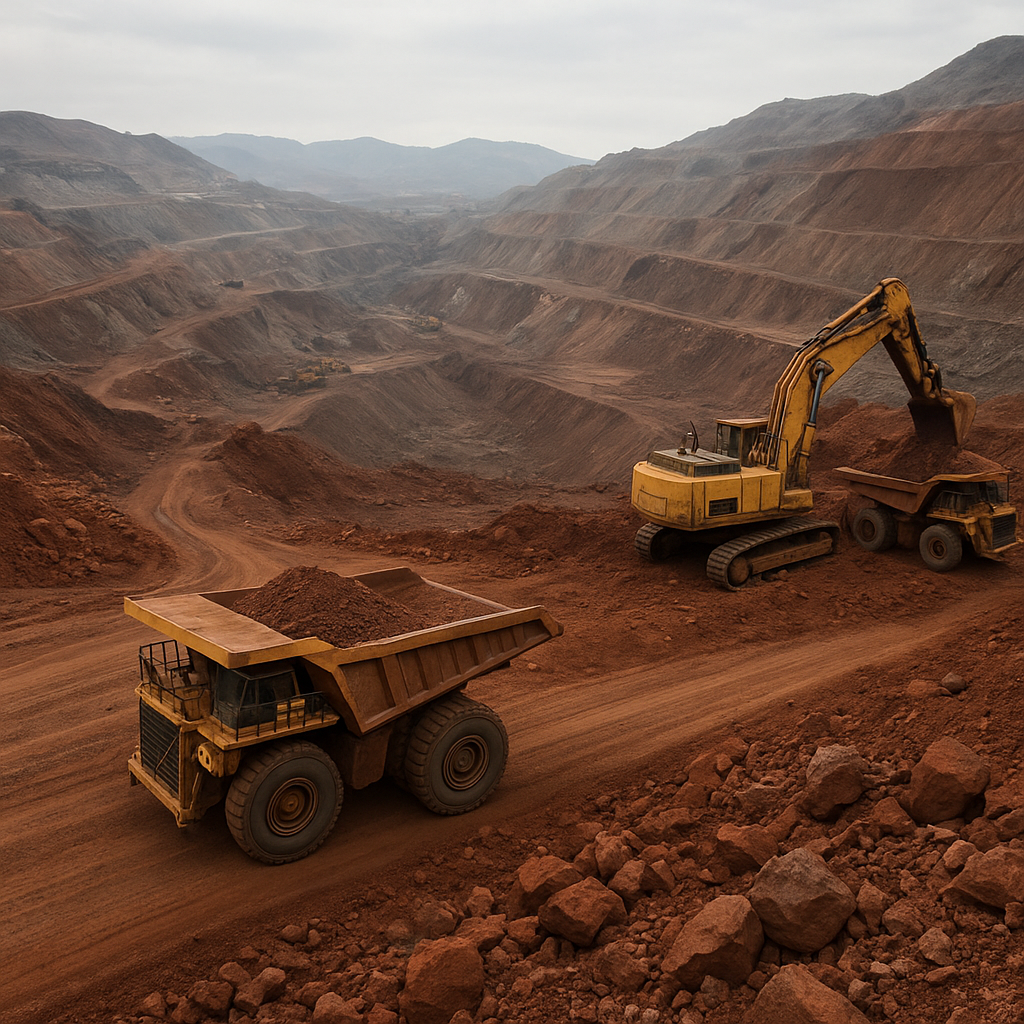
The mining district around Benxi, in northeastern China’s Liaoning province, is one of the country’s historically important centers for iron ore extraction and heavy industry. For well over a century the area has anchored local economies, fed regional steel production, and shaped the landscape, society and infrastructure of the surrounding cities and towns. This article examines where the mine is located, what is extracted there, the broader economic role of the mining complex, and several notable and sometimes surprising aspects of its history and present-day operations.
Location and geological setting
The Benxi mining area lies in a mountainous, forested portion of northeast China, within a valley system that channels rivers toward larger basins of the Yellow Sea. The district is centered on municipal Benxi and stretches into neighboring counties. Situated southeast of the provincial capital Shenyang, the site sits in a region that has long been recognized for its rich mineral endowment.
Geological context
The mineralization in the Benxi area is associated with a complex geological history that includes sedimentary deposition, metamorphism and later tectonic activity. The deposits exposed around Benxi are typically a mix of banded iron formations and metamorphosed sedimentary iron deposits that host both oxide and magnetite-rich ores. In simple terms, miners primarily extract varieties of iron minerals such as hematite and magnetite, although local geology can include other associated minerals and gangue material.
Structurally, ores are often concentrated along fault zones and within folded strata, making some deposits amenable to open-pit methods while others require underground workings. The mix of deposit types contributed to the longevity of mining here: as shallow deposits were exhausted, deeper deposits remained exploitable by more advanced techniques.
Accessibility and infrastructure
- Transport: The proximity to rail lines and later highway networks has been crucial; ores could be shipped directly to nearby smelters or onward to coastal ports for broader distribution.
- Water and energy: The river systems and hydrology of the region supplied water for processing, while coal resources and later grid electricity provided energy for smelting and beneficiation.
- Industrial linkages: The Benxi mines were integrated with local processing plants and steelworks, reducing transportation costs and strengthening regional industrial clusters.
What is mined and how it is processed
The principal commodity of the Benxi mines is iron in the form of iron-bearing minerals. Historically and presently the end use of extracted ore is predominantly for metallurgical purposes—supplying blast furnaces and, in more recent decades, direct-reduction plants or pelletizing plants that turn low-grade concentrates into a feedstock suitable for modern steelmaking.
Mineral types and ore characteristics
Ore types in Benxi typically include both high-grade oxide ores and lower-grade magnetite-bearing bodies. The characteristics of these ores—grain size, impurity content (such as silica, phosphorus, and sulfur), and physical location—determine the processing route the material will take. High-grade lumps can be sintered or used directly, while lower-grade material is commonly beneficiated, milled, and pelletized.
Mining methods
Over the life of the mines, methods evolved from largely manual, small-scale extraction to mechanized, large-scale operations. Today, a mix of open-pit and underground methods may coexist in the Benxi district depending on the deposit geometry. Modern operations emphasize safety, mechanization, and efficiency—using drilling and blasting, excavators, haul trucks, underground loaders, and conveyor systems where appropriate.
Processing and product lines
- Primary crushing and screening to reduce ore size.
- Beneficiation—gravity, magnetic separation and flotation—used to upgrade the concentrate quality.
- Pelletizing and sintering to create feedstock suitable for blast furnaces and direct reduction.
- Integrated supply chains that feed local steel mills, reducing logistic costs and enabling rapid turnover.
Economic significance
The Benxi mining complex has long been a local economic pillar. From employment to infrastructural development and to its contribution to regional industry, its effects ripple across multiple sectors. The district’s long-term output has supported the development of iron and steel manufacture in the northeast—one of China’s earliest heavy industrial heartlands—and has been a key source of raw material for both domestic consumption and export markets at various points in history.
Employment and communities
Mining in and around Benxi provided stable employment for generations. Entire towns and neighborhoods formed around mine shafts and plant gates, with housing, schools, hospitals and social institutions evolving to support mining families. The skills developed—metalworking, metallurgy, mechanical maintenance—diffused into the local labor market and Western Liaoning’s industrial base more broadly.
Industrial integration
The proximity of ore supply to processing facilities delivered clear economic advantages. Integrated plants that combined extraction, beneficiation and smelting reduced transport costs and improved supply security for steelmakers. Benxi’s ores historically supplied both regional mills and industries that required heavy sections, machinery, rail, and shipbuilding materials. The area’s industrial specialization also attracted ancillary industries: equipment manufacturing, repair shops, and logistics services.
Regional and national role
At times in the 20th century Benxi and its mines were part of strategic resource networks that supported national industrialization drives. The concentration of raw materials helped the northeast become a focal point of heavy industry, enabling large-scale steel production that fed construction and national defense projects. While the balance of Chinese mining and steel production has shifted over decades—especially as larger ore provinces and imported iron sands grew in importance—Benxi’s legacy endures as an early contributor to that national capacity.
Environmental, social and modernization issues
Like many long-lived mining districts, Benxi has wrestled with environmental legacy issues and the need to modernize operations to meet regulatory and social expectations. The industrial footprint—waste rock, tailings, landscape alteration, air pollution from smelters, and water-quality impacts—has required phased remediation and ongoing environmental management.
Modernization and technology adoption
In recent decades, local operations have adopted more efficient processing techniques and pollution-control measures. Dust collection systems, water treatment plants, and improved tailings management help reduce the immediate environmental impact. Technology has also enabled higher recovery rates from lower-quality ores, extending the useful life of the mining district while simultaneously reducing the volume of waste generated per tonne of product.
Rehabilitation and reuse
Some former mining sites have been rehabilitated and repurposed for industry parks, tourism or green spaces. The transition from extractive uses to mixed-use redevelopment is complex—requiring soil remediation, stabilization of tailings impoundments, and careful planning to reuse existing infrastructure. These projects can create new economic opportunities while addressing long-standing environmental problems.
Social transitions
As mining operations modernize, fewer workers are needed per tonne of ore produced. This has social consequences: communities must adapt as labor demand shifts, and local governments often promote retraining, small-business development and infrastructure projects to diversify local economies. Maintaining social cohesion during these transitions has been an ongoing policy challenge.
Interesting historical and cultural facets
Beyond the strictly industrial narrative, the Benxi mining area offers numerous interesting and sometimes surprising stories that connect geology, history and culture.
Historical layers
- Early development: The exploitation of iron resources in northeast China dates back centuries in various forms; industrial-scale extraction accelerated with modern transportation and capital in the late 19th and early 20th centuries.
- 20th-century transformation: The region played a significant role during the rapid industrialization phases of the early and mid-20th century, serving both domestic construction and wartime needs at various times.
- Heritage preservation: Some facilities and mining-related structures have been preserved as industrial heritage sites or museums that tell the story of the miners and the industrial communities that formed around the mines.
Tourism and natural attractions
Visitors to the Benxi region often find a mix of industrial history and natural beauty. The famous local water cave system, scenic gorges and forested hills provide recreational opportunities and a contrast to the heavy industrial past. In several cases, former industrial sites have been integrated into interpretive trails and museums that explain the geological and human stories behind extraction.
Scientific interest
Geologists and mineralogists find the Benxi area interesting because it provides a compact record of the kinds of tectonic and sedimentary processes that concentrate iron into mineable bodies. Studies of mineral textures, metamorphism and ore-paragenesis help researchers understand broader regional metallogenesis in northeast Asia.
Markets, trade and the future outlook
Benxi’s mines remain economically relevant, but the broader market context for iron and steel continues to evolve. China’s domestic demand cycles, global commodity prices, and the entry of vast seaborne supplies from other regions all affect the economics of local mines. In addition, rising environmental standards and policy-driven efforts to rationalize capacity have encouraged consolidation and even temporary shutdowns of less efficient operations.
Competitive position
Local mines like those in Benxi must compete on cost, quality and logistics. Where ore quality is high and infrastructure is efficient, operations can remain competitive even in a market increasingly dominated by large seaborne suppliers. Conversely, lower-quality ores require added beneficiation and processing investment, which only pays off if long-term demand and price expectations justify it.
Potential future trajectories
- Continued modernization: Continued investment in processing and environmental control will keep operations viable for longer and align them with stricter regulatory standards.
- Value-added integration: Greater vertical integration—moving from raw ore to higher-value products such as pellets, or forging partnerships directly with steelmakers—can capture more economic value locally.
- Diversification: Local economies may increasingly emphasize tourism, services, and light manufacturing to reduce dependence on raw-material extraction.
Cultural and community notes worth knowing
Mining communities tend to accumulate traditions, folklore and a shared identity shaped by the hazards and rhythms of underground work. Benxi’s miners built networks of mutual aid, social clubs and commemorations that continue to influence civic life. Local festivals, museums and commemorative monuments keep the memory of the mining era alive even as the economic base diversifies.
The story of Benxi is therefore not just a tale of geology and industry, but of people: the generations of miners, engineers and families who lived with and built their lives around the extraction and transformation of earth resources. The area’s experience exemplifies how a single mineral—iron—can influence regional development trajectories, technological adoption, environmental policy and cultural identity across more than a century.

