
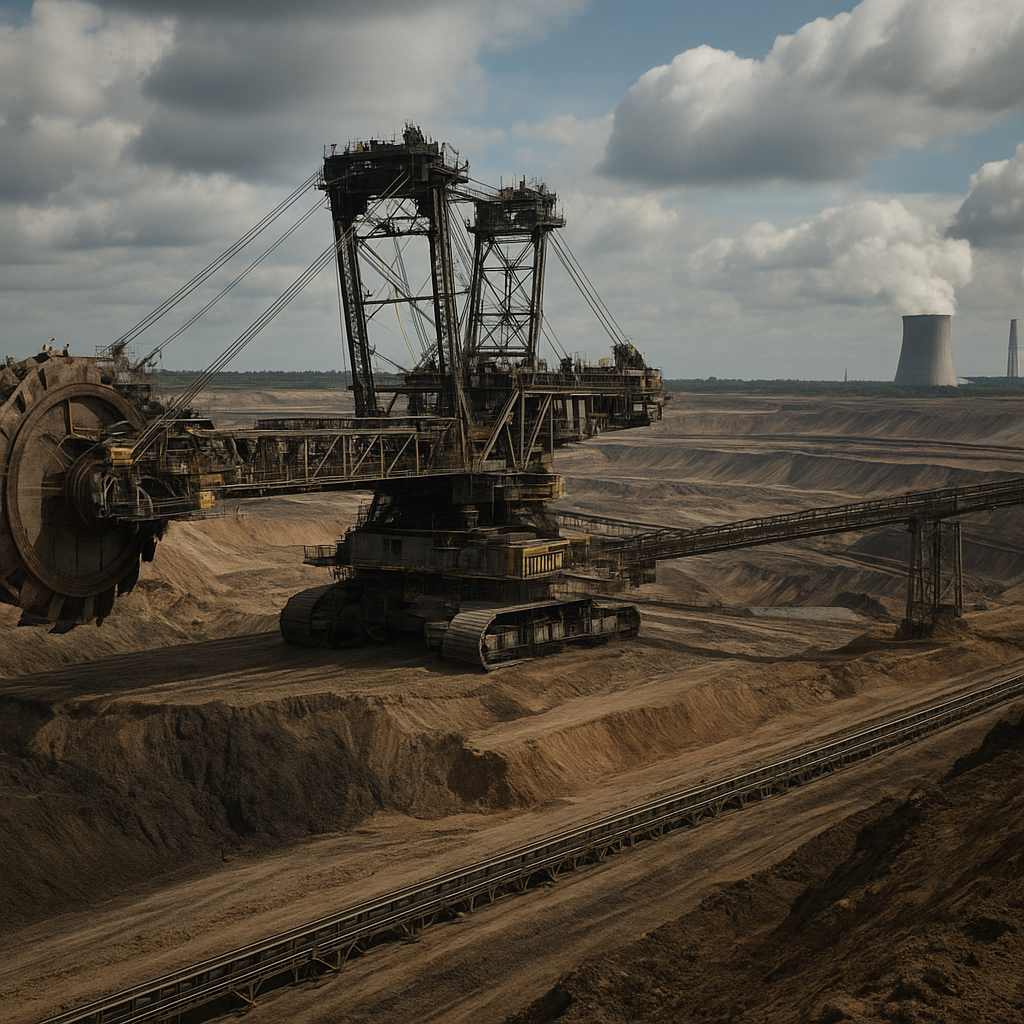
The Bełchatów mining complex is one of the most prominent industrial landscapes in Poland and a key element of the country’s energy system. Located in central Poland, this vast open-pit operation has supplied fuel to one of Europe’s largest power stations for decades and shaped the economy, environment, and communities of the Łódź region. The following article explores the mine’s location, geology, operational methods, economic importance, environmental challenges, and some lesser-known but intriguing facts about its scale and impact.
Location and historical background
The Bełchatów mine is situated near the town of Bełchatów in the Łódź Voivodeship, roughly in the geographic center of Poland. The area is characterized by flat plains and agricultural land, which contrasted sharply with the industrial development that followed the discovery and exploitation of the deposit. Identified in the mid-20th century, the deposit was developed into a full-scale open-pit mine in the 1970s to supply a newly constructed thermal power complex. Over the following decades the site expanded, drawing a workforce from nearby towns and stimulating infrastructure growth in a region that had previously been predominantly rural.
What is extracted: geology and the resource
The principal resource mined at Bełchatów is lignite, commonly referred to as brown coal. Lignite is a lower-rank coal with higher moisture content and lower calorific value than black coal, but it is abundant in this deposit and economically viable to extract by surface mining. The geological profile of the deposit features relatively thick, near-surface seams, which make open-cast extraction technically feasible and cost-effective. The layers of lignite are interbedded with clays, sands, and other sediments, requiring careful planning of extraction and handling to maintain operational efficiency.
Reserves and production
The deposit hosts substantial proven and probable reserves, large enough to sustain long-term extraction at industrial scales. Annual production over recent decades has ranged in the tens of millions of tonnes, primarily directed to the adjacent power complex. This steady stream of fuel underpins one of the largest single-site electricity-generating installations in Europe and has been central to regional energy supply strategies.
Mining methods and infrastructure
Bełchatów is an open-pit or surface mine, which means the overlying material is removed to expose and extract the lignite seams. The operation relies on a highly mechanized system of earthmoving and material transport equipment. Large bucket-wheel excavators, conveyor belts, haul trucks, and stacking equipment form an interconnected network that continuously feeds lignite to crushing, processing, and transportation systems. The mine is closely integrated with the power plant via dedicated conveyor belts and transport facilities that minimize intermediate handling and ensure a near-continuous fuel supply.
- Bucket-wheel excavators and spreaders perform primary excavation and spoil management.
- Long-distance conveyor systems move coal directly to the power station, reducing truck traffic.
- Water management infrastructure controls groundwater and surface run-off to protect both mine stability and surrounding areas.
Economic significance and regional impact
The economic footprint of the Bełchatów complex extends well beyond the pit itself. The mine and the adjacent power plant have been pillars of local and national economic activity. They generate thousands of direct jobs and support numerous indirect positions in maintenance, logistics, metallurgy, and services. Local municipalities receive tax revenues and royalties that have funded public works, education, and health services, altering socio-economic trajectories in the surrounding towns.
The mine’s contribution to the electricity grid is particularly noteworthy. The lignite-fired power facility supplied by the mine has provided a significant share of Poland’s baseload generation for decades, contributing to electricity price stability and national energy security. Because lignite is a domestic fuel, the operation has helped reduce Poland’s dependence on imported fuels for thermal generation.
Supply chain and industrial linkages
A complex supply chain has developed around the mine: suppliers of heavy machinery, conveyor components, electrical equipment, and spare parts; contractors for civil works and environmental mitigation; and companies involved in reclamation and landscape restoration. Universities and vocational schools in the region also collaborate with the mine and power plant on technical training and applied research, strengthening local human capital.
Environmental impacts and mitigation efforts
Large-scale open-pit lignite mining and combustion of lignite in thermal power plants carry substantial environmental challenges. The Bełchatów complex has been associated with significant emissions of carbon dioxide, particulate matter, and other air pollutants. The power station it feeds has been identified as one of the larger point sources of emissions in Europe, which has made the site a focal point in discussions about climate policy and national decarbonization plans.
Mining itself alters landscapes dramatically: soil and vegetation removal, disruption of local hydrology, and the creation of enormous pits and spoil heaps. These impacts can be long-lasting if not adequately managed. In response, operators and regulators have implemented a range of mitigation and remediation measures:
- Progressive reclamation: reshaping spoil heaps, replacing topsoil, and creating new landforms suitable for agriculture, forestry, or recreational uses.
- Water management: constructing containment systems, monitoring groundwater, and ensuring that dewatering does not unduly affect nearby wells or ecosystems.
- Air quality measures: dust suppression, covering conveyors, and filtering emissions at the power station.
- Ecological restoration: planting new forests and creating wetlands to re-establish biodiversity on previously mined lands.
Reclamation here has produced mixed outcomes. While some formerly mined areas have been transformed into green spaces and managed landscapes, long-term ecological recovery takes decades and depends on continual management. Plans for end-use of the largest voids include the possibility of creating lakes or other water bodies, but such proposals require complex hydrological modeling and funding commitments.
Technological responses and emissions reduction
Efforts to reduce the environmental footprint include improving thermal efficiency at the power station, co-firing with biomass in certain units, and exploring carbon management options. Debate continues over the role of carbon capture and storage (CCS) or other advanced technologies: while they could theoretically reduce CO2 emissions, the economics and engineering of CCS at the scale of Bełchatów remain challenging. At the same time, Poland’s energy transition strategy involves increasing renewable generation and modernizing the grid, which will ultimately affect the role of lignite-fired plants.
Social dimensions and local communities
For many residents in the Bełchatów area, the mine has been both a source of employment and a driver of social change. New towns and housing estates were built to accommodate workers; local economies diversified to serve industrial needs; and public amenities expanded through revenues associated with the mine and power plant. Yet, these benefits have been accompanied by concerns over air quality, noise, landscape changes, and the safety and health impacts of living near heavy industrial operations.
Community engagement programs, retraining for workers, and targeted investments in local infrastructure have attempted to balance industrial activity with social well-being. As national energy policy shifts and the long-term future of lignite becomes less certain, social planning—particularly regarding employment transitions and local economic diversification—has risen in priority.
Interesting technical and scale-related facts
The Bełchatów complex impresses with its sheer physical scale and engineering. Some notable points that capture the imagination:
- Large-scale machinery dominates the pit: massive bucket-wheel excavators and continuous conveyors operate on a scale that few industrial projects can match, presenting scenes that are striking from the ground and visible in satellite imagery.
- The mine and power station together create a linked industrial system in which fuel extraction, transport, and combustion are optimized for continuous, high-capacity operation.
- Because of the depth and volume of material moved, the mine is sometimes described as one of the largest man-made excavations in Europe—an engineering landscape that replaced agricultural fields within a few decades.
- Bełchatów’s operation has driven innovation in open-pit mining techniques, material handling, and reclamation practices suited to the particular geology of lignite deposits.
Regulatory context and international attention
Regulation of the mine and its power generation responsibilities is shaped by national energy policy, EU environmental directives, and local planning statutes. Internationally, Bełchatów has been cited in discussions about coal-phase out, climate commitments, and the socioeconomic implications of transitioning away from domestically sourced fossil fuels. As Poland negotiates pathways to meet emissions targets while maintaining energy reliability, sites like Bełchatów have become emblematic of the broader trade-offs between industrial heritage, local livelihoods, and environmental imperatives.
Future prospects and transformation pathways
The future of Bełchatów will be determined by a mixture of market forces, technological developments, and public policy. Several plausible pathways exist:
- Continuation with mitigation: maintaining lignite extraction while investing in emissions controls, efficiency gains, and targeted reclamation.
- Gradual phase-out: reducing operations over time while deploying social programs and economic diversification measures for the region.
- Technological pivot: incorporating advanced emissions reduction or carbon management technologies, potentially extending the site’s operational life but at elevated cost.
- Landscape transformation: once mining ceases, large-scale reclamation could convert pits and spoil areas into lakes, forests, or new development zones, reshaping the local geography for future generations.
Any transition will have to reconcile the technical challenges of decommissioning, the scale of the altered landscape, local expectations, and national energy needs. Policy instruments such as targeted funding for redevelopment, retraining programs, and incentives for clean energy investment will shape the speed and character of change.
Closing observations and noteworthy particulars
Bełchatów remains a central node in Poland’s industrial story: its vast lignite reserves, integrated mining and power generation operations, and long-term economic influence are undeniable. The site exemplifies both the advantages of abundant domestic fuel—reliable baseload power and economic development—and the complex environmental costs that modern societies must weigh. As Poland and Europe move through an era of energy transformation, Bełchatów will likely be a testing ground for practical solutions in reclamation, emissions management, and social transition strategies. The mine’s physical and symbolic footprint ensures that it will remain a subject of technical study and public attention for years to come.

