
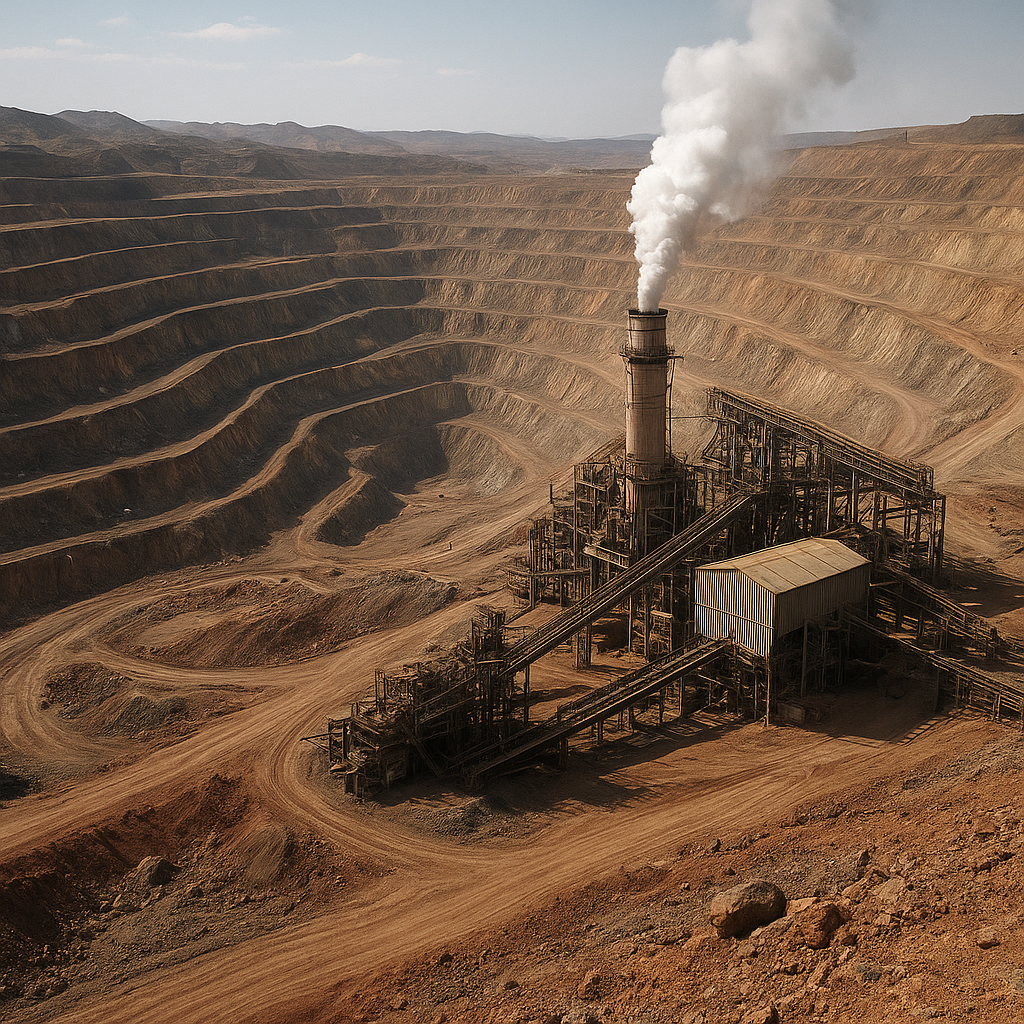
The Bayan Obo mining complex in northern China stands as one of the most consequential mineral deposits of the modern era. Its scale, the diversity of commodities it contains, and its role in shaping global supply chains for critical materials make it an object of industrial, environmental and geopolitical attention. This article examines the mine’s location and geology, the suite of elements and minerals extracted there, the broader economic and strategic importance of those resources, and a selection of lesser-known but intriguing facts that illuminate why Bayan Obo matters beyond the raw numbers.
Location and geological setting
Bayan Obo is located in the Inner Mongolia Autonomous Region of the People’s Republic of China, in a region of steppe and low mountains that has been host to mining activity for decades. The deposit lies near the town of Bayan Obo and the larger city of Baotou; it is generally described as being in the vicinity of Baotou, roughly a few dozen to a few hundred kilometers from the city center depending on the point of reference. The area is part of a broader belt of alkaline intrusive and carbonatite-related systems that worldwide are commonly associated with concentrations of rare earth elements and other metals.
Geologically, the deposit is unusual because it is a composite body: it combines a massive iron-ore body with sizeable concentrations of rare-earth-bearing minerals and the critical metal niobium. The mineralization occurs in a variety of hosts, including magnetite-rich iron-silicate rocks and carbonate-rich zones. This complex interplay of rock types and mineral phases is part of why Bayan Obo yields such a diversity of economically recoverable elements in one place.
What is extracted at Bayan Obo
The mine produces a mixture of commodities rather than a single metal. The major categories are:
- Rare earths: The deposit is famous for its large endowment of rare-earth elements (REEs). These are primarily the light rare earths such as cerium and lanthanum, but the ore also contains valuable amounts of neodymium and praseodymium, which are critical for high-strength permanent magnets.
- Iron: A substantial iron-ore component is present and has been exploited historically for steelmaking and other industrial uses.
- Niobium: Often recovered as a byproduct, niobium (formerly called columbium) is important for high-strength steel alloys and certain superconducting technologies.
- Associated elements and radioactive constituents: The deposit contains trace to moderate amounts of thorium and, in places, uranium. These radioactive elements complicate processing and waste management because they require specialized handling and regulatory oversight.
Mineralogy and processing methods
Mineralogically, Bayan Obo includes minerals such as bastnaesite, monazite, and other REE-bearing phases intergrown with magnetite and carbonate gangue. The ore is usually processed through a combination of crushing, grinding, flotation and gravity separation to concentrate the REE-bearing minerals and iron minerals. Further chemical processing—most notably solvent extraction and ion-exchange techniques—is required to separate individual rare-earth elements and to produce marketable oxides and metals.
The chemical complexity of the ore, including the presence of radioactive thorium, means that processing facilities must be extensive and technically sophisticated. The ability to operate these downstream steps is part of what has historically given Chinese producers an advantage: domestic capacity not only to mine the ore but to refine and separate REEs into usable forms.
Economic and strategic significance
Bayan Obo’s importance extends far beyond a local or regional scale. The deposit helped underpin China’s emergence as the dominant global supplier of rare-earth elements through the late 20th and early 21st centuries. Rare earths are not “rare” in the sense of absolute scarcity, but they are rarely found in concentrations that are economical to mine and, importantly, to process. Bayan Obo is one of the rare exceptions: large-scale concentrations of REEs co-located with iron and niobium provide economies of scale that have been exploited for decades.
Rare-earth elements have a wide range of indispensable applications:
- Permanent magnets (primarily using neodymium and praseodymium) for electric vehicle motors, hard-disk drives, and wind-turbine generators.
- Catalysts and polishing agents (using cerium), including catalytic converters and glass polishing in electronics manufacture.
- Phosphors for lighting and displays, and alloys for batteries and specialized optics.
- Defense applications such as guidance systems, lasers, and high-performance alloys.
Because modern technologies—from consumer electronics to green-energy infrastructure and advanced military systems—depend on REEs, control over large supplies carries significant strategic weight. The concentration of mining and refining capacity in China, anchored by deposits like Bayan Obo, has influenced global supply chains, prompting efforts by other countries to diversify sources, invest in recycling and to develop alternative materials.
Industrial integration and local economy
The Bayan Obo complex is not just a mine; it is an integrated industrial cluster. Mining, beneficiation, metallurgical processing, and chemical separation facilities are linked to transportation networks and metallurgical customers. The activities at Bayan Obo have generated employment and infrastructure in Inner Mongolia, contributed to industrial output, and supported related industries like steelmaking and specialty chemicals.
However, the local economic benefits carry trade-offs: environmental externalities and health concerns (discussed below) have weighed against unmitigated economic gains, and central government policies on resource management and price controls have evolved in response to national priorities.
Environmental, health and regulatory challenges
Mining and processing rare-earth ores present significant environmental challenges, and Bayan Obo is often cited in debates about the environmental costs of REE production. Issues include:
- Tailings and radioactive waste: Processing can concentrate thorium and other radioactive elements into tailings. These must be stored securely to prevent soil and water contamination.
- Water contamination and acid drainage: Chemical treatments used in beneficiation and separation can lead to acidic effluents and the mobilization of heavy metals into groundwater and surface water.
- Airborne dust and particulate pollution: Crushing and grinding, along with tailings handling, produce dust that can carry fine mineral particles into surrounding communities.
Historically, lax enforcement of environmental controls in some parts of the rare-earth industry led to localized pollution and public health problems. In response, Chinese authorities have tightened regulations, closed small and environmentally non-compliant operations, and encouraged consolidation toward larger, better-regulated enterprises. Nonetheless, remediation of legacy contamination remains a long-term challenge.
Geopolitical and market dynamics
Bayan Obo’s contribution to China’s REE dominance has shaped global policy responses. Several notable dynamics include:
- Supply concentration risk: Heavy reliance on a small number of suppliers for critical materials creates vulnerability. High-profile disputes have prompted countries to seek alternative suppliers and to build domestic processing capabilities.
- Export controls and trade leverage: In the past decade, actions and rhetoric around export limits highlighted how control of REE flows can become a tool within broader trade and diplomatic standoffs.
- Investment in diversification: Western countries and partners such as Australia and Japan have invested in new mines, processing facilities, and recycling initiatives to reduce exposure. Public and private funding has targeted projects to produce separated REEs outside China.
The complexity of separating individual REEs from one another and from other elements means that building a supply chain outside established centers requires not only mining investment but also chemical processing expertise and environmental management systems—areas where industrial lessons from operations like Bayan Obo are instructive.
Interesting and lesser-known aspects
Beyond its headline role as a major REE supplier, Bayan Obo offers a number of intriguing angles:
- Composite deposit model: It is relatively rare for a single deposit to host economically recoverable quantities of iron, rare earths and niobium together. This makes Bayan Obo an instructive case for ore genesis studies and resource economics.
- Historic influence on industrial policy: The availability of locally sourced REEs fed into domestic metal and electronics industries, shaping choices in manufacturing and technological development within China.
- Technological evolution: The processing flows used at Bayan Obo have evolved over decades, reflecting both advances in separation chemistry and responses to environmental regulation. The move from simple, small-scale operations to large centralized plants is part of a broader industrial maturation story.
- Scientific value: The deposit has been the subject of intense geoscientific study, providing insights into magmatic and hydrothermal processes that concentrate rare elements.
- Recycling and circular economy potential: As primary ore sources become more scrutinized for environmental impacts, interest in urban mining—recovering REEs from end-of-life products—is growing. Bayan Obo exemplifies why supply security can be pursued by combining primary mining, recycling and material substitution.
Future prospects and technological trends
Looking forward, several trends will shape the significance of Bayan Obo and similar deposits:
- Demand drivers: Continued growth in electrification (electric vehicles, wind power), electronics, and defense technologies will sustain demand for REEs, particularly magnet-grade neodymium and praseodymium.
- Environmental management: Stricter environmental rules and improved waste treatment technologies will increase the operating costs of REE production but reduce damage to local ecosystems and communities.
- Supply diversification: Investments outside China in both mining and downstream separation will gradually alter market structures, though expertise and economies of scale remain barriers to rapid change.
- Material innovation: Advances in materials science—such as lower-REE magnets, alternatives to certain REEs, and enhanced recycling techniques—could modify demand patterns over time.
The role of major deposits like Bayan Obo will thus be affected by market fundamentals and technological shifts. While new mines come online and recycling expands, the geological reality—that high-quality, large-scale REE deposits are rare—means that longstanding deposits will continue to matter for global supply security.
Key takeaways about Bayan Obo
Bayan Obo sits at the intersection of geology, industry and geopolitics. Its large endowment of rare earths, combined with significant iron and niobium, created both an industrial powerhouse and a complex set of environmental responsibilities. The deposit contributed to China’s central role in REE markets, influenced global strategies for supply diversification, and remains a focal point for discussions about sustainable resource development. Its story highlights how a single mineral district can have outsized influence on technology, economy and policy at the international level.

