
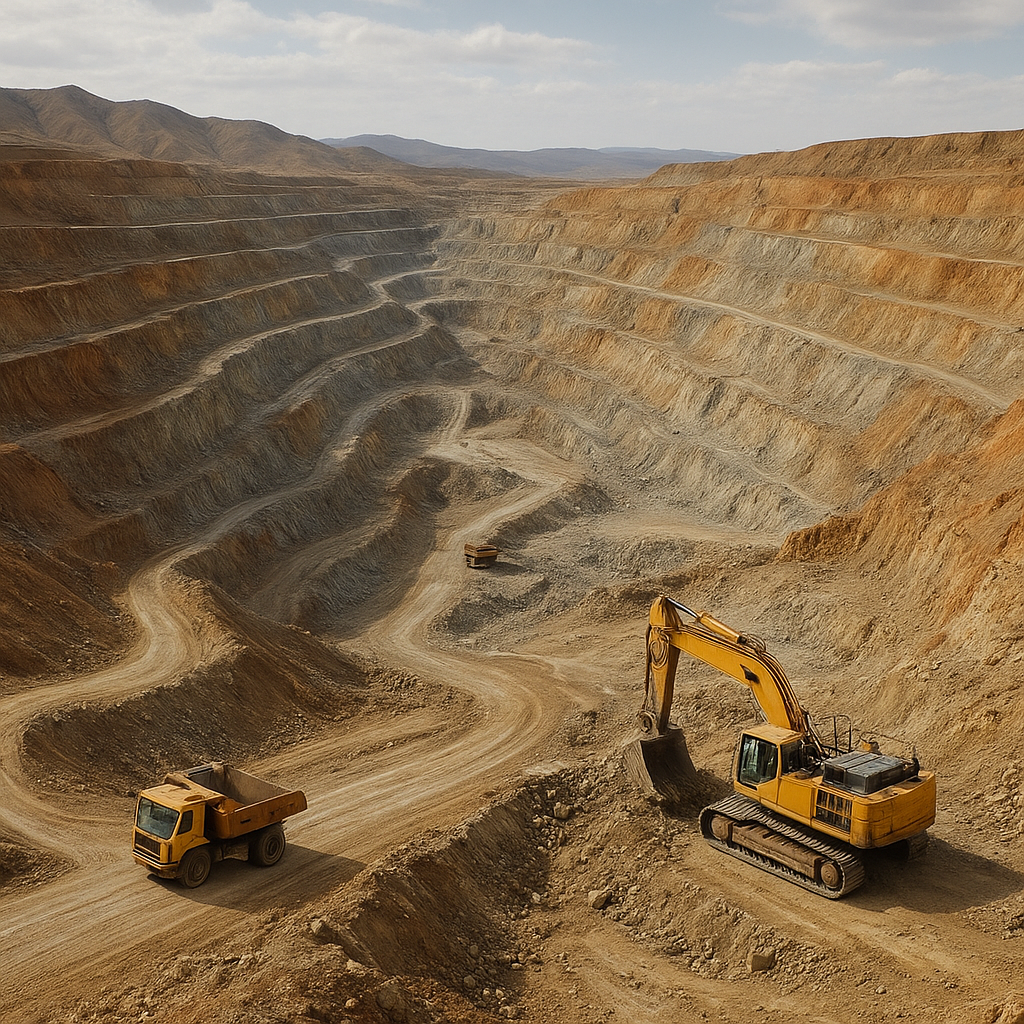
The Balasausqandiq site is one of the mineral occurrences in Kazakhstan that has drawn attention because of its vanadium-bearing ores and the potential role such deposits can play in both regional development and the global supply chain for critical metals. This article examines where the mine is located, what is extracted there, its broader economic importance, and several interesting aspects that connect geology, technology and policy. The analyses below draw on general information about vanadium deposits and Kazakhstan’s mining sector; specific figures for reserves and production can vary by source and over time as exploration and development continue.
Location and Geological Setting
The Balasausqandiq site is situated within Kazakhstan, a country that spans a vast part of Central Asia and is renowned for its rich and varied mineral endowment. The deposit lies in one of Kazakhstan’s mineral provinces that host iron-titanium-vanadium mineralization—types of ore bodies that commonly occur as magnetite-rich layers or lenses associated with igneous intrusions or metamorphosed sequences. These settings often produce ores where vanadium is hosted in the crystal lattice of magnetite or in titanomagnetite minerals.
Geologically, vanadium in such deposits is typically present in the form of vanadium-bearing magnetite, which requires specialized processing to concentrate and extract the vanadium. The regional geology that hosts Balasausqandiq includes Precambrian to Paleozoic rock sequences (in many Kazakh deposits) and tectonic histories that enabled the emplacement and concentration of iron-titanium-vanadium mineral assemblages. Understanding the local stratigraphy, the nature of the intrusive bodies (if any), and the metamorphic overprint is essential for successful exploration and resource estimation.
What Is Extracted: Ore Type and Metallurgical Products
At the Balasausqandiq site the primary commodity of interest is vanadium, commonly produced from vanadiferous titanomagnetite or other magnetite-rich ores. Vanadium rarely occurs as a free metal in nature; it is recovered through the processing of iron-rich ores or residues (slags), or from certain titaniferous magnetite deposits where the vanadium content is economically significant.
Typical mineral products and process steps associated with such deposits include:
- Concentration: Crushing and grinding of ore followed by magnetic separation to produce a magnetite concentrate with elevated iron and vanadium content.
- Smelting or pyrometallurgical treatment to produce a vanadium-rich slag and pig iron or to produce ferrovanadium alloys used in steelmaking.
- Hydrometallurgical extraction to produce refined vanadium chemicals such as V2O5 (vanadium pentoxide) or vanadium precursors for battery materials.
- Production of ferrovanadium for the steel industry, which is the dominant industrial use of vanadium worldwide.
Depending on the development stage at Balasausqandiq, processing could be staged locally or ore concentrates could be transported to regional processing plants. In Kazakhstan, some projects integrate concentration and further refining within the country to capture more value, while others focus on exporting concentrates for external processing.
Economic Significance Locally and Globally
The economic role of a vanadium-bearing mine like Balasausqandiq can be considered at several scales: local (community and regional), national, and global.
Local and Regional Impacts
At the regional level, mine development typically stimulates infrastructure upgrades—roads, power lines, water supply and sometimes rail links—because heavy industry demands reliable logistics and energy. Employment creation is a direct benefit: mines require workers for exploration, construction, and operations, and they also support indirect jobs in services, transport and supply chains. Small towns or settlements near deposits often see increased economic activity, though this can also create pressure on local services and the environment.
National Economic Importance
For Kazakhstan, a country with a strong reliance on mineral exports, vanadium projects contribute to commodity diversification beyond oil, gas and base metals. A developed vanadium operation can provide export revenues, increase domestic processing capabilities and offer feedstock for alloy and chemical plants. If integrated into downstream industries, vanadium projects can help build value-added production capacities such as alloy manufacturing and chemical refining, keeping more of the value chain within the country.
Global Market Role
Vanadium is a niche but strategically important metal. The main global demand driver is steelmaking: vanadium is used as a microalloying element to improve strength and fatigue resistance of steels, especially in rebar and high-strength structural steels. An emerging and rapidly growing market stems from energy storage technologies—most notably, vanadium redox flow batteries (VRFBs), which are attractive for grid-scale storage because of their long cycle life and decoupled power and energy rating. As the global energy transition proceeds, demand scenarios for vanadium could shift significantly if grid storage deployments expand.
Therefore, a deposit such as Balasausqandiq can become part of the supply chain that underpins both traditional metallurgical markets and newer energy storage markets. Countries with stable mining policies and processing capability may capture a greater share of high-value vanadium products.
Mining and Processing Methods Typical for Vanadium Deposits
Mines exploiting vanadiferous magnetite commonly use one or a combination of the following methods:
- Open-pit mining where ores are near surface and horizontally extensive.
- Underground mining for deeper, high-grade lenses.
- Comminution and magnetic separation to produce magnetite concentrates, followed by heavy media separation or other beneficiation steps to upgrade vanadium content.
- Pyrometallurgical routes—smelting to generate vanadium-bearing slags that are then leached or reduced to produce ferrovanadium.
- Hydrometallurgical routes involving oxidative leaching, ion exchange or solvent extraction to produce vanadium chemicals like V2O5 or ammonium metavanadate.
The choice of route depends on ore mineralogy, logistics, environmental regulation and the strategy of the owner. Hydrometallurgical methods can be more selective and have a lower carbon footprint if powered with clean energy, whereas pyrometallurgical methods are traditional and well established for producing ferroalloys.
Environmental and Social Considerations
Like all mining projects, development at Balasausqandiq must balance resource extraction with environmental stewardship and social responsibility. Key considerations include:
- Management of tailings and wastes to prevent contamination of soil and waterways; tailings storage facilities must be engineered and monitored.
- Air emissions control, especially for sulfur dioxide or particulates, during smelting and roasting stages.
- Water use and recycling: beneficiation and hydrometallurgical processing can be water-intensive, so efficient water management is crucial.
- Engagement with local communities to ensure that benefits (jobs, local contracts, infrastructure) are shared and that potential negative impacts are mitigated.
- Progressive rehabilitation planning so disturbed land is restored progressively as operations proceed and again at closure.
Modern projects increasingly adopt environmental, social and governance (ESG) frameworks to attract investment and reduce long-term liability. Given vanadium’s strategic use in energy storage, there is also an opportunity to align production with low-carbon objectives.
Strategic Importance of Vanadium and Market Dynamics
Vanadium’s role as a strategic metal stems from several factors:
- Limited number of concentrated global producers and processing facilities, which can influence price volatility and supply security.
- High demand from the steel sector for small but critical additions that enhance performance of construction and engineering steels.
- Potential for growing demand from energy storage, particularly battery technologies that could support renewable integration.
- Use in aerospace alloys and chemical catalysts, representing specialized downstream markets.
Market prices for vanadium and end-products such as ferrovanadium and vanadium pentoxide reflect both cyclical steel demand and the speculative potential of battery markets. Therefore, the commercial success of a mine like Balasausqandiq depends not only on geological endowment and extraction costs but also on global demand trajectories, currency factors and trade policies.
Investment, Infrastructure and Operational Challenges
Bringing a deposit into sustained production requires capital for exploration, mine construction, processing facilities and infrastructure. For Balasausqandiq, practical considerations would include:
- Access roads and possibly rail to move concentrate or refined product to domestic or international markets.
- Reliable power supply—electrification of processing is advantageous for environmental performance and can lower operating costs.
- Availability of skilled labor and technical services; partnerships with experienced metallurgical firms can shorten the learning curve for complex extraction processes.
- Permitting and environmental approvals; timely engagement with regulators and communities reduces delays and unforeseen expenses.
Operationally, the removal of vanadium from magnetite concentrates requires careful control of mineralogy, reagent use and process temperatures. The economics are sensitive to both recovery rates and the value captured downstream—whether selling concentrates or producing refined vanadium products.
Interesting Facts and Broader Context
Several notable points make vanadium projects like Balasausqandiq interesting beyond their immediate mining function:
- Energy storage connection: Vanadium redox flow batteries use vanadium ions in different oxidation states to store energy. Their long cycle life and safety profile make them attractive for grid applications that require large-capacity, long-duration storage. If VRFB deployments expand, demand for high-purity vanadium chemicals could rise sharply.
- Dual-use in metallurgy and chemistry: Vanadium’s versatility means a single deposit can feed multiple industries—steel producers, chemical manufacturers and battery makers—providing multiple revenue pathways for project owners.
- Geopolitical relevance: Supply concentration for critical metals raises considerations of resource security. Kazakhstan’s willingness to develop domestic processing and to participate in global value chains influences how vanadium flows to different markets.
- Historic and modern metallurgy: Vanadium has been used historically to strengthen steel; today, improved alloy design and metallurgical techniques further leverage vanadium’s benefits in lightweight, high-strength materials for transportation and infrastructure.
- Research and innovation: Advances in hydrometallurgy and recycling (e.g., recovery of vanadium from spent catalysts or battery electrolytes) could shift the supply balance, creating complementarities between primary mines and secondary sourcing.
Prospects and Future Outlook
Looking ahead, the outlook for a mine such as Balasausqandiq will be shaped by exploration success, technological choices, market demand and policy. Key drivers include:
- Exploration results that confirm resource size and grade—larger, higher-grade deposits permit lower unit costs and greater resilience to price swings.
- Investment in local processing that captures value and develops a domestic industry rather than exporting raw concentrates.
- Integration with renewable energy and low-carbon processing methods to align production with climate goals and appeal to environmentally conscious markets.
- Strategic partnerships that link producers with end-users—steel mills, battery manufacturers or chemical processors—to secure offtake and financing.
For Kazakhstan, leveraging deposits like Balasausqandiq to expand into higher-value vanadium products could help diversify the economy and strengthen the country’s role in emerging energy technologies. For the global market, incremental supply from new projects provides resilience and can support the expanding uses of vanadium.
Closing Observations
The Balasausqandiq site exemplifies the type of mineral occurrence that sits at the intersection of geology, industrial metallurgy and modern technological demand. Whether its true potential is realized depends on careful resource evaluation, responsible environmental and social management, and strategic decisions about processing and market engagement. Vanadium’s unique chemistry—serving both age-old metallurgical needs and novel energy storage applications—means that deposits in Kazakhstan can play an outsized role relative to their physical footprint, contributing to local development and the broader transition to more flexible and resilient energy systems.

