
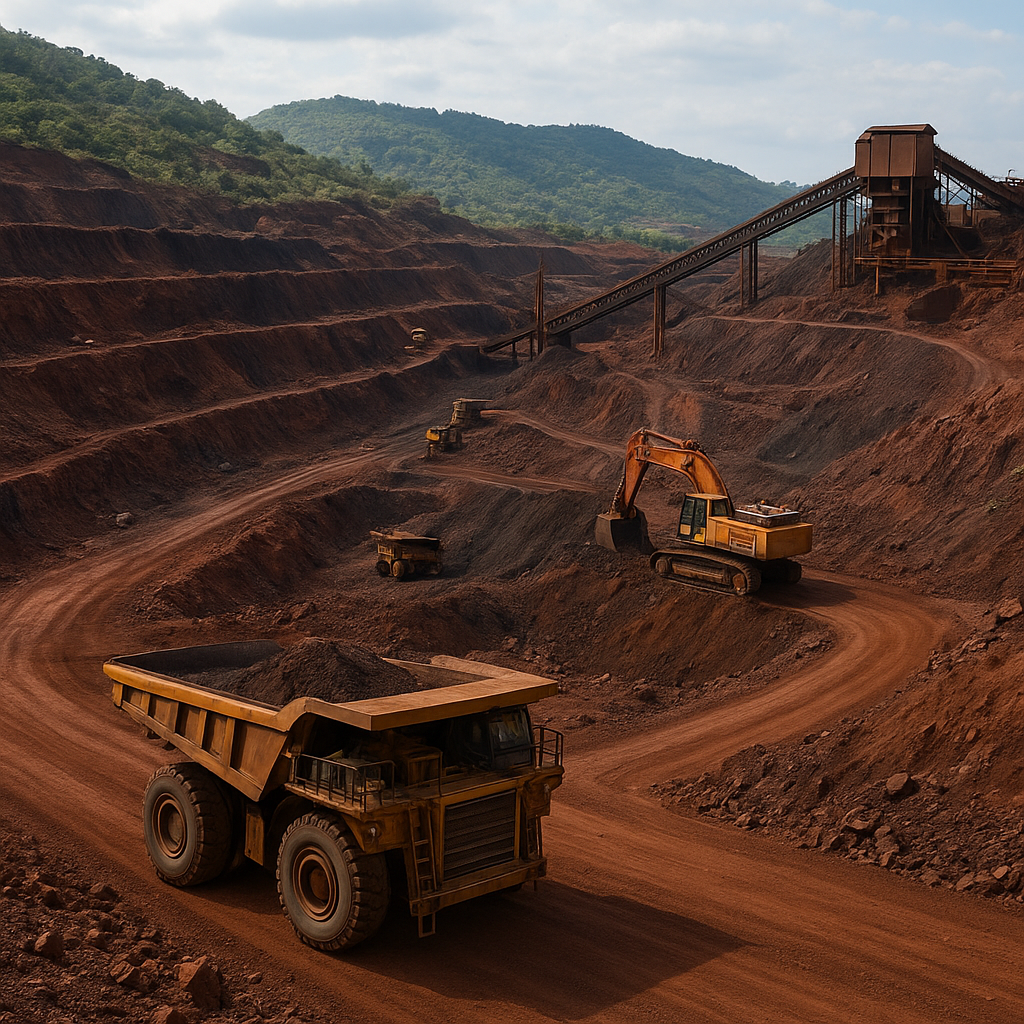
The Bailadila iron ore region is one of India’s most prominent and historically significant mining areas. Located in the rugged, forested hills of central India, it has supplied high-quality ore to domestic steelmakers and international markets for decades. This article explores the mine’s location and geology, the resources extracted, its economic role, and a selection of social, environmental and technical aspects that make Bailadila noteworthy. Emphasis is placed on understanding both the mineral wealth and the complex human and infrastructural systems built around it.
Location and geological setting
The Bailadila range lies in the southern part of the Indian state of Chhattisgarh, primarily within the Dantewada (Bastar) region. The hills are part of the Eastern Ghats’ geological extension and are characterized by a succession of ridges rich in banded iron formations. The name Bailadila is popularly believed to refer to the hump-like shapes of the hills; locally the term is associated with the image of an ox’s hump, a nod to the distinctive topography that hides the mineral deposits.
Geologically, the region hosts extensive deposits of high-grade hematite and other iron-rich formations formed over billions of years. These iron ores are often found as massive, compact bands with relatively low levels of impurities compared with many other global deposits, making them particularly attractive for steel production. The ore grades in the more productive zones historically ranged high enough to be considered premium iron ore feedstock without complex initial processing.
History of discovery and development
Exploration and commercial mining at Bailadila accelerated in the mid-20th century as India industrialized and demanded more domestic iron feedstock for its expanding steel industry. Over the years, a combination of public sector involvement and strategic infrastructure investments transformed remote ore deposits into a continuous supply chain stretching from mine faces to ports. The National Mineral Development Corporation (NMDC) and several other entities played central roles in developing and operating mines in the area.
Infrastructure milestones
- Construction of dedicated rail links that connected the mining towns with ports on the eastern coast.
- Road networks and mine towns were built to accommodate workforces and logistics operations.
- Establishment of beneficiation and handling facilities to prepare ore for blast furnaces and export.
One of the most consequential infrastructural developments was the rail corridor that allowed bulk movement of ore to the east coast, notably to the port at Visakhapatnam, facilitating both domestic distribution and export. Reliable transport drastically reduced unit costs and enabled the sustained scale of production required by large steelmakers.
What is mined and how it is processed
The principal commodity extracted from the Bailadila range is high-grade iron ore, primarily hematite. Historically the ore from certain blocks in Bailadila has been prized for its high iron content and low levels of deleterious elements, making it suitable for direct use in blast furnaces and for sintering and pelletizing processes used in modern steelmaking.
Mining techniques at Bailadila have included a mix of surface (open-pit) and underground operations depending on the deposit geometry and overburden. Modern operations emphasize mechanization, large earth-moving equipment, and systematic drilling-and-blasting regimes. Ore handling typically follows these stages:
- Extraction and haulage to on-site crushers.
- Crushing and screening to produce size-fractioned material.
- Beneficiation where required — washing, gravity separation or magnetic separation — to upgrade iron content and reduce gangue.
- Stockpiling and despatch via conveyor systems or rail.
In recent decades, captive beneficiation and pelletization facilities have become more important, as steelmakers increasingly prefer more uniform feedstock. This has increased the value chain present at the mine and nearby industrial nodes.
Economic significance
Bailadila’s contribution to the regional and national economy is multi-faceted:
- Employment: Mines and ancillary services have provided direct and indirect jobs in a remote area, supporting local economies and urbanizing certain pockets.
- Revenue: Royalties, taxes and corporate investments channel funds to state coffers and public works.
- Supply to steel industry: High-grade ore from Bailadila has been a reliable feed for India’s steel plants and for export markets, supporting a critical industrial sector.
- Infrastructure development: Investment in rail, ports and roads to move ore has produced spillover benefits for other economic activities and improved connectivity.
The export of ores and the supply to domestic steel mills has linked Bailadila to global commodity markets. Periods of high global demand and rising prices amplified revenues and investments, while downturns highlighted the vulnerabilities of regions dependent on a single commodity.
Social and environmental considerations
Mining in Bailadila has occurred in a landscape with significant ecological and social sensitivities. The hills are part of forested tracts that host biodiversity and are traditional homelands for tribal communities. Key issues that have accompanied mining include displacement of communities, changes to livelihoods, deforestation, and concerns about water quality and dust.
Companies and government agencies have increasingly faced pressure to adopt responsible practices. Responses have included:
- Resettlement and rehabilitation programs for displaced families, with varying degrees of success.
- Reclamation and afforestation initiatives on worked-out areas.
- Dust suppression, monitoring of water quality, and efforts to protect nearby catchments.
- Corporate social responsibility (CSR) programs that fund schools, clinics and local infrastructure.
Despite mitigation efforts, critics argue that mining’s benefits are often unevenly distributed and that long-term environmental costs can be substantial. Balancing economic needs with conservation and social justice remains an ongoing challenge in the Bailadila region.
Technical, logistical and regulatory aspects
Large-scale iron ore mining is a complex technical and regulatory undertaking. In Bailadila, operations have to comply with national mining regulations, environmental clearances and state-level permits. Technical challenges include slope stability in open pits, safe handling of high-tonnage traffic, and maintenance of conveyor and rail systems under heavy loads.
Transport and logistics
Transport is a defining feature of Bailadila’s operations. Ore is typically moved in bulk by rail to coastal ports, where it is loaded onto bulk carriers. The efficiency of rail linkages and port handling determines the region’s competitiveness. Investments in rail capacity, loading facilities and modern rolling stock have allowed higher throughput and reduced turnaround times for shipments.
Market dynamics
Global steel demand, prices for iron ore, and domestic policy on mineral concessions all shape production decisions. Access to international markets means that Bailadila is exposed to cyclical commodity swings; however, the high quality of some of its deposits can provide a price premium, moderating volatility relative to lower-grade sources.
Interesting facts and lesser-known aspects
- Bailadila has been an anchor for industrial corridors that extend from the mineral belt to consumer markets, illustrating how a single resource region can catalyze broader economic linkages.
- Some ore bodies in the range are considered to be of unusually high natural iron concentration, which historically reduced the need for complex initial processing and gave producers a competitive edge.
- The name and landscape of the range have cultural resonance for local communities; mining has therefore intersected with indigenous land rights and traditional uses of the forest.
- Technological upgrades over decades have transformed operations from largely manual labor to mechanized, high-capacity mining, altering labor patterns and skill requirements.
- Because large volumes of ore are exported, the region serves as a good example of how hinterland mineral resources integrate with coastal logistics and international trade.
Future outlook
Looking ahead, several trends will likely shape Bailadila’s trajectory. Demand from India’s expanding infrastructure and manufacturing base will sustain domestic consumption of iron ore, while global climate and industrial policies may alter the composition and location of steel production and raw material sourcing. Continued emphasis on sustainable mining practices, rehabilitation of mined land, and more equitable benefit-sharing mechanisms will influence social license to operate in the area.
Technological innovation — from improved beneficiation methods to automation and digital monitoring — can increase productivity and reduce environmental footprint. Meanwhile, evolving policy frameworks on mineral rights, export controls and local development obligations will define how the economic benefits of the region are captured and distributed.
In short, Bailadila is more than a deposit of iron ore. It is a focal point where geology, industry, communities and infrastructure meet. Its history and future reflect broad themes in resource-based development: the promise of wealth, the practicalities of extraction and transport, and the ethical imperative to manage environmental and social impacts responsibly.

