
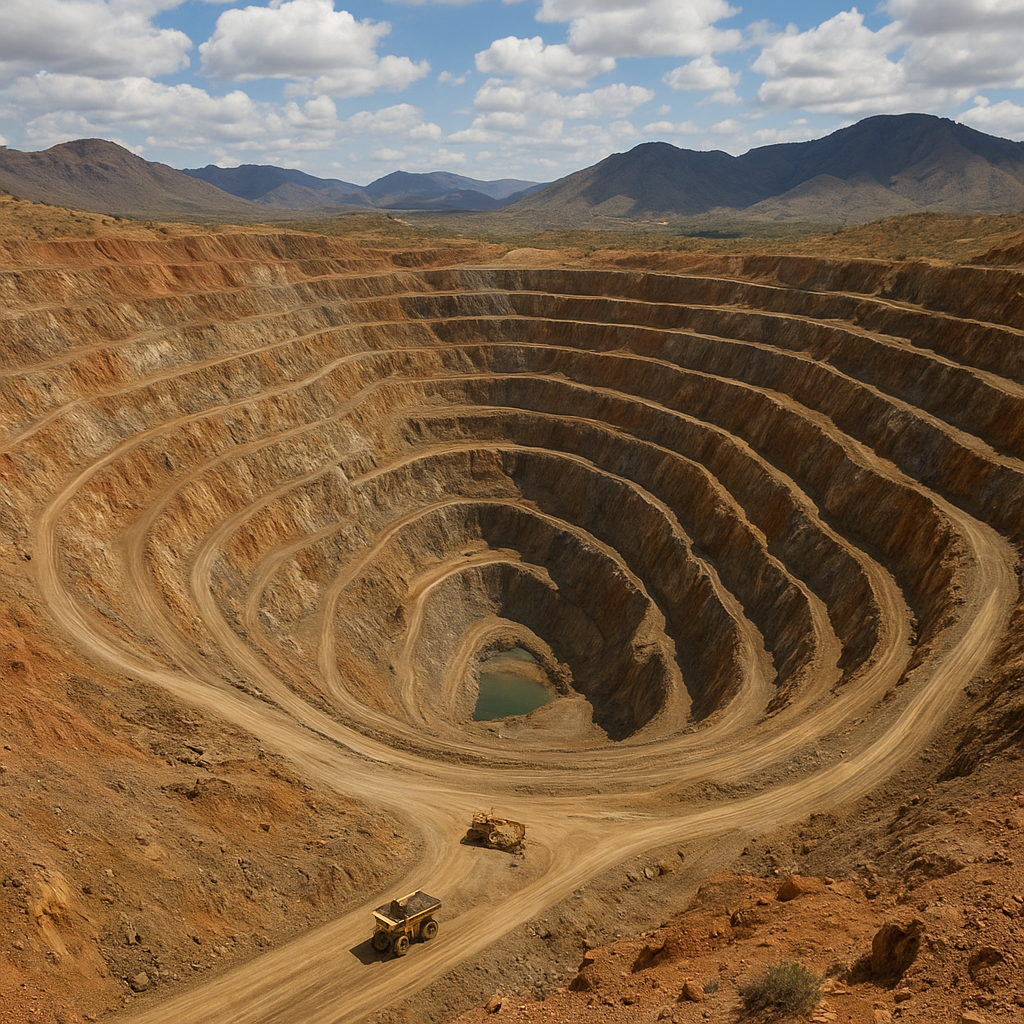
The Bagdad Mine in the United States is one of North America’s long-standing copper operations. Located in central Arizona, it has shaped the local landscape, economy and community life for decades. This article explores the mine’s location and geology, its development and operations, the economic and environmental roles it plays, and several notable facts that highlight why Bagdad remains an important site in the global copper industry.
Location and Geological Setting
The Bagdad operation sits in the western part of central Arizona, in Yavapai County, roughly 100 miles northwest of Phoenix and near the small community of Bagdad. The site occupies a semi-arid, rolling terrain within the southwestern United States’ complex tectonic mosaic. The deposit at Bagdad is a classic porphyry-style orebody, hosted by a sequence of volcanic and intrusive rocks that record multiple pulses of magmatism and hydrothermal activity.
Porphyry copper deposits form when metal-rich fluids driven by magmatic heat concentrate copper, molybdenum and other metals in large, low- to medium-grade volumes. At Bagdad, this process produced a disseminated and stockwork-style mineralization halo surrounding one or more intrusive centers. The mineralized system includes primary copper sulfides such as chalcopyrite and bornite as well as associated gangue minerals. Small amounts of molybdenite and traces of gold and silver are commonly recovered as byproducts.
The regional geology that hosts Bagdad is typical of many Southwestern U.S. porphyries: a history of subduction-related magmatism followed by extensional tectonics that allowed magmas to rise, crystalize and exsolve hydrothermal fluids. The result is a deposit that is physically large, amenable to open-pit mining and economically viable on a bulk-mining scale. Exploration and drilling programs over decades have delineated extensive ore zones and provided the data needed for long-term planning and resource estimation.
History and Development
Small-scale mining around Bagdad dates back to the early 20th century, but the modern era of large-scale production developed in the mid-1900s when mechanized mining and processing technologies made porphyry deposits economically attractive. Over time the Bagdad site evolved from scattered workings into a fully integrated mine and processing complex with the infrastructure necessary for heavy industrial mineral production.
The mine’s ownership history includes major U.S. copper companies. For much of the late 20th and early 21st centuries Bagdad was operated by companies that consolidated and expanded operations in the American Southwest. A key corporate milestone was the acquisition of Phelps Dodge by Freeport-McMoRan, which brought Bagdad into the portfolio of one of the world’s largest copper producers and integrated the mine into broader corporate strategies for resource development, processing optimization and market access.
Technological advances have shaped Bagdad’s development. Improvements in drilling, ore-body modeling, mine planning, and heavy equipment efficiency allowed operators to expand pit size while improving ore recovery. Metallurgical advances in flotation, concentration and copper recovery enhanced the value of mined material and reduced the per-unit cost of producing refined copper. Throughout these changes, Bagdad adapted its facilities — concentrators, material handling and transportation systems — to maintain steady output and respond to market demands.
Community and Workforce
- Bagdad is more than a mine — it supports a town and local infrastructure with roots tightly linked to mining employment.
- The operation historically provided a substantial portion of local jobs, contractors and service-industry income, acting as a primary economic engine for the region.
- Like many company towns, Bagdad’s social and civic life has developed around the mine, including housing, schools, and community programs supported or influenced by mine operators.
Mining Operations and Production
Bagdad’s mining method is dominated by large-scale open-pit mining. The open-pit approach is well-suited to porphyry deposits because of their lateral extent and moderate grade. Mining typically involves drill-and-blast operations, loading with large shovels or loaders, and haulage by 100-ton-class or larger trucks to crushing and grinding circuits. Ore is then processed through a concentrator where flotation separates copper-bearing sulfide minerals from waste rock, producing a copper concentrate that is shipped to smelters and refiners.
The mine produces primarily copper concentrates; quantities vary with ore grade, throughput, and market-driven processing decisions. Molybdenum is commonly recovered as a byproduct and can add meaningful revenue. Precious metals such as gold and silver, if present in sufficient quantities, are recovered in concentrates and contribute to overall project economics.
Processing at Bagdad includes primary crushing, grinding, flotation, thickening and filtration before concentrate is transported off-site. Many porphyry operations also maintain or rely on nearby smelting and refining facilities to convert concentrate into cathode or refined copper products. Whether Bagdad sends concentrate to an on-site smelter or to regional smelting hubs, the downstream metallurgy is an essential part of converting mined rock into marketable metal.
Operational metrics for modern large-scale mines like Bagdad typically include annual ore throughput, copper recovery percentage, strip ratio (the amount of waste moved per ton of ore), and life-of-mine plans that estimate economically extractable reserves. Reserves and resources are routinely updated based on drilling, metallurgy, commodity prices and permitting.
Economic and Environmental Significance
The Bagdad Mine is economically significant on several levels. At a local level, it provides employment, business for contractors and suppliers, and tax and royalty revenues that support public services. At a regional and national level, Bagdad contributes to U.S. copper production and therefore to the supply chain for industries that rely on copper: electrical wiring, construction, telecommunications, manufacturing and an accelerating array of green technologies such as electric vehicles, wind turbines and solar power systems.
Copper’s role in electrification and renewable energy systems gives mines like Bagdad strategic importance. As the world decarbonizes, demand for copper is projected to grow, making domestic sources more valuable for national supply security. Local employment multipliers and the export value of refined metals further solidify the mine’s economic footprint.
Environmental management is a critical facet of current mining practice. Bagdad and similar operations operate under a framework of federal, state and local regulations governing air emissions, water use and discharge, tailings storage, waste rock management and reclamation. Modern mines implement tailings management systems, water recycling and treatment facilities, dust control, and progressive reclamation activities to reduce environmental footprint. Corporate sustainability programs, community engagement and transparency initiatives are increasingly important in maintaining the social license to operate.
Key environmental and safety practices commonly emphasized at Bagdad-type operations include:
- Water conservation and reuse to manage scarce desert water resources.
- Progressive reclamation of disturbed land to restore ecosystems and reduce long-term liabilities.
- Measures to control fugitive dust and airborne emissions from crushing and transport.
- Tailings and waste rock strategies that prioritize stability, monitoring and risk mitigation.
- Community health, safety and economic transition planning as part of mine-life and closure considerations.
Interesting Facts and Future Outlook
Several aspects of Bagdad make it noteworthy beyond simple production statistics. The mine is part of a broader Arizona mining tradition that includes clusters of porphyry deposits; together these mines underpin much of the U.S. copper supply. The community of Bagdad grew in parallel with the mine, creating a local identity closely linked to mining life.
Technological change continues to shape the mine’s future. Automation of haul trucks, improvements in ore-sorting technology, and process optimization can increase recovery and lower unit costs. Advances in metallurgy and smelting, along with market dynamics for concentrate and refined metal, will influence the operation’s profitability and potential expansions.
Exploration around active operations like Bagdad remains an ongoing activity. Brownfields exploration (searching near existing orebodies) can extend mine life by identifying satellite deposits or deeper zones of mineralization. If additional economically viable material is found, it can change the timing of expansions, processing upgrades or the development of new pits.
Finally, the global push toward decarbonization creates both opportunity and responsibility. Demand for copper is likely to rise as electrification, renewable energy and electric vehicles expand. This elevates the strategic value of domestic copper mines, but it also raises expectations for sustainability, community benefit and environmental stewardship. Bagdad, as a mature and industrially significant site, illustrates the balancing act between delivering critical mineral supplies and meeting modern standards for environmental and social governance.
In short, the Bagdad Mine represents a combination of geological fortune and industrial evolution: a large-scale porphyry system that has supported decades of mining activity, regional economic development, and ongoing adaptation to technological, environmental and market pressures. Its place in Arizona’s mining landscape and its contribution to the broader copper supply chain make it an enduring point of interest for industry observers, local communities and policymakers alike.

