Axinite is a visually striking and scientifically intriguing group of minerals that attracts geologists, gem cutters, and mineral collectors alike. Its characteristic wedge-shaped crystals and a palette of warm to cool colors make it immediately recognizable, while its chemistry and physical properties reveal stories about the fluids and conditions that formed it. This article explores what axinite is, where it occurs, how it forms, its physical and optical properties, uses and applications, and a few noteworthy localities and specimens.
What axinite is and why it matters
At its core, axinite is a family of boron-bearing silicate minerals found in a range of geological environments. Members of the axinite group share a similar framework and composition but differ by the dominant cation present in the crystal structure, producing distinct varieties often labeled axinite-(Fe), axinite-(Mn), and axinite-(Mg). The presence of boron is an important chemical signature that sets axinite apart from many other silicates and ties its formation to specialized, often volatile-rich geological processes.
Crystal habit and appearance
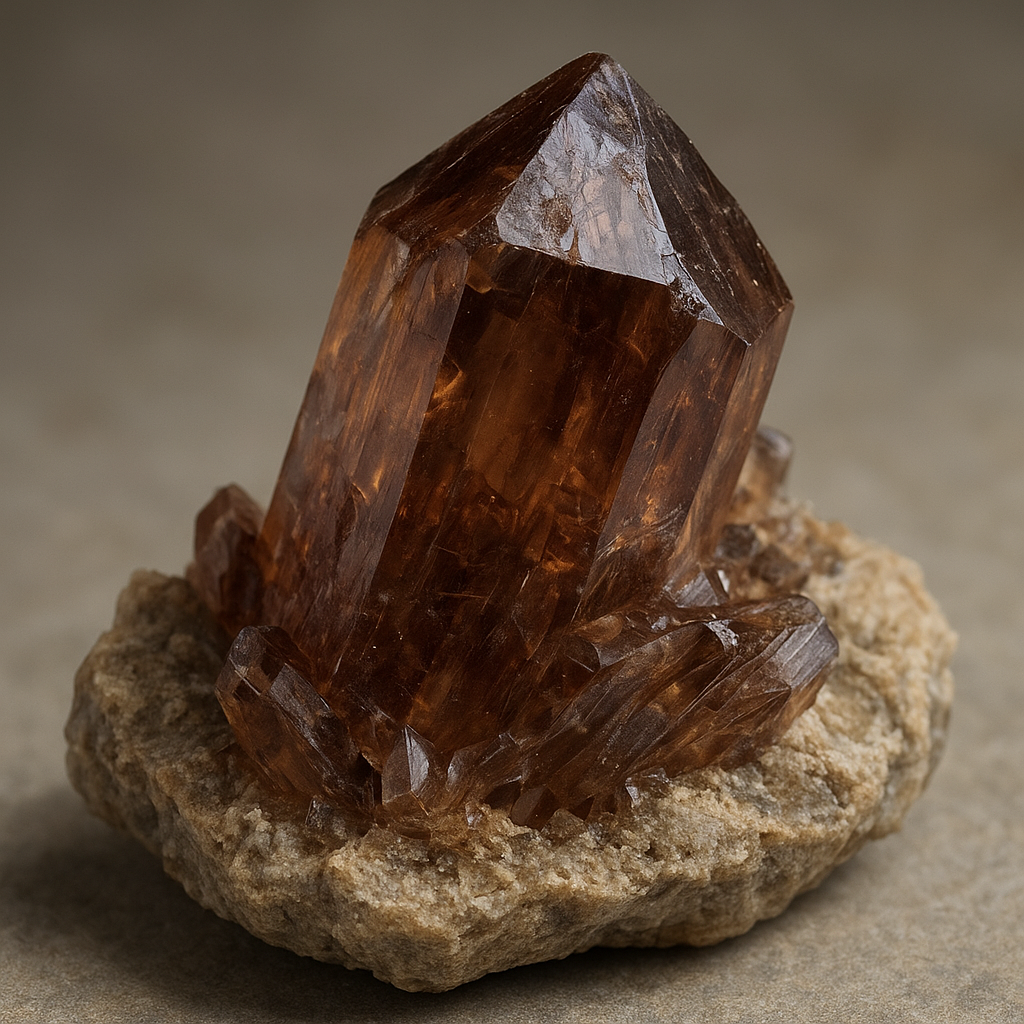
Axinite crystals are best known for their characteristic, sharp, wedge-shaped or bladed habit. They typically form elongate, flattened prisms with one dominant termination that gives them a triangular or wedge-like cross-section. They can range from translucent to transparent and exhibit a vitreous to slightly Adamantine luster when well-formed. Coloration spans from brown and reddish-brown through violet and blue to yellow and green, often controlled by the proportions of iron and manganese in the crystal lattice. A polished facet of high-quality material can be quite attractive as a lapidary gem.
Crystal system and internal structure
Axinite belongs to the triclinic crystal system. Structural complexity at the atomic level contributes to its distinctive external morphology and to several interesting physical properties. The internal arrangement of silicate tetrahedra, boron groups, and metallic cations produces anisotropies that influence cleavage, optical behavior, and electrical responses to heat and pressure.
Occurrence and geological settings
Axinite forms in environments that provide a combination of calcium, aluminum, silica, and boron, often with variable amounts of iron, manganese, or magnesium. It is commonly encountered in:
- Contact metamorphic zones, particularly where boron-bearing fluids interact with calcium-rich host rocks.
- Metasomatic skarns resulting from the ingress of silica- and boron-rich hydrothermal fluids into carbonate rocks.
- Hydrothermal veins and pockets within metamorphic terrains and in some igneous contexts.
Association with other minerals
Axinite is typically found alongside minerals that reflect similar formation conditions. Frequent associates include garnet, epidote, quartz, calcite, chlorite, prehnite, and various borates. In skarn deposits it is often intergrown with other calcium silicates and iron- or manganese-bearing minerals. These mineral associations make axinite valuable as a petrogenetic indicator: the presence of axinite suggests boron-rich fluids and specific ranges of temperature and pressure during formation.
Formation conditions
Although axinite can form across a range of temperatures and pressures, it commonly indicates low- to medium-grade metamorphic conditions or the thermal influence of nearby magmatic intrusions. The availability of boron is a key factor: boron is concentrated in some hydrothermal fluids derived from granitic or other evolved magmas, or released by metamorphic breakdown of boron-bearing minerals in the host rock. Where these fluids encounter calcium- and aluminum-bearing lithologies, axinite can precipitate as part of a suite of boron-rich minerals.
Physical and optical properties
Axinite’s combination of physical hardness, attractive colors, and unique crystal habits gives it both scientific interest and aesthetic value.
Hardness and durability
With a Mohs hardness generally in the range of 6.5 to 7, axinite is suitable for certain types of jewelry when cut and set carefully. However, its pronounced cleavage and sometimes brittle nature demand skillful lapidary work. Surfaces can be polished to a pleasant shine, revealing internal color zoning in some crystals.
Optical behavior and color causes
Color in axinite is mainly influenced by transition metal content: iron tends to produce browns and deep reddish-browns, while manganese can impart pink to violet tones. A few specimens display bluish or greenish hues. Optical properties such as birefringence and pleochroism are noticeable under polarized light and are used diagnostically when identifying specimens in thin section or with a polarizing microscope.
Electro-mechanical properties
Like several structurally anisotropic minerals, axinite can show measurable piezoelectric and pyroelectric responses. These phenomena occur because deformation or temperature change in the crystal lattice leads to the separation of charge. While axinite is not exploited commercially as an electrical material, these properties attract laboratory interest for fundamental studies of mineral physics and can be demonstrated in educational settings.
Uses and applications
Axinite’s uses are specialized and tend to fall into three broad categories: gemological, scientific, and educational/collecting.
Gemstone and lapidary uses
Transparent axinite crystals of good color and clarity are occasionally faceted as collector gemstones. Because of their relative rarity and tendency toward cleavage, axinite gems are uncommon and typically reserved for collectors rather than mainstream jewelry. When used, axinite is often cut into cabochons or faceted stones for pendants and display pieces rather than rings that face daily wear.
Scientific and research roles
In geology and mineralogy, axinite serves as a useful indicator mineral. Its presence is interpreted as evidence for boron-rich fluid activity and particular thermal histories in the host rock. Researchers use axinite to reconstruct aspects of fluid composition, temperature, and pressure during metasomatism and contact metamorphism. In solid-state physics and crystallography, axinite’s electro-mechanical behaviors provide a platform for studying pyroelectric and piezoelectric phenomena within complex silicates.
Educational and collector value
Well-formed axinite crystals are prized by mineral collectors because of their distinctive shape and relatively uncommon occurrence. Museum specimens from classic localities can be both scientifically informative and visually dramatic. For educational demonstrations, axinite’s piezoelectric and pyroelectric responses can be used to illustrate principles of crystal symmetry and electric polarization.
Notable localities and famous specimens
Axinite has been discovered in many regions worldwide, and certain localities are particularly well known for producing attractive or large crystals. Typical types of localities include contact-metamorphic skarns, hydrothermal veins, and altered volcanic rocks. Representative global occurrences include mines and exposures in Europe, Asia, and North America.
- European deposits produce many fine specimens and contributed historically to early mineralogical descriptions.
- Several locations in Asia yield colorful axinite crystals often associated with complex metamorphic terranes.
- In North America, pockets of axinite occur in regions of past igneous activity where boron-bearing fluids interacted with carbonate rocks.
Collecting tips and identification
For collectors and field geologists, a few practical points help in identifying axinite in hand specimens:
- Look for the characteristic wedge-shaped or bladed crystals that are often flattened and tapered.
- Note color variations and vitreous luster; when transparent, internal color zoning can be revealing.
- Observe associations with garnet, epidote, calcite, and quartz—common partners in skarns and contact zones.
- Test hardness (carefully) and check for cleavage; axinite can be brittle and may cleave along characteristic directions.
Interesting scientific and cultural notes
Certain aspects of axinite make it interesting beyond straightforward mineral identification. Its association with boron-rich fluids ties it to processes that concentrate unusual elements, and these processes can affect ore formation as well as the local geochemistry of a metamorphic contact or skarn. Axinite’s piezoelectric and pyroelectric behavior allows it to serve as an instructive example in courses on mineral physics, and finely crystallized specimens are used to illustrate the relationship between structure and physical properties.
Axinite in the context of mineral groups
Axinite belongs to a broader group of borosilicates that share common structural motifs and chemical themes. Comparison with related minerals helps place axinite within the palette of boron-bearing phases and highlights how small chemical substitutions (e.g., Fe versus Mn versus Mg) lead to distinct named species. Mineralogists classify axinite-group members by the dominant cation occupying particular lattice sites, which is why specimen labels will often include a suffix such as -(Fe) or -(Mn).
Practical advice for collectors and gem-cutters
If you are considering axinite for a collection or as a gem, a few practical considerations will help you appreciate and preserve your material:
- Handle crystals carefully: cleavage and brittleness make them vulnerable to chipping.
- Avoid harsh chemical cleaners; mild soap and water are usually sufficient for surface cleaning.
- When commissioning a cut, work with a lapidary experienced with brittle and cleavage-prone materials.
- Label specimens with locality and associated minerals; this information enhances both scientific and market value.
Axinite sits at an interesting intersection of beauty and science. It offers visually attractive specimens for collectors and gem lovers, while its chemistry and formation conditions provide geologists with clues about past fluid activity and metamorphic environments. Whether studied under a microscope, admired as a collector gem, or researched for its electro-mechanical properties, axinite remains a compelling subject in mineralogical studies.