Astrophyllite is a striking and enigmatic mineral that captures attention with its metallic sheen and fanlike, often star-shaped crystal aggregates. Found in unusual, silica-poor igneous environments, it is prized by mineral collectors and admired by lapidaries despite its relative softness and fragility. In this article we explore its origin, properties, global occurrences, applications, and the scientific and cultural contexts that make astrophyllite so compelling.
Appearance, name and basic characteristics
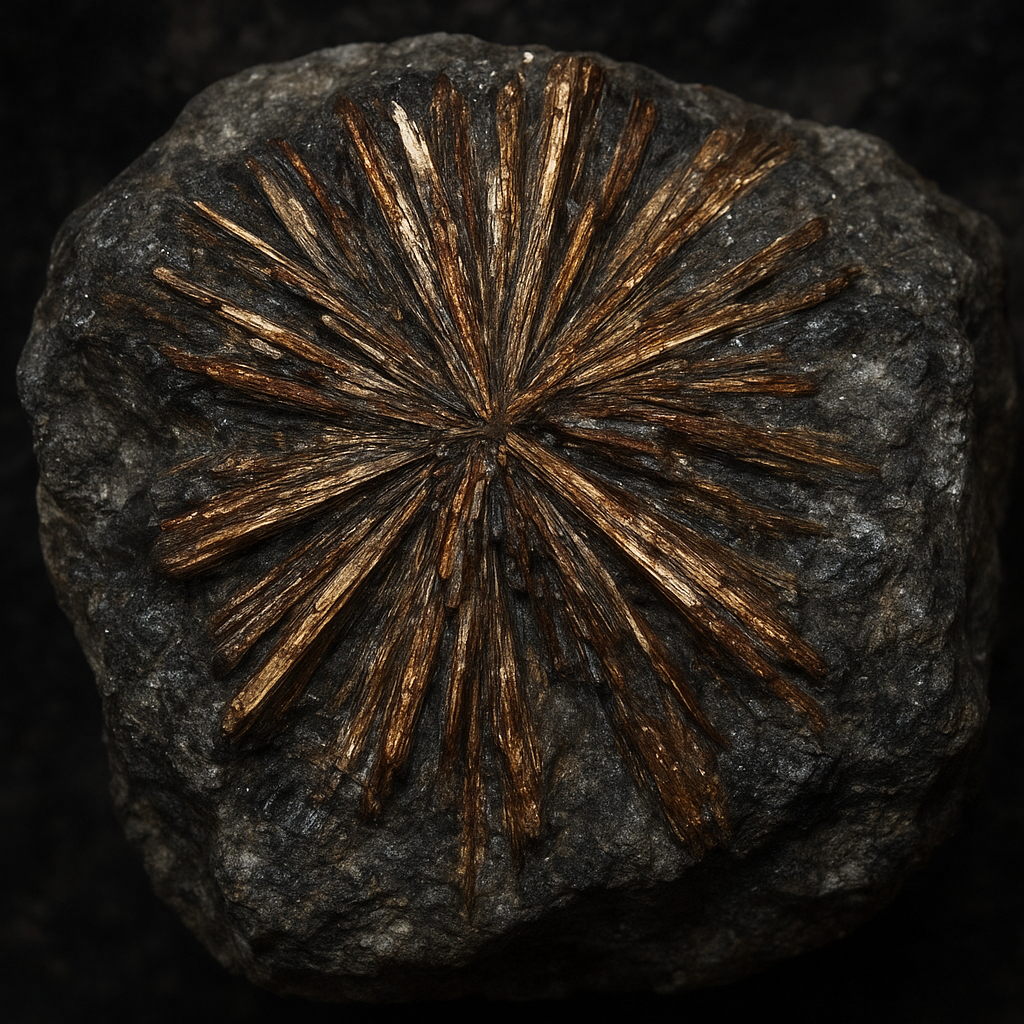
The name astrophyllite derives from the Greek words meaning “star” and “leaf,” a nod to the mineral’s typical radiating, leaf-like crystals that sometimes resemble tiny, golden stars. Specimens range in color from deep brown and bronze to golden yellow, with a metallic to submetallic luster that makes the mineral appear to glow when light hits the cleavage surfaces. Crystals are generally bladed or fibrous and often occur in radial or fan-shaped aggregates that are aesthetically pleasing and diagnostically useful.
Astrophyllite is a complex, hydrous potassium–sodium–iron–titanium silicate whose composition varies from locality to locality, reflecting the geochemical idiosyncrasies of the host rocks. The mineral is brittle, with a relatively low hardness (roughly around 3.5–4 on the Mohs scale), and it exhibits perfect to good cleavage on one or more planes, which is why its delicate plates can flake apart easily. Its layered habit often leads to descriptions such as mica-like, though astrophyllite belongs to a distinct structural family.
Geological setting and where it occurs
Astrophyllite is not a common mineral; it forms in geochemical environments that are themselves unusual. It is typically associated with highly alkaline igneous rocks such as nepheline syenites, peralkaline granites, and evolved pegmatites. These rocks are rich in alkalis (sodium and potassium) and often enriched in titanium, iron, and other large-ion lithophile elements. Astrophyllite commonly appears during the late, low-temperature stages of crystallization, when incompatible elements become concentrated in the residual melt.
Typical host rocks and formation conditions
- Peralkaline igneous complexes (e.g., nepheline syenites and related pegmatites) where silica activity is low and alkalis are abundant.
- Late-stage pegmatitic veins and cavities that concentrate titanium, iron and alkali elements.
- Hydrothermal alteration zones associated with alkaline intrusions where fluid chemistry favors the growth of hydrous silicates.
Because these geological conditions are uncommon, astrophyllite is frequently a mineral of very restricted distribution and limited volume at any single locality.
Notable localities
While astrophyllite occurs in several countries, a handful of localities are particularly famous among collectors and mineralogists. These sites have produced well-formed or aesthetically significant specimens and continue to be cited in the literature.
- Kola Peninsula, Russia — The alkaline complexes in the Kola Peninsula, especially the Khibiny and Lovozero massifs, are classic sources of astrophyllite and many other rare minerals. Specimens from this region often show rich, metallic luster and complex associations with other peralkaline minerals.
- Ilímaussaq complex, South Greenland — Known for its unique suite of uncommon minerals, Ilímaussaq yields astrophyllite in attractive, well-crystallized forms, often associated with minerals like eudialyte and naujakasite.
- Mont Saint-Hilaire, Quebec, Canada — This alkaline intrusive complex has produced fine display specimens prized by museums and private collectors.
- Pikes Peak region, Colorado, USA — Several historic occurrences of astrophyllite are reported from alkaline pegmatites and associated dikes in this district.
- Skarns and alkaline complexes in Norway, as well as sporadic finds in other countries with peralkaline magmatism, complete the picture of a mineral with a globally scattered but geologically coherent distribution.
Chemistry, crystallography and physical properties
Astrophyllite’s chemistry is variable, which is part of what makes it scientifically interesting. The mineral contains significant amounts of iron and titanium, combined with silica, alkalis, and water in its structure. This compositional flexibility means that minor elements such as manganese, niobium, or rare-earth elements may be present in trace amounts depending on the source. The crystal system of astrophyllite is triclinic, and the mineral commonly forms bladed or flattened crystals that produce the characteristic radiating sprays.
Key physical traits include a distinctive metallic or submetallic bronze to brown color, comparatively high density (reflecting its iron and titanium content), and perfect cleavage that yields thin reflective plates. These plates catch the light and give specimens an almost starry appearance. Optical properties under the microscope reveal complex behavior, but for field identification collectors often rely on appearance, luster, and the typical mineral associations.
Why composition matters
The presence of elements such as titanium and potassium is not incidental: they control the stability field of astrophyllite and distinguish it from morphologically similar minerals. Small changes in composition can result in different crystal habits or the formation of closely related phases. For mineralogists, analyzing astrophyllite helps reconstruct the chemistry of the late-stage magmatic fluids and offers clues about the crystallization history of exotic igneous bodies.
Associated minerals and paragenesis
Astrophyllite rarely occurs alone. It is commonly associated with a suite of other alkaline and rare-element minerals that together characterize highly evolved igneous systems. Typical associates include:
- aegirine and other pyroxenes
- arfvedsonite and other amphiboles
- eudialyte and other zirconium-rich silicates
- nepheline, sodalite and feldspathoids
- titanite (sphene), zircon and other accessory phases
These mineral assemblages are consistent with formation in low-silica, alkaline melts where calcium is relatively scarce but large alkali and high-field-strength elements are available. The presence of astrophyllite among these minerals helps to pinpoint the conditions under which the host rock evolved.
Uses, value and lapidary work
Astrophyllite does not have widespread industrial uses due to its rarity, variable composition and physical fragility. Its principal value lies in three areas: scientific study, mineral collecting, and lapidary and ornamental applications.
Collector and museum value
Fine, well-crystallized specimens of astrophyllite are sought after by collectors and museums. Unique radial sprays with a metallic sheen or specimens that exhibit an attractive contrast with matrix minerals can command high prices. The demand is driven by the aesthetic appeal—those small, shimmering fans are visually striking—and the mineral’s relative rarity from quality localities.
Lapidary uses and jewelry
Occasionally astrophyllite is used as a gemstone or in cabochons when pieces are large and coherent enough to cut. Because of its low hardness and perfect cleavage, cutting astrophyllite requires skill and restraint: thin sections can flake or crumble, and the resulting pieces are best set in protective jewelry rather than exposed rings. Lapidarists prize polished pieces for their metallic, reflective banding and the intriguing appearance of the crystal plates beneath a domed surface.
An example of typical lapidary practice might involve backing a thin slice with a sturdy matrix or composite backing to provide support, then shaping and polishing the dome to reveal the internal radiating patterns. Jewelry made from astrophyllite is niche and often sold as a specialty item to collectors of unusual gems.
Care, conservation and display
Because astrophyllite is brittle and chemically complex, specimens and gemstone pieces require careful handling and conservation.
- Keep specimens dry and avoid prolonged exposure to humidity and weathering, which can alter the surface sheen and promote breakdown of delicate plates.
- Handle minimalistically: repeated touching or scratching can dislodge thin blades.
- Store specimens cushioned and separate from harder minerals that could scratch them.
- When used in jewelry, designs that protect the stone—bezel settings, protective framing, or use as pendants rather than exposed rings—prolong the life of the piece.
Museums often mount astrophyllite samples on supportive bases to display the radiating habit while preventing pressure on fragile crystals.
Scientific interest and research directions
Astrophyllite attracts scientific attention for several reasons. First, its chemistry and crystal structure are complex, and variations hold clues to magmatic differentiation processes in peralkaline systems. Second, astrophyllite is part of a broader assemblage of rare minerals that collectively map out the late-stage geochemical evolution of certain igneous complexes. Analyzing astrophyllite’s elemental substitutions, trace-element inventory, and textural relations gives researchers insights into how titanium and iron behaved during the ultimate crystallization phases of these exotic magmas.
Modern techniques—electron microprobe analysis, X-ray diffraction, and transmission electron microscopy—allow scientists to probe subtle structural features and compositional zoning. This work refines our understanding of mineral paragenesis and the physicochemical parameters (temperature, pressure, fugacity of oxygen) that govern the stability of astrophyllite relative to other phases.
Wider implications
Although astrophyllite itself is unlikely to become an industrial material, studying its formation helps geoscientists model the behavior of incompatible elements, the evolution of granitic and syenitic melts, and the conditions that generate economically important rare-element deposits. In that sense, astrophyllite is a small but informative piece in the larger puzzle of crustal differentiation and mineral deposit genesis.
Cultural and metaphysical associations
Like many visually striking minerals, astrophyllite has inspired metaphysical interest. Within these communities it is often attributed properties related to grounding, energy alignment, and emotional healing. Collectors who value minerals for symbolic reasons prize astrophyllite for its starry appearance—evocative of inner illumination or transformational change. While these claims are cultural rather than scientific, they reflect the human tendency to find meaning in natural beauty and contribute to the mineral’s niche market appeal.
In museums and private collections, astrophyllite serves a dual role: a specimen of geological significance and an object of aesthetic and sometimes spiritual appreciation.
Interesting facts and remarkable specimens
Several aspects of astrophyllite make it particularly memorable:
- Its common habit—radiating plates—gives it a natural ornamentation that resembles rays or leaves; the name itself celebrates this morphology, often underlined as star-leaf imagery in collector catalogs.
- Even though it is visually metallic and sometimes golden, astrophyllite is not a metal-bearing ore in any practical sense. Its preciousness is aesthetic and scientific rather than economic.
- Specimens that display well-formed fans embedded in contrasting matrix rock are among the most desirable for display because they highlight both form and context: the aesthetic radiating fans and the geological story told by the surrounding minerals.
Collectors and museums occasionally trade stories about single, iconic pieces that have become reference specimens in teaching collections. These specimens are used to demonstrate late-stage pegmatitic mineralization, peralkaline petrogenesis, and the visual interplay of metallic sheen within otherwise dull host rock.
How to recognize astrophyllite in the field
For hobbyist collectors and geology enthusiasts, several field observations can suggest the presence of astrophyllite:
- Look for metallic or bronze-colored radial sprays or fanlike aggregates in silica-poor alkaline rocks.
- Note the mineral associations—if nepheline, aegirine, eudialyte, or other rare alkaline minerals are present, astrophyllite is more plausible.
- Beware that its softness and cleavage make it easy to misidentify from small fragments; a proper identification often requires microscopy or chemical analysis.
When in doubt, photograph in situ, document the host rock and nearby mineralogy, and, if collection is permitted, obtain a specimen for later lab identification. Responsible collecting etiquette and local regulations should always be followed.
Conclusion
Astrophyllite occupies a niche where aesthetics, rarity, and scientific curiosity meet. Its starry, golden fans are not only visually captivating but also testify to the extraordinary chemistry of the igneous environments that produce them. Though not an ore of broad industrial importance, astrophyllite is rich in informational and aesthetic value: collectors prize its appearance, lapidarists enjoy the challenge of bringing out its inner radiance in cabochons, and scientists study it to learn how unusual magmas evolve. The interplay of chemical complexity, delicate physical habit, and restricted occurrence ensures that astrophyllite will remain a mineralogical gem—both figuratively and literally—for enthusiasts and researchers alike.