
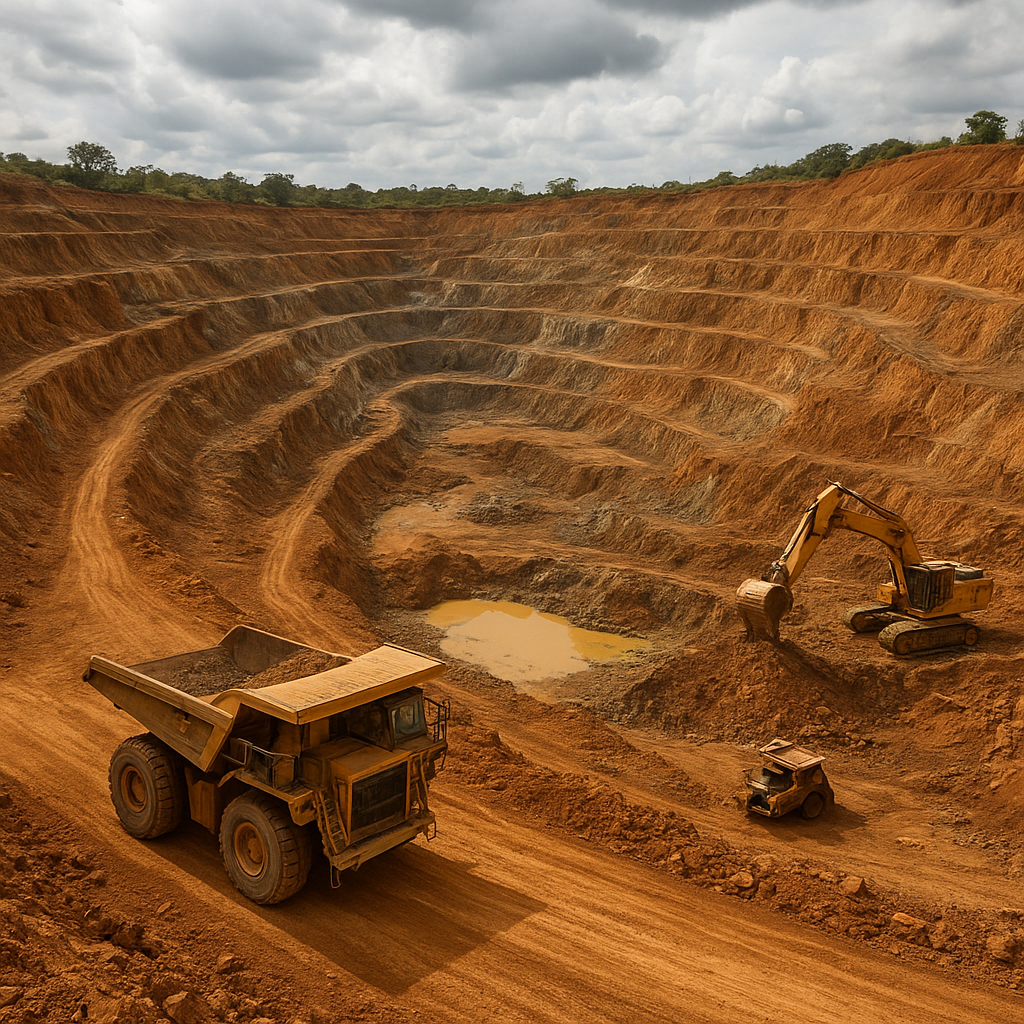
The Ashanti gold mining area in central Ghana is one of West Africa’s most historically and economically important mineral provinces. Stretching across a landscape of gently rolling hills, tropical forest patches and rural settlements, this district has shaped local communities, national policy and international mining investment for well over a century. The following article explores where the mine is located, what is extracted there, its broader economic role, and several compelling aspects that make the Ashanti gold story unique.
Location and geological setting
The Ashanti mining district sits within the Ashanti region of Ghana, roughly centered around the city of Kumasi and extending southward toward the coastal belt. The most famous operation in the area is the Obuasi mine, located about 60–80 kilometres south of Kumasi depending on the route. The district lies within the Birimian greenstone belt, a geological terrane that hosts some of West Africa’s richest gold deposits.
Geologically, the mineralization in the Ashanti belt is associated with metamorphosed volcanic and sedimentary rocks, with gold commonly occurring in quartz veins and sulfide-rich hydrothermal systems. Over geological timescales, tectonic forces and fluid flow created concentrated zones of mineralization that modern mining targets. The deposits are typically amenable to both open-pit and underground extraction, although many of the richer zones require underground methods due to depth and orebody geometry.
What is extracted: commodities and by-products
The principal commodity extracted from the Ashanti mine area is, unsurprisingly, gold. Production ranges from high-grade vein-hosted gold to more disseminated mineralization requiring bulk mining techniques. Besides native gold and electrum, the ore often contains sulfide minerals such as pyrite and arsenopyrite, which can carry gold at microscopic scales. These host minerals mean that some processing must include flotation or other concentration steps to recover the gold effectively.
While gold is dominant, mining and processing activities can yield small quantities of by-products or associated metals depending on the specific ore. These can include
- Silver: occasionally present with gold as an associated precious metal.
- Iron-bearing sulfides: common in ore, relevant for tailings management and processing.
- Trace elements: including arsenic, which requires careful environmental controls.
Because of the mineralogy, modern operations emphasize accurate ore-grade control and metallurgical testing to maximize recovery while minimizing environmental risks.
History and development of mining in Ashanti
The area’s gold history predates colonial times: the Ashanti Kingdom flourished in part because of the region’s abundant gold, which played a central role in trade, politics and cultural identity. With European contact and eventual colonial rule, the region became known internationally as the “Gold Coast.” Industrial-scale mining began in the late 19th and early 20th centuries, accelerating as modern exploration and mechanized methods arrived.
Throughout the 20th century, a succession of operators developed large mines, among them the operation at Obuasi. Over time, companies invested in deeper underground development to follow high-grade shoots, while earlier open pits were exhausted. The 21st century has seen cycles of investment, closure and redevelopment driven by gold price movements, technical challenges and evolving regulatory frameworks. International mining companies, often in partnership with the Ghanaian state, have played prominent roles in shaping the modern industry.
Key milestones
- Traditional Ashanti control of gold resources before colonization.
- Colonial-era commercialization and expansion of mining activities.
- Modern industrialization and underground mining development in the 20th century.
- Corporate mergers and international investment shaping the contemporary ownership landscape.
Mining and processing operations: methods and technology
In the Ashanti district, mining methods reflect the geological setting and the depth of the ore bodies. Early surface mining gave way to a focus on underground extraction as the most economical way to access higher-grade lodes at depth. Modern operations use a combination of mechanized drilling, blasting, and mucking, followed by haulage via decline ramps and shaft systems.
Processing typically combines crushing, milling and gravity concentration with more advanced metallurgical circuits such as carbon-in-pulp (CIP), carbon-in-leach (CIL), or flotation followed by leaching. The objective is to maximize gold recovery while limiting the environmental footprint through efficient reagent use and tailings management. Innovations in mineral processing and geometallurgy have improved recoveries from complex ores and enabled the exploitation of previously marginal mineralization.
Workforce, safety and automation
Employment in the mine ranges from underground miners and metallurgists to engineers, geologists and support staff. Modern underground operations emphasize safety systems, ventilation, ground support and real-time monitoring to manage geotechnical risks. Increasingly, automation and remote monitoring technologies are being introduced for tasks such as drilling and material handling, which can enhance productivity and safety but also change the composition of the local workforce.
Economic significance: national and local impacts
The Ashanti mining district has long been a cornerstone of Ghana’s mineral economy. Gold from the region contributes substantially to the country’s export earnings and foreign exchange reserves. At the national level, the industry provides government revenue through royalties, corporate income taxes, and other fiscal instruments. Revenue supports public services, infrastructure development and economic diversification efforts.
Locally, the mine is a major employer and source of indirect economic activity. Contracting opportunities for local businesses—transport, catering, security, and small-scale suppliers—create a layered economic ecosystem. The presence of mining operations often stimulates improvements in regional infrastructure such as roads, power supply and communications, with benefits that extend beyond mining itself.
- Direct employment: miners, engineers, geoscientists and administrative staff.
- Indirect employment: suppliers, contractors and service providers.
- Government revenue: taxes, royalties and export proceeds.
- Local investment: community programs, infrastructure and education initiatives.
However, the economic benefits are balanced against challenges such as fluctuating global gold prices, the need for continuous capital investment to access deeper orebodies, and the social costs associated with displacement or environmental impacts. Effective governance and transparent revenue management are critical to ensuring that mineral wealth translates into sustainable development.
Social and environmental considerations
Mining activity inevitably interacts with social and environmental systems. In the Ashanti area these interactions are complex, involving traditional land rights, artisanal miners, local communities and corporate operators. One persistent challenge is the coexistence of large-scale formal mining and informal artisanal and small-scale mining (locally known as galamsey). Artisanal miners often work close to formal concessions, creating tensions over land use, safety and environmental degradation.
Key environmental issues include:
- Water quality: runoff and tailings can affect rivers and groundwater if not properly managed.
- Land disturbance: deforestation and soil erosion from both formal and informal mining.
- Tailings management: the need for secure, engineered facilities to store processing residues.
- Air quality and dust: blasting and ore handling can elevate particulate levels.
To address these risks, modern operators implement environmental management plans, water treatment facilities, progressive rehabilitation of disturbed land and community engagement programs. Corporate social responsibility (CSR) initiatives often focus on health, education, skills training and local infrastructure to offset some social costs and to build long-term relationships with host communities.
Health and safety
Health and safety remain top priorities, both underground and at processing plants. Issues such as occupational exposures, underground ground falls and the safe handling of chemicals require ongoing investment in training, equipment and monitoring. Public health can also be affected by informal mining activities and pollution, making multi-stakeholder approaches necessary to protect vulnerable communities.
Interesting aspects and cultural connections
The Ashanti gold story is not just about geology and production; it’s deeply interwoven with culture, history and identity. The region’s ancient reputation as a center of gold craftsmanship and trade helped shape the political power of pre-colonial states. Even today, gold retains symbolic value in local ceremonies, art and social practices.
- Heritage and craft: Traditional goldsmithing and artisanal techniques remain part of the cultural fabric, producing jewelry and ceremonial items that reflect centuries-old motifs.
- Colonial legacy: The term “Gold Coast” memorializes the region’s role in global gold trade during the colonial period.
- Technological evolution: The transition from hand-dug pits to mechanized underground operations illustrates the dramatic technological journey of mining in the area.
- Community resilience: Many towns and villages have adapted economically and culturally around the rhythms of mining activity.
Another interesting dimension is the interplay between modern environmental science and traditional land stewardship. Local knowledge about water sources, vegetation and land use complements technical assessments conducted by mining companies and regulators. When integrated respectfully, these perspectives can improve environmental outcomes and community trust.
Future prospects and challenges
Looking ahead, the long-term outlook for gold mining in the Ashanti district depends on several interlinked factors. These include the discovery of new orebodies, the economics driven by global gold prices, advances in mining and processing technology, and the regulatory framework governing mineral rights and environmental protection. As easily accessible ore is depleted, operators must invest in deeper underground development, more sophisticated metallurgical circuits, and innovative rehabilitation techniques.
Key challenges that will shape future development include:
- Balancing the needs of formal mining companies and artisanal miners to reduce illegal activity and environmental harm.
- Ensuring that royalties and taxes are managed transparently to deliver tangible development benefits.
- Investing in sustainable practices to reduce water use, energy consumption and tailings risks.
- Adapting to social expectations for corporate responsibility and equitable community partnerships.
At the same time, there are opportunities for diversification: leveraging mining revenues to support local industry, improving education and training to create skilled workforces, and deploying renewable energy solutions to reduce the carbon footprint of operations. The combination of rich mineral endowment, historical depth and human capital gives the Ashanti district enduring relevance in Ghana’s development narrative.
Concluding observations
The Ashanti mining area remains a focal point of Ghana’s mineral economy, combining deep historical roots with modern industrial practice. Its gold resources continue to attract investment and attention because of their quality, accessibility and the region’s established mining infrastructure. While the benefits—employment, revenue and development—are significant, realizing them sustainably requires careful stewardship of environmental resources, inclusive policies for local communities and transparent management of mineral wealth.

