Annabergite occupies a small but fascinating corner of mineralogy: a striking, often vivid green secondary arsenate that serves both as a visual emblem of weathered nickel deposits and as a reminder of the complex interplay between geology, chemistry and human industry. This article explores where annabergite is found, how it forms, what uses and implications it has, and several interesting scientific and historical facets connected with this delicate hydrated mineral.
Occurrence and geological setting
Annabergite is typically a product of the oxidation zones of nickel-bearing ore bodies where primary nickel-arsenic phases break down in the presence of oxygenated groundwater. It seldom forms large, gemmy crystals; instead it appears as thin crusts, botryoidal or powdery coatings and rare acicular aggregates on vein walls or in vugs. Because it is a secondary mineral, its presence signals an active weathering environment and the mobility of certain elements, notably nickel and arsenic.
Formation processes
- Primary nickel arsenides, such as niccolite or various nickel sulfides and arsenides, react with oxygenated, often slightly acidic groundwater to free nickel and arsenate ions.
- Under the right pH and redox conditions, nickel ions combine with arsenate and water to precipitate as the hydrated nickel arsenate known as annabergite (chemical formula commonly written as Ni3(AsO4)2·8H2O).
- Evaporation, seasonal fluctuations in groundwater chemistry, and micro-environment differences (micro-pH, presence of carbonate or sulfate) influence whether the precipitate forms fine crystalline coatings or a powdery mass.
Typical and notable localities
The mineral was first identified at a classic type locality that gives it its name, but it appears in many nickel-rich mining districts worldwide. Notable occurrences include old mining areas in central Europe and other continents with nickel-arsenide mineralization.
- Annaberg-Buchholz, Saxony (Germany) — the type locality and historical source of the mineral’s name. Here, small, bright green crusts were observed on altered nickel ores.
- Freiberg region (Germany) — another historic mining district where arsenate secondary minerals are abundant.
- Cornwall (United Kingdom) — in some copper-nickel bearing veins and gossans.
- Australia (various nickel fields) — where oxidation of nickel sulfides in arid climates has produced secondary arsenates.
- North America (for example parts of Nevada and British Columbia) — in oxidized zones of nickel and arsenic-bearing deposits.
- Chile and Mexico — in certain polymetallic veins and weathering profiles.
Because the mineral often forms thin, delicate surface coatings, it can easily be overlooked in field work unless one is specifically searching for the characteristic green incrustations that contrast with duller host rocks.
Physical and chemical properties
Annabergite’s identity is largely defined by a combination of its characteristic color and its chemistry. Its formula, representing the nickel analogue of the cobalt mineral erythrite, demonstrates the close relationship between chemical substitution and mineral appearance.
- Chemical formula: Ni3(AsO4)2·8H2O (nickel arsenate octahydrate)
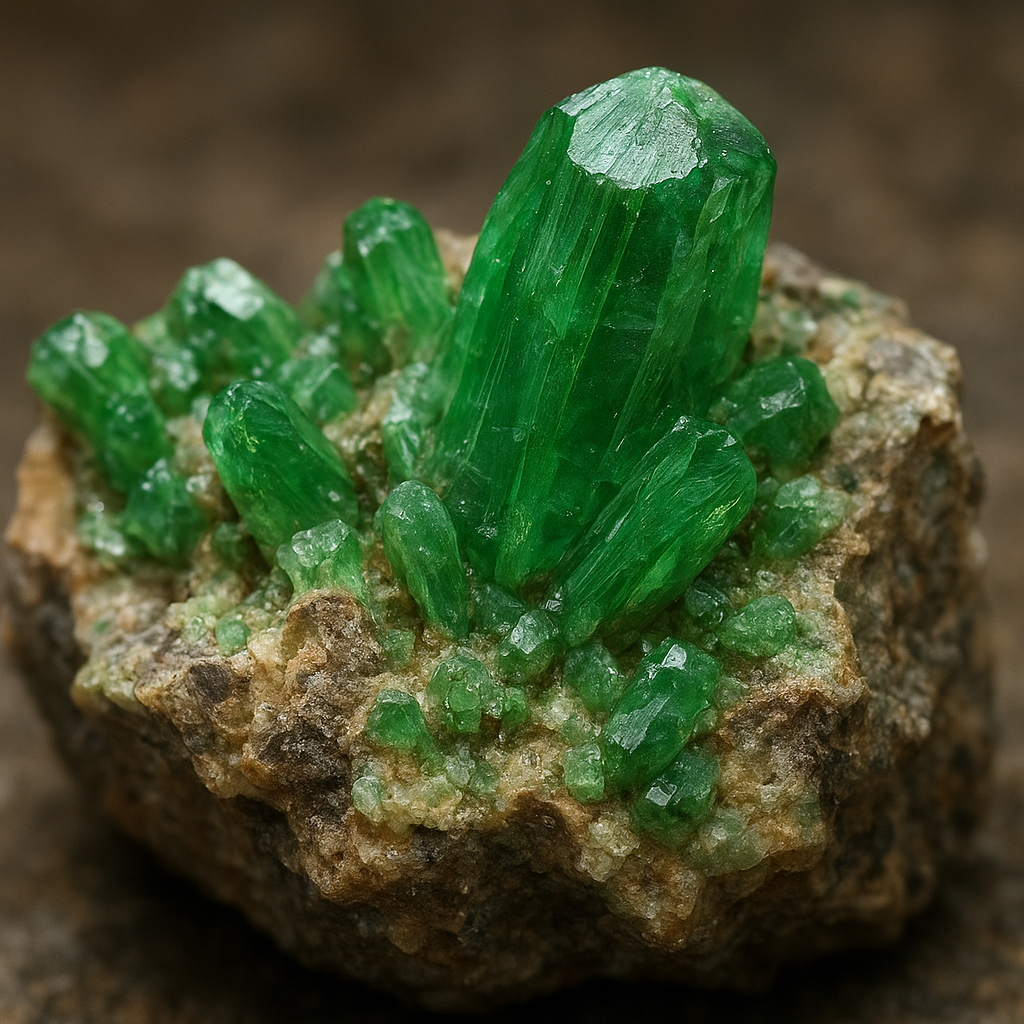
- Color: typically vivid apple-green to emerald-green; paler shades can occur depending on impurities and hydration state. The distinctive green hue is a diagnostic clue in the field.
- Crystal system: generally monoclinic, though well-formed macroscopic crystals are rare. Most specimens are acicular to fibrous or form fine crystalline crusts.
- Hardness and tenacity: very soft and easily powderable; on the Mohs scale it is often in the low range (~1.5–2.5). This low hardness makes it fragile and unsuitable for wear.
- Specific gravity: relatively low to moderate for an arsenate mineral (around ~3.0 g/cm³, but this can vary slightly with hydration).
- Streak: typically pale green; the streak test can be useful when samples are robust enough to perform it.
- Solubility and stability: because it is a hydrated arsenate, loss of water (dehydration) or exposure to changing pH can alter appearance, sometimes causing fading or disintegration.
The bright green color often leads to confusion with other green secondary minerals. Precise identification benefits from analytical techniques such as X-ray diffraction (XRD), scanning electron microscopy with energy-dispersive spectroscopy (SEM-EDS), or simple spot tests for nickel and arsenic where appropriate and safe.
Uses and practical significance
Annabergite does not have significant industrial applications due to its rarity, low abundance and the presence of arsenic in its structure. Nevertheless, it is valuable in several practical and scientific contexts.
Indicator mineral for exploration
One of the most important applied roles of annabergite is as an indicator or pathfinder mineral in mineral exploration. Its bright color and specific association with nickel-arsenic mineralization make it a useful, visible sign that nickel-bearing ores have undergone oxidation in a particular area.
- Exploration geologists may use the occurrence of annabergite crusts as a clue to pursue sampling and more detailed geochemical surveys nearby.
- Because it forms in the oxidation roof of sulfide deposits, its presence can mark the vertical extent of weathering and suggest the existence of underlying primary nickel ores.
Collector and educational value
Specimens of high aesthetic quality—thin botryoidal crusts or small groups of acicular crystals with vivid green color—are sought by mineral collectors. Museums and educational collections often display annabergite to illustrate secondary mineralization processes and to contrast it with cobalt-bearing analogues like erythrite.
Scientific and geochemical importance
From a scientific standpoint, annabergite is an instructive mineral for studying element mobility in the near-surface environment. The mineral highlights how arsenic and nickel can be mobilized, precipitated and sequestered during weathering. Studies of such secondary minerals contribute to our understanding of contamination pathways and natural attenuation processes in mining districts.
Associated minerals and environmental aspects
Annabergite is seldom encountered alone. Its occurrence typically accompanies a suite of other oxidation products and secondary arsenates, reflecting the breakdown of a more complex primary assemblage.
- Common associates: erythrite (Co3(AsO4)2·8H2O), pharmacosiderite, scorodite, and other arsenates or oxides of iron, cobalt and nickel.
- Primary hosts: nickeline, niccolite, skutterudite, gersdorffite and various nickel sulfides and arsenides.
Environmentally, the relationship with arsenic raises points of concern. When primary arsenide minerals oxidize, arsenic can be released to solution and mobilized in groundwater. The precipitation of minerals like annabergite can sequester some of that arsenic locally, but changing chemical conditions (e.g., pH shifts, reductive dissolution during remediation activities) can remobilize arsenic, posing contamination risks.
Arsenic mobility and remediation considerations
Understanding the stability of annabergite under varying environmental conditions helps in designing remediation strategies for arsenic-contaminated mine sites. For example:
- In acid mine drainage scenarios, arsenic can remain mobile and move away from the source unless it is captured by secondary mineral phases.
- Engineered or natural attenuation that favors the precipitation of insoluble arsenates can immobilize arsenic temporarily; however, long-term stability requires monitoring because reductive conditions can dissolve these phases.
Thus, although annabergite itself is not a remediation tool, its presence (or absence) provides clues to past and present element fluxes in mine-impacted environments.
Collecting, identification and care
Because of its delicate habit, collectors must exercise caution. Proper handling and conservation techniques help preserve the subtle beauty of annabergite specimens.
- Handling: specimens should be handled minimally and supported from beneath with foam or padded trays to avoid abrasion.
- Cleaning: avoid rinsing with water or using ultrasonic cleaners; many annabergite coatings are water-soluble or will slough off when wetted. Dry brushing with a soft brush under a stereo microscope is preferred.
- Storage: maintain a stable humidity; desiccation can cause dehydration and alteration, while extreme humidity may encourage recrystallization or mold growth on matrix materials.
- Display: museum curators often mount delicate specimens in sealed cases with inert supports and low-light conditions to minimize photochemical changes.
- Safety: because the mineral contains arsenic, avoid inhaling dust or ingesting particles. Use gloves when handling powdery samples and wash hands afterwards.
Identification tips
- Visual: a bright apple- to emerald-green coating on nickel-bearing host rock is a strong initial indicator.
- Association: if found with known nickel minerals, consider annabergite as a candidate.
- Tests and instruments: if available, SEM-EDS will quickly confirm nickel and arsenic ratios; XRD can confirm crystallography; spot tests for nickel (after safe, controlled methods) can supplement field ID.
Historical notes and scientific interest
The history of annabergite intersects with the growth of descriptive mineralogy in 19th-century Europe. Named after a locality in the Saxon Ore Mountains, the mineral drew attention because its vivid color provided a clear visual signature of nickel oxidation and because it highlighted the close mineralogical relationships between cobalt and nickel arsenates.
- Name and discovery: the name recalls Annaberg, where chrysoprase-green crusts on nickel ores were first studied and described in the 1800s.
- Chemical analogues: its cobalt analogue, erythrite, is often pink to crimson; comparing annabergite and erythrite gave early mineralogists insight into element substitution and color mechanisms in arsenates.
- Modern analyses: recent work uses microscopic and spectroscopic methods to study micro-textures, hydration behavior and trace element substitutions (for example partial replacement of nickel by cobalt or magnesium), which can record subtle aspects of weathering histories.
Clues to past mining activity
In old, reclaimed mining districts, patches of green annabergite may be the only visible traces of erstwhile nickel-arsenide mineralization. Archaeologists and industrial historians sometimes use such mineralogical evidence to reconstruct the extent and character of historical mining operations.
Educational role
Annabergite is a useful teaching mineral. Its formation demonstrates:
- how primary sulfides and arsenides weather into secondary minerals,
- how fluid-rock interaction and local geochemistry control mineral precipitation, and
- how color and crystal habit relate to chemistry and structure.
For students learning about geochemistry and mineral paragenesis, a small specimen of annabergite offers a tactile and visual supplement to textbook descriptions of oxidation zones and element cycling.
Closing observations
Although annabergite will never be a commodity mineral, its scientific, educational and exploratory utility makes it noteworthy. The bright green of thin crusts implanted on weathered nickel ores highlights the interplay of nickel and arsenic under near-surface conditions, while its delicate, fragile habit cautions collectors and conservators to treat specimens with care. As analytical techniques continue to refine our understanding of secondary mineral formation, annabergite remains a modest but informative witness to the dynamic processes that continue to shape ore deposits long after active mining has ceased.