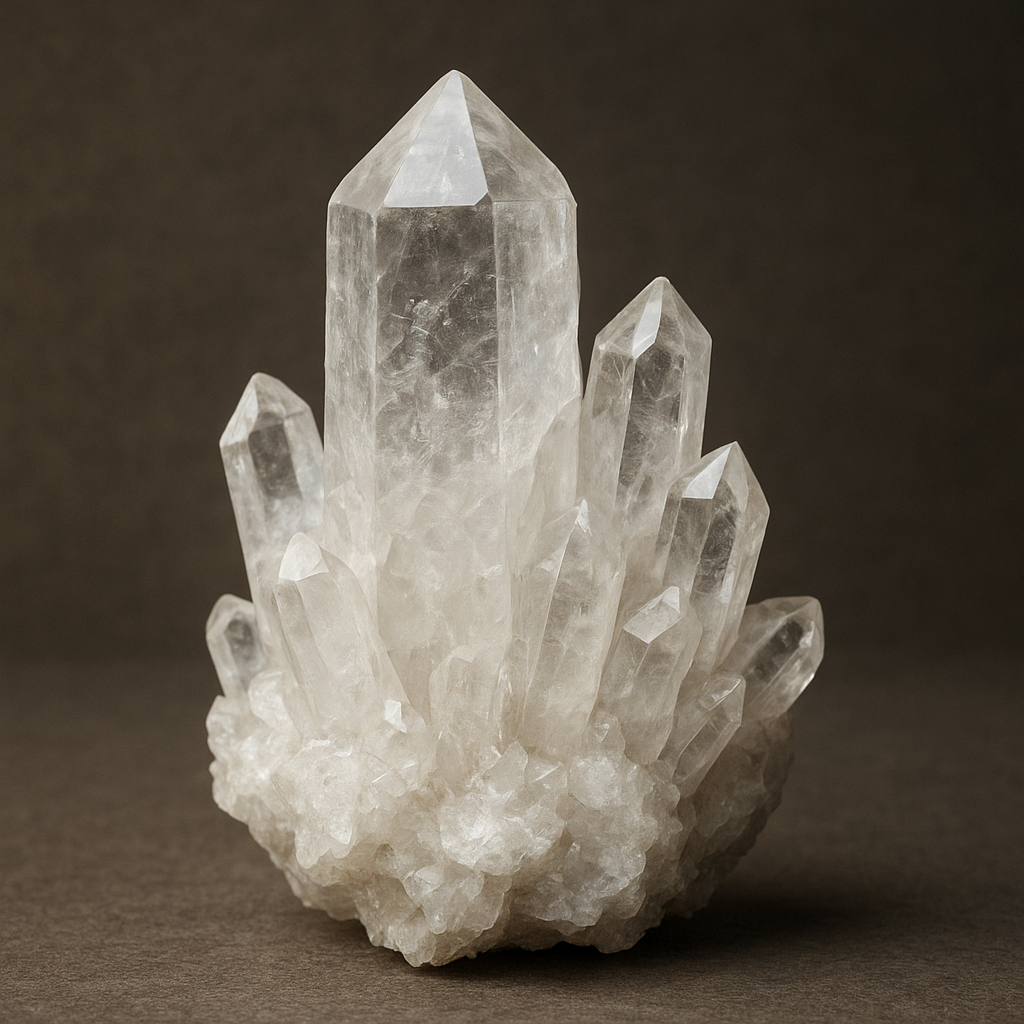
Ankerite is a fascinating member of the carbonate mineral family whose chemical variability and textural diversity make it important both as a recorder of past geological processes and as an indicator mineral in many ore-forming environments. This article explores where ankerite occurs, how it forms, its physical and chemical characteristics, and the practical and scientific applications that make it valuable to geologists, mineralogists and environmental scientists. Along the way we will touch on allied minerals, analytical methods used to study ankerite, and a few surprising roles this mineral plays in broader geological and industrial contexts.
Composition, structure and physical properties
Ankerite belongs to the dolomite group of carbonate minerals and is often described as the iron- and manganese-rich counterpart of dolomite. Its idealized formula can be written as Ca(Fe,Mg,Mn)(CO3)2, reflecting a solid solution in which divalent cations (iron Fe2+, magnesium Mg2+, and manganese Mn2+) substitute for each other in the crystal lattice. This compositional flexibility produces a spectrum of colours and densities and is central to ankerite’s utility as a geochemical recorder.
Crystallographically, ankerite adopts a trigonal (rhombohedral) structure similar to dolomite, with alternating layers of calcium and the divalent cation (Fe/Mg/Mn) between layers of carbonate groups. Typical physical properties include:
- Colour: pale yellow-brown to brown, sometimes reddish, grey or buff depending on Fe and Mn content;
- Lustre: vitreous to pearly on cleavage surfaces;
- Cleavage: rhombohedral, reflecting its carbonate lattice;
- Hardness: around 3.5–4 on the Mohs scale;
- Specific gravity: varies with composition, typically ~2.8–3.2 — higher values with greater iron or manganese content;
- Reactivity: effervesces weakly with dilute hydrochloric acid when powdered (reaction often slower than calcite due to dolomite-group structure).
Chemical variability often leads to zonation within single crystals or replacement textures, where cores and rims record changing fluid chemistry during growth or alteration. Such compositional zoning is frequently exploited to reconstruct fluid histories using microanalytical techniques.
Where ankerite is found: geological settings and classic localities
Ankerite forms in a wide range of geological environments. It is common as a diagenetic or hydrothermal carbonate and as a product of replacement reactions in carbonate rocks. Key settings include:
- Sedimentary diagenesis: In sedimentary basins ankerite can form during burial diagenesis where pore waters are enriched in Fe and Mn. It may occur as cement, pore-filling concretions, or replacive minerals in limestones and dolostones.
- Hydrothermal veins and replacement bodies: In many hydrothermal ore deposits ankerite forms as an alteration product of carbonate host rocks or as gangue mineral in veins accompanying sulfide mineralization. It often marks the presence of Fe- and Mn-bearing hydrothermal fluids.
- Skarns and contact metamorphic zones: Where carbonate rocks are invaded by magmatic fluids, reaction zones (skarns) commonly host ankerite alongside other calc-silicate and sulfide minerals.
- Magmatic-hydrothermal systems and volcanic-hosted mineralization: Ankerite can precipitate from fluids expelled by cooling intrusions and occasionally in volcanic settings where CO2-rich fluids interact with mafic or felsic country rocks.
- Metasomatized or altered basalts and ultramafics: Late-stage fluids can produce carbonate assemblages containing ankerite, particularly in low-temperature hydrothermal alteration zones.
Classic occurrences of ankerite are reported from Europe (e.g., parts of the United Kingdom and Romania), Scandinavia, North America, and many mining districts worldwide where carbonate-hosted base metal deposits occur. Because ankerite commonly associates with ore-forming processes, it is frequently mentioned in descriptions of historic mining districts and modern exploration projects.
Formation processes: diagenesis, hydrothermal activity and metasomatism
Understanding how ankerite forms requires integrating sedimentary, hydrothermal and metamorphic perspectives. Three broad formation pathways are most commonly recognized:
Diagenetic precipitation in sedimentary basins
In organic-rich sediments, microbial processes and mineral–fluid interactions can alter pore-water chemistry, producing Fe- and Mn-rich solutions. Under the right thermodynamic conditions, these cations combine with calcium and carbonate to precipitate ankerite as cement or nodules. Diagenetic ankerite commonly records progressive burial: early cements may have light isotopic signatures, while later stages reflect deeper, higher-temperature fluids.
Hydrothermal precipitation and replacement
Hydrothermal fluids, especially those associated with base-metal mineralization, often carry elevated concentrations of Fe and Mn. When these fluids interact with carbonate host rocks or experience cooling and CO2 fugacity changes, ankerite may precipitate in veins and as pervasive replacement of limestone. Textures commonly include zoned crystals, veinlets, and radial aggregates, and ankerite in these settings often coexists with sulfides (e.g., pyrite, chalcopyrite) and other carbonate minerals.
Metasomatism and contact metamorphism
At the margins of intrusions, aggressive fluids can import Fe and Mg and replace original carbonate minerals through metasomatic processes. Ankerite may therefore be a widespread component of contact aureoles and skarn assemblages. Its presence often indicates a complex chemical interplay between magmatic fluids and carbonate country rocks.
Analytical techniques and what ankerite can tell us
Ankerite is a powerful archive of palaeofluid chemistry and temperature when investigated with modern analytical methods. Common approaches include:
- Electron microprobe (EPMA) and SEM-EDS: Provide major-element compositions and mapping of zoning patterns at high spatial resolution.
- X-ray diffraction (XRD): Confirms crystal structure and identifies solid-solution relationships within the dolomite group.
- Stable isotope analysis (C and O): Carbon and oxygen isotopes in ankerite inform on carbonate source, temperature of formation and influence of meteoric versus marine fluids.
- Fe isotope and trace-element studies: Trace elements (Sr, Mn, Fe, REE) and iron isotopes can help fingerprint fluid origin and redox conditions.
- Mössbauer spectroscopy and X-ray absorption: Determine the oxidation state and coordination environment of iron, distinguishing Fe2+ from any Fe3+ produced during alteration.
- Fluid inclusion microthermometry: When hosted in inclusion-bearing ankerite, fluid inclusions can yield trapping temperatures and salinities that constrain formation conditions.
Together these methods allow researchers to reconstruct detailed histories: for example, identifying multiple pulses of mineralizing fluid, distinguishing diagenetic versus hydrothermal origins, or quantifying the role of microbial activity in early cementation.
Practical uses and economic significance
While ankerite itself is not commonly an ore mineral extracted for its own sake, it plays several important roles in economic geology and related fields:
- Exploration indicator: Ankerite is frequently associated with carbonate-hosted base-metal deposits and certain skarns. Its presence can guide exploration geologists toward potentially mineralized zones.
- Geochemical trap and host: Although not typically a primary metal ore, ankerite can sequester elements such as Mn, Fe and trace metals and thus affect the distribution of economically important elements in ore systems.
- Reservoir and seal properties: In petroleum geology and CO2 storage studies, the occurrence of carbonate cements like ankerite influences porosity, permeability and geomechanical behavior of reservoir rocks. Diagenetic ankerite can both occlude pores and provide a chemically reactive phase that interacts with injected CO2.
- Environmental role: In mine wastes and weathering profiles, ankerite dissolution or alteration can release Fe and Mn, but carbonate buffering can also mitigate acid generation. Understanding ankerite behaviour is therefore relevant to environmental remediation and mine-water management.
Interesting scientific topics related to ankerite
Several lines of study make ankerite particularly compelling to researchers:
- Isotopic recorders of ancient fluids: Ankerite can retain distinct carbon and oxygen isotopic signatures that reflect the interplay of marine, meteoric and hydrothermal fluids over geologic time.
- Solid solution and zonation studies: The continuous substitution among Fe, Mg and Mn provides a natural laboratory to study diffusion, crystal growth kinetics and metasomatic replacement mechanisms.
- Role in carbon cycling and CO2 sequestration: Because ankerite incorporates carbonate, its formation and dissolution are relevant to natural and engineered carbon storage. Understanding kinetics and stability under different temperature–pressure conditions helps model long-term storage of CO2 in subsurface reservoirs.
- Redox-sensitive behaviour of iron and manganese: Ankerite records changes in redox during diagenesis or hydrothermal activity; coupled with sulfide mineralogy, it contributes to reconstructing ore-forming redox histories.
- Microbial influence on carbonate diagenesis: In some sedimentary environments microbial activity promotes localized ankerite precipitation; studying such occurrences sheds light on microbe–mineral interactions in the geological record.
Textures, alteration and weathering
Ankerite may undergo a variety of secondary changes after formation. Oxidation of iron-bearing ankerite at or near the surface can produce iron oxides and hydroxides (goethite, hematite) and manganese oxides, often leaving dark-stained veins and weathering rinds. Under acidic conditions ankerite dissolves, releasing metals to solution — a process relevant to acid mine drainage and soil geochemistry. In metamorphic settings, ankerite may recrystallize or be transformed into other carbonate minerals depending on pressure–temperature conditions.
How to recognize ankerite in hand specimen and thin section
In hand specimen ankerite may be distinguished by its colour (brownish tones when Fe-rich), rhombohedral fragments or cleavage pieces, and association with carbonate host rocks or hydrothermal veins. Reaction to dilute HCl is often slower than calcite, so a weak effervescence on powdered surfaces is a practical field clue. Under the microscope, ankerite shows characteristic interference colours in cross-polarized light and displays compositional zoning visible in backscattered electron images; cathodoluminescence can reveal growth patterns not visible in ordinary transmitted light.
Related minerals and solid-solution partners
Ankerite sits within a continuum of dolomite-group carbonates. Important end-members and related phases include:
- Dolomite (CaMg(CO3)2) — the Mg-rich end-member;
- Siderite (FeCO3) — Fe-rich carbonate that can grade into ankerite compositions under Ca-bearing conditions;
- Kutnohorite (CaMn(CO3)2) — Mn-rich member often substituting into ankerite;
- Calcite and aragonite — non-dolomite carbonates that may be replaced by or coexist with ankerite in various environments.
Zonation between these compositions records changes in fluid chemistry and temperature, and in many ore deposits the interplay among these minerals is used to interpret paragenetic sequences.
Concluding remarks on ongoing research directions
Current research on ankerite emphasizes high-resolution chemical and isotopic techniques to unravel complex fluid histories in sedimentary basins and ore systems. Interest in subsurface carbon storage has also renewed attention to the stability and reaction kinetics of Fe–Ca–Mg carbonates. Finally, as analytical tools continue to improve, ankerite will remain a small but potent archive of the chemical evolution of fluids in the Earth’s crust — a mineral that links sedimentary processes, hydrothermal activity and environmental geochemistry in ways that are both practically useful and scientifically intriguing.