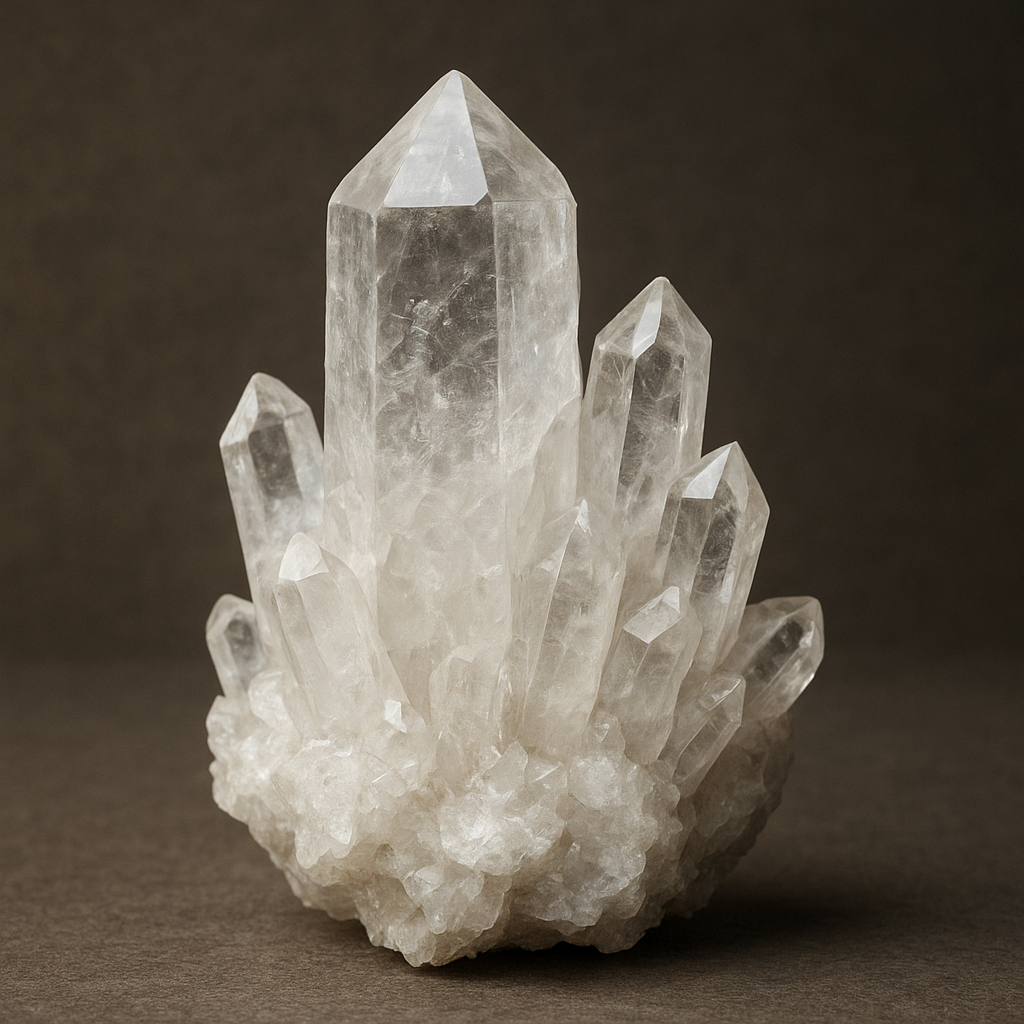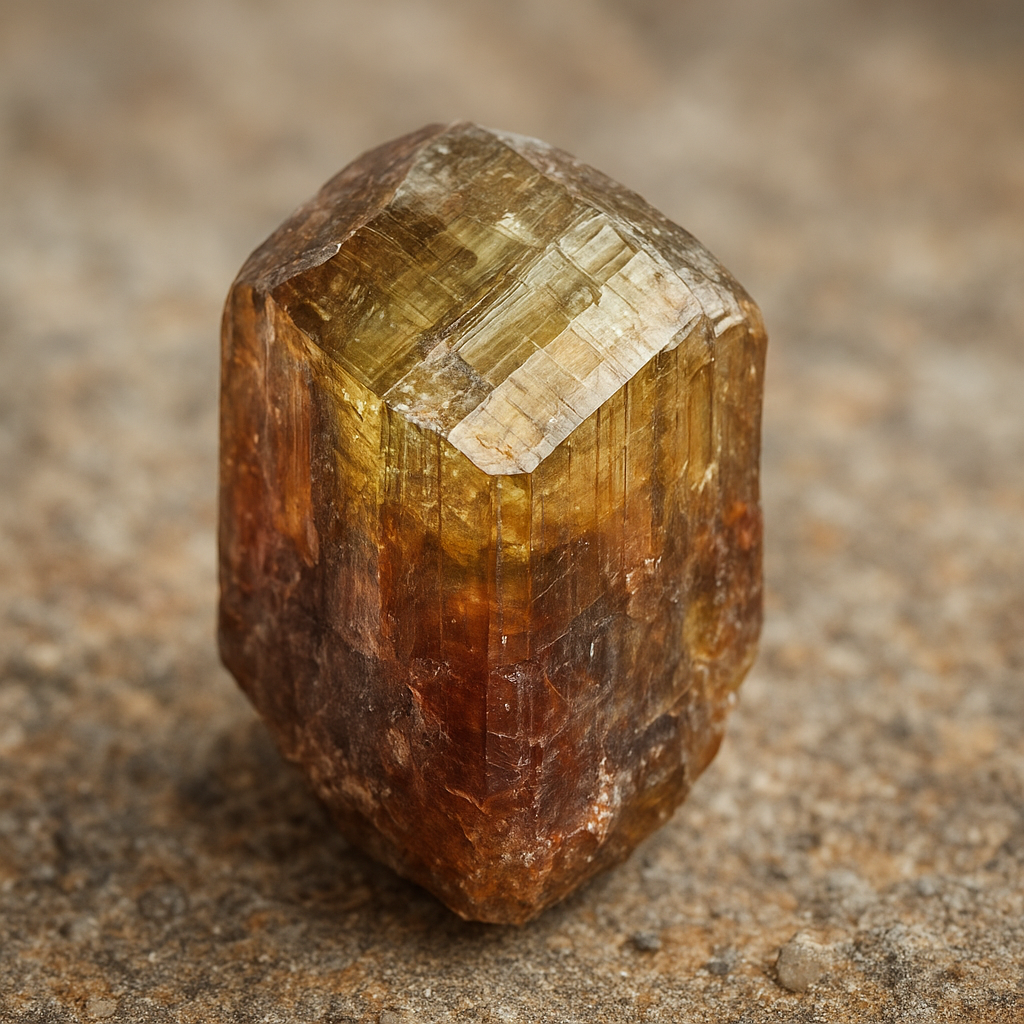
Andalusite is a distinctive and scientifically valuable mineral whose presence tells a story about the pressure and temperature history of rocks, and whose physical properties have found uses in both industry and jewelry. Named after the Spanish region where it was first recognized, this aluminum silicate is one of three polymorphs of Al2SiO5 and plays a central role in metamorphic petrology, material science and gemology. The following article explores the mineral’s chemistry and structure, geological occurrence, practical applications and some lesser-known but compelling facts that make andalusite important to scientists, artisans and engineers alike.
Mineralogy, Chemistry and Physical Properties
At its essence, andalusite is composed of the chemical formula Al2SiO5, placing it in the class of aluminosilicate minerals. It is a polymorph with two closely related minerals: kyanite and sillimanite. These three polymorphs have the same chemical composition but differ in crystal structure and stability fields, meaning each forms under different combinations of pressure and temperature. Andalusite crystallizes in the orthorhombic system and commonly appears as stout prismatic crystals, sometimes with square cross-sections.
Key physical and optical characteristics
- Hardness: Approximately Mohs 6.5–7.5, making andalusite reasonably durable when used as a gem.
- Specific gravity: Roughly 3.14–3.19, depending on chemical impurities and inclusion content.
- Cleavage and fracture: Typically shows good cleavage on one direction and conchoidal to uneven fracture in others.
- Color: Ranges from colorless and pale yellow to pink, brown, green and reddish hues; many specimens are zoned or show mixtures of colors.
- Optical properties: Andalusite is biaxial and noted for strong pleochroism, a phenomenon in which the stone displays different colors when viewed from different crystallographic directions—this is a prized trait in gemstone cutting.
The presence of trace elements and microscopic inclusions can impart a variety of colors. One famous variety, chiastolite, contains distinctive dark carbonaceous inclusions arranged in a cruciform pattern, making such specimens striking and historically significant as talismans or religious objects.
Geological Occurrence and Significance
Andalusite forms primarily in low-pressure regional metamorphic and contact metamorphic environments. Geologists use it as an important index mineral because its stability field in pressure-temperature (P–T) space is relatively well constrained: generally at low pressure and moderate to high temperatures compared with its polymorphs. Thus, the appearance of andalusite in a metamorphic rock often indicates specific metamorphic conditions and aids in interpreting the tectonic history of a region.
Typical host rocks and mineral associations
- Pelitic schists and hornfelses derived from clay-rich sedimentary rocks are the most common hosts.
- Contact aureoles around igneous intrusions, where country rock experiences localized heating at relatively low confining pressure, are favorable settings.
- Common mineral associates include muscovite, biotite, garnet, staurolite, kyanite (in transitional assemblages), quartz and sillimanite (in higher temperature zones).
Global distribution and notable occurrences
Although named after the Andalusia region of Spain, andalusite is found worldwide. Significant occurrences and sources include:
- Spain — historical type locality and classic specimens.
- Brazil — notable for producing gem-quality crystals and material for industrial use.
- Sri Lanka — known for gem-quality andalusite with attractive pleochroism.
- France, Russia, Canada (Quebec), the United States (including North Carolina and California), Australia and India — all report noteworthy deposits used for gem and industrial applications.
In the field, andalusite can be recognized by its prismatic habit, hardness, and pleochroic colors in thin section under polarized light. Its presence in metamorphic rock assemblages is routinely used to constrain metamorphic P–T paths and to interpret contact metamorphism around plutons.
Industrial Uses and Applications
Beyond its scientific value, andalusite has tangible industrial importance. The mineral’s high aluminum content and favorable high-temperature behavior make it an ingredient or feedstock in the manufacture of certain refractory materials and specialty ceramics.
Refractories and ceramics
- Andalusite is processed and graded for use as a raw material in refractory bricks, kiln linings and castables where high-temperature stability, resistance to thermal shock and chemical inertness are required.
- It can be transformed through controlled calcination into mullite (an alumina-silicate phase prized in advanced ceramic products), making andalusite a useful precursor in the production of high-performance ceramic components.
- In foundries and steelmaking, refractory mixes containing andalusite improve life and performance of linings by combining thermal resistance with mechanical strength.
Other industrial and technical applications
Smaller-scale andalusite uses include its role as an aggregate or additive in chemically resistant concretes and cements for high-temperature environments. Specialized ceramics, kilns for glassmaking, and even certain filtration systems for molten materials may benefit from andalusite-derived products.
Gemological and Decorative Use
While many andalusite crystals go to industry, gem-quality material is prized for its optical behavior. The mineral’s strong pleochroism — displaying different colors such as green, brown, yellow and red depending on viewing orientation — means skilled cutters can orient faceted stones to maximize color contrast. Gem andalusite is often cut as odd-shaped, faceted stones for collectors and jewelry designers who value its unique appearance.
Cutting, value and care
- Faceters typically orient andalusite so that the eye sees the most attractive blend of colors; because pleochroism is directional, rough orientation is critical.
- Andalusite is moderately hard and durable in everyday wear but should be protected from hard knocks and harsh chemicals.
- Market value depends on color saturation, pleochroic contrast, clarity, and size. The most sought-after examples show dramatic multi-color effects.
Cultural and historical notes
Variations such as chiastolite have attracted folklore and cultural significance for centuries: the cruciform pattern in chiastolite made it a popular amulet in some traditions. Museums and collectors prize unusual and well-formed specimens for both aesthetic and scientific reasons.
Scientific Importance and Research Directions
Andalusite occupies a central place in metamorphic petrology because it provides a direct window into the P–T conditions that rocks have experienced. Experimental petrology and thermodynamic modeling refine the stability fields of Al2SiO5 polymorphs, and andalusite-bearing rocks are often studied to reconstruct geothermal gradients and tectonic processes. Current research topics involving andalusite include reaction kinetics between polymorphs, the behavior of trace elements and inclusions during metamorphism, and the formation of mullite during industrial processing.
Phase stability and metamorphic implications
The three polymorphs—andalusite, kyanite and sillimanite—define a classic petrologic problem: their relative occurrence maps directly onto pressure-temperature space. Because they do not form through simple chemical change but instead by structural rearrangement, they are powerful indicators of metamorphic conditions. For example, finding andalusite alongside other index minerals allows geologists to estimate the maximum pressure experienced by the rock, an essential step in reconstructing metamorphic histories.
Analytical techniques
- X-ray diffraction and electron microprobe analysis help characterize crystal chemistry and identify minor element substitutions.
- Optical petrography—observing thin sections under polarized light—remains a fundamental technique for identifying andalusite and its pleochroic behavior.
- Thermodynamic modeling of mineral assemblages, often combined with field mapping, constrains pressure-temperature-time (P–T–t) paths for metamorphic terrains.
Practical Identification and Collecting Tips
For collectors and amateur geologists, recognizing andalusite can be rewarding. Look for stout prismatic crystals with square or rectangular cross-sections in schists and hornfelses. Use a hand lens or microscope to inspect for pleochroic color shifts when tilting the specimen in polarized light. Chiastolite specimens, with their characteristic dark cross, are both easy to spot and highly collectible.
Field safety and ethical collecting
When collecting andalusite specimens, always respect private property and protected areas. Large commercial deposits are usually mined with permits and provide material to industry; small-scale collecting for educational or hobbyist purposes is best done in designated locations or localities where collecting is allowed.
Interesting Facts and Lesser-known Connections
Several facts make andalusite more than a mere industrial raw material or a petrologist’s index mineral. For instance, the mineral’s strong pleochroism means a single properly cut gem can appear to contain multiple colors without the need for heat treatment or dye. Chiastolite’s cross-shaped inclusions inspired folklore and religious use, and well-preserved samples are sometimes featured in museum displays to illustrate mineral growth and inclusion processes.
- Because andalusite is one of a trio of polymorphs, its study illustrates core principles of mineral physics: how identical chemistry can yield different structures and different physical behavior.
- Andalusite’s conversion to mullite under certain thermal conditions links deep-earth mineralogy to modern industrial ceramic science—a striking cross-disciplinary bridge.
- The mineral’s name preserves a geographical legacy: it serves as a reminder of the historical tradition of naming minerals after type localities and the early naturalists who first described them.
Conclusion and Continuing Relevance
In both scientific and practical realms, andalusite remains a mineral of continuing interest. Its role as an index mineral in metamorphic petrology, its transformation pathways that feed modern ceramic industries, and its aesthetic appeal in gemology ensure it will be studied and appreciated from the lab to the jewelry case. From the classic specimens of Spain to the commercial deposits of Brazil and gem finds in Sri Lanka, andalusite connects deep geological processes to human uses—making it a small but significant piece of the planet’s mineralogical diversity.