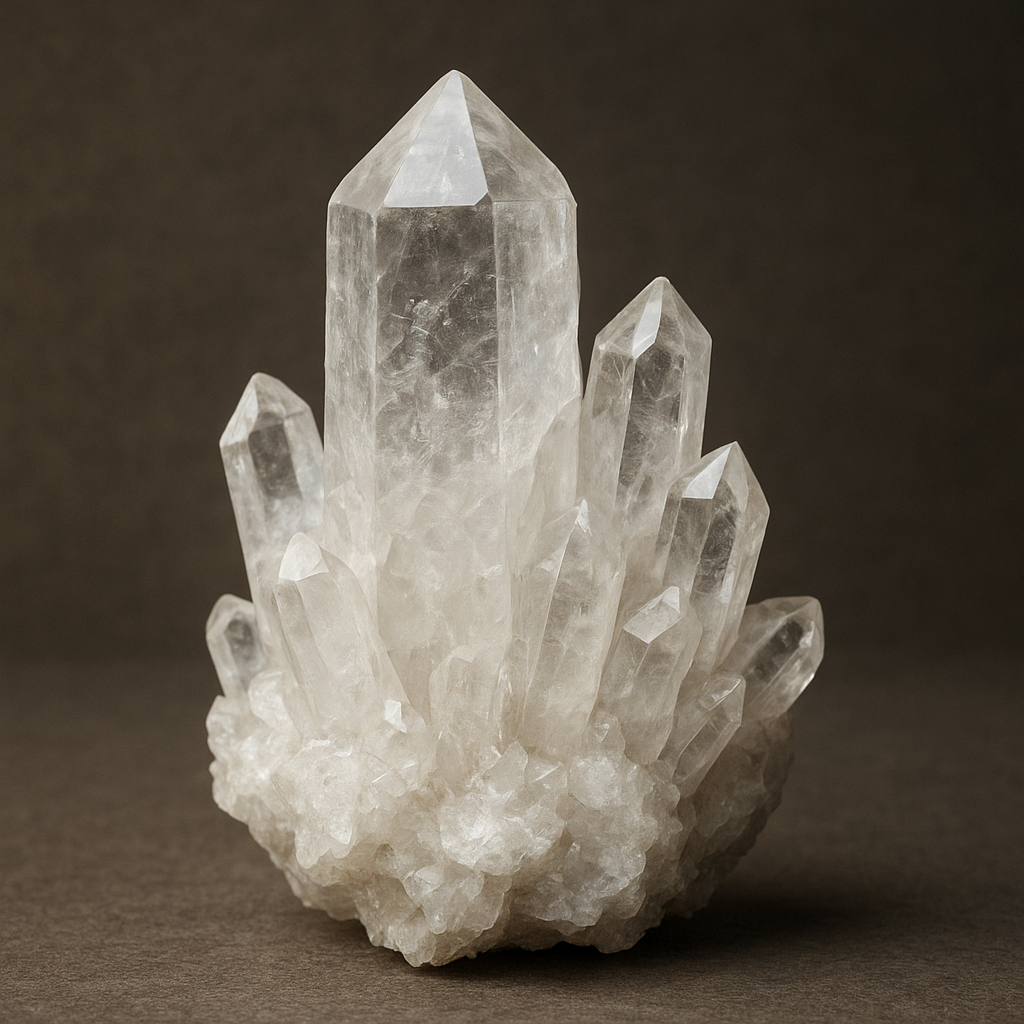
Albite is one of the most widespread but also one of the most underestimated minerals on Earth. As a key member of the feldspar group, it occurs in a huge variety of rocks, from common granites and pegmatites to high-grade metamorphic rocks and even some volcanic lavas. Despite its unassuming white and glassy appearance, albite plays a crucial role in understanding crustal evolution, magma crystallization, and the metamorphic history of rocks. It is also an important industrial raw material, used in ceramics, glassmaking, and as a component of specialized technological products. Exploring albite means touching many areas of geology, from mineral chemistry to plate tectonics, as well as several branches of applied earth sciences and materials engineering.
Chemical composition, structure and physical properties
Albite is a sodium-rich member of the plagioclase feldspar series with the ideal chemical formula NaAlSi3O8. In the broader classification of feldspars, it belongs to the **tectosilicate** group, which is characterized by a three-dimensional framework of SiO4 and AlO4 tetrahedra. Each tetrahedron shares all four corners (oxygen atoms) with neighboring tetrahedra, forming a rigid, interconnected framework that hosts sodium cations in the structural cavities. The feldspar framework itself is remarkably stable, and its subtle distortions give rise to different feldspar species and structural states.
In the plagioclase solid-solution series, albite represents the sodium end-member, while **anorthite** (CaAl2Si2O8) forms the calcium-rich end-member. Natural plagioclases usually display intermediate compositions between these poles, described using the abbreviation Ab for albite and An for anorthite (for example, Ab80An20). Pure albite is referred to as Ab90–Ab100. Across this series, compositional variation is accompanied by changes in density, refractive indices, and stability fields at different temperatures and pressures, which makes plagioclases powerful tools in **geothermobarometry** and igneous petrology.
The crystal structure of albite can exist in different structural states, commonly divided into high-temperature and low-temperature forms. High albite is more symmetrical and stable at elevated temperatures, while low albite displays slight ordering of aluminum and silicon in the tetrahedral framework when cooled. These structural changes do not alter the overall composition but can influence physical properties, such as symmetry, twinning behavior, and subtle optical characteristics visible under the petrographic microscope.
In hand specimen, albite is typically white to grayish white, sometimes with a slightly bluish or greenish tint. It has a vitreous luster on fresh surfaces and a hardness of about 6–6.5 on the Mohs scale, typical of feldspars. The specific gravity is relatively low, around 2.6–2.65, which reflects its sodium-rich composition. Albite has two pronounced **cleavage** directions at nearly 90°, a diagnostic feature shared with other feldspars. When broken, it displays a characteristic blocky or tabular habit with smooth cleavage faces that can reflect light strongly.
One of the most typical and useful features of albite is its complex twinning. Albite commonly exhibits polysynthetic twinning visible under the microscope or even to the naked eye in some plagioclase crystals as striations on cleavage faces. These twinning patterns are often referred to as albite twins. Under crossed polars in thin section, these twins produce alternating light and dark bands that help differentiate albite from other feldspars and provide clues about the crystal’s orientation and composition.
From an optical standpoint, albite is biaxial and usually displays low to moderate birefringence, with characteristic interference colors under polarized light. Its refractive indices and extinction angles vary systematically with composition, allowing petrographers to estimate the percentage of albite versus anorthite in a plagioclase grain. This capability is fundamental for reconstructing crystallization sequences in igneous rocks and for deciphering metamorphic reactions.
Albite is generally not strongly colored, but in some environments it can host inclusions or minor trace elements that impart faint coloration. In rare cases, albite can show attractive optical phenomena such as peristerite schiller or iridescence when it forms exsolution lamellae with other feldspars. Such features are sometimes exploited in ornamental stones, though albite itself is not as famous as labradorite or moonstone for these optical effects.
Geological occurrence and formation environments
Albite is extremely abundant in the Earth’s crust and can appear across a wide spectrum of geological environments. It plays a central role in many igneous, metamorphic, and hydrothermal rocks, and can also occur in sedimentary settings as detrital grains or as a product of diagenetic alteration. Understanding where and how albite forms is crucial for interpreting the geological history of crustal rocks and the conditions under which they evolved.
Albite in igneous rocks
In igneous petrology, albite is a primary phase in many felsic rocks, particularly granites, granodiorites, rhyolites, and associated intrusive and extrusive equivalents. In these rocks, it may occur as discrete sodium-rich plagioclase or as the albite-rich rims of zoned plagioclase crystals that are richer in anorthite at the core. This zoning reflects dynamic conditions during magma **crystallization**, such as changing temperature, pressure, and water content.
Albite is especially abundant in granitic pegmatites, where extremely slow cooling and strongly fractionated melts allow large feldspar crystals to develop. Pegmatitic albite can form coarse, blocky crystals or finely lamellar intergrowths with potassium feldspar. The latter texture is known as microcline–albite perthite or, when on a macroscopic scale, simply perthite. These intergrowths record the exsolution of initially homogeneous alkali feldspar into separate K-feldspar and Na-feldspar domains during cooling, offering insights into the cooling history of plutons and pegmatite bodies.
In certain highly differentiated and peralkaline igneous rocks, albite can even appear as an almost monomineralic phase, forming albite-rich granites sometimes termed albitites. These rocks may be associated with rare-metal deposits, including tantalum, niobium, and rare earth elements. In this context, albite is not merely a background framework but can be closely tied to the concentration and remobilization of economically important elements in the late stages of magmatic evolution.
Metamorphic albite and albitization
Albite also features prominently in metamorphic environments, where it may form during the transformation of calcium-rich plagioclase or other feldspars under changing pressure, temperature, and fluid composition. In low-grade metamorphic rocks such as greenschists, albite often replaces original igneous plagioclase, forming fine-grained, sodium-rich feldspar mosaics. This process of sodium enrichment is commonly referred to as **albitization** and is closely tied to fluid–rock interaction.
Albitization involves the introduction of sodium-bearing fluids that remove calcium and sometimes potassium from the original mineral assemblage. In the case of plagioclase, Ca-rich cores can be replaced by Na-rich albite, dramatically altering the mineralogy and sometimes the mechanical properties of the host rock. This exchange can occur over a wide range of conditions, from diagenetic to amphibolite facies, and is often associated with deformation zones, hydrothermal systems, and regional metamorphism.
In higher-grade metamorphic rocks such as amphibolites and granulites, albite may coexist with more calcic plagioclase or transform to other feldspars depending on the specific P–T conditions. In blueschist and eclogite facies environments, albite tends to be unstable at very high pressures and may break down to yield jadeite plus quartz or other sodium-bearing phases. These reactions are used as sensitive indicators of subduction-zone conditions and help geologists reconstruct the pressure–temperature–time paths of deeply buried rocks.
Hydrothermal and sedimentary settings
Beyond strictly magmatic and metamorphic contexts, albite is a common product of hydrothermal alteration. Fluids associated with ore-forming systems, volcanic centers, or deep circulation along fault zones can cause the partial or complete replacement of original feldspars by albite. This can create albitized halos around mineralized zones, which may serve as useful exploration guides for certain types of ore deposits, especially those linked to granitic intrusions and pegmatites.
In sedimentary rocks, albite can survive weathering and be transported as detrital grains, though it is less resistant than quartz. During diagenesis, aluminosilicate reactions within sandstones and shales can generate new albite from clay minerals or other feldspars. This diagenetic albite often appears as fine, authigenic grains or as overgrowths on older detrital crystals. The extent of feldspar alteration and albitization can strongly influence **porosity** and permeability in reservoir rocks, which in turn affects the storage and migration of hydrocarbons and groundwater.
By tracing the presence, composition, and textures of albite in these various environments, geologists gain a powerful tool for deciphering rock histories. Albite thus acts as a silent witness to magmatic differentiation, metamorphic reactions, and hydrothermal alteration, carrying within its chemical and structural features the record of tectonic and geochemical processes that shaped the crust.
Industrial applications and technological relevance
Although it often goes unnoticed by non-specialists, albite plays a significant role in several industrial sectors. As a sodium feldspar, it is a crucial component in ceramics, glass production, and certain specialized materials. Its **fluxing** properties, relatively low melting temperature, and ability to form stable aluminosilicate networks make it highly valuable in controlling the behavior of raw materials during heating and cooling.
Ceramics and glassmaking
In the ceramics industry, albite-bearing feldspar is widely used as a flux in the production of porcelain, tiles, sanitary ware, tableware, and other high-quality ceramic products. When fired, albite lowers the melting point of the mixture, promotes the formation of a glassy phase, and enhances the densification of the ceramic body. This improves mechanical strength, reduces porosity, and contributes to a smooth, homogeneous surface.
Albite also plays a role in the behavior of glazes, where it influences viscosity, thermal expansion, and the development of color and texture. Its sodium content helps form a continuous glassy matrix that binds other crystalline phases, while the aluminum and silica contribute to the structural integrity of the glaze. The careful balance between albite, quartz, kaolin, and other raw materials determines the final properties of ceramic products, such as whiteness, translucency, and resistance to thermal shock.
In glassmaking, albite-bearing feldspar provides alumina and alkalis, which are essential for improving the chemical durability and mechanical strength of glass. The feldspar component helps regulate viscosity during melting and forming, ensuring that the glass can be worked and shaped effectively. For certain types of technical glass and fiberglass, the precise proportions of albite and other feldspars affect not only melting behavior but also the coefficient of thermal expansion and resistance to devitrification.
Construction, fillers and specialized materials
Albite is also used as a raw material in the production of some construction ceramics, including floor and wall tiles and specialized refractory products, where controlled melting behavior and thermal stability are required. Fine-ground albite can serve as a functional filler in paints, plastics, and rubber, where it improves mechanical properties, abrasion resistance, and dimensional stability.
Because of its relatively high hardness and chemical inertness, albite-containing feldspar powders are well suited for applications where mild abrasives or durable fillers are needed. In polymer composites, the addition of feldspar can reduce shrinkage during curing and enhance resistance to wear. Although albite is not usually the only component in such fillers, its presence contributes to the overall performance of the composite.
In some high-technology applications, synthetic or highly purified feldspars with compositions close to albite are used in the production of advanced ceramics and electronic components. The aluminosilicate framework, combined with controlled impurity levels, offers predictable electrical and thermal behavior. Research into feldspar-based glass-ceramics and low-expansion materials continues to explore compositions along the albite–anorthite join, aiming to optimize properties for substrates, insulators, and sealing glasses.
Economic geology and resource distribution
Commercially, most feldspar deposits exploited for ceramic and glassmaking industries contain mixtures of potassium feldspar and sodium feldspar, with albite often forming a substantial fraction. High-quality feldspar ore should have low contents of iron-bearing minerals and other colorants that could affect the whiteness or transparency of the final products. Beneficiation processes, including flotation and magnetic separation, are used to concentrate feldspar and remove contaminants.
Major feldspar-producing countries include Turkey, Italy, China, India, and several others, where granitic and pegmatitic rocks supply large quantities of raw material. Albite-rich pegmatites may also host rare-metal mineralization, so feldspar extraction can be associated with recovery of other commodities. In some regions, albitized rocks associated with hydrothermal systems are investigated both for industrial feldspar and for their potential to host ore deposits.
The wide distribution of albite-bearing rocks and the relative ease of mining granites and pegmatites make feldspar resources abundant on a global scale. However, local variations in quality, degree of weathering, and proximity to industrial centers strongly influence the economic viability of specific deposits. Environmental considerations, including landscape impact and waste management, are becoming increasingly important in mining operations that target feldspar for ceramic and glass industries.
Albite in scientific research and planetary perspectives
Beyond its practical uses, albite is an essential mineral in scientific research, especially in the fields of petrology, geochemistry, and geophysics. Its stability relations, reaction behavior, and physical properties provide valuable constraints on models of crustal evolution, magmatic processes, and even planetary differentiation on other worlds.
Phase equilibria and thermodynamic studies
Because albite is a major component of granitic and rhyolitic magmas, its melting and crystallization behavior has been extensively studied in experimental petrology. By subjecting albite and albite-rich compositions to controlled high-temperature and high-pressure conditions, researchers determine phase diagrams that describe the conditions under which albite melts, crystallizes, or reacts with coexisting minerals and fluids.
These experiments help constrain the stability fields of albite relative to other framework silicates, such as quartz and alkali feldspars. They also clarify its reactions with water-bearing fluids and volatiles such as CO2 and halogens. For example, the presence of water markedly lowers the solidus temperature of granitic compositions, influencing the depth and temperature at which partial melting can occur in the continental crust. Albite-related equilibria are thus central to understanding crustal anatexis and the generation of silicic magmas.
Thermodynamic datasets derived from albite experiments feed into numerical models of crustal and mantle processes. The Gibbs free energies, heat capacities, and volume properties of albite are used to calculate phase stability, density changes, and seismic velocity structures in the crust. Because feldspars, including albite, dominate many crustal rocks, their properties exert a strong influence on predicted seismic profiles and on interpretations of geophysical surveys.
Isotope geochemistry and weathering
Albite participates in geochemical cycles involving major elements such as sodium, aluminum, and silicon, and it can host trace amounts of radioactive or radiogenic isotopes. In some cases, Rb–Sr or other isotopic systems in feldspars provide age information about cooling, metamorphism, or magmatic crystallization. Although orthoclase and microcline are more commonly used for certain isotopic dating techniques, albite-bearing plagioclases can also contribute important constraints on the timing of geological events.
The weathering of albite at Earth’s surface contributes to the formation of clay minerals and to the long-term regulation of atmospheric CO2. During chemical weathering, albite can react with carbonic acid in meteoric waters, gradually releasing sodium and silica into solution and forming secondary minerals such as kaolinite or smectite. This process consumes CO2 from the atmosphere–hydrosphere system and plays a role in the slower components of the **carbon** cycle over geological timescales.
Geochemists study albite weathering rates in natural settings and laboratory experiments to better understand how silicate weathering responds to climate, tectonics, and vegetation. These insights feed into models of long-term climate stability, continental erosion, and riverine fluxes of dissolved ions to the oceans. The behavior of albite and other feldspars thus links deep Earth processes to surface environments and global biogeochemical cycles.
Albite and planetary geology
The significance of albite is not limited to Earth. On the Moon, feldspar-rich rocks, particularly anorthositic crustal materials, have been studied using samples brought back by the Apollo missions and lunar meteorites. Although the lunar anorthosites are dominated by calcic plagioclase, sodium-bearing variants and albite-rich domains provide clues about the differentiation and cooling of the lunar magma ocean. The relative proportions of albite and anorthite help constrain the composition and evolution of the lunar crust.
Remote sensing data from orbiting spacecraft around planets and asteroids often reveal spectral signatures consistent with feldspar-bearing rocks. Distinguishing between albite, anorthite, and alkali feldspars based on spectral features is challenging, but progress in laboratory spectroscopy and missions equipped with improved sensors has enhanced our ability to infer crustal compositions on other planetary bodies. On Mars, for instance, the detection of feldspar-rich terrains supports the existence of more evolved, silica-rich crustal materials, and albite may be a component of those rocks.
In meteorites, especially in some achondrites and brecciated crustal fragments, albite occurs as part of feldspathic clasts that record magmatic and metamorphic processes on their parent bodies. The presence and composition of albite can shed light on the thermal histories, differentiation states, and aqueous alteration events experienced by these small planetary objects. This, in turn, contributes to a broader understanding of how crusts form and evolve in the early solar system.
Cultural and gemological aspects
While albite is not primarily a gemstone, it does appear in the realm of ornamental stones and **gemology** through its association with other feldspars and occasionally as attractive specimens in its own right. Some collectors value well-formed albite crystals from pegmatites, where they may grow in association with quartz, tourmaline, beryl, and rare accessory minerals. In such settings, albite can form distinctive, blocky crystals or delicate, platy aggregates that contrast aesthetically with colored gem minerals.
Albite is closely related to several feldspar varieties that are used as gemstones, such as moonstone and peristerite, where intergrowths of albite and other feldspars create optical phenomena like adularescence and iridescent schiller. Although pure albite is rarely marketed independently as a gemstone, its structural and compositional characteristics are integral to understanding the behavior of these gem materials. Gem cutters and dealers dealing with feldspar gems must be aware of the delicate cleavage and moderate hardness of albite-bearing stones, which influence cutting angles, polishing techniques, and durability in jewelry.
In some cultural contexts, feldspar-rich rocks containing albite have been used historically as building or decorative stones, valued for their light color and ability to take a good polish. While quartz-rich granites are more commonly recognized, many such stones owe part of their appearance and physical performance to the presence of albite. The subtle interplay of white albite, pink K-feldspar, gray quartz, and dark mafic minerals contributes to the aesthetic diversity of dimension stones used in architecture and sculpture.
For mineral enthusiasts, albite provides an accessible yet scientifically rich subject. Microscopic examination of twinning patterns, zoning, and exsolution textures in albite offers a window into complex geological processes. Collectors who focus on systematic mineralogy often include multiple albite specimens from different localities to illustrate variations in crystal habit, association, and geological environment. In this way, albite occupies a quiet but significant niche at the intersection of science, technology, and human appreciation of the mineral world.