
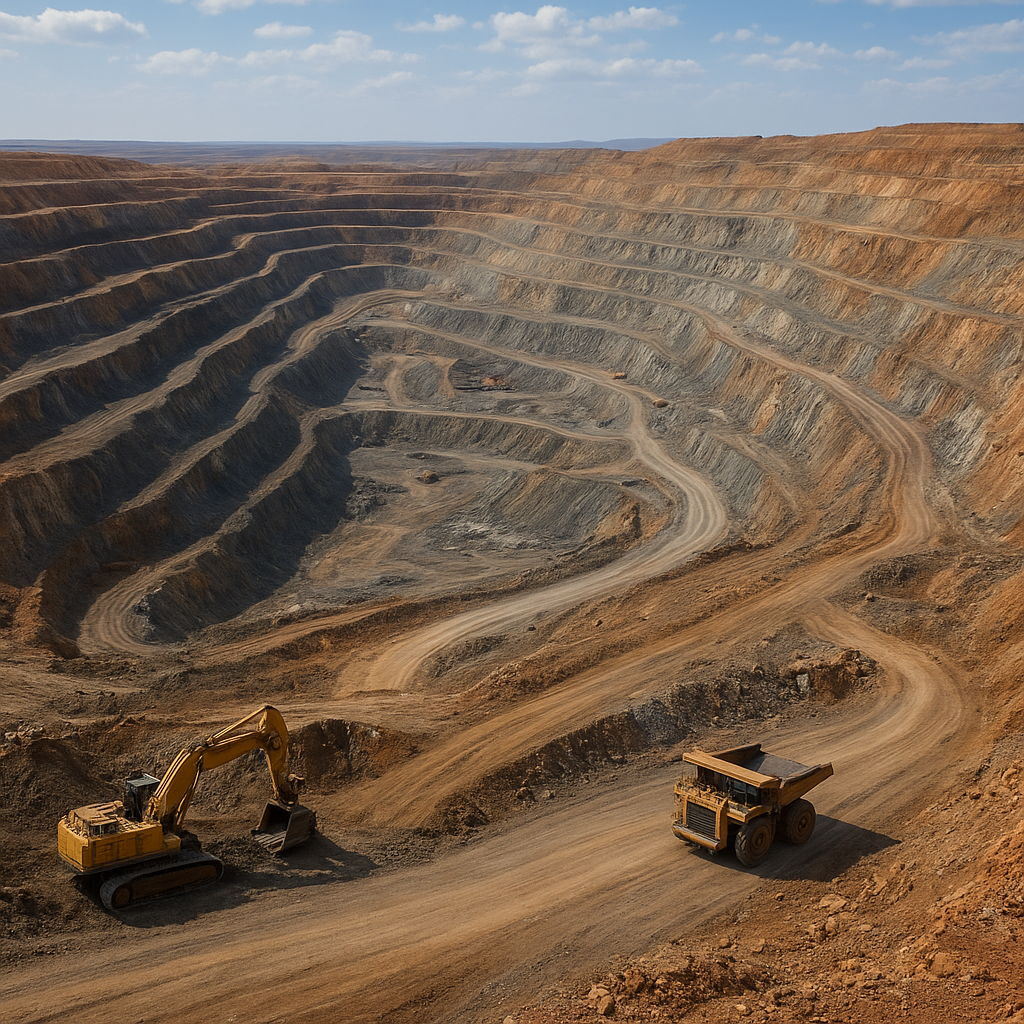
The Aktogay mine is one of the most significant modern copper projects in Central Asia. Located in the central-eastern part of Kazakhstan, the operation exploits a very large porphyry-style deposit and combines large-scale open-pit mining with on-site processing facilities. Aktogay has attracted attention both for the sheer volume of material it handles and for its role in Kazakhstan’s plans to expand mineral-based export earnings and industrial capacity. This article outlines where Aktogay sits on the map, how the ore is mined and treated, why it matters economically, and several interesting technical and social aspects that make Aktogay notable on the global mining stage.
Location and geological setting
Aktogay is situated in the broad steppe and semi-arid uplands of Kazakhstan. The deposit lies within a geological province known for large porphyry and hydrothermal accumulations that formed during episodes of magmatism and crustal deformation. Porphyry copper systems typically produce immense tonnages of low- to moderate-grade mineralization, and Aktogay is a textbook example: a vast, disseminated copper system with both oxide and sulphide mineral domains.
The geology of Aktogay is characterized by intrusive porphyritic bodies hosted in metamorphosed and sedimentary country rocks. Mineralization is widespread rather than concentrated in narrow veins, which makes the deposit amenable to bulk mining methods. Key minerals include chalcopyrite and, in oxide zones closer to surface, secondary copper minerals. This vertical zonation of mineral types has driven the combined processing strategy used at the site.
Mining methods and processing technology
Aktogay is primarily an open-pit operation. The mining approach is designed to move very large volumes of ore and waste efficiently, which is necessary to make low-grade porphyry economics work. Large shovels and high-capacity haul trucks, as well as carefully planned pit benches and waste dumps, form the backbone of the operation. Stripping ratios and pit sequencing are optimized to ensure a steady feed of ore to the processing plants.
Processing: oxide and sulphide streams
The Aktogay complex treats oxide and sulphide material using different technologies tailored to the mineralogy. The near-surface oxide copper zones are commonly processed via heap leaching followed by solvent extraction and electrowinning (SX/EW). Heap leaching is a capital- and energy-efficient method for recovering copper from oxidized ores: crushed ore is stacked on lined pads, irrigated with leach solution, and liberated copper is collected and recovered as high-purity cathode.
Deeper, primary sulphide mineralization is typically processed in a concentrator. Comminution (crushing and grinding) reduces the ore to a fine particle size, and flotation concentrates the copper-bearing minerals into a higher-grade product. The resulting copper concentrate is then transported to smelters for further refining into metal.
Infrastructure and logistics
- On-site facilities: Aktogay hosts crushing and grinding circuits, flotation cells, heap leach pads, SX/EW plants, and tailings management facilities. Integrating these systems on-site reduces the need to transport low-grade ore long distances.
- Power supply: Large-scale copper operations require stable and substantial electrical energy. Aktogay’s power needs are met through a combination of national grid connections and on-site generation where necessary.
- Transport links: Because concentrate and cathode products must reach domestic or international markets, the mine relies on a network of roads and railways to move product to smelters and ports. Efficient logistics are essential to maintaining competitive operating costs.
- Water management: Located in a semi-arid environment, Aktogay employs water recycling, pond systems, and careful catchment planning to limit freshwater withdrawals and ensure sustainable supply for processing.
Economic and social significance
Aktogay plays several economic roles at national and regional levels. First and foremost, it contributes to Kazakhstan’s position as a supplier of industrial metals. Copper is a critical raw material for electrical infrastructure, industrial machinery, and transport sectors, and growing global demand — driven by electrification and renewable energy systems — highlights the strategic importance of large copper producers.
On the national scale, revenue from the mine takes the form of taxes, royalties, and export earnings. The operation also attracts investment in local infrastructure: roads, power, and communications improvements that benefit surrounding communities. Job creation at the mine, in support services, and through contracting opportunities provides an important economic base in what are otherwise sparsely populated regions.
At the regional level, Aktogay can catalyze additional industrial development: service companies, suppliers, and downstream processors often cluster around major resource projects. Over time this can contribute to economic diversification and skills transfer, as local workforces gain technical and managerial experience in large-scale industrial operations.
Employment and human capital
- Direct employment: The mine employs geologists, engineers, metallurgists, operators, maintenance crews, and administrative staff. Modern operations emphasize continuous training and safety.
- Indirect employment: Contractors, transport companies, and local suppliers benefit from the project, expanding regional economic activity.
- Community programs: Many large mining companies invest in social programs, education, and healthcare initiatives in host regions to foster sustainable development and community relations.
Environmental management and sustainability measures
Large mining projects in sensitive landscapes face significant environmental responsibilities. Aktogay has to manage its footprint on land, water, and biodiversity while minimizing emissions and energy use. Key areas of focus typically include:
- Tailings and waste rock management: Proper design and monitoring of tailings storage facilities and waste dumps is essential to prevent leachate, erosion, or accidental releases.
- Water recycling and conservation: Closed-loop systems and water-efficient processing help limit withdrawals from local aquifers and surface sources.
- Dust and emissions control: Dust suppression on roads and stockpiles, and the use of modern equipment and fuel efficiency measures, reduce air quality impacts.
- Progressive rehabilitation: Recontouring, topsoil replacement, and revegetation of disturbed areas support long-term landscape recovery.
In addition to operational controls, there is growing emphasis on the environmental footprint of products. Copper produced at Aktogay is destined for technologies that themselves support decarbonization, such as electric vehicles and renewable energy systems. This creates a nuanced sustainability narrative: while mining has local environmental costs, the material produced enables broader emissions reductions across other sectors.
Interesting technical and strategic aspects
Aktogay is interesting for several technical and strategic reasons.
- Scale and bulk methodology: The mine exemplifies how very large, low-grade porphyry deposits can be made economically viable through scale. Bulk mining and continuous processing deliver predictable throughput and cash flows.
- Dual processing streams: Managing both oxide heap leach and sulphide flotation streams at one site requires careful metallurgical planning and flexible operations. This hybrid approach can accelerate early cash flow from higher-value oxide processing while sulphide concentrator facilities are ramped up.
- Strategic contribution to supply chains: As global demand for copper grows, large deposits such as Aktogay become strategic assets. They help to diversify global supply away from concentration in a few producing countries and support downstream industrialization in their home economies.
- Technological adoption: Modern mines like Aktogay typically deploy digital monitoring, fleet automation options, and advanced process control systems to optimize performance and reduce costs. These technologies also aid environmental monitoring and safety management.
- Local economic multiplier effects: The requirement for consumables, maintenance services, and logistics creates durable markets for local entrepreneurs and businesses, strengthening regional economic resilience over time.
Future prospects and market context
The medium- to long-term prospects for Aktogay are linked closely to global copper demand and commodity pricing, as well as to the mine’s ability to sustain low unit costs. Several contextual factors matter:
- Global electrification and renewable energy deployment increase demand for copper wiring, cabling, and components, supporting prices and long-term offtake opportunities.
- Investment cycles and capital allocation decisions by the operating company influence expansion, exploration at depth or along strike, and potential processing upgrades.
- Logistical upgrades, such as improved rail links or local smelting capacity, could change the value chain and increase domestic beneficiation of mineral products.
- Regulatory and fiscal regimes in Kazakhstan affect project economics, including taxation, royalties, and environmental requirements.
Exploration around the Aktogay system and similar districts may identify satellite deposits or extensions to the known mineralization, providing the potential for resource growth and longer mine life. In parallel, innovations in processing and automation may further reduce operating costs and environmental impacts, reinforcing Aktogay’s competitiveness.
Concluding observations
Aktogay stands out as a modern, large-scale copper project characteristic of 21st-century bulk mining. It demonstrates how significant mineral resources can be developed in challenging environments to supply critical raw materials for global industry. The combination of porphyry geology, integrated processing, and strategic positioning within Kazakhstan’s mining sector makes Aktogay an important case study in contemporary mining economics and responsible resource development.

