Actinolite is a member of the amphibole group of silicate minerals that appears in a variety of geological settings. It ranges from slender prismatic crystals to silky, fibrous masses and from vivid greens to dark grays. This article explores the mineral’s chemistry, physical properties, global occurrences, historical and modern uses, health and regulatory issues related to its asbestiform varieties, and other topics of interest that connect geology, industry, and culture.
Mineralogy and Physical Properties
The mineral commonly called actinolite forms a continuous chemical series between the magnesium-rich tremolite and the iron-rich ferro-actinolite. Its simplified chemical formula can be expressed as Ca2(Mg,Fe)5Si8O22(OH)2, reflecting substitution between magnesium and iron in the crystal lattice. Like other members of the amphibole group, actinolite crystallizes in the monoclinic system and displays the characteristic amphibole two-direction cleavage at angles close to 56° and 124°.
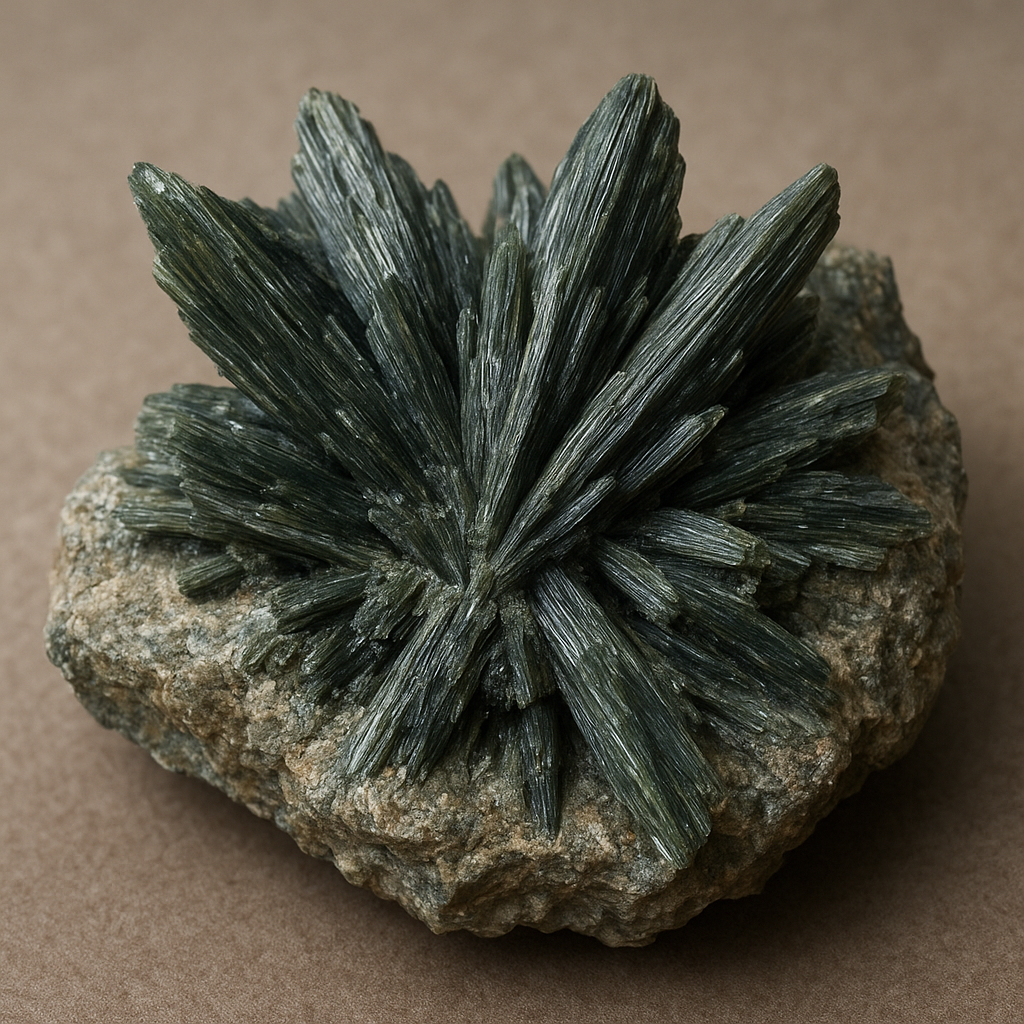
Typical physical properties include a Mohs hardness of approximately 5 to 6, a specific gravity generally between 3.0 and 3.4, and a vitreous to silky luster. Color is most commonly green (from pale to dark) or gray-green, but it can also be nearly black in iron-rich varieties. Transparency ranges from transparent to translucent or opaque, depending on grain size and the presence of fibrous aggregates. Under polarized light in thin section, actinolite typically shows strong pleochroism, which can help distinguish it from other green minerals.
Two textural modes are particularly important: the compact prismatic habit and the acicular, fibrous habit. The fibrous form is the one that has drawn significant attention because it may occur in an asbestiform habit — long, flexible, and thin fibers that can pose respiratory hazards if airborne.
Geological Occurrence and Formation
Actinolite most commonly forms during low- to medium-grade regional metamorphism of mafic igneous rocks and in contact metamorphism of impure calcareous sediments. Major geological environments include:
- Greenschist and amphibolite facies metamorphic rocks, where actinolite replaces pyroxenes or forms from hydrothermal alteration.
- Skarn deposits derived from the interaction of intrusive magmas with carbonate rocks; actinolite is a common component of calcium-rich skarn assemblages.
- Serpentinized ultramafic rocks and shear zones, where metamorphic fluids produce amphiboles from olivine and pyroxene.
- Hydrothermal veins and retrograde alteration zones, often associated with chlorite, epidote, and other metamorphic minerals.
Notable occurrences are found worldwide. Examples include the jade-bearing belts of British Columbia and Alaska, where actinolite-rich amphiboles contribute to nephrite jade; metamorphic terrains of Italy, Austria, and Slovenia; portions of Russia and China known for fibrous amphiboles; and various localities in the United States such as Vermont and California. In many of these regions actinolite is part of complex mineral assemblages and can be an indicator mineral of particular pressure-temperature conditions during metamorphism.
Uses and Economic Importance
Actinolite’s economic relevance is multifaceted but is constrained by health considerations where the mineral occurs in asbestiform form. Uses and significance include:
- Gem and ornamental stone: When compact and tough, fibrous aggregates of tremolite-actinolite can produce the material known as nephrite, one of the two minerals (with jadeite) traditionally called jade. Nephrite has been carved for millennia into tools, ornaments, and cultural objects, particularly in Asia, the Pacific, and North America.
- Indicator mineral in exploration: Actinolite may point to specific metamorphic conditions and the presence of other economically interesting minerals in skarns and metamorphosed ore bodies.
- Industrial uses historically tied to asbestos: In the past, asbestiform varieties of actinolite were mined and used similarly to other asbestos minerals for insulation and fireproofing. Because of serious health risks, such uses have been largely discontinued and are now heavily regulated or banned in many countries.
- Lapidary and collectors: Non-fibrous actinolite crystals and aggregated forms are valued by mineral collectors for their form, color, and association with other metamorphic minerals.
While actinolite itself is not a major ore mineral, its role in the formation and alteration of metamorphic and skarn environments makes it useful to geologists seeking to understand metamorphic histories and search for other mineralization.
Health, Safety, and Regulation
The most consequential aspect of actinolite for society arises when the mineral occurs in an asbestiform habit. As with other regulated asbestos minerals (chrysotile, amosite, crocidolite, tremolite, anthophyllite), inhalation of respirable amphibole fibers can lead to serious diseases: asbestosis (fibrotic lung disease), lung cancer, and mesothelioma. The amphibole fibers are chemically durable and can persist in lung tissue, causing long-term inflammation and damage.
Because of these risks, most countries have strict regulation and guidelines governing the handling, mining, and disposal of asbestos-bearing materials. Controls include air monitoring, use of personal protective equipment (PPE), wet methods to suppress dust, engineering controls in workplaces, and complete bans on the mining and sale of certain asbestos minerals in some jurisdictions. Buildings and legacy industrial sites are often assessed for the presence of fibrous actinolite to manage renovation or demolition safely.
Testing and identification are important because non-fibrous actinolite and visually similar green minerals are harmless when stable in rock and not prone to producing respirable fibers. Analytical techniques commonly used include polarized light microscopy (PLM), scanning electron microscopy (SEM) with energy-dispersive X-ray spectroscopy (EDS), and transmission electron microscopy (TEM) for the smallest fibers. Regulatory agencies often specify approved testing methods for confirming the presence of asbestos-form minerals.
Identification, Similar Minerals, and Laboratory Analysis
Field identification of actinolite relies on a few diagnostic features: green color, two cleavages characteristic of amphiboles, a prismatic habit, and a relatively moderate hardness. However, because actinolite can be confused with other green silicates and amphiboles, detailed identification typically requires laboratory work.
Common minerals that can be mistaken for actinolite include chlorite, epidote, olivine, green hornblende, and some varieties of serpentine. In addition, tremolite is closely related chemically and may intergrow with actinolite, forming a compositional continuum. Where the fibrous habit is present, distinguishing between asbestiform actinolite and other asbestos minerals (for example tremolite or riebeckite) is crucial for health assessments.
Analytical techniques useful for identification:
- Polarized light microscopy (PLM) — for optical properties and fiber morphology in bulk samples or filters.
- X-ray diffraction (XRD) — for crystalline phase identification in powdered samples.
- SEM-EDS — for morphology and semi-quantitative chemistry at micrometer scale.
- TEM — for the smallest fibers and their crystalline structure; often used in regulatory and medical contexts.
Cultural, Historical, and Artistic Connections
One of the most fascinating aspects of actinolite is its role in the history of jade carving. The so-called nephrite jade used by many cultures is a compact, fibrous aggregate of tremolite-actinolite amphiboles. Neolithic tools, Chinese ritual objects, Maori and Pacific adornments, and Native American carvings have all been made from nephrite, prized for toughness and polishability. In these contexts the mineral’s fibrous nature contributes to toughness rather than posing a health hazard, because the fibers are tightly interlocked and not easily released as respirable dust during normal use.
Specimens of actinolite with well-formed crystals or attractive green coloring are collected and displayed by mineral enthusiasts. In museum contexts, actinolite-bearing specimens can tell stories about regional metamorphism, contact zones between igneous intrusions and carbonate rocks, and historical uses of amphibole-rich stones.
Research Topics and Interesting Facts
Several modern research avenues involve actinolite and its broader amphibole family. Geologists use actinolite chemistry and texture as a thermometer and barometer of metamorphism — its presence and composition can constrain temperature and fluid conditions during rock alteration. Petrologists examine actinolite to understand metasomatic processes in subduction zones and the evolution of greenstone belts.
Public health researchers study the epidemiology of diseases associated with amphibole fibers to refine risk models and improve occupational safety. Advances in microscopy and materials analysis continue to sharpen the ability to detect and characterize tiny fibers, helping regulators and scientists separate hazardous asbestiform minerals from harmless, compact forms of the same or similar chemistry.
Interesting facts:
- Actinolite belongs to a mineral series that includes tremolite (Mg-rich) and ferro-actinolite (Fe-rich), so chemical composition varies across localities.
- The same mineral chemistry that contributes to jade’s toughness (an intergrown fibrous texture) is what historically allowed those stones to be carved into durable artifacts.
- Although often green, actinolite’s color intensity is a function of iron content — more iron tends to produce darker green to black shades.
- As an indicator mineral, actinolite can suggest the presence of skarn-related metal deposits or specific metamorphic P-T conditions valuable to exploration geologists.
Practical Advice for Collectors, Workers, and the Public
If you handle actinolite specimens or encounter green amphiboles in outcrops or building materials, a cautious approach is recommended. For collectors, intact hand specimens that are compact and non-friable are generally safe to own and display. Avoid breaking, sanding, or grinding material that might be fibrous. For construction and renovation projects, materials testing is essential before demolition or disturbance of suspected asbestos-bearing rock or past construction materials containing amphiboles.
When work must be done on materials suspected of containing fibrous actinolite, rely on trained professionals who follow local regulatory requirements: obtain laboratory testing, use appropriate containment and removal procedures, and ensure proper disposal. Personal protective measures such as respirators certified for asbestos use are necessary in occupational settings when controls cannot fully eliminate airborne fibers.
Closing Observations
Actinolite is a mineral of contrasts: scientifically interesting for its role in metamorphic processes and useful in cultural contexts as nephrite jade, yet potentially dangerous when it forms as airborne fibers. Understanding its chemistry, geological environments, and textural modes is essential for geologists, health professionals, regulators, and collectors. The story of actinolite spans deep time and human history, connecting the Earth’s dynamic interior to art, industry, and public health in the modern world.