Adularia is a distinctive variety of potassium feldspar valued both by mineralogists and gem enthusiasts. Known for its often pearly or adularescent sheen and its association with low-temperature geological environments, adularia occupies an important place in the study of hydrothermal systems and in the marketplace for fine specimens and gems. This article explores the mineral’s physical and chemical properties, typical geological settings where it forms, its uses — especially as a source of the gem known as moonstone — and several interesting facets that illustrate why adularia continues to attract attention from collectors, researchers, and prospectors.
Nature, composition and physical properties
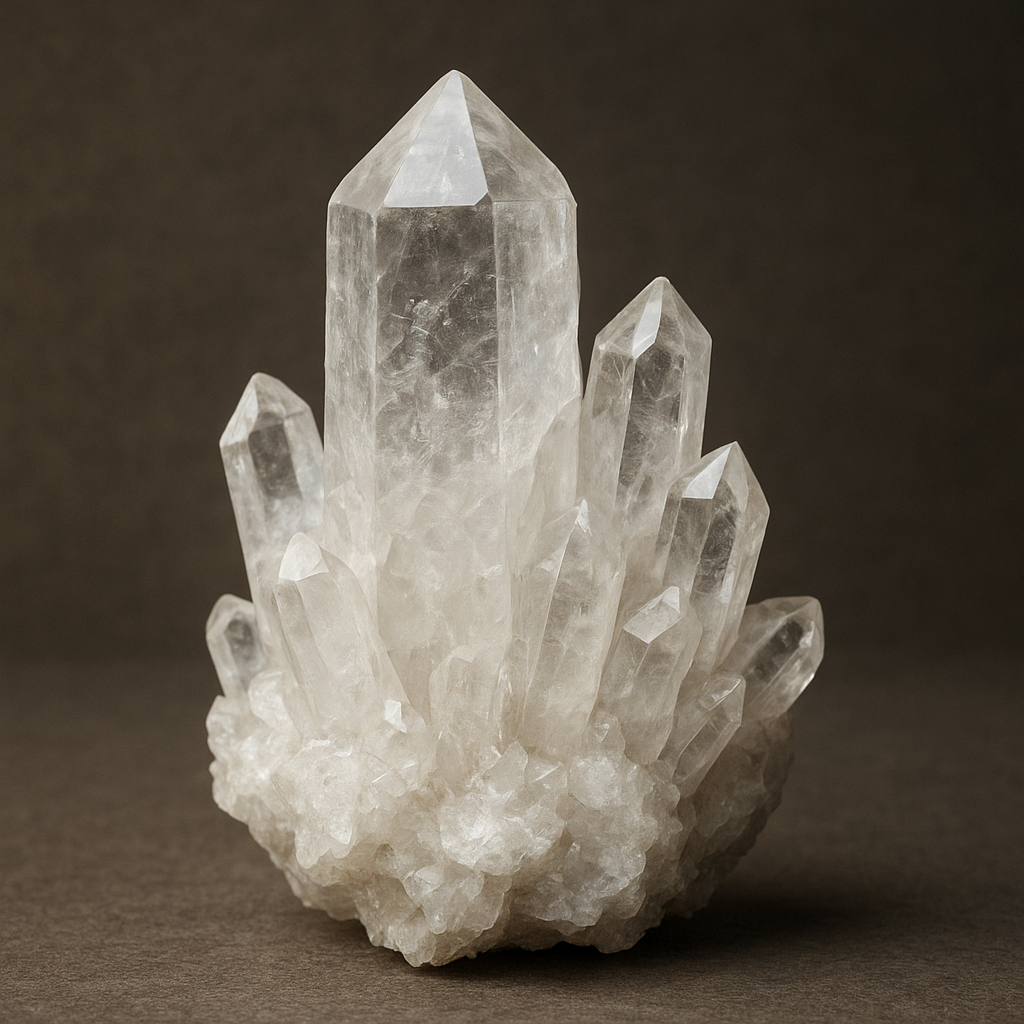
Adularia is a potassium-rich member of the feldspar group with a chemical formula approximating KAlSi3O8. It is often classified as a low-temperature, poorly ordered form of orthoclase—sometimes referred to as orthoclase-adularia—although the terminology in feldspar taxonomy can be subtle. Adularia typically crystallizes in the monoclinic system and is recognized by its tabular crystals, white to colorless appearance, and pearly luster on cleavage surfaces. Hardness generally falls around 6 to 6.5 on the Mohs scale, and specific gravity is roughly 2.56–2.60.
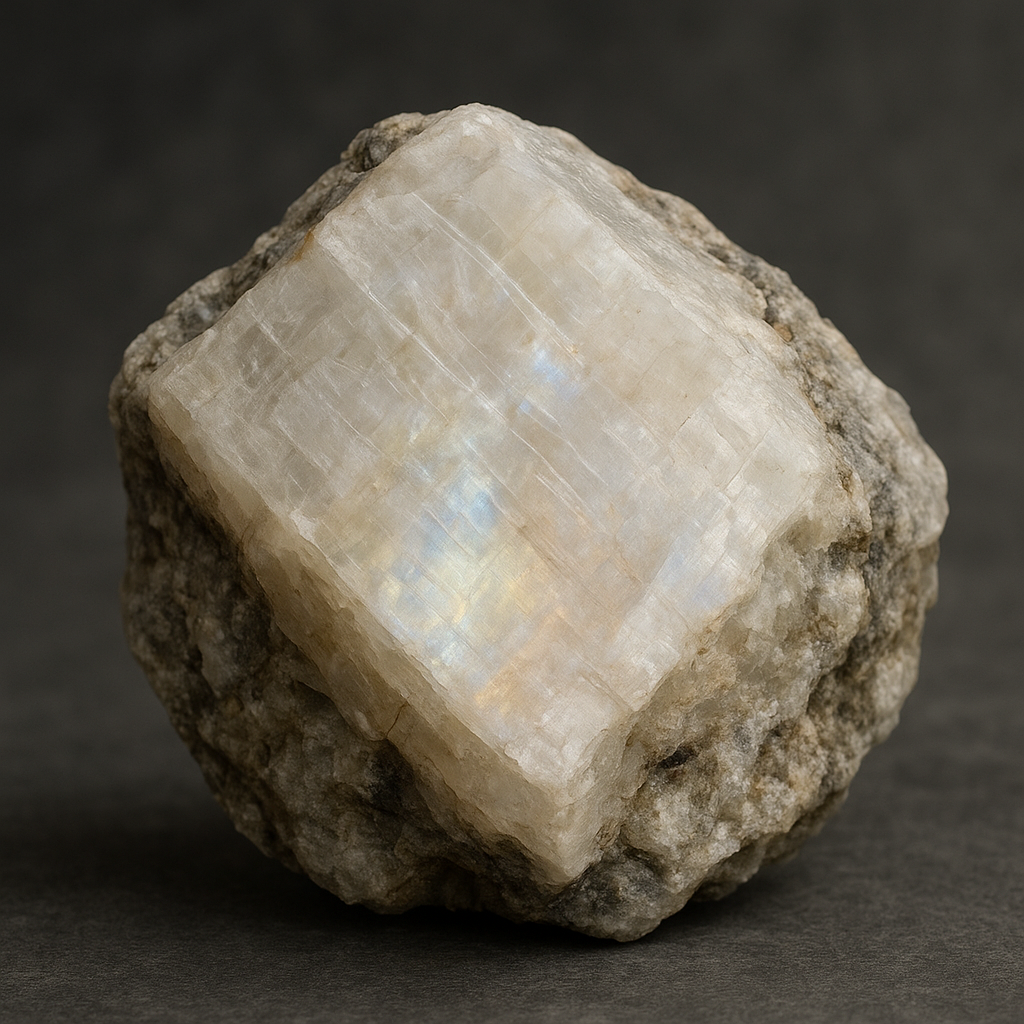
A particularly noteworthy optical phenomenon associated with some adularia specimens is adularescence, a soft, billowy light that appears to glide across the surface of the stone when it is moved. This effect arises from the scattering of light by extremely fine lamellar intergrowths and microscopic structures within the mineral—commonly the result of exsolution or other nanoscale layering between K-rich and Na-rich feldspar phases. When adularia displays a pronounced adularescent sheen and good transparency it is often cut and sold as the gem moonstone.
Typical geological settings and notable occurrences
Adularia forms in a range of low-temperature geological environments. It is most commonly associated with open-space fillings in veins, cavities, and fissures where hydrothermal fluids have precipitated minerals at relatively cool temperatures. Because of these conditions, adularia is a characteristic mineral in alpine-type fissures in metamorphic terranes, in volcanic-hosted hydrothermal systems, and as part of alteration halos in certain ore deposits.
Alpine fissures and pegmatitic pockets
Classic specimens of well-formed adularia crystals come from alpine-type fissures in high-grade metamorphic terranes. In these settings, meteoric or magmatic fluids percolate through fractures and precipitate adularia together with quartz, calcite and other gangue minerals. The Swiss Alps gave the mineral its name (from the Adula or Adula Alps region), and many historically important crystal specimens have been recovered from Alpine localities.
Low-sulfidation epithermal systems
In the world of economic geology, adularia is intimately connected with low-sulfidation epithermal gold and silver deposits. In these systems, ascending hydrothermal fluids cool and deposit quartz and adularia in open spaces, and these lithologies can host precious metal mineralization such as electrum, native gold, and silver sulfides. Because adularia forms under specific temperature and chemical conditions, its presence can serve as an indicator of favorable precious metal-bearing horizons in exploration.
Gem-producing regions
Gem-quality adularia (marketed as moonstone) originates from a number of regions around the world. Sri Lanka and parts of India — including the Kashmir area — have produced some of the finest moonstones prized for their intense blue or silvery adularescence. Other important gem localities include Myanmar (Burma), Madagascar, and certain deposits in Brazil and Peru. While adularia crystals for collectors are reported from European localities such as Norway and the Swiss Alps, gem-quality material often comes from tropical alluvial or primary sources in Asia and the Indian Ocean region.
- European alpine localities: Switzerland, Austria, Norway
- Asian gem sources: Sri Lanka, India (Kashmir), Myanmar
- Other noteworthy occurrences: Madagascar, Brazil, Peru, some areas of the United States
Uses and applications
Adularia has both scientific and commercial uses. While it is not a primary industrial source of potassium feldspar for glass and ceramics, its presence and textural relationships are valuable in geological interpretation. Adularia’s role in nature and industry can be considered under three headings: gem and ornamental use, scientific and exploration applications, and minor industrial uses of K-feldspar more generally.
Gemstone and jewelry
The most visible use of adularia is as a gemstone. When adularescence is strong and the stone is suitably transparent or translucent, the material is faceted or cabochon-cut and sold as moonstone. Moonstones may range from nearly colorless with a blue flash to pale peach, gray, or green varieties. The gem has been popular in jewelry for centuries, appearing in antique and Art Nouveau designs, as well as in contemporary artisan pieces. Gem-quality adularia often commands a premium when the adularescence is sharp, the body color is attractive, and the material is free from fractures and inclusions that diminish the optical effect.
Exploration and economic geology
Geologists use adularia as a petrologic clue. Its formation conditions—particularly in hydrothermal and near-surface environments—help constrain fluid temperatures, salinities, and histories of mineralizing systems. In epithermal exploration, adularia-quartz assemblages can mark the locus of precious metal mineralization. Geothermometry techniques and fluid-inclusion studies on adularia-bearing veins provide data used to reconstruct the evolution of ore-forming systems, assisting explorers in vectoring towards potentially mineralized zones.
Industrial context
Although large-scale industrial applications rarely require adularia specifically, potassium feldspars as a group are important fluxes in glassmaking and ceramics. In some local traditions where feldspar-bearing rocks are used for their feldspar content, adularia-bearing rocks might be a local source of raw material. For collectors and museums, high-quality adularia crystals are prized as display specimens.
Formation processes and scientific interest
Adularia yields insight into fluid-rock interaction at relatively low temperatures. The mineral commonly forms by precipitation from hydrothermal solutions that are moderately saline and enriched in potassium. In open cavities, cooling and depressurization lead to the nucleation of adularia crystals together with quartz, calcite, and sometimes zeolites or chlorite. Where conditions fluctuate, adularia may show zoning, twinning, or exsolution textures that reveal its thermal history.
The intimate relationship between adularia and adularescence also attracts materials-science interest. The optical effect is controlled by microstructures often only visible with high-resolution microscopy. Studies of adularia therefore contribute to broader understanding of light scattering, nanoscale lamellae formation, and the kinetics of feldspar ordering and exsolution. These microscopic structural details are the reason why some specimens make exceptional gems while others do not.
Adularization and alteration
The term “adularization” is used by geologists to describe the alteration process that introduces potassium into rocks and precipitates adularia, typically transforming earlier mineral assemblages into K-feldspar rich assemblages. This process is commonly associated with boiling or mixing of hydrothermal fluids in shallow crustal environments and can be a hallmark of chemically reducing conditions that favor deposition of native gold in epithermal systems.
Collecting, conservation and curious facts
Adularia is popular among mineral collectors for several reasons: well-formed crystals can be striking, the association with quartz often produces attractive specimens, and gem-quality pieces have additional market appeal. Collectors should be aware of a few practical points.
- Specimen stability: Adularia is relatively stable but can be brittle. Avoid harsh cleaning with acids and take care when cleaning to preserve the adularescent surface.
- Jewelry care: As a gemstone, moonstone requires gentle handling. Cabochons should be protected from sharp blows and stored separately to avoid scratches from harder gems.
- Identification: Distinguishing adularia from other K-feldspars or moonstone-like materials requires observation of crystal habit, cleavage, and optical properties; thin-section petrography or X-ray diffraction can confirm identity.
Some entertaining and educational facts: adularia gave its name to the classic gem effect found in moonstone, and historic alpine localities remain emblematic in mineral literature. The mineral’s association with precious metals means that fine adularia specimens are sometimes recovered from old mining dumps and veins, giving collectors a glimpse of both geological beauty and mining history. Modern scientific work continues to tease apart the nanoscale causes of adularescence, connecting traditional gem lore with cutting-edge microscopy and spectroscopy.
Research directions and open questions
Active research themes involving adularia include refining the temperature and fluid-chemistry constraints on its formation, understanding the kinetics of ordering and exsolution that produce adularescence, and improving the use of adularia as a pathfinder mineral in exploration. Additionally, by integrating isotopic studies, fluid inclusion microthermometry, and high-resolution imaging, scientists aim to better reconstruct the life history of hydrothermal systems that produce economically important mineralization. Given the mineral’s accessibility in many low-temperature vein systems, adularia will likely remain a focus for both academic study and applied exploration for years to come.