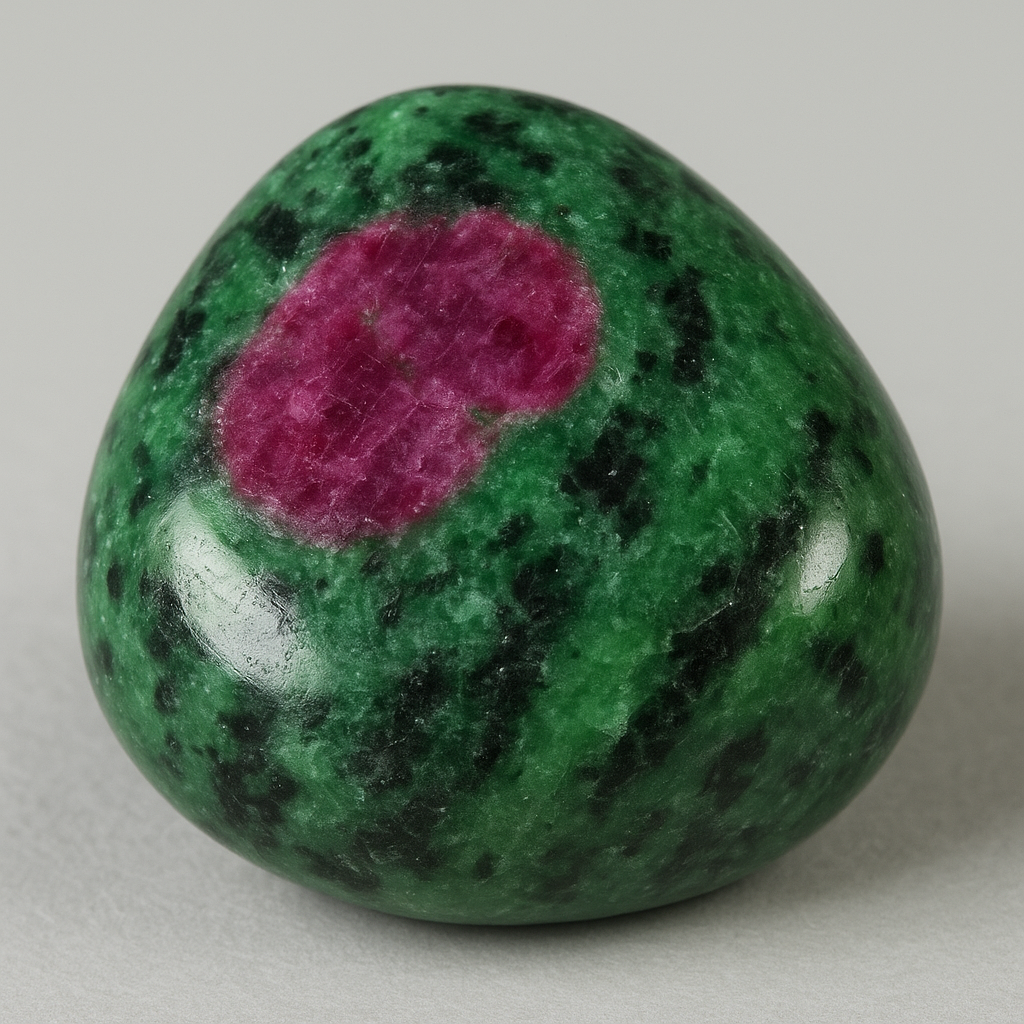
Ruby-in-zoisite is an arresting natural combination of vivid red corundum embedded in a verdant matrix of green zoisite, sometimes streaked or dotted with black hornblende. The stone—often sold under the trade name anyolite—has captured attention from gem collectors, lapidaries and designers because of its striking contrast of colors, intriguing formation history and accessible price point. This article explores the mineralogy, global occurrences, practical uses, lapidary considerations, care and cultural meanings associated with this material, and highlights a few lesser-known but fascinating details that make ruby-in-zoisite worth studying and wearing.
Mineralogy and Formation
At its core, ruby-in-zoisite is a natural assemblage of two main minerals: green zoisite (a member of the epidote group) and red ruby (gem-quality corundum). Zoisite itself is a calcium aluminum silicate mineral with the formula Ca2Al3(SiO4)(Si2O7)O(OH). It forms under regional or contact metamorphic conditions where aluminum- and calcium-bearing rocks are subjected to heat and pressure. When chromium is present during formation, it can color corundum to deep red and impart greenish hues to zoisite, resulting in the visually spectacular intergrowths that define ruby-in-zoisite.
The assemblage often contains black amphibole (commonly tschermakite or hornblende) that provides a dramatic contrast and enhances visual depth. The growth of ruby crystals within a zoisite matrix indicates a complex metamorphic history: aluminum-rich protoliths underwent conditions that allowed corundum to crystallize first or simultaneously, followed by zoisite growth during retrograde metamorphism. In places where fluids were chromium-enriched, localized red corundum could nucleate inside or adjacent to zoisite-rich zones.
Key physical properties
- Composition: mixture of zoisite (Ca-Al silicate) and corundum (Al2O3)
- Hardness: variable—zoisite ~6–7 on the Mohs scale; ruby (corundum) is 9
- Specific gravity: typically in the range of 3.2–3.6 depending on proportions
- Cleavage and fracture: zoisite shows good cleavage in one direction and may be brittle; corundum has no cleavage but conchoidal fracture
- Luster: vitreous to pearly on zoisite; adamantine on polished corundum faces
Because the two minerals have different hardnesses and behavior under cutting and wear, ruby-in-zoisite presents both aesthetic opportunities and technical challenges for gem cutters and jewelers.
Where It Occurs
Ruby-in-zoisite is most famously associated with East Africa, but similar occurrences are known from several parts of the world. Deposits are typically found where metamorphosed aluminous rocks—such as gneiss, schist or impure marbles—were exposed to chromium-bearing fluids or rocks during metamorphism.
Notable localities
- Tanzania — The Longido and Tunduru regions, near the Arusha area, are the classic and most commercially significant sources of ruby-in-zoisite. The material from Tanzania was first brought to the wider market in the mid-20th century and is often marketed under the trade name anyolite.
- Kenya — Adjacent geological terrains produce similar zoisite-corundum assemblages; occurrences in Kenya are less extensive but contribute to regional supply.
- Other regions — Fragments or similar combinations have been reported in parts of southern Africa, India and Austria, though none of these rival the Tanzanian deposits in scale or fame.
The large, easily collectible masses from Tanzanian workings have fueled both the lapidary trade and local carving industries. Most commercially available anyolite today originates from small-scale mines where hand-sorting yields decorative pieces suited to cabochons, beads and carved objects.
Uses and Applications
Ruby-in-zoisite has found a comfortable niche that straddles affordable gemstone jewelry, decorative carvings and metaphysical markets. Its visual drama—red eyes or veins of ruby punctuating a green field—creates strong aesthetic appeal without the cost of solid ruby or fine tanzanite.
Jewelry
Because of its relatively accessible price and distinctive appearance, ruby-in-zoisite is popular in artisan and statement jewelry. Typical applications include:
- Cabochons set in silver or mixed-metal designs—cabochon cuts enhance the color contrast and mask the material’s natural cleavage
- Beads and mala strands—smooth, polished beads show the patterning well and are durable enough for daily wear if treated with basic care
- Inlay work and statement pendants—thicker slices serve as focal pieces in necklaces and bracelets
Fine faceting is less common because the mixed-mineral nature makes it difficult to achieve even light behavior across the stone; cabochons and carvings are the lapidary staples.
Carving and ornamentation
Large blocks of anyolite are readily carved into figurines, spheres, eggs and decorative objects. Carvers prize the material for the way the red ruby accents can be positioned to form “eyes” or focal points in sculptures, while the green zoisite provides the body and texture. Because the stone polishes to a rich sheen, finished pieces are visually compelling and relatively affordable compared to single-mineral counterparts like jade or high-grade marble.
Metaphysical and holistic uses
In metaphysical circles, ruby-in-zoisite is often associated with vitality, transformation and energetic balance. Practitioners attribute the red corundum with stimulating life force and passion, while the green zoisite is linked to growth, healing and the heart center. Such meanings—though not scientifically proven—contribute substantially to demand among spiritual and wellness communities.
Lapidary Techniques and Design Considerations
Working ruby-in-zoisite requires sensitivity to its mixed composition. The juxtaposition of a very hard mineral (corundum) and a softer, cleaving host (zoisite) affects cutting strategy, tooling and finishing.
Cutting and shaping
- Use coarse diamond wheels for initial shaping. The hardness contrast causes uneven wear on wheels, so cutters should monitor tools and switch to finer laps carefully.
- Cautious thinning: when removing material near visible corundum grains, work slowly to prevent chipping at the zoisite-corundum interface.
- Cabochon cutting is preferred. The rounded form minimizes the appearance of fractures and enhances the stone’s color interplay.
- Faceting is possible but demanding; any attempt risks differential polish rates and a faceted surface that highlights the different optical properties of the constituents.
Polishing
Final polish usually involves successively finer diamond pastes or cerium oxide depending on composition. Polishing corundum to a high luster is straightforward, but zoisite can take a slightly different sheen; blending these to a uniform finish is a skillful task. Carvers often use rotary tools and diamond burs for delicate areas around separate corundum crystals.
Design strategies
- Emphasize contrast by orienting a ruby inclusion as a focal point—this yields “eye” pendants and figurines with dramatic appeal.
- Use silver or mixed metals that complement both green and red tones. Yellow gold can be overpowering; white metals and antiqued finishes often work best.
- In settings, mount stones to protect cleavages: bezel mounts and protective prongs reduce risk of impact damage compared to exposed edge settings.
Care, Treatments and Identification
Ruby-in-zoisite is generally untreated and sold in natural form. However, buyers and owners should be aware of its physical sensitivities and common identification markers.
Care and cleaning
- Avoid harsh heat: while corundum withstands heat well, prolonged exposure can affect zoisite’s stability. Do not steam clean or use high-heat processes.
- Clean with warm, soapy water and a soft brush; ultrasonic cleaners may be risky if the piece contains internal fractures or tension between minerals.
- Store carefully: because zoisite can chip or cleave, store pieces separately or cushioned to avoid impact.
Treatments and enhancements
Most commercial ruby-in-zoisite is untreated. Dyes, resins or stabilization can be applied in some lower-grade pieces to improve appearance, so buyers should request disclosure from reputable dealers. The presence of epoxy fills or artificial coloring can often be detected under magnification or by noting unusually uniform color and lack of natural texture.
How to identify genuine ruby-in-zoisite
- Visual contrast: natural assemblages show irregular intergrowths of red and green; painted or assembled pieces may show unnaturally sharp boundaries.
- Hardness test: corundum areas should resist scratching by a steel point, while zoisite will be scratched more easily; avoid destructive testing on valuable specimens.
- Use of a loupe: look for growth zoning, natural inclusions, and the textural relationship between corundum and zoisite—lab-grown composites typically lack complex natural interfaces.
Cultural, Historical and Market Notes
The trade name anyolite—used widely in crafts and by some gem dealers—originated in the mid-20th century and is sometimes attributed to a Maasai word, though etymologies vary in sources. Regardless of naming, the material’s rise in popularity correlates with increased small-scale mining in northern Tanzania and greater global demand for distinctive, affordable gemstones.
Market positioning
Ruby-in-zoisite occupies an accessible price tier. It is significantly less expensive than clean, facetable ruby, yet its dramatic color pairing gives designers and consumers the glamour of a statement piece without the large investment. This affordability has made it a staple in artisanal and museum-shop type offerings, as well as in contemporary jewelry lines that favor bold color contrasts.
Collecting and specimen appreciation
Collectors prize large, well-patterned specimens that show full ruby crystals embedded in an attractive zoisite host. Museum-quality pieces display outstanding crystal form, excellent color saturation and minimal fractures. Large carved objects and polished slabs of anyolite command interest both for their visual drama and for the story they tell about metamorphic processes.
Metaphysical Associations and Popular Beliefs
In crystal healing and New Age communities ruby-in-zoisite is often used as a stone of transformation. Practitioners assign the combination of red and green to balancing heart and vitality energies, and some use the stone during meditation to foster creativity, courage and groundedness. While such claims are spiritual rather than scientific, they significantly influence demand and how the stone is marketed.
Common metaphysical uses
- Balancing the heart and root chakras—red for life force, green for compassion
- Enhancing personal growth and change—used in rituals focused on transition and renewal
- Wearing as a talisman for motivation and emotional resilience
Interesting Facts and Lesser-Known Details
Beyond its visual appeal, ruby-in-zoisite has a few quirks and stories that make it interesting to mineral enthusiasts:
- Because the material combines minerals of different hardnesses, polished flat faces sometimes show micro-reliefs at the boundaries where corundum resists wear while zoisite dulls more quickly.
- Large, clean ruby crystals embedded in zoisite are rare and can raise the value of a specimen considerably; such specimens are often more valuable to mineral collectors than to jewelers.
- The aesthetic use of contrasting mineral assemblages has a long history in decorative arts (e.g., in pietra dura), and ruby-in-zoisite is a naturally occurring example of this visually compelling approach.
- Some wildlife and botanical-inspired carvers intentionally orient ruby spots as eyes or blossoms, integrating geology into narrative sculpture.
Whether appreciated for its geological story, its affordability as a vibrant gemstone, or its symbolic resonance in spiritual practices, ruby-in-zoisite remains a fascinating and versatile material. Its combination of mineralogical complexity and visual drama ensures that it will continue to attract interest from a wide audience, from field geologists and mineral collectors to jewelers, artisans and those seeking meaningful adornment.