
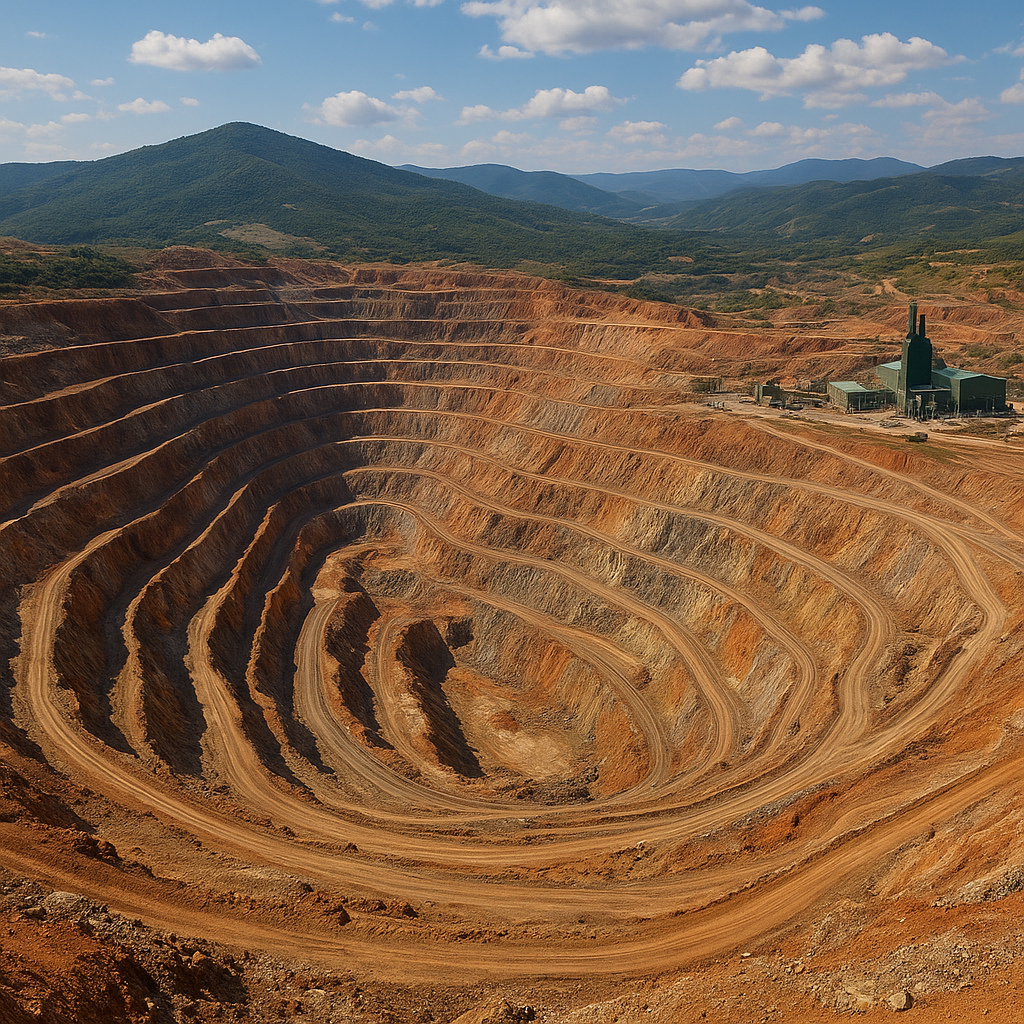
The Asarel mining complex is a defining feature of central Bulgaria’s industrial landscape and a cornerstone of the country’s non-ferrous metal sector. Located close to the town of Panagyurishte, this operation exploits one of the region’s most important copper-bearing deposits. The site combines decades of geological research, large-scale open-pit mining and modern processing to produce a copper concentrate that feeds smelters and the wider metals market. Beyond raw output, the mine exerts a substantial influence on local employment, regional infrastructure and Bulgaria’s position in global mineral supply chains, while raising complex questions about environmental management and sustainable development.
Location and geological setting
The Asarel complex lies in the Sredna Gora mountain zone of central Bulgaria, an area known for its rich mineralization and long mining tradition. The deposit is part of a larger copper district around Panagyurishte that includes several related centers of mineral wealth. Geologically, the ore bodies are typical of a porphyry-style system: disseminated sulfide mineralization hosted in intrusive rocks and their surrounding country rocks. These systems are characterized by large volumes of relatively low-grade ore, which are economically viable only when mined at scale using bulk-mining methods.
The dominant ore minerals in the Asarel deposit include chalcopyrite (the principal copper-bearing sulfide), together with lesser quantities of bornite and secondary copper minerals in oxidized zones. Associated elements such as gold and silver often occur as by-products, and trace amounts of molybdenum or other metals can be present depending on the local lithology and hydrothermal history. The overall geological picture is one of a structurally controlled porphyry system, where hydrothermal fluids introduced copper and other metals into a permeable network of fractures and altered host rocks.
Mining method and processing
Asarel is primarily an open-pit operation, which means the ore is extracted from large surface pits using a combination of drilling, blasting, loading and hauling. Modern surface mining equipment—shovels, excavators, large haul trucks and sometimes in-pit crushers and conveyors—are employed to move millions of tonnes of rock per year. The open-pit approach suits the deposit’s geometry and grade, allowing operators to process huge tonnages at relatively low cost per tonne.
Once ore is delivered to the processing facilities, it undergoes comminution (crushing and grinding) to liberate sulfide particles. After size reduction, the material is treated by flotation, where chemicals and air bubbles separate hydrophobic sulfide particles into a concentrated product. The resulting copper concentrate typically contains the bulk of the copper and valuable by-product metals and is then thickened, filtered and transported—often by truck or rail—to smelters and refineries for final metal recovery. Modern plants emphasize high recovery rates and concentrate grades to maximize the value of each tonne of ore mined.
Economic importance and regional role
The Asarel complex ranks among the most important industrial assets in the region, contributing directly and indirectly to Bulgaria’s economy. Direct benefits include salaries for a large workforce, tax and royalty payments to national and local governments, and contracts with local suppliers for services, maintenance, transportation and construction. Indirectly, the mine stimulates the broader supply chain: hotels, restaurants, retail, engineering services and educational institutions that train skilled workers.
From an export perspective, copper and copper concentrates are significant foreign-exchange earners. The metal is a critical input for electrical wiring, electronics, construction and transport infrastructure globally, so steady production supports Bulgaria’s balance of trade. The mine’s output also helps to sustain downstream industries in the country and neighboring regions, such as smelting and refining operations, metal fabrication and component manufacturing.
Social and community interactions
Large mining operations such as Asarel play a visible role in community life. The company’s social programs commonly fund infrastructure improvements—roads, schools, medical facilities—and cultural activities in Panagyurishte and nearby villages. Training and apprenticeship schemes help local residents gain technical skills, increasing local employment opportunities and reducing outmigration from rural areas.
At the same time, the presence of a mine challenges communities to balance economic benefits with quality-of-life concerns. Noise, dust and changes in landscape can generate tensions that require careful management and ongoing dialogue between the company, municipal authorities and residents. Successful community relations programs typically combine transparent communication, fair compensation for land use, participatory planning for rehabilitation and sustained investment in local development projects.
Environmental management and sustainability
Environmental stewardship is a central theme in modern mining practice and a major focus at Asarel. Key environmental issues include management of waste rock and tailings, protection of water resources, dust suppression, biodiversity conservation and control of acid rock drainage where sulfide minerals are exposed to air and water. To address these challenges, operators implement a range of technical and administrative measures: lined tailings facilities, thickened tailings and dry stacking options, water recycling systems, progressive rehabilitation of disturbed land and continuous environmental monitoring.
Tailings storage remains one of the industry’s most important safety and environmental priorities. The design and maintenance of tailings dams follow international standards and national regulations, and operators increasingly adopt improved technologies to reduce risk—such as filtered tailings, staged embankments and rigorous seismic stability assessments. Water management includes collection and treatment of contact water, minimizing seepage to groundwater and reusing process water to reduce freshwater intake.
Environmental programs at Asarel tend to be accompanied by independent audits, community reporting and sometimes collaboration with universities or NGOs for biodiversity assessments and restoration projects. The mine’s environmental record is not without controversies, as is common in the sector, but continuous investments in mitigation and monitoring are central to how the operation presents itself to regulators and the public.
History, ownership and modernization
The Panagyurishte mining district has a layered history that stretches from ancient small-scale extraction to industrial-scale operations in the 20th century. The modern Asarel complex evolved during the mid-to-late 20th century as a planned industrial enterprise, with major expansions and technological upgrades in subsequent decades. Like many mines in Eastern Europe, Asarel has undergone waves of modernization, privatization and restructuring since the end of the socialist era—shifts that have changed ownership structures, investment patterns and operational focus.
In recent decades, investments have focused on plant upgrades, automation, improved haulage logistics and stronger environmental controls. Advances in mineral processing chemistry have raised recoveries, while information technology and automation have improved fleet management and safety. These improvements have lengthened the life-of-mine and enhanced operating efficiency, making the deposit viable for a longer period than earlier models predicted.
Interesting facts and technical highlights
- The Asarel open pit is large enough to be a prominent landscape feature and, in clear satellite imagery, can be observed from space—an indication of the scale typical to porphyry-style mining.
- Although the mine primarily produces copper, valuable by-products such as gold and silver often accompany the concentrate and contribute to the project’s overall economics.
- Modern mining logistics at Asarel make extensive use of heavy machinery and, in some areas, in-pit crushing and conveying systems to optimize haul distances and reduce truck traffic.
- The mine has spurred local industrial clusters—foundries, repair shops and engineering firms—that service both mining and non-mining customers across central Bulgaria.
- Workforce training programs at the complex emphasize multi-skill technicians who can operate and maintain complex processing equipment and environmental systems, reinforcing long-term local capacity.
Challenges and future outlook
Looking ahead, the long-term viability of Asarel depends on several interlinked factors. Commodity prices are a fundamental driver: sustained higher prices for copper can justify deeper benches or lower-grade ore processing, whereas prolonged price weakness places pressure on margins and investment. Resource depletion and the need to access deeper or more complex ore bodies increase costs and technical challenges. Innovations in ore-sorting, energy efficiency and processing chemistry may extend the mine life by improving recoveries and reducing operating expenses.
Societal expectations around environmental performance and corporate responsibility are rising, so maintaining the mine’s social license to operate will require continued transparency, community investment and measurable environmental improvements. Finally, global trends such as electrification, renewable energy rollouts and the growth of electric vehicles are likely to increase long-run demand for copper—potentially strengthening the strategic importance of assets like Asarel for both Bulgaria and the wider European metals supply chain.
Concluding observations
Asarel is more than a single mine; it is a regional economic engine and a complex technical enterprise that illustrates many of the central themes of contemporary mining. From its geological roots in porphyry mineralization to its role in producing copper concentrate, from the practicalities of large-scale open-pit extraction to the ongoing work of environmental management and community engagement, the site exemplifies both the opportunities and responsibilities that come with extracting industrial raw materials. Its continuing evolution will be shaped by geology, markets, technology and the dialogue between operators, regulators and local communities—an interplay that will determine the mine’s legacy in central Bulgaria for decades to come.

