
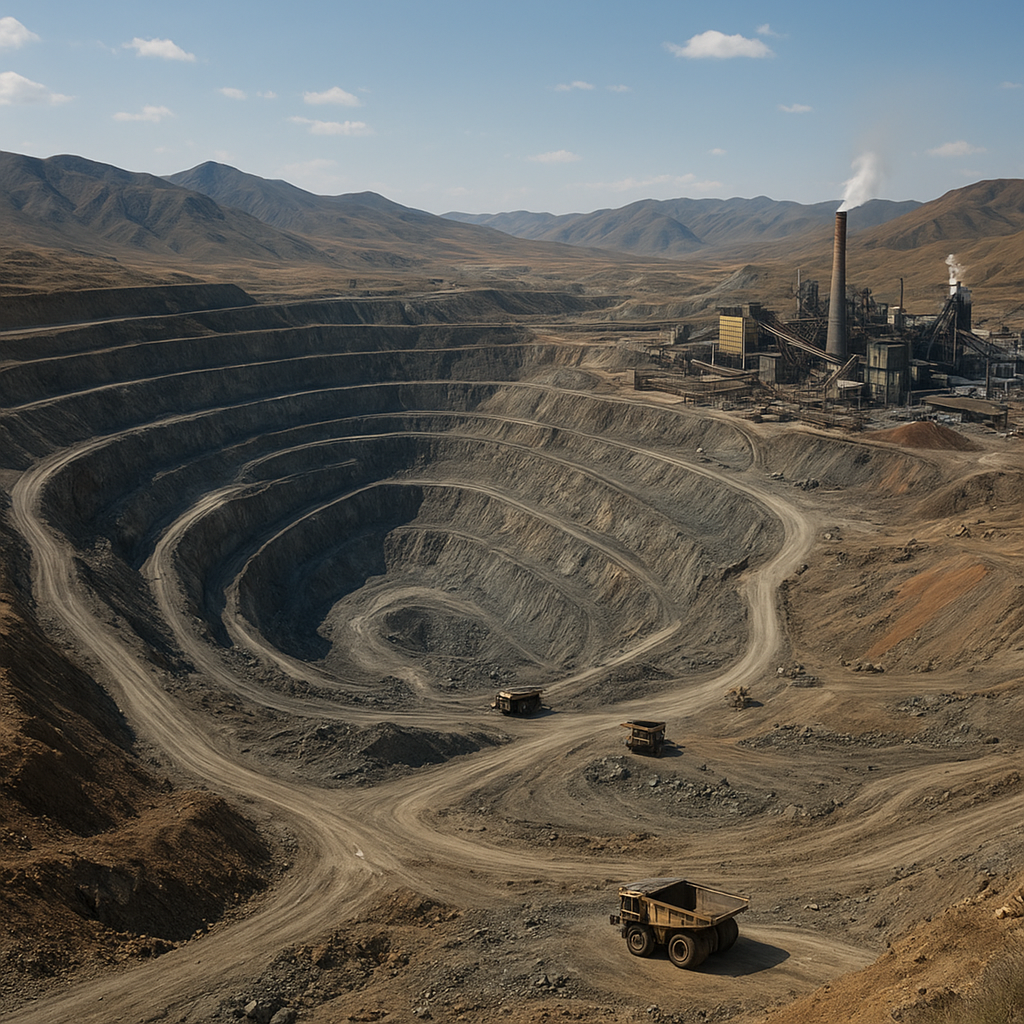
The Aksu Ferroalloy facility and associated mining operations form an important node in Kazakhstan’s industrial landscape. Situated in the northern steppe near the city of Aksu, the complex is best understood as an integrated cluster where raw ore resources are extracted, processed and transformed into high-value ferroalloy products. While the precise technical configuration varies over time with investments and technological shifts, the site’s long-term role has been to convert chromium-bearing materials into the inputs that feed global stainless steel and specialty metallurgy industries. This article describes where the operation is located, what is extracted and processed there, the wider economic importance of the activity, and several points of interest that illuminate why Aksu’s ferroalloy activities matter beyond their immediate industrial function.
Location, geology and regional context
The Aksu operations are anchored close to the town of Aksu in the Pavlodar Region of northeastern Kazakhstan, a part of the country characterized by broad plains, river systems and accessible transport corridors that historically supported large-scale industry. Aksu itself is positioned on the Irtysh River, which has for decades offered logistical advantages: water for industrial processes, a corridor for rail and road, and connection to broader Eurasian trade routes.
Geologically, the deposits that feed ferroalloy plants are typically chromite-bearing ultramafic bodies or layered intrusions that hold concentrations of chromium and other transition metals. Where chromite is present in economically viable concentrations, it can be extracted either as open-pit or underground material, depending on the depth, shape and overburden. In the broader Kazakh context, chromium resources are distributed across a number of belts; the Aksu-related operations are notable for securing nearby feedstock or for being a processing hub for chromite concentrates brought in from regional sources.
Transport and logistical setting
Strategically, the Aksu complex benefits from its multimodal connectivity. Rail links in the Pavlodar region connect to Kazakh domestic markets and to Russian transcontinental lines; highways link to industrial centers and export terminals. This transport network reduces costs for importing raw materials, exporting finished ferroalloys, and mobilizing labor and equipment. The triad of river access, rail, and road makes the location attractive for metal processing facilities that must balance raw-material supply with global market access.
Mining, processing and products
At the heart of the operation is the conversion chain from mined material to market-ready ferroalloy. The initial stage is extraction: chromite-bearing ore is mined, typically crushed and concentrated through physical beneficiation such as gravity separation, magnetic separation or flotation to increase the chromium content and remove gangue minerals. The concentrates are then suitable feed for smelting in electric furnaces, where they are combined with carbon materials to produce ferrochrome, a core ferroalloy used in stainless steel and corrosion-resistant alloys.
Furnacing at Aksu-type plants often uses submerged arc furnaces or similar high-temperature electrothermal units. These smelting processes reduce the chromite and produce alloys with variable chromium content depending on the intended application. Low-carbon ferrochrome variants and high-carbon ferrochrome variants address different segments of metallurgy: stainless steel makers, specialty alloy producers, and certain engineering applications that require specific impurity profiles and mechanical properties.
- Primary products: ferrochrome (high-carbon and low-carbon variants), chromium metal for specialty uses, and intermediate concentrates.
- By-products: slag with recoverable metals, dusts captured by filtration systems, and heat which may be recovered in integrated setups.
- Typical downstream customers: stainless steel mills, alloy producers, and metallurgical converters in regional markets across Eurasia.
Processing innovations and quality control
To meet modern quality specifications, processing lines at significant ferroalloy complexes incorporate continuous sampling, computerized process control, and modern refractory linings to optimize furnace life and product consistency. Aksu operations have historically trended toward such upgrades where investments allowed: automated control reduces energy consumption per tonne of alloy, and advanced dust-collection systems both protect workers and recover valuable particulates. Quality control laboratories test for chromium content, carbon, silicon, manganese and trace impurities—parameters critical for industrial buyers.
Economic significance and regional impact
The Aksu ferroalloy activities contribute at multiple levels to the Kazakh economy. On the local and regional level, the facility is an employer and a source of industrial wages, stimulating demand for services, housing and transport. On the national level, ferroalloy production supports exports, helps diversify the mineral economy beyond hydrocarbons, and anchors skills and supply chains in heavy industry.
Ferroalloys are an important value-added step in the raw-material chain: instead of merely exporting chromite concentrates, creating ferrochrome domestically captures a larger share of the value of the mineral endowment. This value capture supports local suppliers, creates higher-wage technical jobs, and generates tax revenue for municipal and regional budgets. In many resource-rich countries, the move up the value chain—from ore extraction to alloy production to finished metal—has been a central industrial policy objective; Aksu’s ferroalloy operations align with that strategic aim.
- Employment: direct jobs at the plant and mine, plus indirect jobs in logistics, maintenance, and supporting services.
- Fiscal contribution: corporate taxes, royalties, and local levies that support public services.
- Industrial clustering: the presence of a ferroalloy plant attracts suppliers, maintenance contractors, and secondary processors.
- Export diversification: ferroalloys enter global markets as higher-value merchandise compared with raw ore.
Market drivers and vulnerabilities
Global demand for stainless steel and specialist alloys drives the market for ferrochrome. When global stainless steel production expands, demand — and thus prices — for ferroalloys rises, benefiting producers. Conversely, downturns in steel production, trade barriers, fluctuating energy costs, or disruptions in raw-material supply chains can hurt profitability. Energy intensity is a particular vulnerability: smelting is electricity- and carbon-intensive. Plants that secure stable, affordable power and invest in energy efficiency are more resilient.
Environmental, social and governance aspects
Mining and smelting operations carry environmental footprints that require modern management. Typical impacts include dust and particulate emissions, water consumption and discharge, tailings and slag management, and landscape alteration where open-pit mining occurs. The Aksu context—like comparable operations worldwide—has been moving toward stricter environmental controls driven by regulation, lender requirements, and corporate responsibility goals.
Key mitigation and management strategies include enclosed handling systems for ore and concentrates to limit dust, multi-stage filtration and electrostatic precipitators on furnaces, tailings dams with engineered liners, and progressive rehabilitation of disturbed lands. Water recycling in beneficiation plants reduces freshwater withdrawal; energy efficiency and modernization reduce greenhouse gas emissions per tonne of product. Investments in monitoring programs and transparent reporting improve community trust.
Social license and community relations
Maintaining social license to operate is central. Employment and procurement benefit local economies, but communities rightly expect measures to protect health, secure livelihoods after mine closure, and ensure that pollution does not degrade local environments. Community engagement programs, local hiring initiatives, vocational training, and infrastructure projects (roads, medical facilities, schools) are common ways mines and plants contribute beyond direct employment. Long-term planning for mine closure and land reclamation is a vital part of responsible operations.
History, ownership and development trajectory
Many industrial centers in Kazakhstan trace their origins to Soviet-era investment in heavy industry and metallurgy. Over subsequent decades, ownership structures shifted through privatization, consolidation and foreign partnerships. The Aksu ferroalloy complex has evolved similarly, adapting to market reforms, investment cycles, and technological change. Where new capital has been applied, upgrades to furnaces, beneficiation circuits and environmental systems have improved productivity and product quality.
Recent trends shaping development trajectories include:
- Modernization of smelting and beneficiation technology to improve yields and reduce energy intensity.
- Integration with regional value chains to secure feedstock and market access.
- Strategic partnerships and export agreements that open markets for ferrochrome products.
These shifts influence not only production levels but also the competencies and career profiles of the local workforce.
Interesting aspects and lesser-known points
Several features of Aksu-style ferroalloy operations often surprise those unfamiliar with the sector:
- Historical continuity: many modern plants build on decades of accumulated metallurgical know-how, combining legacy infrastructure with cutting-edge control systems.
- Integration benefits: proximity of processing to transport hubs reduces logistic costs and curbs wasteful shipments of low-value concentrates.
- Technical nuance: producing low-carbon ferrochrome—a product prized by stainless steel makers—requires careful control of furnace chemistry and alternative reducing agents, and commands premium prices when specifications are tight.
- Energy innovation: some sites experiment with waste-heat recovery to feed district heating or preheat process streams, improving overall plant efficiency.
- Global linkages: despite being regionally anchored, plants like Aksu are sensitive to policies and demand in distant markets—European and East Asian stainless steel output can materially affect local profitability.
Opportunities for the future
Looking forward, the Aksu complex and similar operations have opportunities in several directions: diversifying product mixes (e.g., producing higher-purity chromium for specialty alloys), investing in decarbonization pathways (electrification, energy recovery, carbon capture where feasible), and deepening local value chains (co-locating downstream stainless steel or alloy processing). Emphasizing sustainability and compliance with international environmental and social norms can also facilitate access to green finance and premium markets.
Finally, the role of infrastructure—reliable power, rail links, and port access—cannot be overstated. Efficient logistics lower per-tonne costs, enabling competitive pricing on the world stage. For Kazakhstan, leveraging sites like Aksu to move further up the metallurgical value chain supports national ambitions to diversify industry and increase the economic returns from its mineral wealth.

