
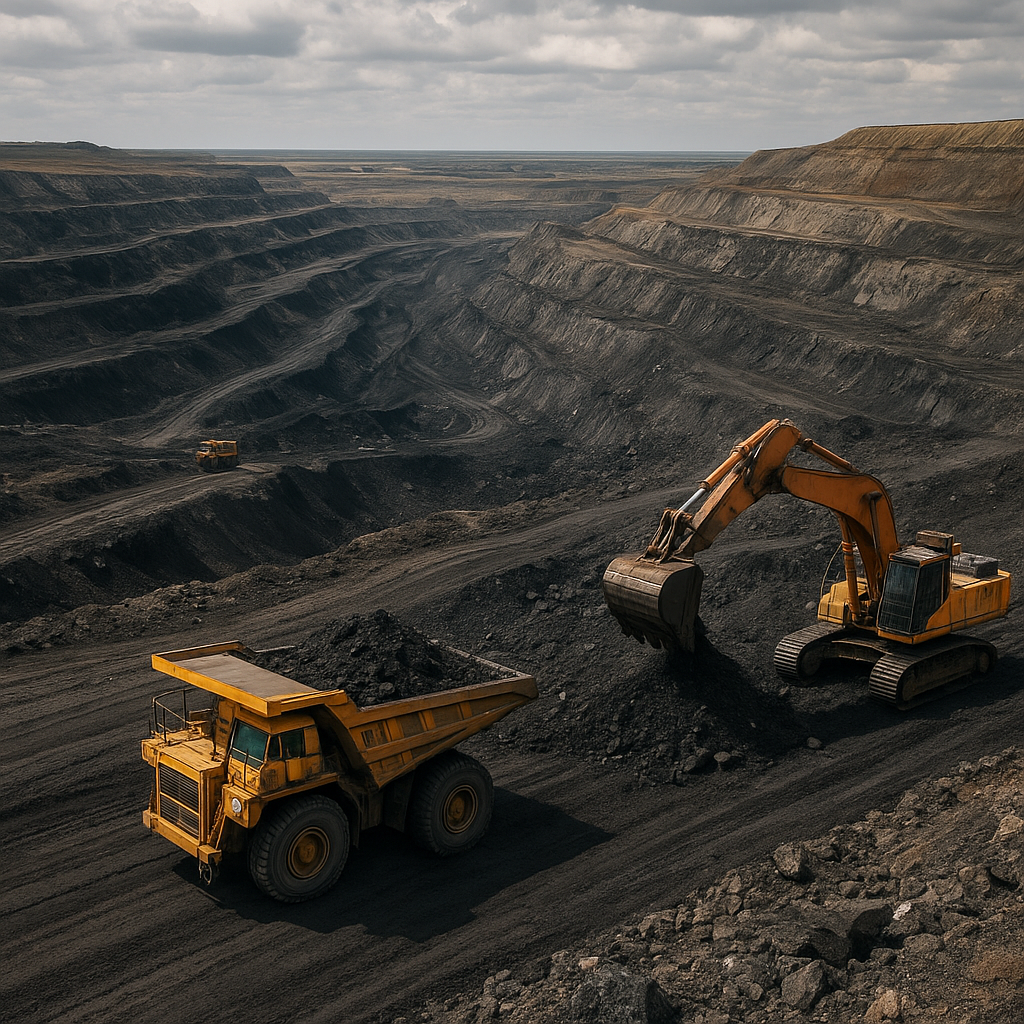
The coalfields around the city of Karaganda form one of Central Asia’s most important mining regions. Located in central Kazakhstan, the Karaganda coal basin has powered local industry, supplied national energy systems, and shaped the social and urban landscape for nearly a century. This article examines where the mines are, what types of coal they produce, the basin’s economic importance, the technical and environmental challenges of extracting fossil fuels in the region, and several notable or surprising aspects of this storied mining area.
Location and geological setting
The Karaganda coalfields lie in the heart of Kazakhstan on the Kazakh Uplands, roughly between the cities of Karaganda and Temirtau and extending into adjacent districts. The region is often referred to as the Karaganda basin or Karagandy Coal Basin. It occupies a large intermontane area with a continental climate—hot summers and very cold winters—which has influenced both mining operations and settlement patterns.
Geologically, the basin contains multiple coal-bearing strata formed during the Permian and Carboniferous periods. These strata host a variety of coal ranks and seam geometries: from near-surface seams that permitted early open-pit or shallow underground workings, to deeper, thicker seams requiring modern underground techniques. The basin’s coal is mainly of the bituminous type with significant volumes of coking-quality coal, which is particularly important for metallurgical processes.
Seam characteristics and distribution
- Coal seams in the basin vary in thickness; many key seams are several meters thick, making them attractive for mechanized extraction.
- The coal has favorable properties for industrial use—relatively high carbon content and good coking characteristics in many deposits.
- Associated geology includes mudstones, sandstones, and occasional intercalated mineral layers that affect mining design and ventilation.
Mining history and development
The discovery and exploitation of coal in the Karaganda region accelerated in the early 20th century, but it was during the Soviet period that the basin was developed intensively. Towns and cities, including Karaganda itself, grew around mines and associated heavy industry—most notably steelmaking facilities in nearby Temirtau. Coal mining shaped demographic flows, with waves of workers and specialists moving into the region.
Large-scale state-driven investment during the Soviet era prioritized coal for both energy and metallurgy. Coal outputs from Karaganda fed power stations, factories, and steel mills across the USSR. Many of the mining settlements were planned and built to serve specific pits, which led to a distinct pattern of industrial towns, rail infrastructure, and social services clustered around mining activity.
Transition since independence
After Kazakhstan gained independence in 1991, the mining sector underwent restructuring. Some mines were privatized or reorganized; investment fluctuated with global commodity prices and national economic priorities. Despite these changes, Karaganda’s mines remained a core source of domestic coal, and the region continued to adapt—introducing new equipment in some operations while older workings were gradually closed or rehabilitated.
What is mined: coal types and products
The Karaganda basin yields several coal grades. The most economically valuable are the bituminous coals with good coking properties, which can be processed into coke for the steel industry. Other outputs include thermal coals used for power generation and household heating, and lower-rank grades used in local energy circuits.
- Coking coal: High importance for steel production—used by local metallurgical plants and exported when logistics allow.
- Thermal coal: Burned in power plants and heating stations across the region, ensuring energy security and district heating.
- By-products and processing outputs: Coal washing and preparation plants improve quality and reduce ash content for industrial consumers.
Because of the basin’s mixed geology, the coal’s calorific value and ash content vary across seams and deposits, driving investment in beneficiation and selective mining to meet market requirements.
Economic importance and industrial links
The Karaganda coal complex remains central to the industrial fabric of central Kazakhstan. Its economic importance can be described at several levels:
- Regional employment and urban economies: Mining supports thousands of direct jobs and many more in services, transport, and manufacturing tied to the mines and plant maintenance.
- Energy security: Coal from the basin supplies thermal power plants and district heating networks, especially during long, cold winters where reliable domestic fuel is crucial.
- Metallurgy: Coking-quality coal is essential for steelmaking; proximity to steelworks reduces transport costs and underpins heavy industry in the region.
- Fiscal and export revenue: Mining contributes to local and national budgets through royalties, taxes, and—when exported—foreign currency earnings.
Beyond direct revenues, the presence of the coal industry generated a cluster effect: suppliers of mining equipment, construction firms, logistics providers, and educational institutions offering mining-related training and research facilities.
Transport and logistical networks
Efficient rail and road links are crucial. Railheads around Karaganda connect the coalfields to power stations, industrial consumers, and export corridors to Russia, China, and western Kazakhstan. Investments in logistics—rail upgrades, loading terminals, and washing plants—can improve competitiveness and broaden market reach.
Mining methods and operational practices
Operations in the Karaganda basin employ a range of mining methods depending on seam depth and geometry. Historically, both underground and surface mining were used. Many older underground workings relied on conventional room-and-pillar and longwall systems, while modern mines increasingly deploy mechanized longwall faces, continuous miners, and improved roof-control technologies.
- Underground mining: Preferred in deeper deposits; requires robust ventilation and methane management systems.
- Open-pit mining: Used where seams approach the surface and overburden removal is economical.
- Coal preparation: Washing and beneficiation plants remove impurities, increasing calorific value and reducing emissions when coal is burned.
Safety and mechanization have improved over time, but legacy issues—such as abandoned shafts, older wooden supports, and methane-bearing seams—require ongoing management and investment to meet modern occupational health standards.
Environmental and social challenges
Coal mining in Karaganda has delivered economic benefits but also posed significant environmental and social challenges. Some of these are typical of large, long-running coal basins; others are specific to the region’s climate, history, and land use patterns.
- Land disturbance and subsidence: Underground extraction has produced areas of surface subsidence, necessitating land-use planning and rehabilitation measures.
- Air quality and dust: Mining, coal processing, and coal-fired heating contribute to particulate emissions; dust control and washing are important mitigation measures.
- Water management: Coal preparation and dewatering operations require careful handling to prevent contamination of surface and groundwater resources in a region where water can be scarce.
- Mine closure and legacy infrastructure: As older pits close, communities confront unemployment, abandoned infrastructure, and the need for economic diversification.
Mitigation efforts include reclamation programs, introduction of cleaner technologies in coal processing, and methane capture—both to improve safety and to harness methane as an energy source. Social programs aimed at retraining and economic diversification are also key for long-term regional resilience.
Interesting historical and cultural aspects
The Karaganda basin’s story intertwines geology with human history in dramatic ways. The city of Karaganda grew rapidly around mining activity and became emblematic of Soviet industrial development. The region’s past is linked to the labor camps of the Stalin era—mining activity during that period involved forced labor at times, and memorials and museums now document this difficult chapter.
- Urban mining culture: The cityscape, neighborhoods, and everyday rhythms of life in Karaganda reflect decades of mining-centered urban planning.
- Mining heritage: Museums and local archives preserve tools, records, and stories of miners, offering a cultural resource for education and tourism.
- Technological evolution: From hand-cut coal faces to fully mechanized longwall systems, the basin illustrates the industrial evolution of mining technology over the 20th and 21st centuries.
Another notable point: Karaganda’s mines have periodically been the focus of international attention for both geological research and socio-environmental studies, making the basin a subject of interdisciplinary interest.
Current trends and future prospects
Looking ahead, the Karaganda basin faces opportunities and constraints shaped by global energy trends, national policy, and technological change. Demand for metallurgical coal is influenced by global steel production, while thermal coal faces competition from gas and renewables for power generation. Domestic energy needs and the cost of alternative fuels will continue to shape the basin’s role in Kazakhstan’s energy mix.
- Modernization: Investment in mechanization, safety, and environmental controls can extend the productive life of mines and reduce local impacts.
- Value-added processing: Expanding coal washing, briquetting, or supplying coke to steelmakers can capture more value locally.
- Diversification and rehabilitation: Economic programs to diversify mining towns’ economies and rehabilitate closed mine sites can reduce social vulnerability.
- Decarbonization pressures: International climate goals and national policies may create new incentives to reduce emissions, capture methane, and explore alternative economic pathways for coal-dependent regions.
Potential exists to repurpose some mining infrastructure—works that capture methane for power, redevelop former industrial sites for light manufacturing, or promote heritage tourism tied to the region’s mining past. The balance between maintaining a reliable domestic energy supply and pursuing low-carbon development will be a central policy conversation for Kazakhstan in the coming decades.
Technical and policy measures to consider
To sustain the basin’s benefits while addressing challenges, a range of measures can be pursued. These include:
- Upgrading ventilation and methane drainage systems to enhance safety and reduce greenhouse emissions.
- Investing in coal-washing plants and quality control to improve marketability and reduce pollutants from combustion.
- Implementing comprehensive mine-closure planning and land-reclamation programs to restore ecosystems and enable new land uses.
- Supporting workforce transition through vocational training, small-business support, and incentives for diversified investment in mining towns.
Policy frameworks that align national energy strategy with regional development plans will be essential to manage the social and environmental impacts of continuing coal use while supporting economic stability.
Final observations
The Karaganda coal basin remains a vital part of Kazakhstan’s industrial backbone. Its reserves of coal—including significant coking resources—have historically underpinned regional industry and energy systems. The region exemplifies complex trade-offs between economic utility, environmental stewardship, and social welfare. Efforts to modernize mining operations, reduce emissions, and diversify local economies will determine how the Karaganda mines contribute to Kazakhstan’s future. Understanding the basin requires attention not only to geology and extraction techniques but also to the human stories and policy choices that continue to shape this important Central Asian mining landscape.

