
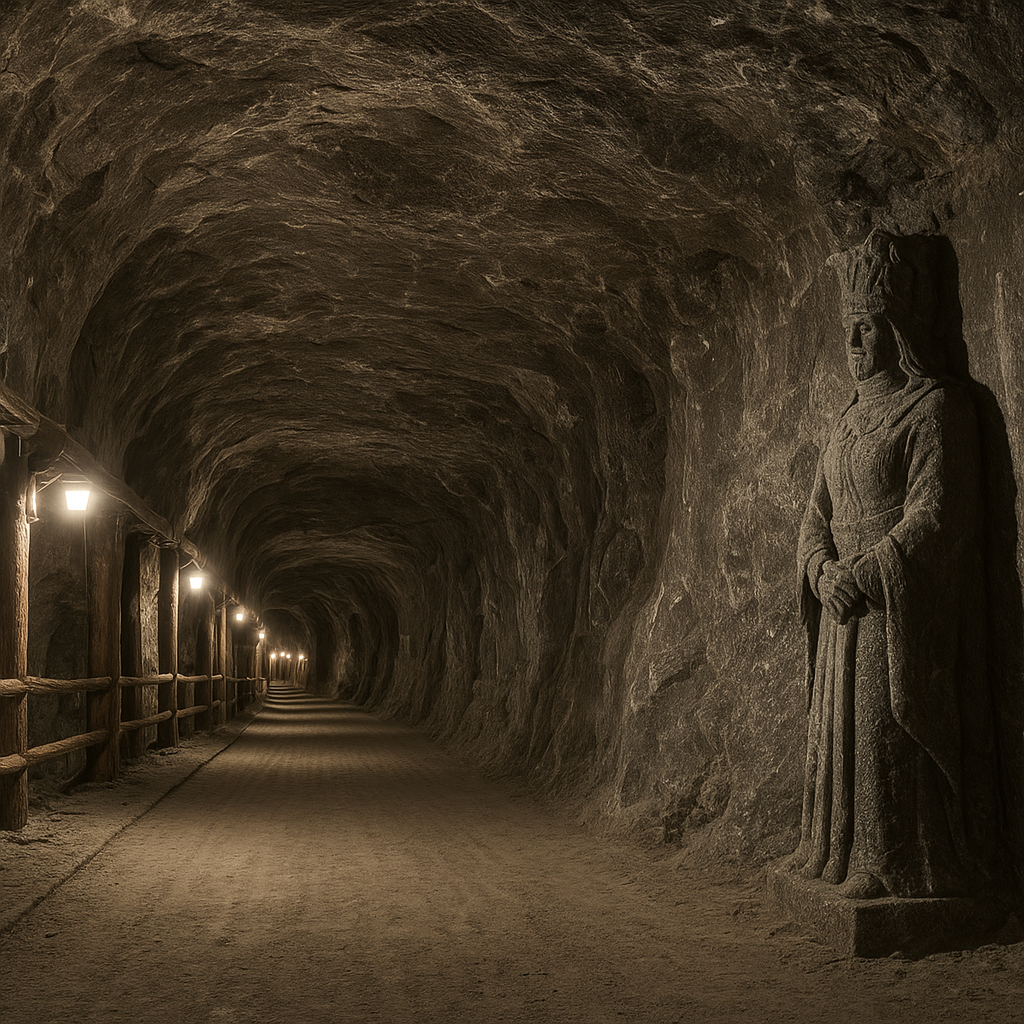
The Wieliczka Salt Mine is one of the most remarkable and historically rich underground complexes in the world. Located near the city of Kraków in southern Poland, this extraordinary site combines centuries of industrial activity with artistic expression carved directly into layers of salt. Visitors descend into vast caverns, pass through chapels and lakes, and confront a living testimony to the central role that salt has played in regional development. The mine’s story touches on geology, technology, religion and tourism — all of which contribute to its continuing significance.
Where it is and how it formed
The mine sits just southeast of Kraków, in the town of Wieliczka, within Poland’s Lesser Poland Voivodeship. Its position is geologically determined: thick deposits of rock salt (halite) formed here millions of years ago during the evaporation of ancient inland seas. Over geological time, the sedimented salts were buried and lithified, creating extensive subterranean layers. These deposits were subsequently covered with overlaying strata, which provided stability and allowed miners to develop elaborate, multi-level workings.
Rock salt in Wieliczka occurs in thick beds, and natural processes created pockets and veins suitable for extraction. The mine extends to substantial depths and stretches for many kilometers horizontally. The presence of groundwater in some areas resulted in brine and saline lakes, which, together with the dry mined chambers, formed a diverse underground environment. As miners followed the salt veins, they carved out rooms and passages that would later be used for chapels, statues and practical mine infrastructure.
History of extraction and human presence
The history of the Wieliczka site spans many centuries. Salt was a crucial commodity in pre-modern Europe: essential for food preservation, animal husbandry and various industries. For Polish rulers, salt mines were a strategic and lucrative asset, often referred to as “white gold” because of their economic value. Over time, extraction at Wieliczka developed from early, relatively simple methods to increasingly sophisticated mining technology, reflecting broader European advances in mining knowledge.
Mining techniques evolved from surface collection of brine and shallow excavations to underground galleries and chambers. Miners used tools such as picks and hammers in early periods and later adopted more advanced mechanical and drilling equipment. Galleries were supported by timber and later by masonry and stonework to prevent collapses. Ventilation, drainage and transport of salt to the surface also posed engineering challenges, which successive generations of miners addressed through shafts, airways and hoisting systems.
The mine’s human history is interwoven with culture and religion. Miners formed tight-knit communities with their own rituals, patron saints and symbols. One of the best-known legends associated with the site involves Saint Kinga, a 13th-century princess and patron saint of salt miners. According to tradition, she asked miners to dig a shaft in her native region; when they did, a lump of salt miraculously appeared on the site she had left, which she brought to Poland. The Chapel of Saint Kinga — an exquisite chapel carved entirely from salt — commemorates this story and showcases the blending of faith and labour that characterizes the mine.
Economic importance through the ages
Salt extraction at Wieliczka had profound economic effects locally and nationally. For medieval Polish rulers, revenues from salt provided a steady and reliable source of income to support administration, defense and public works. Salt trade routes connected Wieliczka to towns and markets throughout Central Europe, making the mine an engine of regional commerce.
At the local level, the mine sustained generations of families. Employment extended beyond miners themselves to include blacksmiths, carpenters, transport workers and merchants who provided equipment, maintenance and market access. Secondary industries and services clustered around the mine, stimulating the growth of nearby communities and influencing the shape of the regional economy.
With the industrial revolution and the expansion of alternative sources of salt, the nature of Wieliczka’s economic role evolved. Large-scale industrial production elsewhere reduced the mine’s relative importance as a raw salt supplier. In response, the site adapted by emphasizing its cultural and touristic value. Today, the mine remains economically significant primarily as a major cultural attraction and conference venue, drawing visitors and supporting jobs in hospitality, guiding services and cultural heritage management. The shift from production to preservation and tourism illustrates how historic industrial sites can be repurposed for new economies.
Art, architecture and spiritual spaces underground
One of the most striking aspects of the Wieliczka Salt Mine is the volume and quality of artistic work carved directly into the salt rock. Over centuries, miners and artists created chapels, altarpieces, sculptures and reliefs — many of them religious in theme. The most famous is the Chapel of St. Kinga, a cathedral-sized chamber whose vaults, columns and chandeliers are made from salt, often polished to a luminous sheen. Visitors encounter carved scenes depicting biblical stories, saints, and miners at work, all sculpted with an eye for both devotional purpose and aesthetic expression.
These spaces performed dual roles: they were sites of worship and community gathering for miners, and they served as memorials to the labour and lives of those who worked underground. The fusion of practical mining infrastructure and meticulous artistic detail makes the mine unique: the corridors and galleries are simultaneously industrial pathways and a subterranean museum.
Techniques and materials
Artists and miners used different densities and colors of salt to produce contrasts and textures. The salt’s relative softness compared to many rocks made it possible to execute detailed carvings, though the humidity and microclimate of the mine required careful maintenance. Some decorative elements were enhanced with other materials — wood, metal fittings and lighting systems — to create the dramatic visual effects that attract tourists today.
Tourism, conservation and modern uses
Over the past century, Wieliczka has developed into a world-renowned tourist destination. The subterranean routes are organized for guided visits, often including stops at historic chambers, chapels and saline lakes. The site is valued not only for its aesthetic and historical features but also for its atmospheric qualities: the underground environment offers cool, stable temperatures and distinct air qualities that have inspired wellness and therapeutic applications.
Conservation efforts are essential to maintaining the structural integrity and artistic detail of the mine. Salt is soluble and sensitive to moisture; thus, managing humidity, groundwater inflow and visitor-induced wear are critical. Engineers monitor airflows, water seepage and rock stability, while conservation specialists stabilize carvings, repair salt surfaces and design visitor routes that reduce physical impact. These activities underscore the complex balance between access and preservation.
Modern uses of the mine extend beyond tourism. The mine hosts cultural events such as concerts, exhibitions and conferences, taking advantage of the acoustic qualities and dramatic ambiance of the underground halls. In some parts of the complex, health and wellness services exploit the stable microclimate for respiratory therapy — a practice sometimes labeled “halotherapy” — though scientific assessments vary about the efficacy of such treatments. Regardless, the mine’s versatility as a venue demonstrates how heritage sites can find new life in contemporary contexts.
Cultural recognition and protection
Wieliczka’s outstanding universal value has been recognized at international levels. The mine is inscribed on the UNESCO World Heritage List, an acknowledgment of both its historical importance and its exceptional testimony to human ingenuity. This designation has reinforced conservation priorities and attracted international scholarly interest in mining heritage, industrial archaeology and the cultural landscapes of resource extraction.
National and local authorities also play key roles in managing the site. Policy frameworks govern visitor numbers, safety standards and restoration practices. Collaboration among historians, engineers, conservationists and local communities ensures that decisions reflect a range of values: economic benefit from tourism, respect for the site’s industrial past, and commitment to safeguarding its material fabric for future generations.
Interesting features and little-known facts
The Wieliczka Mine contains many features that surprise and fascinate visitors. Below is a selection of notable elements that together create the mine’s singular character:
- Chapels carved entirely from salt, with altars, reliefs and chandeliers that glint in the muted light.
- Salt sculptures representing historical, religious and everyday scenes carved by skilled miners and artists.
- Subterranean lakes and brine-filled chambers that reflect carved ceilings like mirrors, producing striking visual effects.
- Long, multilayered galleries that document the development of mining technology across centuries.
- Underground climates used for therapeutic purposes: stable temperatures and filtered air led to the creation of health-focused chambers.
- Multifunctional halls used for concerts, art exhibitions and even weddings — a dramatic setting that merges past and present.
- A miners’ museum that preserves tools, uniforms and archival materials, giving insight into labor history and community life.
- Rich mineral textures: varying colors and crystalline forms within the salt that provide natural artistic motifs.
- Legends and lore, including the St. Kinga narrative and other miner traditions that communicate intangible cultural heritage.
Why Wieliczka still matters
Wieliczka stands as more than a tourist curiosity. It is an emblem of how natural resources shape human history and cultural identity. From its geological origin to its carved chapels and present-day events, the site encapsulates a trajectory from resource extraction to heritage conservation. The mine’s ongoing maintenance, interpretation and reuse reflect contemporary approaches to preserving industrial sites: honoring labor histories, creating educational experiences, and generating sustainable economic activity through culture and tourism.
For scholars, display-makers and local communities alike, Wieliczka provides a living laboratory on the relationships between geology, technology and society. For visitors, it offers an immersive experience — descending below ground to witness human creativity etched in crystalline salt. Whether approached as a monument of industrial heritage, a spiritual space, or a center for cultural activity, Wieliczka continues to inspire curiosity and respect for the complex ways in which natural resources are interwoven with human lives.

