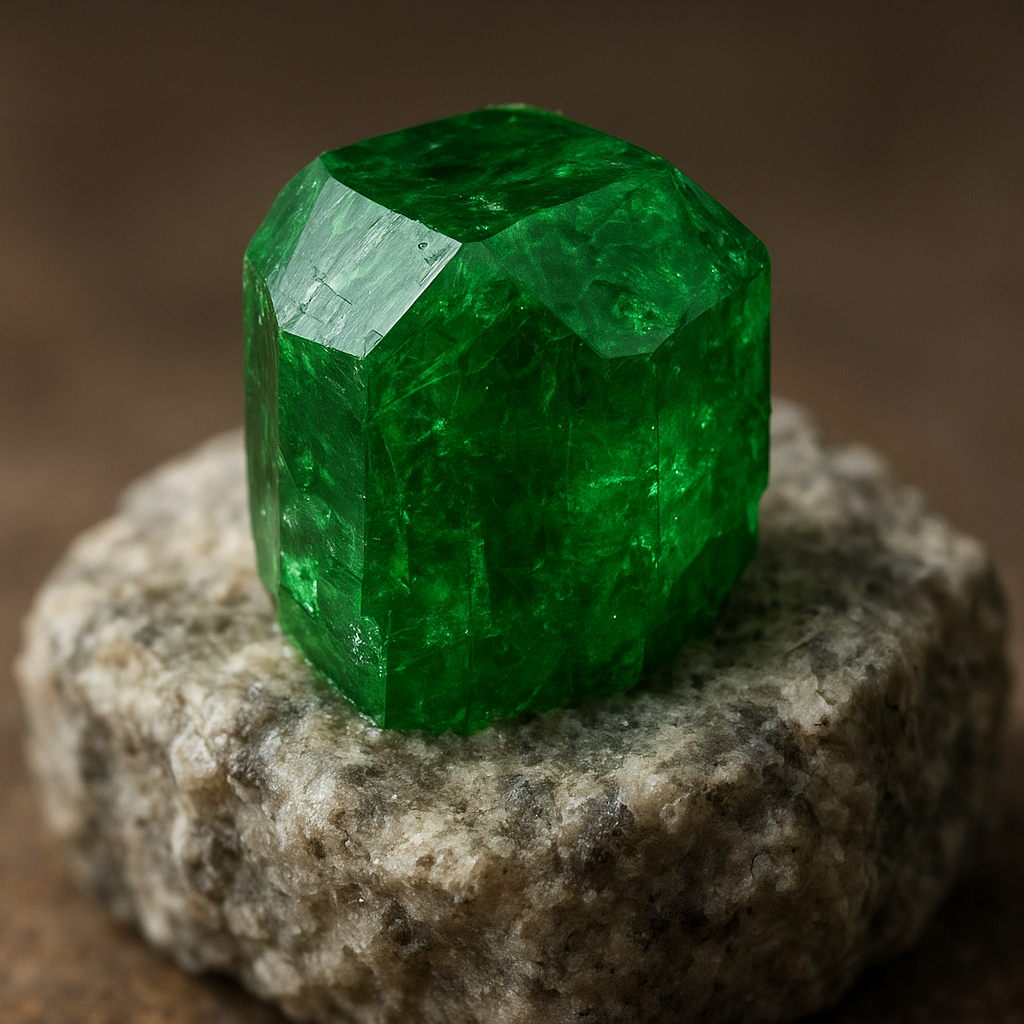
Tsavorite is a captivating green gemstone that has won attention from gemologists, jewelers and collectors for its intense color and brilliant clarity. A variety of the grossular garnet species, tsavorite combines striking visual appeal with a relative rarity that makes it prized in fine jewelry. The following article explores its origin, geology, gemological properties, uses, market dynamics and some lesser-known aspects that make tsavorite one of the most interesting gemstones discovered in the 20th century.
What Tsavorite Is and Why It Stands Out
The stone commonly known as tsavorite is a green variety of grossular garnet, chemically represented as Ca3Al2(SiO4)3. Its vivid green hues arise primarily from trace amounts of vanadium and chromium, which replace aluminum in the crystal lattice to generate colors that range from bright grass-green to deep forest-green. Unlike many emeralds, tsavorite typically exhibits exceptional brilliance because of garnet’s high refractive properties and generally clean clarity. It is mostly found as natural, untreated gems, an attribute that enhances its desirability for purist collectors and high-end jewelry designers.
Geology and Where Tsavorite Occurs
Tectonic history, localized metasomatic events and the presence of calcium-rich host rocks set the stage for tsavorite formation. The gem develops in environments where contact metamorphism and skarn-type metasomatism alter carbonate-rich (calcium-bearing) sedimentary rocks adjacent to intruding igneous bodies. During these processes, chromium and vanadium-bearing fluids interact with calcium and aluminium to produce grossular garnet crystals with intense green coloration.
Primary Known Localities
- Kenya — The region around the Tsavo National Park and the Taita-Taveta area produced the major early deposits that brought the gem to prominence. Kenyan tsavorites are celebrated for their vivid, electric greens and excellent clarity.
- Tanzania — Neighboring Tanzania yielded the first discovery of green grossular that would later be marketed as tsavorite. Tanzanian occurrences can produce richly colored specimens and occasionally larger crystals.
- Other occurrences — Smaller occurrences and occasional finds have been documented in places such as Madagascar, Pakistan and parts of East Africa. These secondary localities supply the market sporadically and often produce stones of varying color intensity.
Tsavorite is not a common gem; significant deposits are relatively limited, and large, high-quality stones remain rare. The concentration of notable deposits in East Africa contributes to the gem’s story and its niche status among collectors.
History of Discovery and Commercialization
The gemstone entered the global gem trade in the late 1960s and early 1970s. A prospector and gem dealer named Campbell Bridges is credited with discovering and bringing to light the green grossular garnets in East Africa. The name tsavorite came from the nearby Tsavo National Park in Kenya and was popularized when prominent jewelers and retailers introduced the material to international markets during the 1970s. One major luxury house played a significant role in marketing tsavorite to Western consumers, helping the stone gain recognition alongside traditional green gems such as emerald.
The combination of an attractive marketing story, a fresh, vivid green color and the fact that the gems were usually sold in their natural state contributed to a rising interest among both designers and gemstone connoisseurs.
Gemological Properties and Identification
Tsavorite is a member of the garnet group, which typically crystallizes in the isometric (cubic) system. Its key gemological attributes include:
- Chemical formula: Ca3Al2(SiO4)3 (grossular group)
- Color: ranges from light yellowish-green to deep emerald-green, with the most valued stones showing vivid, saturated green
- Refractive index: approximately 1.740–1.760 (varies slightly with composition)
- Specific gravity: roughly 3.60–3.70
- Hardness: around 6.5–7.0 on the Mohs scale, making it durable enough for most jewelry
- Optical character: generally isotropic (garnets are normally singly refractive), though stress or inclusions can produce anomalous double refraction
Because garnets are usually singly refractive, gemologists can distinguish tsavorite from doubly refractive green gems (like emerald) using a refractometer and polarization techniques. Tsavorite also exhibits a distinctive absorption pattern in spectroscopic analysis indicative of chromium and vanadium.
Typical Inclusions
Tsavorites commonly show mineral inclusions such as needles, tiny crystals, and growth zoning. However, compared to many emeralds, high-clarity tsavorites are more frequently encountered and those with few to no visible inclusions are highly prized. The relative clarity of fine tsavorite specimens contributes significantly to their brilliance and market value.
Cutting, Grading and Market Considerations
Cutters of tsavorite aim to maximize color saturation and brilliance while retaining as much carat weight as possible. Because tsavorites show strong color, thoughtful cutting can enhance depth and saturation without overly compromising light return. Common shapes include round, oval, cushion and emerald cuts, each chosen to balance color and fire.
- Primary value factors: color (hue, tone, saturation), clarity, carat weight and cut quality.
- Color preference: the most desirable tsavorites display a pure, vivid green with little to no secondary yellow or blue hues.
- Size premium: large tsavorites over 2 carats are relatively rare; prices increase steeply for excellent-color stones as size grows.
The market for tsavorite sits between mainstream semi-precious stones and premium gemstones. Because most tsavorite is sold in an untreated state, buyers often value its natural origin. Major luxury jewelers sometimes use tsavorite as a distinctive alternative to emeralds, especially in pieces where durability and brilliance are prioritized.
Applications and Uses in Jewelry and Design
Tsavorite has become a favored stone for rings, earrings, pendants and high-fashion pieces. Its combination of sparkle and strong green color makes it suitable for both delicate and statement designs. Jewelry designers appreciate tsavorite for several reasons:
- It offers an eye-catching green without the need for treatments commonly used in emeralds.
- Its relative hardness and toughness make it practical for everyday wear compared with softer green gems.
- It pairs well with diamonds and other colored stones to create striking contrasts.
Designs that emphasize the stone’s color — such as halo settings with diamonds or complementary colored gemstones — are especially effective. Tsavorite is also used in bespoke and artisan jewelry, where its natural, often untreated status aligns with sustainable and ethical design trends.
Ethical, Environmental and Social Considerations
Most tsavorite comes from small-scale and artisanal mines in East Africa, often located in remote regions. Mining can provide significant economic opportunities for local communities but may also bring environmental degradation, land-use conflicts and social challenges. The following points summarize relevant concerns and initiatives:
- Artisanal mining: Many tsavorite deposits are exploited by local miners working with limited mechanization. This can lead to unregulated practices, safety hazards and variable environmental impacts.
- Land rights and conflicts: The proximity of some deposits to protected areas, communities and valuable agricultural land occasionally gives rise to disputes over mining access.
- Traceability and fair trade: Consumers increasingly seek assurances that gemstones were sourced responsibly. Programs and certifications aimed at improving traceability, fair pay and environmental stewardship are growing in importance.
- Positive impacts: Responsible mining initiatives can fund schools, clinics and local infrastructure, while ethical supply chains support long-term community development.
For buyers who prioritize ethics, seeking tsavorite from reputable dealers who can document origin, labor conditions and environmental practices helps encourage better mining standards.
Care, Cleaning and Durability
Tsavorite’s moderate to good hardness and overall toughness make it suitable for many types of jewelry. To care for tsavorite:
- Clean with warm soapy water and a soft brush. Rinse thoroughly and dry with a lint-free cloth.
- Ultrasonic cleaning is generally acceptable for clean, solid tsavorite stones, but avoid ultrasonics if the stone has visible inclusions or fracture-filled areas (rare for tsavorite).
- Avoid harsh chemicals and prolonged exposure to extreme heat; sudden temperature changes can increase internal stress.
- Store separately or wrapped in soft cloth to avoid abrasion from harder gems like diamonds.
With reasonable care, tsavorite jewelry can maintain its brightness and color for many years.
Comparisons and Alternatives
Tsavorite is often compared to emerald because both are prized green gemstones, yet they differ meaningfully:
- Clarity: emeralds commonly contain notable inclusions and are frequently oiled or treated to improve appearance. Tsavorites are often cleaner and rarely require enhancement.
- Durability and maintenance: tsavorite’s relative toughness and resistance to surface-reaching fissures make it more practical for daily wear than many emeralds.
- Brilliance: tsavorite generally shows stronger brilliance due to higher refractive properties in garnet.
Other green gemstones—such as chrome diopside, peridot, demantoid garnet and tourmaline—offer alternatives at various price points. Each has distinct optical and physical properties, so gemological testing is useful for accurate identification and valuation.
Interesting Facts and Cultural Notes
- The name of the gem ties it to a specific landscape — Tsavo National Park — which enhances its story and appeal.
- Because tsavorite is commonly untreated, it appeals to collectors who favor natural, unenhanced gems.
- While tsavorite can approach the green typical of high-quality emerald, its optical performance and relative clarity give it a unique visual signature distinct from classic emeralds.
- Collectors prize large, vivid specimens; unusual sizes and particularly saturated colors can become centerpiece stones for museum-quality jewelry.
Collecting, Investing and Practical Buying Tips
Whether buying tsavorite for personal wear or as an investment, consider these practical guidelines:
- Prioritize color first — look for a vivid, well-saturated green with minimal secondary tones.
- Clarity matters — while some inclusions are acceptable, fewer visible inclusions increase the gem’s aesthetic and monetary value.
- Size and cut influence price significantly; expect a sharp price increase for excellent-color stones as carat weight rises.
- Buy from reputable dealers who provide documentation about the stone’s origin and any treatments (if applicable).
- For ethical buyers, inquire about mining practices and traceability; certified or transparent supply chains are preferable.
Collectors often view tsavorite as a gem with both aesthetic appeal and a compelling provenance — a combination that supports long-term desirability.
Final Observations on the Gem’s Appeal
Tsavorite offers a rare combination of attributes: an intense natural green color, notable brilliance, and a story rooted in a distinct and dramatic region of East Africa. The stone’s relative rarity and frequent lack of treatment place it in a special category among green gemstones. For jewelers, gem dealers and collectors seeking an alternative to more traditional green stones, tsavorite provides both technical advantages and an evocative narrative that connects the gem not just to geology, but to culture and place.