
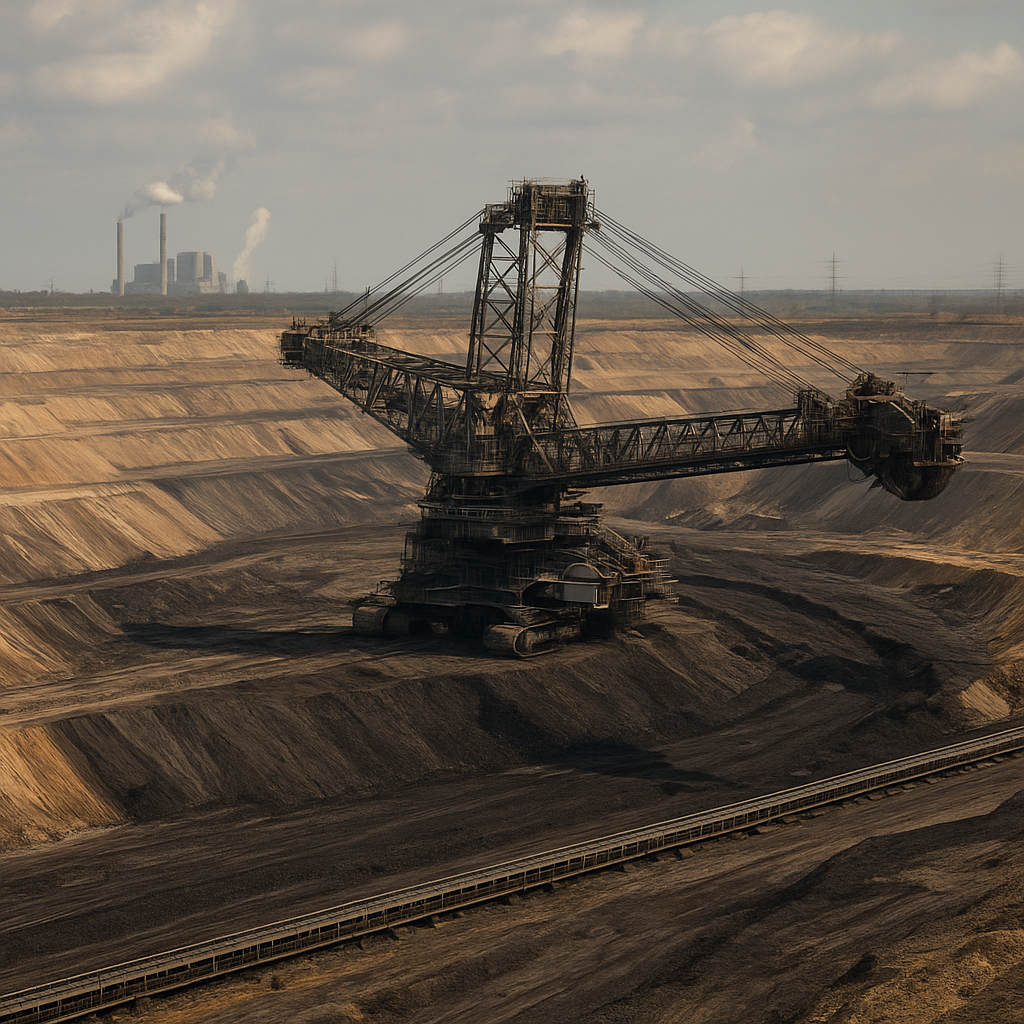
The United Schleenhain Mine is one of the better-known lignite operations in the Central German mining region. Situated near small towns and villages south of Leipzig, it has played an important role in supplying low-grade coal for nearby power stations and industry, shaping the local landscape and economy for decades. This article examines the mine’s location and geology, the methods used to extract lignite, its economic importance, and several notable and sometimes surprising aspects of its history and post-mining development.
Location and geological setting
The United Schleenhain Mine lies in the state of Saxony, in the wider Central German lignite (brown coal) basin that stretches through parts of Saxony, Saxony-Anhalt and Thuringia. The mine is positioned close to communities such as Schleenhain and neighboring settlements south of the city of Leipzig. The deposit forms part of a long band of near-surface coal seams that were laid down during the Tertiary period and later uplifted and exposed by geological processes.
The geology of the region is characterized by lignite seams interbedded with clays, sands and layers of organic-rich soil. These seams are typically shallow and horizontally extensive, which makes them highly suited to open-cast or surface mining techniques rather than underground extraction. Seam thickness in the Central German fields can vary from a few meters to tens of meters, permitting high-volume extraction where the overburden can be economically removed and stored.
Because the seams are close to the surface, the mine’s footprint has had significant effects on the land form. Overburden removal creates spoil heaps and large voids that later require careful management and rehabilitation. The region’s hydrology is also influenced by mining, with groundwater levels often lowered locally and water management becoming a central issue during the operational and reclamation phases.
Mining methods, equipment and production
United Schleenhain has been operated primarily as a surface mine using large-scale mechanical equipment. The mining process typically involves systematic removal of the overburden, extraction of the lignite seam, and transport of the coal to processing facilities or directly to power stations. Key pieces of equipment include bucket-wheel excavators, conveyor systems and heavy earth-moving machinery.
- Bucket-wheel excavators are especially emblematic of lignite mining in Germany. These gigantic machines can continuously remove thousands of cubic meters of material per day, making them efficient for the wide, shallow seams of the area.
- Extensive conveyor networks link the working faces to stockpiles and to rail or road loading facilities. These conveyors reduce the need for truck transport and enable continuous movement of material.
- On-site processing may include simple crushing and screening steps to prepare lignite for transport. Because lignite has a high moisture content, some processing and drying may occur at downstream power plants rather than at the mine itself.
Production volumes historically depended on regional energy demand and the operational strategies of utilities and mining companies. Lignite from Schleenhain and neighboring pits has traditionally fed nearby thermal power stations and industrial consumers, providing a reliable fuel source that is locally available and inexpensive relative to some alternatives.
Economic importance and regional role
The United Schleenhain Mine has been economically significant at local and regional scales. Lignite mining supports multiple economic functions:
- Energy supply: Lignite is a foundational fuel for several lignite-fired power plants in central Germany. The proximity of the mine to power generation facilities reduces transport costs and helps ensure stable fuel deliveries.
- Employment: Mining and associated logistics—maintenance, transport, and reclamation—create jobs for local communities. While mechanization has reduced the number of workers required compared with early 20th-century operations, the mine remains an employer and a source of local incomes.
- Infrastructure: Access roads, rail spurs and conveyors built for mining also support broader logistics and sometimes benefit local business and industry.
- Industrial feedstock: Beyond electricity, lignite has been used historically for briquette production and as a feedstock in some chemical processes, though these uses have diminished over the decades.
The mine has thus been woven into the region’s industrial fabric. Local municipalities have relied on tax revenues and indirect economic activity from the mine, while workers’ households supported shops and services that might otherwise struggle in a rural setting. That said, the long-term trend in energy policy—especially Germany’s planned coal phase-out and the global shift toward decarbonization—has introduced uncertainty and required planning for economic transition.
Environmental and social impacts
Lignite mining at Schleenhain has produced a range of environmental and social effects over its operational life. Open-cast mining alters landscapes dramatically and creates both immediate and long-term challenges.
- Landscape transformation: Large pits and spoil heaps change local topography, sometimes irreversibly in the short term. The scale of change can be dramatic, with entire tracts of farmland and woodlands removed to access seams of coal.
- Water and hydrology: Lowered groundwater levels during operations can affect wells and wetlands. After closure, some pits are permitted to fill and form artificial lakes, but water quality and management must be handled carefully to prevent acidification or other issues.
- Biodiversity: Active mining eliminates habitat, though post-mining reclamation programs aim to restore diverse landscapes, establish new habitats and encourage nature recovery. Reclaimed areas can become valuable green spaces, though the ecology will often differ from original natural systems.
- Social displacement: In many mining regions, villages have been relocated to allow for pit expansion. While relocation programs provide compensation and new housing, the social fabric and historical continuity of communities can be disrupted.
- Air quality and emissions: Lignite is among the carbon-rich, high-emission fossil fuels. Combustion in power plants emits CO2 and other pollutants unless mitigated—an increasingly contentious issue in the context of climate policy.
Public attitudes toward the mine have therefore been mixed. Many residents appreciate the jobs and economic benefits, while others criticize environmental damage and advocate for faster transitions to low-carbon energy. The balancing act between economic needs and environmental protection has shaped local politics and planning for decades.
Notable historical and technical points
Certain aspects of the United Schleenhain Mine stand out as particularly notable or illustrative of broader trends in German lignite mining:
- Scale and mechanization: The mine illustrates the high degree of mechanization reached by German surface mines. Massive machines and integrated conveyor systems enabled continuous operations and high throughput.
- Post-reunification changes: Like many mines in the former East Germany, operations and responsibilities underwent major adjustments after 1990. Companies restructured, and state entities became involved in the complex business of reclamation and environmental stabilization.
- Reclamation experiments: The site has hosted or inspired a number of reclamation initiatives, testing methods for creating stable slopes, establishing vegetation on spoil, and transforming pits into lakes or recreational areas.
- Heritage and memory: The mining culture—its music, folklore, and community traditions—remains a part of local identity. Museums and interpretive trails preserve elements of this industrial heritage for visitors and younger generations.
Transition, policy context and future perspectives
Germany’s energy policy and climate commitments have profound implications for lignite operations across the country, including United Schleenhain. National and European targets to reduce greenhouse gas emissions have placed lignite under pressure. The government’s coal phase-out plan, combined with economic and social measures to aid affected regions, aims to shift energy systems toward renewables, natural gas (for transitional purposes), and more efficient demand-side measures.
For the United Schleenhain area, this policy context means several likely developments:
- Reduced production and eventual closure planning for individual pits once they are no longer economically viable or politically acceptable.
- Greater emphasis on reclamation, including transforming former mining land to new uses: lakes for recreation, industrial parks, or ecological restoration projects to support biodiversity.
- Economic diversification programs to replace mining jobs with employment in sectors such as renewable energy, manufacturing, services, and tourism linked to post-mining landscapes.
- Community engagement and compensation mechanisms to help residents adapt to change, including retraining and targeted investment in local infrastructure.
Transition is complex and often slow. Successful outcomes usually depend on careful planning, substantial public and private investment, and strong collaboration among governments, companies and communities.
Interesting and lesser-known facts
Beyond its industrial and economic roles, the United Schleenhain Mine and its region offer several intriguing features that visitors and observers often find surprising:
- Hidden archaeology: As overburden is removed, ancient soils and archaeological layers can be exposed, occasionally revealing artifacts or fossilized plant remains that improve understanding of the region’s prehistoric environment.
- Engineering achievements: The scale of continuous excavation, the precision of conveyor logistics and the long-term planning to coordinate mining, power generation and reclamation reflect significant engineering and logistical expertise.
- Post-mining creativity: Some reclaimed mining areas have been reimagined as cultural spaces—hosting festivals, industrial museums and art projects that use the rugged, sculpted terrain as a backdrop.
- Wildlife returns: Given time and suitable reclamation, flora and fauna can reestablish on former spoil heaps and reclaimed terraces, creating new ecological niches that support unexpected biodiversity.
- Local narratives: Stories of relocation and adaptation—families moved to make way for a mining pit, workers’ skills passed between generations, and the evolution of mining towns—form a rich local oral history often captured in community archives and museum exhibits.
Practical information and visiting
For those interested in the industrial landscape, parts of the mining region around Schleenhain can be appreciated from public viewpoints and visitor centers that explain the history and technology of lignite extraction. Access to active operational areas is restricted for safety reasons, but local museums, interpretive trails and photo points often provide safe and informative ways to learn about mining processes and post-mining landscapes. The interplay of industry, community and environment makes the area a living case study of how extractive economies evolve and adapt.
Closing observations
United Schleenhain Mine exemplifies the central challenges and opportunities of lignite mining in Germany: a resource that provided affordable fuel and local employment for decades, while leaving a legacy of environmental modification that requires careful management and imaginative reuse. As policy and markets push toward a low-carbon future, the mine and its region face the shared task of shaping post-mining identities and economies—turning scarred landscapes into new forms of value while respecting the cultural memory of mining communities. The technical scale of operations, the ongoing reclamation efforts, and the social dimensions of change all make Schleenhain an instructive example of industrial transformation.

