
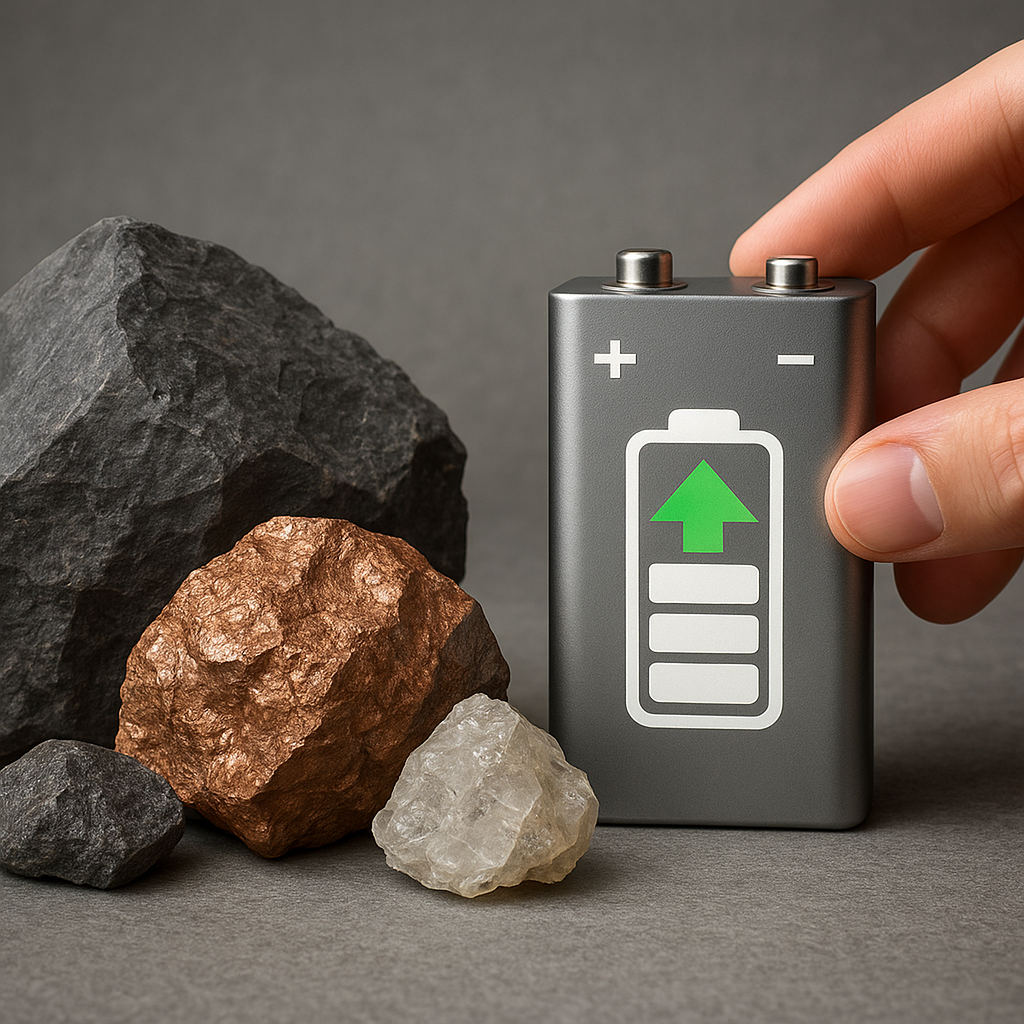
The global transition to electrified transport and decarbonized power grids has already reshaped demand for minerals. Yet the next wave of change may come not from policy alone but from technological breakthroughs in **battery** chemistry. Alternative chemistries are maturing that could reduce dependence on certain critical minerals, open new supply chains, and create winners and losers across mining, refining, and manufacturing. This article examines how emerging battery technologies could transform mineral markets, the likely timelines, economic consequences, and strategic responses for producers, policymakers, and investors.
Emerging battery chemistries and what they promise
Battery research has moved well beyond incremental improvements to conventional lithium-ion cells. Several families of chemistries are progressing from laboratory validation to pilot plants and early commercial deployments. Each carries distinct material inputs and performance trade-offs that will shape mineral demand.
Solid-state batteries
Solid-state batteries replace the liquid electrolyte with a solid conductor. They promise higher energy density, faster charging, and improved safety. If successfully commercialized at scale, solid-state architectures could retain the use of **lithium** while reducing or eliminating the need for certain cathode materials that rely on high proportions of **nickel** or **cobalt**. However, some solid-state designs require advanced ceramics or sulfide-based electrolytes that introduce demand for other raw materials and complex manufacturing equipment.
Sodium-ion and alternative alkali chemistries
sodium-ion batteries substitute sodium for lithium. Sodium is far more abundant and geographically diversified than lithium, which could reduce supply concentration risks. Sodium-ion cells typically use different cathode materials and can be paired with cheaper anodes, lowering reliance on **graphite** (though some sodium systems still use carbon-based anodes). Early deployments target stationary storage and lower-cost electric vehicles, where energy density is less critical than cost and raw-material availability.
Lithium-sulfur, lithium-air and high-capacity chemistries
Advanced lithium-based chemistries such as lithium-sulfur and lithium-air aim to dramatically raise theoretical energy density. These systems shift material demand toward sulfur and porous carbon structures instead of heavy metals. If scaled, they could drive up demand for low-cost **sulfur** while easing pressure on **cobalt** and **nickel**.
Zinc, aluminum and organic systems
Zinc-based and aluminum-ion chemistries are attractive for grid-scale storage because of low-cost feedstocks and safer chemistries. Organic and polymer-based batteries minimize reliance on finite metals altogether, leaning on commodity chemicals producible in many countries. While these solutions currently lag behind in cycle life and energy density, breakthroughs could redirect demand away from metals like **copper** and **nickel** toward petrochemical feedstocks and specialty organics.
Immediate and medium-term impacts on mineral demand
New battery chemistries will not flip markets overnight. Commercial adoption follows cost declines, scaling of manufacturing, and standardization. Nevertheless, shifts in the palette of required minerals could be profound.
- Short term (0–5 years): The market will likely see diversification within the lithium-ion family—greater adoption of lithium iron phosphate (LFP) in certain EV segments and grid storage reduces demand growth for **nickel** and **cobalt**. Meanwhile, pilot-scale rollouts of sodium-ion and improved recycling programs begin to moderate growth in **lithium** demand intensity.
- Medium term (5–15 years): If **solid-state** technologies achieve scale, demand for high-Ni cathode materials may fall, while demand for specialty ceramics and thin-film manufacturing equipment rises. Successful scale-up of **sodium-ion** could materially reduce incremental **lithium** demand growth, particularly for lower-range EVs and stationary storage.
- Long term (15+ years): Widespread adoption of radically different chemistries—organic batteries, lithium-sulfur, or metal-air systems—could restructure entire mineral chains, lowering demand for **cobalt**, **nickel**, and even **graphite**, while increasing demand for **sulfur**, carbon nanomaterials, and other inputs.
The net effect on raw-material prices will depend on the pace of technology diffusion, capacity additions, and the degree to which legacy industries can repurpose existing processing assets. Overbuilds in mining capacity for one mineral could lead to prolonged price weakness if alternative chemistries displace that mineral’s share of battery production.
Supply chains, processing and geographic winners
Mineral markets are defined not only by geology but by processing and refining capacity. The rise of new chemistries will shift where value is captured.
From ore to chemicals: the importance of refining
Many countries possess mineral resources but lack midstream processing. For example, deposits of spodumene (a lithium ore) require conversion into chemicals like lithium carbonate or hydroxide. Emerging battery chemistries that use more processed or different feedstocks could advantage countries with chemical manufacturing capabilities over those that only mine raw ore. Likewise, if sulfur becomes a sought-after feedstock for lithium-sulfur batteries, major oil and gas producers with large sulfur byproduct streams could become battery-material hubs.
Geographic redistribution
Shifts in material demand can change geopolitical leverage. Currently, large shares of refined battery materials—processing of **lithium**, refining of **cobalt**, smelting of **nickel**—are concentrated in a handful of countries. Technologies relying on abundant and widely distributed materials like sodium or zinc could reduce geopolitical risk and diversify suppliers. Conversely, if new chemistries require specialty minerals or advanced ceramics, countries with the necessary high-tech manufacturing ecosystems could gain disproportionate influence.
Manufacturers and gigafactories
Battery factories are capital-intensive and designed around specific cell architectures. A rapid industry pivot to a different chemistry would require costly retooling or new lines. Large manufacturers will hedge by operating multi-chemistry capacity, but smaller players and some suppliers could be left with stranded assets. Investors in manufacturing equipment and process chemicals must anticipate potential shifts in demand for their products.
Recycling, circular economy and the role of regulation
As alternative chemistries enter the market, recycling becomes both a strategic asset and a complicated policy area. The mineral intensity of batteries means that circular practices can materially alter primary resource needs.
- Enhanced value of recycling: If certain metals like **nickel** or **cobalt** become less central, their recycling value may decline; however, high raw-material prices can justify investment into better recovery methods. Conversely, chemistries that keep **lithium** and **graphite** in active use will make lithium-ion recycling more attractive economically.
- Design for recyclability: New battery formats should be engineered with end-of-life recovery in mind. Policymakers can accelerate circularity by mandating collection schemes, minimum recycled content, and standardized cell formats where feasible.
- Regulatory alignment: Standards and safety regulation for emerging chemistries will determine deployment speed. If regulators require rigorous certification and new infrastructure for novel electrolytes or solid components, commercial rollouts may slow, extending the dominance of incumbent mineral-based supply chains.
Economic, environmental and social considerations
Switching chemistries touches not only commodity markets but also local economies and environmental footprints. Mining regions that have developed around a specific commodity could face economic disruption if demand falters. For instance, areas heavily dependent on **cobalt** or high-grade **nickel** mining may need strategies for economic diversification.
Environmental trade-offs
Some alternative materials bring improved lifecycle footprints—reduced greenhouse-gas emissions from lower-energy processing, or elimination of problematic mining practices. Others may create new environmental burdens, such as increased petrochemical use for organic batteries or energy- and water-intensive processing for advanced ceramics. Lifecycle assessments must guide adoption to avoid unintended environmental consequences.
Social license to operate
Communities and civil society increasingly influence mining approvals and battery manufacturing siting. Technologies that lessen the need for artisanal or conflict-affected minerals could reduce human-rights risks. Yet miners, refiners, and workers in affected regions will need transition assistance to avoid social dislocation.
Market forecasts, investment strategies and scenarios
Forecasting mineral markets in an era of rapid innovation requires scenario thinking. Investors and policymakers should consider probability-weighted paths rather than single-point estimates.
- Baseline scenario: Incremental improvements in li-ion chemistries and scaled recycling moderate demand growth for some metals, but **lithium** remains a core input. Price cycles continue to be driven by supply lag and new mine development timelines.
- Diversification scenario: Wider adoption of LFP and partial displacement by **sodium-ion** leads to reduced growth in **nickel** and **cobalt** demand. Markets for **graphite** remain robust, but secondary supply increases through recycling lower the pressure on mines.
- Disruption scenario: Breakthrough commercial deployment of **solid-state** or lithium-sulfur dramatically reshapes demand. Investment shifts into new materials, specialty chemicals, and cell manufacturing equipment. Some mining projects become stranded while new processing hubs emerge.
Investors should evaluate mineral projects not only on geology but on resilience to chemistry shifts—considering the commodity mix, processing flexibility, and potential for repositioning assets. Governments can de-risk their economies by supporting workforce retraining, incentivizing downstream processing, and fostering domestic research into new chemistries.
Strategies for stakeholders
Different actors can take targeted actions to prepare for shifting mineral markets:
- Miners: Invest in flexibility—diversify portfolios across multiple commodities, develop beneficiation and processing capacity, and explore recycling partnerships to capture value from secondary streams.
- Manufacturers: Build modular gigafactory capacity adaptable to multiple cell chemistries. Strengthen supplier relationships and hedge raw-material exposures through offtake agreements and vertical integration.
- Policymakers: Support R&D, standardization, and recycling mandates. Provide transition assistance for regions dependent on at-risk minerals and encourage domestic processing to capture more value.
- Investors: Use scenario analyses and stress tests. Favor companies with technological flexibility, strong balance sheets, and exposure to a range of materials including **copper** and processing chemicals.
- Researchers: Prioritize scalable chemistries that consider material availability and end-of-life recovery, not just cell performance.
Innovation in battery chemistry is not simply a technical challenge; it is a market and policy puzzle that will rewrite the map of resource demand and value.
