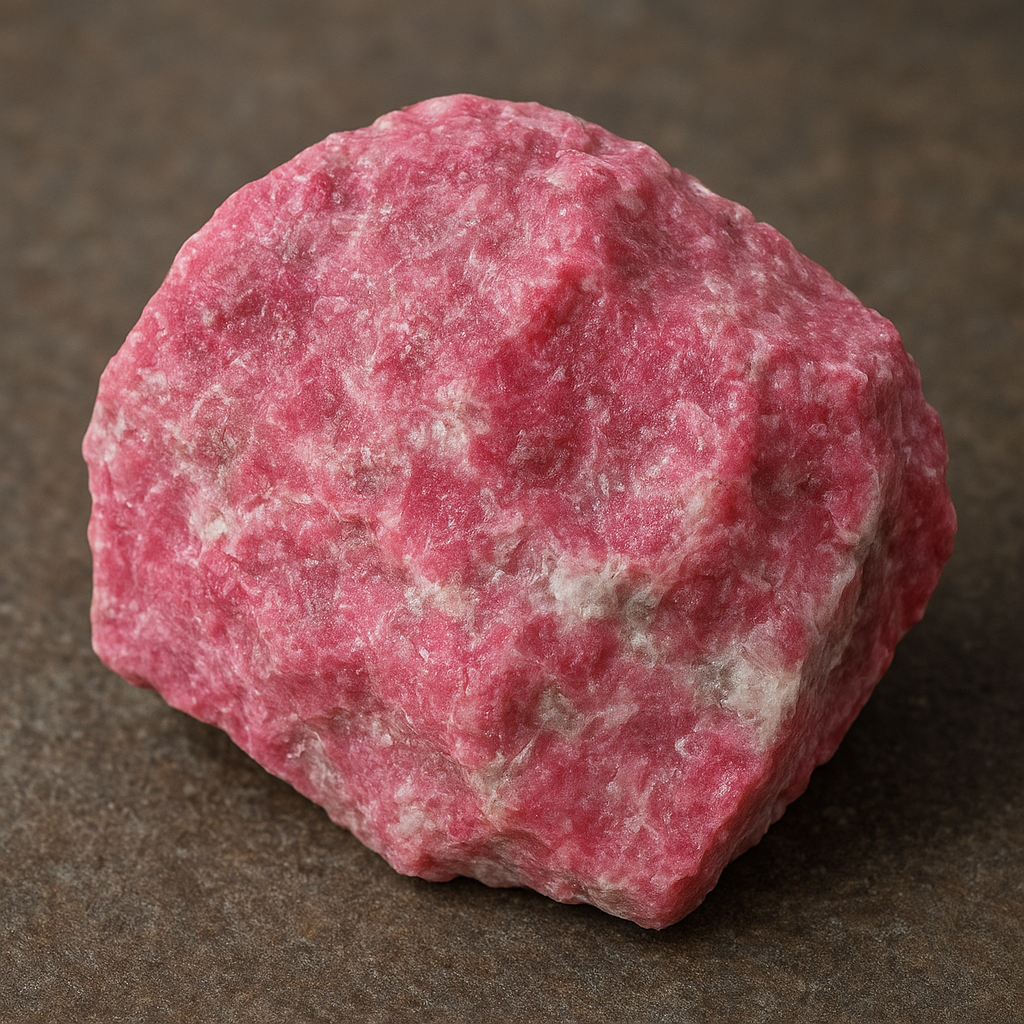
Thulite is a captivating pink variety of the mineral zoisite, distinguished by its warm rose hues and its association with manganese. Often appreciated by collectors, lapidaries, and metaphysical practitioners alike, this stone occupies a curious place between widely known gemstones and local ornamental materials. The following article explores where thulite occurs, how it is used, what makes it distinctive in terms of geology and appearance, and several interesting aspects that connect science, craft, and culture.
Geological origin and mineralogy
The mineral at the heart of thulite is zoisite, an orthorhombic silicate that forms in a variety of metamorphic environments. The pink color that defines thulite is caused by trace amounts of manganese substituting into the mineral structure. Where manganese is present in sufficient concentration, a pale to vivid pink or rose coloration appears, ranging from soft pastel tones to deep raspberry shades. Thulite often occurs with a mix of white or pale minerals—commonly calcite or feldspar—producing mottled, streaked, or speckled patterns that are prized in decorative stonework.
Typical geological settings for thulite formation include regional metamorphism of manganese-rich sedimentary rocks and contact or hydrothermal alteration zones where fluids have introduced or mobilized manganese. Zoisite itself is related to several other gem varieties; the best-known relative is tanzanite (blue-violet zoisite colored by vanadium and/or chromium), while thulite is simply the manganese-colored end of the same mineral family. Microscopically, zoisite’s crystal habits and cleavage may influence how a thulite specimen breaks and how it is best worked by a lapidary.
Where thulite is found
Although thulite is not as globally famous as ruby or sapphire, it has been discovered in several regions around the world. The type locality and classical source is in Norway, where early finds near the village of Sauland in the Telemark region gave the material its evocative name, derived from ancient Thule, a poetic name for the far north. Norway remains strongly associated with thulite in both historical and collector contexts.
- Norway: The classic and historically most famous source; material from Telemark often shows the strong pink shades collectors expect.
- Austria and parts of the European Alps: Localities with metamorphic manganese-rich rocks have produced thulite specimens, sometimes with distinctive regional patterns.
- New Zealand: Occurrences in certain regions have yielded ornamental stones and cabochon material.
- North America: Small occurrences have been reported in Canada and the United States; these are generally more localized and of interest to regional collectors.
- Other occurrences: Reports of thulite or similar manganese-rich zoisite are occasional in other countries where appropriate geology exists.
Because thulite forms only where manganese-rich host rocks are present and suitably metamorphosed, its distribution is inherently patchy. Many specimens are found as irregular masses or vein-like bodies rather than large crystalline forms, which influences how the stone is extracted and cut.
Physical properties and identification
From the standpoint of gemological properties, thulite behaves like other members of the zoisite group. Typical characteristics include a Mohs hardness in the neighborhood of 6 to 7, a vitreous to pearly luster on cleavage surfaces, and a specific gravity that is moderate to relatively high for non-metallic minerals. Optical properties reflect zoisite’s refractive indices and birefringence; however, thulite is often translucent to opaque in hand specimens, which affects how it is evaluated and used.
- Hardness: approximately 6–7 (suitable for many ornamental uses, though care is needed to avoid scratching).
- Luster: typically vitreous to pearly.
- Transparency: ranges from opaque to translucent; gem-quality translucent pieces are rarer and more highly valued.
- Associated minerals: often found with calcite, quartz, epidote and other metamorphic assemblage members.
Identification of thulite in the field is commonly done by color and context—but careful laboratory tests (thin section petrography, X-ray diffraction, or electron microprobe analysis) can confirm the presence of zoisite and the manganese that creates the pink hue. Thulite differs from other pink stones like rhodonite or pink tourmaline in structure and associated minerals; for example, rhodonite tends to have a different cleavage and commonly contains more iron and manganese in different crystallographic sites.
Lapidary techniques and typical forms
Thulite’s popularity stems largely from its versatility in ornamental carving and jewelry when cut appropriately. Because many specimens are mottled or contain matrix material, the lapidary approach is often to emphasize pattern and surface polish rather than faceting. The use of thulite is characterized by several common forms:
- Cabochons: Rounded, polished cabochons are a favorite for thulite, especially when the stone shows attractive banding or mottling that reads well in a domed shape.
- Beads: Stringing thulite beads is common for bracelets and necklaces, where the stone’s color provides a soft, warm accent.
- Carvings and small sculptures: Because thulite can be available in sizeable slabs, artisans carve figurines, cameos, and ornamental objects from it.
- Inlay and mosaics: Thin slices and slivers are used in inlay work, where color contrast with other stones makes striking patterns.
When preparing thulite for use, lapidaries often stabilize porous or fractured material with resin to prevent future damage. Careful orientation during cutting can reveal desirable veins and veining patterns; when working with translucent material, backlighting and slicing at different angles can change the perceived saturation of the pink color.
Uses in jewelry, ornamentation, and industry
Thulite’s primary commercial uses are in jewelry and decorative arts rather than large-scale industrial applications. Its pleasant pink tones and relative affordability make it a favorite for artisans and small jewelry designers. Typical uses include:
- Fashion jewelry: cabochon rings, pendants, and earrings designed for everyday wear or statement pieces.
- Beadwork and rosaries: bead strands made of thulite emphasize color coordination and tactile warmth.
- Decorative objects: paperweights, desk ornaments, and small sculptures carved from large pieces of thulite.
- Architectural inlay: occasionally used as an accent in tabletops or ornamental inlays where small slabs are practical.
Because thulite is not typically faceted as a brilliant gemstone, its market value is influenced by color intensity, translucency, pattern, and the size of usable material. High-quality translucent thulite with a uniform vivid pink can be more valuable than heavily mottled varieties, but many buyers prize the natural patterns and matrix inclusions for uniqueness.
Cultural, historical, and metaphysical aspects
Beyond its physical and commercial appeal, thulite occupies a modest niche in cultural and metaphysical contexts. The stone’s name, rooted in the notion of Thule and the far north, has lent it a certain romantic aura in the history of mineral collecting. In modern crystal circles, thulite is commonly associated with the heart and emotional healing:
- Emotional support: Thulite is often recommended by practitioners for enhancing feelings of love, compassion, and emotional balance.
- Creativity and motivation: Its warm tones are seen as encouraging creativity and a positive mindset.
- Physical associations: Some traditions link pink stones with heart-related energies; thulite is sometimes included in rituals or personal talismans connected to relationships.
While these metaphysical claims are part of popular culture rather than empirically supported science, they have contributed to thulite’s demand among certain buyer groups. Museums and private collections often display thulite specimens both for their geological interest and for the aesthetic pleasure derived from their color and pattern.
Market, collecting, and care
For collectors, thulite offers an accessible entry point into colored stones that are not ubiquitous yet not prohibitively expensive. Because significant quantities of material can sometimes be obtained from a single quarry, thulite pieces are often reasonably priced, depending on quality. When assessing thulite for purchase, consider:
- Color and uniformity: deeper, more saturated pinks generally command higher prices.
- Transparency: translucent pieces suitable for backlighting or certain jewelry settings are rarer and more desirable.
- Pattern and matrix: unique patterns can increase aesthetic value for decorative uses.
- Finish and cut: well-polished cabochons and expertly carved items tend to show the material at its best.
Care for thulite is similar to care for other mid-hardness gemstones. Avoid exposure to strong chemicals or ultrasonic cleaners if the piece has been stabilized with resin. Clean gently with mild soap, lukewarm water, and a soft cloth. Store thulite items separately from harder stones to reduce the risk of scratches, and remove jewelry during activities that could subject it to hard knocks.
Identification pitfalls and imitations
Because pink minerals are popular, it’s important to distinguish thulite from lookalikes. Minerals such as rhodonite, rhodochrosite, pink calcite, and dyed marbles can sometimes be mistaken for thulite in casual markets. Key differentiators include hardness, specific gravity, associated minerals, and the stone’s reaction to simple tests:
- Scratch testing and hardness comparison (done carefully to avoid damage) will separate softer calcite from harder zoisite.
- Observation of crystal habit and cleavage under magnification can be diagnostic for mineral identification.
- Laboratory techniques (e.g., Raman spectroscopy, XRD) are definitive and commonly used by museums and serious gemologists.
Imitations are not widespread for thulite specifically, but dyed materials and stabilized resins can alter appearance. When buying high-value specimens, ask for provenance and any treatment disclosures, particularly with pieces marketed as unusually translucent or intense.
Interesting and lesser-known facts
Several facts about thulite make it particularly interesting to collectors and cultural historians:
- Names and mythology: The name “thulite” references ancient geographic and literary traditions; Thule was a classical name for distant northern lands, lending the stone a romantic identity tied to its Norwegian roots.
- Variation within the zoisite family: Thulite and tanzanite are chemically related but colored by different trace elements—manganese for thulite, vanadium or chromium for tanzanite.
- Decorative versatility: Because thulite can occur in slabs large enough for carving, it sits in an interesting place between wearable gemstones and decorative stone used in interior design.
- Collecting niche: Serious mineral collectors value thulite not only for fresh aesthetic specimens but also for historically significant pieces from classical European localities.
Whether considered through a geological lens, as a material for craftsmanship, or as a stone with symbolic meaning, thulite occupies a multifaceted niche. Its combination of pleasant pink tones, tactile warmth, and relative rarity compared with mainstream gems makes it enduringly appealing to a variety of audiences. For those seeking something that blends natural history, artisanal potential, and accessible beauty, thulite remains a stone worth exploring further.