
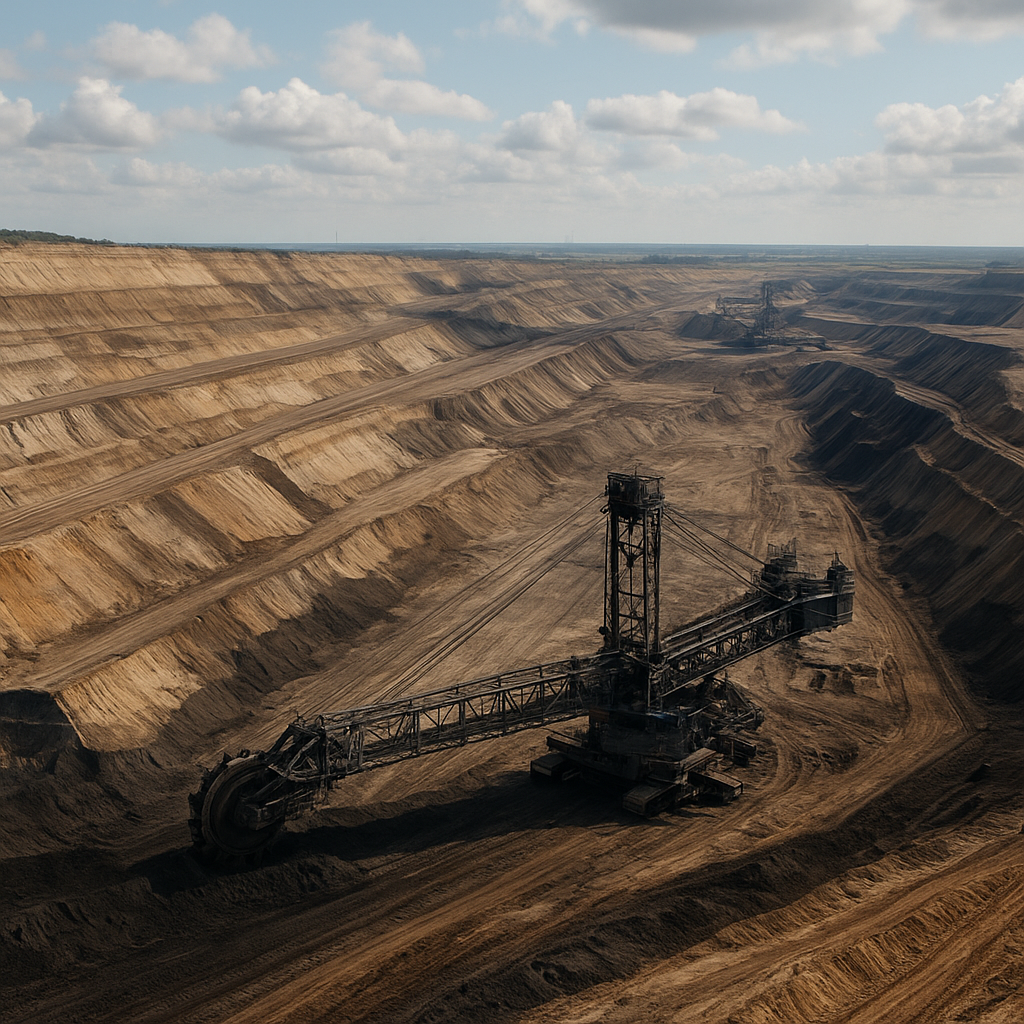
The Garzweiler open-pit mine is one of the most striking industrial landscapes in western Europe, a vast excavation that both fuels local power systems and raises sharp questions about environmental and social costs. Located in the Rhineland region of western Germany, the site exemplifies the intensive extraction of lignite — a low-grade brown coal that has powered factories and households for decades. This article explores where Garzweiler is located, what is extracted there, its economic role, and a number of intriguing technical, social, and ecological aspects that make Garzweiler a focal point of conversation about the future of energy and land use in Europe.
Geographic setting and geological background
Garzweiler sits in the heart of the larger Rhenish lignite mining district in the state of North Rhine-Westphalia. The Rhenish field is one of Europe’s largest deposits of lignite, formed in shallow inland basins during the Neogene period. The deposit layers are relatively near the surface, which makes them accessible to large-scale open-cast excavation. The mine itself is positioned between several municipalities southwest of Mönchengladbach and west of Cologne, in a landscape that was historically agricultural but has been transformed into an industrial extraction zone over the past century.
How the geology determines mine form and methods
The nature of lignite seams — thick, continuous layers with limited burial depth — determines the extraction method. Open-pit mining allows companies to remove overburden (the soil and rock above the coal) and extract the brown coal in continuous benches. The result is a terraced giant pit that can stretch for many kilometers and reach significant depths. Because the seams are extensive and the material bulky, extracting and burning lignite is economical only when power plants are located close to the mine, minimizing transport costs.
Operations and what is extracted
At Garzweiler, the commodity in question is lignite. In practical terms, this means large volumes of soft, moisture-rich coal that are transported directly from the excavation site to nearby power stations by conveyor belts or short rail links. Several major power plants in the Rhineland receive fuel from Garzweiler and other mines in the region; this local supply chain underpins a substantial portion of regional electricity production.
Mining phases and techniques
- Strip mining: Layers of topsoil and overburden are removed and stored for later use in land reclamation.
- Bucket-wheel excavators: Massive machines continuously scoop lignite and load it onto conveyor systems.
- Conveyor belts and short-haul rail: Transport systems move the excavated material efficiently to power plants or staging yards.
- Progressive backfilling: In some sections, spoil is relocated to permit early stages of landscape reshaping and stabilization.
These operations are highly mechanized and operate around the clock during production phases. The scale of equipment used at Garzweiler — the enormous conveyor systems, bucket wheels, and spreaders — make it visually and operationally characteristic of modern opencast mining.
Economic significance
The economic role of Garzweiler is multifaceted. At its core, the mine supplies domestic fuel for electricity generation, contributing to energy security and grid stability in western Germany. Because lignite has a lower energy density and higher moisture content than hard coal, it is most economically exploited when power stations are nearby; Garzweiler’s proximity to several large thermal plants reduces fuel transport costs and allows continuous, predictable supply.
Direct and indirect economic contributions
- Employment: The mine provides direct jobs in excavation, equipment maintenance, logistics, and administration, and indirectly supports jobs in local services, equipment manufacturing, and power generation.
- Local revenue: Taxes, royalties, and infrastructure spending associated with mining can be important sources of municipal and regional funding.
- Industrial support: Nearby industries that rely on stable electricity supplies benefit from predictable generation capacity.
- Energy prices and security: Locally sourced fuel can smooth supply chains and reduce dependence on imported energy in certain scenarios.
However, these economic benefits are balanced by costs and uncertainties. The large-scale relocation of communities, the long-term commitments of power plants, and evolving national policy on carbon emissions all shape how the mine contributes economically. In recent years, the push to decarbonize European power systems has created uncertainty about the long-term viability of coal-based operations and the scale of future investments in the mine area.
Social, environmental and political dimensions
The human and ecological footprint of a project the size of Garzweiler is substantial. Entire villages have been moved or demolished to make way for the expanding pit, and long histories connected to local churches, farms, and ways of life have been disrupted. One particularly visible symbol of this transformation was the dismantling or relocation of local churches and historical buildings that could not coexist with the expansion of mining areas. The social cost of relocation — including loss of place, heritage, and social networks — has been a focal point of public debate.
Environmental impacts
- Greenhouse gas emissions: Burning lignite produces more carbon dioxide per unit of energy than higher-grade coals and many other fuels, contributing to global climate concerns.
- Groundwater and hydrology: Excavation can alter water tables, requiring extensive dewatering and impacts on local wells and ecosystems.
- Biodiversity: Large contiguous habitats are disrupted; however, some reclaimed areas aim to recreate habitats where feasible.
- Dust and air quality: Mining and transport activities generate dust, which can impact human health and local ecosystems.
Politically, Garzweiler has been at the intersection of energy policy, environmental activism, and regional planning. Climate protest movements and local resistance to village demolitions have brought media attention and legal challenges. At the same time, state and federal policies on coal phase-out impose timelines and frameworks that directly influence mining companies’ long-term planning.
Reclamation, future uses, and transitions
Once mining ends in a given area, operators and authorities face the challenge of reshaping an industrial scar into a usable landscape. Reclamation practices at Garzweiler have included topsoil replacement, contouring spoil heaps into hills, and designing new landforms for agriculture, forestry, or recreation. There are also plans to transform exhausted pits into lakes, creating new habitats and leisure spaces; similar conversions in other European contexts have given rise to recreational lakes, wildlife reserves, and tourism opportunities.
Strategies for a post-mining landscape
- Lake creation: Flooding deep pits to form artificial lakes for recreation, habitat, and local climate moderation.
- Agricultural and forestry use: Rebuilt soils can support new farming and reforestation initiatives over time.
- Renewable energy integration: Former industrial sites may host solar parks or be considered for energy storage projects, including proposals to use pit basins for pumped-storage systems.
- Heritage and education: Preserving portions of the mining story through museums or interpretive centers helps communities remember and interpret the region’s industrial past.
Reclamation is technically feasible but requires long horizons and significant investment. Success depends on soil restoration quality, water chemistry management in flooded pits, and social acceptance of new land uses. The presence of a major extraction site in a populous region means that reclamation plans are closely scrutinized and must respond to diverse stakeholder expectations.
Interesting and lesser-known aspects
Beyond the headline-level controversies and statistics, Garzweiler contains a number of features and episodes that are surprising or particularly illustrative of modern industrial landscapes:
- Engineering spectacle: The scale of the machinery used at Garzweiler — bucket-wheel excavators that can be longer than a football field — makes the site an engineering marvel. For enthusiasts of industrial archaeology and heavy equipment design, the mine is a living display of continuous mining technology.
- Village relocations and cultural memory: Some relocated communities attempted to preserve churches and historic buildings by moving or reconstructing them, a process that highlights the human efforts to conserve identity in the face of industrial change. The dismantling or relocation of landmarks became emblematic and drew widespread media attention.
- Regional interdependence: Garzweiler’s operations illustrate how energy systems are geographically integrated: mines, power plants, and grid infrastructure co-evolve. The presence of large, dispatchable lignite-fired plants historically helped balance the region’s electricity supply and supported industrial customers.
- Legal and civic mobilization: Local residents, environmental groups, and national climate movements have used courts, protests, and public campaigns to influence mining policy. The interplay of law, politics, and protest in this region reflects broader tensions about how to manage industrial transitions fairly.
- Experimental landscape design: Reclamation projects sometimes incorporate novel ideas such as creating microclimates, wetlands for biodiversity, or combined uses like solar installations on reshaped spoil heaps, illustrating adaptive approaches to post-industrial land management.
Technology and research connections
Researchers study Garzweiler and similar sites to learn about long-term landscape evolution, groundwater dynamics under dewatering regimes, and the ecological potential of reclaimed mining areas. The mine thus serves as a field laboratory for disciplines ranging from hydrology and soil science to energy economics and cultural geography. Lessons learned in the Rhineland inform reclamation and energy transition practices around the world where large-scale surface mining once played a dominant role.
Outlook: energy transition and the role of Garzweiler
The future of Garzweiler is tied to national and regional decisions about energy policy. Germany’s planned coal phase-out, agreed frameworks for compensation and regional support, and growing investments in renewable energy shape scenarios for the mine’s closure and the speed of transition. While the immediate economic and employment effects of a closure are a concern for affected communities, the long-term opportunities include diversified local economies, new land uses, and reduced local emissions.
At the heart of debates about Garzweiler is a broader question: how to balance immediate socio-economic needs with long-term environmental and climate goals. The mine’s history and future illustrate a transitionary moment — one in which engineering, economics, social justice, and environmental stewardship must be negotiated in concrete terms.
Whether viewed as an industrial powerhouse, a contested symbol of fossil-fuel dependence, or a potential canvas for novel post-mining landscapes, Garzweiler remains a consequential site. Its continuing evolution will reflect not only local choices but also national and European commitments to climate action, energy security, and sustainable land management. The challenge will be to convert the deep technical know-how embedded in mining operations into constructive pathways for communities and ecosystems as the era of lignite-fired generation draws to a close.

