Thomsonite is a member of the zeolite family that captures the attention of mineral collectors, lapidaries, and geologists alike because of its delicate crystal habits, attractive colors, and geological story. Although it is not one of the most widespread zeolites, its occurrence in amygdaloidal basalts and its habit of forming rounded, radiating aggregates make it both scientifically interesting and visually appealing. This article explores how thomsonite forms, where it is found, how it is used, and several intriguing aspects of its natural history and human value.
Geology and Formation: How Thomsonite Comes to Be
Thomsonite is a secondary mineral that develops in the cavities and vesicles of volcanic rocks, particularly in mafic lava flows such as basalt. After a lava flow solidifies, gas bubbles trapped in the cooling rock create spaces known as amygdales or vugs. Over time, circulating low-temperature hydrothermal fluids—rich in silica, aluminum, sodium, calcium and water—percolate through the rock. When conditions (pH, temperature, and chemistry) are right, these fluids precipitate zeolite minerals, among them thomsonite.
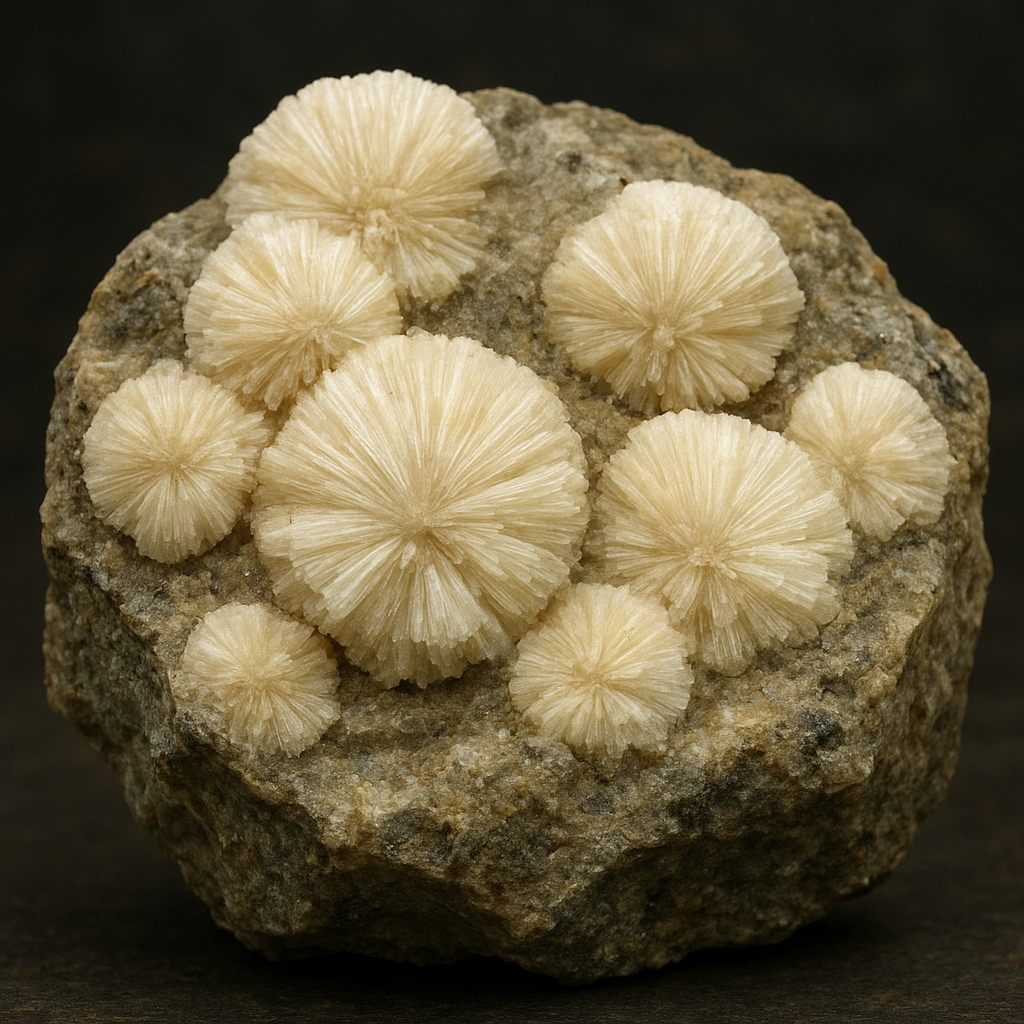
The process of zeolitization often begins with alteration of volcanic glass and unstable primary phases, which liberates ions that reorganize into ordered aluminosilicate frameworks. The resulting zeolites, including thomsonite, are hydrated aluminosilicates with cage-like structures that can host water molecules and exchangeable cations. This makes them both porous and sensitive to fluid chemistry during growth. Thomsonite typically forms as radiating bundles of slender crystals or as spherical, botryoidal masses that display concentric banding when cut and polished.
Because such hydrothermal alteration is common wherever basaltic provinces cool and fracture, thomsonite and related zeolites can occur worldwide. The mineral is most commonly reported from well-studied basaltic settings and from regions where historic collecting has concentrated attention on attractive zeolite occurrences.
Where It Occurs: Notable Localities and Geological Settings
The type locality for thomsonite is the Isle of Skye in Scotland, where it was first recognized and named in honor of the Scottish chemist Thomas Thomson. From that origin the mineral has been identified in a number of basaltic provinces. Among the best-known and most collectible thomsonite occurrences are:
- Isle of Skye, Scotland — the type locality and a historically important source; here thomsonite typically occurs in vesicles in ancient basalt flows.
- Lake Superior region, North America — the Keweenaw Peninsula, Isle Royale, and other Lake Superior islands have produced attractive nodules and polished cabochons popular with collectors and craftsmen.
- Iceland and other North Atlantic volcanic islands — basaltic lavas with abundant vugs and hydrothermal alteration can host thomsonite and several other zeolite species.
- Basaltic provinces worldwide — wherever the right combination of volcanic glass, fluids, and time exists, small thomsonite occurrences may form. Collectors report finds in parts of India, Russia, and Norway, often associated with other zeolites such as stilbite, heulandite, and analcime.
In many of these localities, thomsonite is not the dominant mineral but appears in intimate association with a suite of zeolites and secondary minerals. Field collectors seeking thomsonite look for amygdaloidal basalts with attractive vugs; careful splitting of the rock and examination under good light reveal the typical spherulitic or radiating thomsonite aggregates.
Physical and Chemical Characteristics
Chemically, thomsonite belongs to the zeolite group and can be described in broad terms as a hydrated sodium–calcium aluminosilicate. Like other zeolites it has an open framework that accommodates water molecules and exchangeable cations, giving it some of the characteristic properties of the family. Physically, thomsonite often displays:
- Color: typically white to cream, but also pink, pale green, brown, and orange-banded varieties are known—colors often depend on trace impurities or inclusions.
- Habit: radiating acicular crystals, fibrous aggregates, or rounded, concentric spherical nodules that polish well.
- Transparency: transparent to translucent in thin crystals or aggregate sections.
- Hardness: moderate—generally around the middle of the Mohs scale (sufficient for preservation as a polished gem but not as durable as many common gem minerals).
- Density: relatively low compared with many silicates, owing to its open, hydrated structure.
Under magnification thomsonite shows a fibrous or needle-like habit in many specimens, with crystals radiating from central points. Thin sections viewed with polarized light or scanning electron microscopy reveal the fine-scale framework typical of zeolites and can show zoning and growth textures that record changing conditions of formation.
Uses: From Collecting to Lapidary to Scientific Interest
The uses of thomsonite fall largely into three categories: collectors and display specimens, lapidary uses and jewelry, and scientific or conceptual interest tied to the zeolite family’s properties.
- Collectors and museums prize thomsonite for its attractive radial aggregates and for the aesthetic value of polished nodules that sometimes reveal concentric banding. High-quality specimens are sought after in mineral shows and specialized collections.
- Lapidary and jewelry: because some thomsonite nodules polish to a smooth finish with interesting internal patterns, they are occasionally fashioned into cabochons, beads, and small ornamental objects. The mineral is not considered a mainstream gemstone because it can be brittle and somewhat soft for everyday wear, but it remains a boutique material prized for unique pieces.
- Scientific and industrial context: thomsonite itself is not a major industrial mineral, but it illustrates important properties of zeolites—porosity, ion-exchange capability, and molecular-sieving behavior. Synthetic zeolites derived from the same structural principles are indispensable in modern industry for catalysis, gas separation, water purification, and adsorption. Thomsonite serves as a natural analogue for researchers interested in zeolite formation and fluid–rock interactions.
It is worth noting that some enthusiasts also attribute metaphysical qualities to thomsonite—claims including emotional balance and enhanced clarity—though these are cultural and anecdotal rather than scientific. For practical uses—especially environmental applications—engineered or abundant natural zeolites are preferred over rare species like thomsonite.
Collecting, Preparation, and Care
For field collectors, thomsonite is most often recovered by carefully splitting amygdaloidal basalts and searching vugs with a hand lens. Because valuable pieces are sometimes fragile, prudent collecting practices and respectful access to sites are important. When preparing thomsonite specimens for display or for lapidary work, several practical considerations apply:
- Consolidation: porous or friable pieces may be stabilized with reversible consolidants for display, although many collectors prefer untreated specimens when possible.
- Cleaning: gentle cleaning with soft brushes and mild soap is recommended; avoid strong acids and prolonged exposure to heat, since zeolites can dehydrate and alter under extreme conditions.
- Cutting and polishing: lapidary work should be performed by experienced cutters familiar with the mineral’s tendency to fracture along fibrous aggregates. Slow cutting speeds, light pressure, and fine abrasives yield the best polish without inducing cracks.
- Jewelry use: when used in jewelry, thomsonite is best set in pieces that minimize impact (pendants, earrings rather than rings) and protected by bezels or covered settings.
Identification in the field often relies on context—association with other zeolites and placement in basaltic vugs—as well as simple physical inspection. Professional identification uses optical microscopy, X-ray diffraction, and sometimes chemical analysis to confirm the zeolite species, since several zeolites can appear similar at hand sample scale.
Historical and Scientific Notes
Thomsonite was named for Thomas Thomson, a Scottish chemist and mineralogist who contributed to early 19th-century mineral studies. Over the decades since its naming, thomsonite has been part of broader research on zeolite mineralogy, hydrothermal processes, and secondary alteration of volcanic rocks. Researchers study thomsonite and related zeolites to understand the temperature and chemistry of fluids that alter volcanic country rocks, to reconstruct paleo-hydrothermal systems, and to gain insights into natural ion-exchange processes.
Modern techniques—including electron microscopy, X-ray diffraction, and spectroscopic analysis—have allowed mineralogists to examine thomsonite’s internal structure, trace-element content, and growth history in detail. Such work has helped clarify how subtle changes in solution chemistry and growth kinetics produce the variety of habits and colors observed in natural specimens.
Interesting Aspects and Lesser-Known Facts
A few points about thomsonite that may surprise non-specialists:
- Despite being relatively rare as a collectible mineral, thomsonite illustrates a widespread and important process: zeolitization of basaltic rocks, which has global geological significance.
- Some thomsonite nodules from notable localities display striking concentric banding and color contrasts when sliced and polished—patterns that are sought after by lapidaries for one-of-a-kind pieces.
- From a materials perspective, the same structural features that make zeolites useful industrially—porosity and cation exchange—are present in miniature in natural thomsonite, offering a natural laboratory for studying adsorption and molecular confinement at low temperatures.
- Because thomsonite occurs in vugs that sometimes host multiple zeolite phases, a single vug can be a micro-ecosystem of mineral growth, preserving a record of sequential precipitation as the chemistry of hydrothermal fluids evolves over time.
Final Remarks on Appreciation and Research Potential
Thomsonite occupies a niche at the intersection of geological science, aesthetic appreciation, and lapidary craft. It is not a workhorse mineral in industry, but it is a compelling example of how secondary processes transform volcanic rocks into reservoirs of delicate and beautiful mineral forms. For collectors and gem cutters, the appeal is visual and tactile—an opportunity to reveal hidden internal patterns by careful cutting and polishing. For geologists and materials scientists, thomsonite and its zeolite relatives offer insight into low-temperature alteration processes and into the structural principles that underpin an important class of functional materials.