
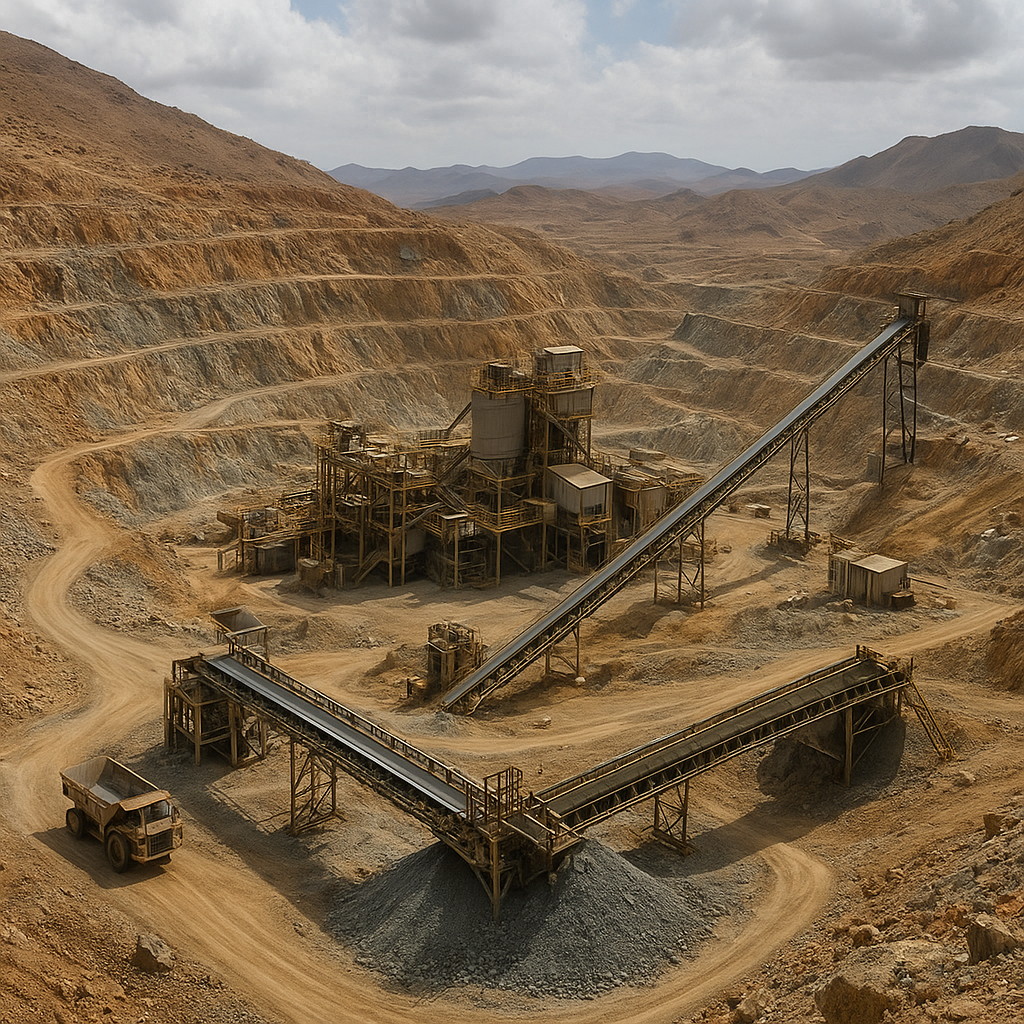
The Guemassa Mine, located in the interior of Morocco, is a notable polymetallic site that has drawn attention for its production of zinc, lead and copper. Set against the geological backdrop of the Atlas foothills, Guemassa exemplifies the type of mineral deposit that has helped shape Morocco’s modern mining landscape. This article explores the mine’s location and geology, the minerals and methods of extraction, its economic role at local and national levels, and several compelling facts and future prospects that make Guemassa an interesting case study in North African mining.
Location and Geological Setting
Geographic context
The Guemassa Mine sits in central Morocco, within relative proximity to major urban centers in the Marrakech region and accessible by a network of regional roads and infrastructure. Its position in the Atlas Mountains’ outer ranges is significant: the area is a crossroads of diverse geological terranes where ancient tectonic processes have concentrated metals in exploitable deposits. This location also places the mine within reach of local labor pools and logistical hubs, aiding in operations and transport.
Geology and mineralization
Guemassa is best understood as a polymetallic deposit where sulfide-rich mineralization occurs within carbonate and metamorphic host rocks. The site displays classic features associated with replacement and hydrothermal systems—zones where mineral-bearing fluids have migrated and precipitated sulfides rich in copper, zinc, and lead. In regional terms, such deposits in Morocco are often related to skarn and carbonate-replacement processes, and while the precise local classification may vary, the practical result is the same: a concentrated mineral package amenable to mining.
Exploration history
Exploration at Guemassa has combined traditional field mapping, geochemical sampling, and modern subsurface techniques such as drilling and geophysical surveys. Over the last several decades, exploration has shifted from reconnaissance to more systematic resource definition, improving understanding of the geometry and grade distribution of the ore bodies. These efforts have been essential to design both the mining method and the downstream processing flowsheet.
Mining and Minerals Extracted
Primary commodities
- Zinc — typically recovered as sphalerite (ZnS) and often the principal economic driver at polymetallic mines where concentrations are sufficient for bulk treatment and sale.
- Lead — usually present as galena (PbS), closely associated with zinc and recovered as a separate concentrate after flotation and separation steps.
- Copper — commonly found as chalcopyrite and other copper sulfides; at Guemassa, copper forms part of the polymetallic suite contributing to overall project economics.
Mining methods
Given the deposit characteristics at Guemassa—multiple, relatively high-grade sulfide lenses hosted in competent rock—operations have favored conventional underground methods where appropriate, complemented by selective open-pit extraction in shallower zones. The choice between underground and surface mining depends on ore depth, geometry, and economic thresholds. Modern operations emphasize mechanization, safety, and efficiency, with drills, loaders, and conveyor systems reducing reliance on manual labor while increasing productivity.
Processing and metallurgy
Ore from Guemassa undergoes crushing and grinding to liberate sulfide minerals, followed by flotation circuits that separate and concentrate copper, zinc, and lead minerals into distinct concentrates. The plant design often includes stages to remove deleterious elements and to produce concentrates that meet smelter specifications. Upgrading and refining may occur domestically or, more commonly, concentrates are shipped to international smelters. Effective processing is critical to maximize recoveries and to add value before export.
Economic Importance and Industry Impact
Local and regional contributions
At the local level, Guemassa provides direct employment in mining operations, processing facilities, and support services. Jobs created by the mine often have a multiplier effect, generating demand for housing, food services, transport, and other ancillary industries. Local procurement of supplies can boost small and medium enterprises in the region. Training programs tied to the mine increase the skill base of the workforce, which can raise long-term employability beyond the life of the mine.
National significance
While Morocco’s economy is well known for its phosphate industry, base metals projects like Guemassa diversify the mineral export portfolio. Revenues from concentrate sales contribute to foreign exchange earnings, and taxation and royalties add to public finances. Furthermore, the presence of reserves of base metals supports downstream industries that require metal feedstocks and can attract investment in metal processing and refining capabilities.
Supply chain and export
Concentrates produced at Guemassa typically enter international supply chains, destined for smelters and refiners in Europe, Asia, or the Middle East. Export logistics involve rail, road, and port infrastructure; the efficiency of these links strongly influences the mine’s competitiveness. Efforts to improve processing domestically could allow more value capture by converting concentrates to refined metals before export, but that requires significant capital, energy, and technological investment.
Social and Environmental Aspects
Community engagement
Modern mining projects place high emphasis on community relations. Guemassa’s operators typically engage local stakeholders through consultation, employment commitments, and development projects—such as infrastructure upgrades, educational support, and health services. When operated responsibly, the mine can help fund local improvements and provide long-term benefits through skills transfer and economic diversification.
Environmental management
Mining sulfide ores carries environmental risks—acid generation, metal-laden tailings, and disruptions to local water systems being chief concerns. Sound environmental practice at Guemassa includes robust tailings management, water treatment facilities, progressive rehabilitation of disturbed lands, and continuous monitoring. Modern environmental frameworks and corporate social responsibility policies aim to minimize the footprint of mining and to ensure that closure plans are in place well before the end of mine life.
Regulation and governance
The mine operates under Moroccan mining law and environmental regulations, which set standards for permitting, operations, and closure. Compliance with these standards is crucial not only for legal operation but also for maintaining a social license to operate. International standards and financing requirements often encourage or require higher levels of environmental, social and governance (ESG) performance, pushing operators to adopt best practices.
Interesting Facts and Future Prospects
Historical roots and modern revival
Mining in Morocco has ancient roots, with metal extraction taking place since antiquity. Guemassa is part of this long history—but modern technology has transformed extraction and processing, increasing yields and reducing environmental impact relative to historic practices. This continuity between past and present gives Guemassa cultural resonance as well as economic utility.
Technological opportunities
There are opportunities to deploy advanced exploration technologies—such as 3D geological modeling, remote sensing, and automated drilling—to more precisely define mineralization and to optimize mining plans. In processing, innovations in flotation chemistry, fine grinding, and sensor-based ore sorting can enhance recoveries while lowering energy and water consumption.
Strategic metals and circular economy
Although Guemassa’s main outputs are base metals rather than the so-called critical minerals, the metals it produces remain central to modern industry—from construction and transport to electronics. Increasing global emphasis on recycling and the processing of secondary materials means the mine sits within a broader value chain where primary production and recycling both play roles in securing metal supplies. Investments in local smelting or refining could reduce dependence on foreign processors and create higher-value jobs.
Environmental innovations and reclamation
Progressive reclamation techniques at Guemassa can turn mined areas into productive landscapes—such as reforested zones, managed grazing land, or sites for renewable energy installations. Tailings rehabilitation, when executed correctly, can significantly reduce long-term environmental liabilities and even provide opportunities for biodiversity enhancement on formerly mined land.
Investment and exploration potential
Policymakers and companies view deposits such as Guemassa not only for current production but for exploration upside. Geological models refined through ongoing drilling may reveal satellite ores or deeper extensions, prolonging mine life and improving project economics. Strategic investment in infrastructure—roads, power, and water—benefits both the mine and surrounding communities, making future exploration more feasible and potentially more profitable.
Key takeaways: a living asset
- The Guemassa Mine exemplifies how a polymetallic site in Morocco contributes to regional development and to the national mining portfolio.
- Its production of zinc, lead, and copper feeds global supply chains and supports local employment and services.
- Ongoing exploration, technological improvements, and high standards of processing and environmental management are central to the mine’s sustainable future.
Guemassa is more than a point on a map; it is a complex interaction of geology, engineering, economics, community dynamics and environmental stewardship. As the global demand for metals evolves, sites like Guemassa will continue to play important roles—both as sources of raw materials and as testbeds for modern, responsible mining practices.

