
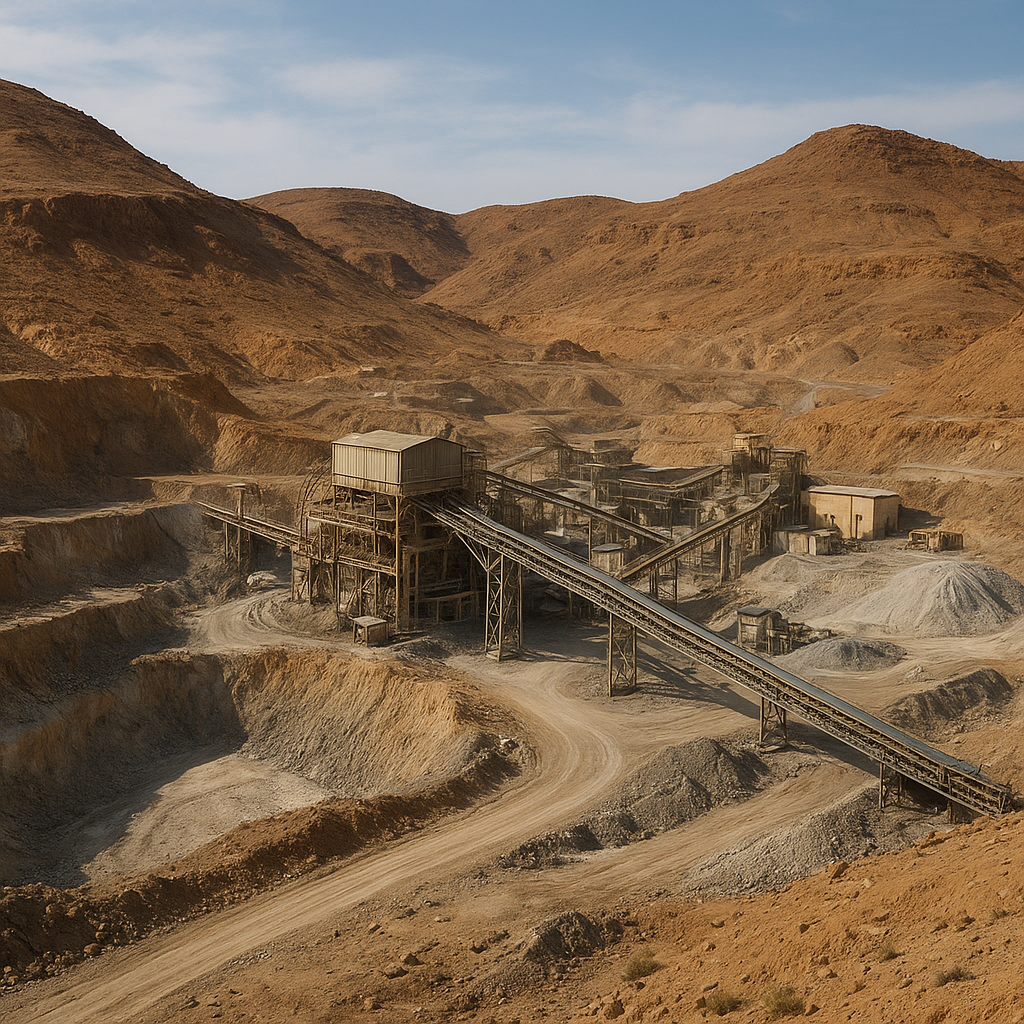
The Imiter Mine sits among the rugged folds of southern Morocco’s mountain ranges as a long-standing source of one of humanity’s most sought-after metals: silver. Known to geologists and miners for its concentrated veins and polymetallic character, Imiter has played a persistent role in local economies, national mineral exports, and regional mining culture. This article explores where the mine is located, the minerals and ores produced there, the broader economic significance of operations in and around Imiter, and several intriguing facts that reveal why this mine matters beyond raw tonnage and revenues. The goal is to provide a rounded portrait that links geology, technology, community, and environmental questions into a single narrative.
Location and geological setting
The Imiter Mine is situated in southern Morocco within the complex terranes of the Anti-Atlas mountain chain and its adjacent plateaus. The area is characterized by folded and faulted rocks that record a long tectonic history, creating favorable conditions for hydrothermal mineralization. Locally, the mine lies close to small settlements and roads that connect the highlands to regional urban centers; the isolation of the site has shaped both the operation’s logistics and its relationship with local communities.
Geologically, Imiter is typical of many high-grade silver deposits that formed from mineral-laden fluids migrating through fractures and fault zones. The geological setting includes veins of sulphide minerals hosted in metamorphosed and igneous rocks. Mineral assemblages often include galena and sphalerite—carriers of lead and zinc respectively—alongside abundant native and sulphidic silver. These associations make the deposit economically polymetallic: while silver is the headline commodity, recoverable by-products such as lead and zinc can add value to the ore package.
Vein systems and ore textures
The veins at Imiter are commonly narrow to moderate in width but rich in metal content, which historically favored underground mining techniques. Texturally, ores show banding, brecciation, and veining where mineralization exploited pre-existing structures. The presence of coarse-grained galena (lead sulphide) hosting silver as inclusions or as silver-bearing sulphosalts is a key feature: these textures allow metallurgists to recover significant quantities of silver by crushing and concentrating sulphide minerals prior to smelting or hydrometallurgical treatment.
What is produced and how it is extracted
At its core, Imiter is a silver mine. The ore mined contains high concentrations of silver associated with sulphide minerals, primarily galena (lead sulphide) and sphalerite (zinc sulphide). Because of the polymetallic nature of the deposit, miners and metallurgists treat the ore to capture not only silver but also the associated base metals that can be recovered as concentrates.
Mining at Imiter has historically relied on underground workings rather than large open pits, because vein-hosted deposits often concentrate metal in narrow shoots rather than extensive near-surface envelopes. Underground methods commonly include room-and-pillar or cut-and-fill stoping, with careful ground control to manage stability in fractured host rock. Ore is transported to a processing plant where it undergoes comminution (crushing and grinding), followed by physical concentration. Froth flotation is a standard industry technique to selectively float sulphide minerals, producing lead and zinc concentrates that carry most of the silver.
Processing pathways for the concentrates vary: they can be shipped to regional smelters for pyrometallurgical treatment, where concentrates are roasted and smelted to produce bullion and metal alloys, or they can be processed using modern hydrometallurgical methods that dissolve silver and selectively recover it via precipitation or electrowinning. The choice of process depends on the concentrate composition, local infrastructure, and economic considerations—transport costs, smelter contracting, and the market price of silver and base metals.
Supporting infrastructure and labor
Because Imiter is not in a major urban center, the mine’s operational success depends on well-developed logistical support: access roads, on-site power generation or grid connection, water management, and maintenance workshops. A combination of local skilled workers and specialized technical teams typically staffs the mine. Over time, such operations foster skills transfer—mechanics, electricians, underground miners, and metallurgists often receive on-the-job training that strengthens the regional labor pool.
Economic importance and regional impact
The economic significance of Imiter can be considered on several scales: local, regional, and national. Locally, the mine provides direct employment and indirect economic activity. Wages paid to miners and plant operators circulate through small businesses—shops, transport services, food providers—supporting livelihoods in nearby towns and villages. These microeconomic effects increase household incomes and can lift standards of living in otherwise economically marginal landscapes.
Regionally, mining operations like Imiter contribute to infrastructure development. Roads upgraded to carry ore and concentrate improve connectivity for communities, while investments in power and water infrastructure often have spillover benefits. The presence of a mining operation can attract service industries—machining, fabrication, and logistics firms—that broaden the economic base beyond mineral extraction.
At the national level, mineral exports are an important source of foreign exchange. Although Morocco is globally best-known for phosphate, high-value metals such as silver contribute to export earnings and diversify the national mineral portfolio. Revenues from mining accrue through royalties, taxes, and corporate investments, which can be directed toward public services. Responsible governance of mining revenues is crucial for translating extractive activity into long-term development gains rather than short-term windfalls.
- Employment: direct jobs in mining and processing; indirect jobs in supply and service chains.
- Exports: concentrate and metal sales bolster foreign exchange reserves.
- Skills: technical training creates a cadre of skilled workers with transferable capabilities.
- Infrastructure: transport and utilities upgraded for mining serve wider communities.
Environmental, social and governance considerations
Mining in semi-arid and mountain environments raises specific environmental and social questions. Water is commonly the most sensitive resource: processing and dust suppression require significant volumes, while local communities depend on limited groundwater and seasonal streams. Responsible water management—recycling process water, minimizing fresh water withdrawals, and careful tailings water control—is essential to avoid exacerbating water stress.
Waste management is another high-stakes area. Tailings (the fine-grained residues after metal recovery) must be stored in engineered facilities to prevent leakage, dam failure, or downstream contamination. Sulphide-rich tailings can oxidize, producing acidic drainage that mobilizes heavy metals if not properly managed. Modern tailings facilities incorporate liners, seepage collection, and rehabilitation plans to minimize long-term risk.
Social licensing—gaining and maintaining the acceptance of local communities—is central to a mine’s viability. Engagement includes transparent communication about employment, procurement, environmental monitoring, and investment in community priorities like education, health, and water supply. In many Moroccan mining districts, communities expect a tangible share of the benefits and a voice in decisions affecting land, water, and economic opportunity.
Regulatory and governance framework
Mining activities are regulated by national law and monitored by regional authorities, with standards on environmental assessment, workplace safety, and fiscal obligations. Good governance practices include independent environmental monitoring, third-party audits, and clear contractual arrangements that define local content, royalty payments, and rehabilitation commitments. Over the long term, stronger governance reduces conflict and creates a predictable environment for both investors and communities.
Interesting facts and lesser-known aspects
Beyond its immediate economic role, Imiter exemplifies several broader trends and curiosities in modern mining:
- Polymetallic complexity: The association of silver with lead and zinc means that metallurgical decisions have outsized impacts on project economics. Innovations in flotation chemistry and hydrometallurgy can increase recovery rates and reduce environmental footprints.
- Underground craftsmanship: Because veins are often narrow, Imiter-type operations preserve a tradition of skilled underground mining that combines mechanization with hand-worked stopes—an interesting hybrid of artisanal technique and industrial scale.
- Local geology as a natural archive: The mineral veins and alteration zones around Imiter record fluid flows and tectonic events that help geoscientists reconstruct regional crustal histories—making the mine a site of scientific as well as economic interest.
- Community narratives: Mines like Imiter are often part of local identity, featuring in oral histories and local economies in ways that extend beyond mere employment. Festivals, place names, and local crafts can be intertwined with the mining tradition.
- Commodity linkages: Silver’s role in modern technologies—from electronics to renewable-energy systems—means that remote mines in Morocco ultimately connect to global supply chains for high-tech goods. A gram of silver extracted at Imiter may end up in a smartphone, solar panel, or medical equipment.
Outlook and future prospects
The future of a deposit such as Imiter depends on several interlinked variables: commodity prices, technical advances in mineral processing, regulatory frameworks, and the evolution of local and global markets. Higher silver prices can revitalize margins and justify investment in deeper or lower-grade portions of the deposit. Conversely, stringent environmental regulation and water scarcity may raise operating costs and compel more sustainable practices.
Technological advances offer pathways to extend the life and reduce the impacts of operations. Improved flotation reagents, dry-stack tailings, and electrification of underground fleets can reduce water use, tailings risk, and greenhouse-gas emissions. Digitalization and remote monitoring can boost safety and efficiency in far-flung operations. For communities and governments, diversifying the local economy—through skills training, small business support, and infrastructure—lessens dependence on a single mine and increases resilience when commodity cycles turn.
Imiter’s importance thus extends beyond the silver it produces. It is an entry point for discussions about sustainable mining, technology transfer, and responsible resource governance. As the world negotiates the twin demands of growing material needs and environmental stewardship, mines like Imiter will continue to illustrate both the opportunities and the challenges of extracting mineral wealth in ways that aim to be equitable, safe, and environmentally mindful.

