
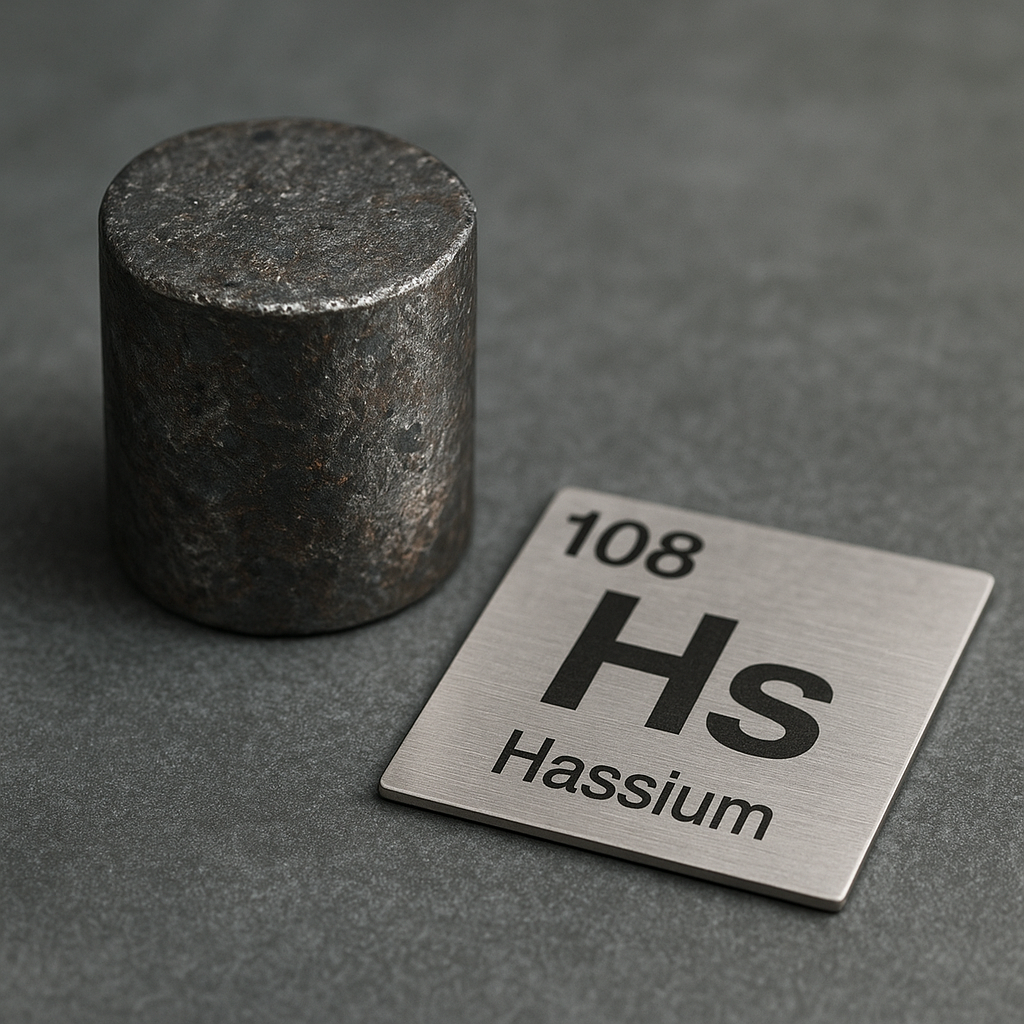
This article explores the rare and intriguing world of Hassium, the heavy synthetic member of the periodic table known as element 108. Although it does not appear in nature in any stable form, hassium has an outsized importance in current research into the limits of the periodic table, the behavior of extremely heavy nuclei, and how chemical periodicity evolves under strong relativistic influences. Below you will find a detailed account of its discovery, how and where it is made, what scientists have learned about its chemistry, and why experiments with this fleeting metal matter to modern science.
Discovery and name
The existence of hassium was first reported by researchers working at the Gesellschaft für Schwerionenforschung (GSI) in Darmstadt, Germany. The team produced extremely heavy atomic nuclei by bombarding heavy targets with energetic ion beams. Early experiments produced nuclides that were assigned to atomic number 108, and the work performed at GSI established the basis for recognizing a new element in that region of the periodic table.
The element was later given the name Hassium in honor of the German state of Hesse, the federal state where Darmstadt is located. Its chemical symbol is Hs. The name reflects a common practice for newly discovered heavy elements: acknowledging the institutions, regions, or scientists associated with their discovery. The choice of name and credit for discovery were part of international discussions among laboratories and naming authorities during the 1990s, as groups in Europe and Russia pursued parallel research on transactinides.
Where hassium occurs and how it is produced
Natural occurrence
Hassium has no natural occurrence on Earth in any measurable quantity. Nuclei with atomic number 108 are unstable and decay rapidly, so any primordial hassium that might have existed when the planet formed would have long since vanished. There are also no known natural processes that create hassium in meaningful amounts today; cosmic-ray spallation and astrophysical nucleosynthesis are not expected to produce persistent hassium isotopes at detectable levels.
Laboratory production
All known hassium isotopes have been produced artificially in particle-accelerator facilities. Production generally involves nuclear fusion reactions in which a heavy target nucleus is bombarded by a lighter ion. Two broad classes of synthesis methods have been used:
- Cold-fusion-like techniques that employ lead or bismuth targets and medium-weight projectiles. These reactions favor the formation of nuclei with relatively low excitation energy, which can increase the chance of forming a neutron-deficient hassium isotope after emission of one or a few neutrons.
- Hot-fusion methods that use actinide targets and calcium-48 beams. These produce higher excitation energies and typically create more neutron-rich isotopes of heavy elements.
Production rates are extremely low: typically only a few atoms (sometimes single atoms) of a given hassium isotope are made in reaction runs that may last days or weeks. Specialized separators and detectors are required to isolate the short-lived atoms and identify them by their characteristic decay chains.
Isotopes and decay
Scientists have synthesized a number of hassium isotopes that differ in neutron number. The isotopes vary in stability, with most decaying by alpha emission or spontaneous fission. Because the lifetimes are brief, typically on the order of milliseconds to seconds for many isotopes, experimental chemistry and physics with hassium require rapid, highly efficient separation and detection techniques. A few isotopes have lifetimes long enough to permit chemical experiments that probe how hassium behaves relative to lighter members of its group.
Chemical properties and experiments
Hassium is placed in group 8 of the periodic table, alongside iron, ruthenium, and osmium. This position suggests certain parallels in chemical behavior, but for superheavy elements like hassium the interplay of nuclear and electronic effects produces nuances that must be explored experimentally and theoretically.
Gas-phase chemistry and oxides
One of the most notable achievements in transactinide chemistry was the study of hassium in the gas phase, primarily through investigations of its highest known oxide, analogous to osmium tetroxide. Scientists succeeded in producing and identifying molecules consistent with a hassium oxide of the type HsO4. These gas-phase experiments used rapid chemical separation techniques and chromatography to detect the adsorption behavior of the oxide on surfaces and compare it to that of osmium tetroxide. Results indicate that hassium forms a stable tetroxide under the appropriate reaction conditions, and that its volatility and adsorption properties can be related to those of osmium, albeit with measurable differences.
Relativistic effects and unusual chemistry
For the heaviest elements, electrons in inner shells move at velocities that are a significant fraction of the speed of light. These relativistic effects alter orbital energies and radial distributions, which in turn influence oxidation states, bond strengths, and chemical preferences. In hassium, relativistic stabilization of s and p1/2 orbitals and the expansion or destabilization of certain d orbitals can affect how readily the element attains high oxidation states and how covalent versus ionic its compounds become.
Chemists and theoreticians study hassium both to test predictions of relativistic quantum chemistry and to probe how periodic trends persist or break down at extreme nuclear charge. These investigations have broader implications: they help refine computational methods used across chemistry and materials science and deepen understanding of how fundamental forces shape observable properties.
Applications and scientific significance
There are no commercial or practical applications of hassium, given the element’s minuscule production rates and short-lived isotopes. However, hassium plays an important role in fundamental research:
- Nuclear physics: Production and decay data for hassium isotopes inform models of nuclear structure, shell closures, and the mechanisms that govern alpha decay and spontaneous fission. Results feed into the search for the so-called island of stability, a theoretical region of the chart of nuclides where superheavy nuclei might exhibit increased stability.
- Chemical periodicity: Experimental chemistry with hassium tests how well periodic trends extend to the heaviest accessible elements and probes the impact of relativistic effects on bonding and oxidation-state preferences.
- Method development: The techniques required to create, separate, and analyze single atoms of hassium drive innovation in detector technology, fast chemistry, and automated handling systems that can be applied to other areas of radiochemistry and nuclear material analysis.
- Astrophysics and nucleosynthesis: Understanding heavy-element formation pathways and decay chains contributes data that help interpret observational signatures and theoretical models of element production in extreme stellar environments.
Experimental challenges and instrumentation
Working with hassium tests the limits of modern experimental apparatus. Key challenges include:
- Production intensity: Creating even a few atoms requires large accelerators and long irradiation times with intense ion beams.
- Rapid separation: Short half-lives demand separation and transport methods that operate on millisecond- to second-timescales. Techniques such as gas-jet transport, recoil separators, and rapid chromatography are essential.
- Sensitivity and unambiguous identification: Detectors must distinguish decay chains and measure energies and times with precision to assign atomic numbers and mass numbers confidently.
Facilities with the necessary capabilities include specialized heavy-ion laboratories in Europe, Russia, Japan, and the United States. Collaboration among labs, and cross-checks of results with independent experiments, help build a reliable picture of hassium properties.
Safety and handling
Although hassium atoms are radioactive, their extreme rarity means that macroscopic hazards associated with quantities of the element do not exist outside of hypothetical hypothetical bulk production scenarios. Nevertheless, facilities that produce hassium operate under strict radiological safety protocols because the equipment and target materials used in synthesis—actinide targets, high-energy beams, and produced decay products—pose hazards. Radiation protection, remote handling, and secure containment are standard practice.
Interesting facts and broader context
Some points that highlight the broader scientific and cultural interest in hassium:
- The element’s name commemorates the region where the pioneering experiments were conducted, emphasizing the local and institutional pride tied to major discoveries in fundamental science.
- Hassium chemistry has been directly compared to that of osmium, allowing a rare experimental test of group trends across a broad span of atomic number.
- Research on hassium and neighboring transactinides provides incremental advances toward understanding whether heavier, more stable superheavy elements might be synthesized in the future.
- The practical obstacles to creating and studying hassium have driven advances in fast, automated chemistry that also benefit other fields requiring rapid analysis of short-lived species.
Ongoing questions and future directions
Despite progress, many open questions remain. Researchers continue to seek:
- More complete maps of hassium isotopes and their decay schemes to clarify nuclear structure effects and refine predictive models.
- Additional chemical studies that explore different oxidation states, complexation behavior, and solid-state properties, should production rates and isotope lifetimes permit.
- Improved theoretical treatments that incorporate relativity, electron correlation, and nuclear shape effects to predict properties that experiments can test.
In the quest to push the boundaries of the periodic table, experiments with elements such as hassium are indispensable. They illuminate how atomic and nuclear physics intertwine at extreme proton numbers and provide a proving ground for theory and technique. While hassium will likely never be part of everyday technology, its scientific value is considerable: it is a window into the fundamental behavior of matter at the limits of complexity and stability.