Staurolite is a compelling and often enigmatic mineral that attracts attention from petrologists, collectors and folklorists alike. Found primarily in medium-grade metamorphic rocks, it is especially noted for its distinctive crystal habit and frequent twinning that produces cross-shaped specimens cherished as curios and talismans. This article explores the mineral’s mineralogy, geological settings, practical uses, cultural significance and recent scientific research, offering an integrated view that connects laboratory studies with field observations and human interest.
Mineralogy and crystal characteristics
At its core, staurolite is a crystalline aluminosilicate whose generalized chemical composition accommodates iron, magnesium and aluminium in varying proportions. The mineral is most commonly described by the simplified formula Fe2+2Al9Si4O22(OH)2, although substitution by Mg, Mn and trace elements is frequent. It crystallizes in the monoclinic system and typically forms stout, prismatic crystals that are dense and compact.
Physically, staurolite is characterized by a relatively high hardness (roughly 7–7.5 on the Mohs scale) and a specific gravity commonly in the ~3.6–3.9 range. Colors range from deep reddish-brown to brownish-black, with crystals often appearing opaque to translucent on thin edges. Optical properties include moderate birefringence and pleochroism in thin sections, and staurolite is frequently recognized in petrographic microscope studies by its distinctive relief and extinction behavior.
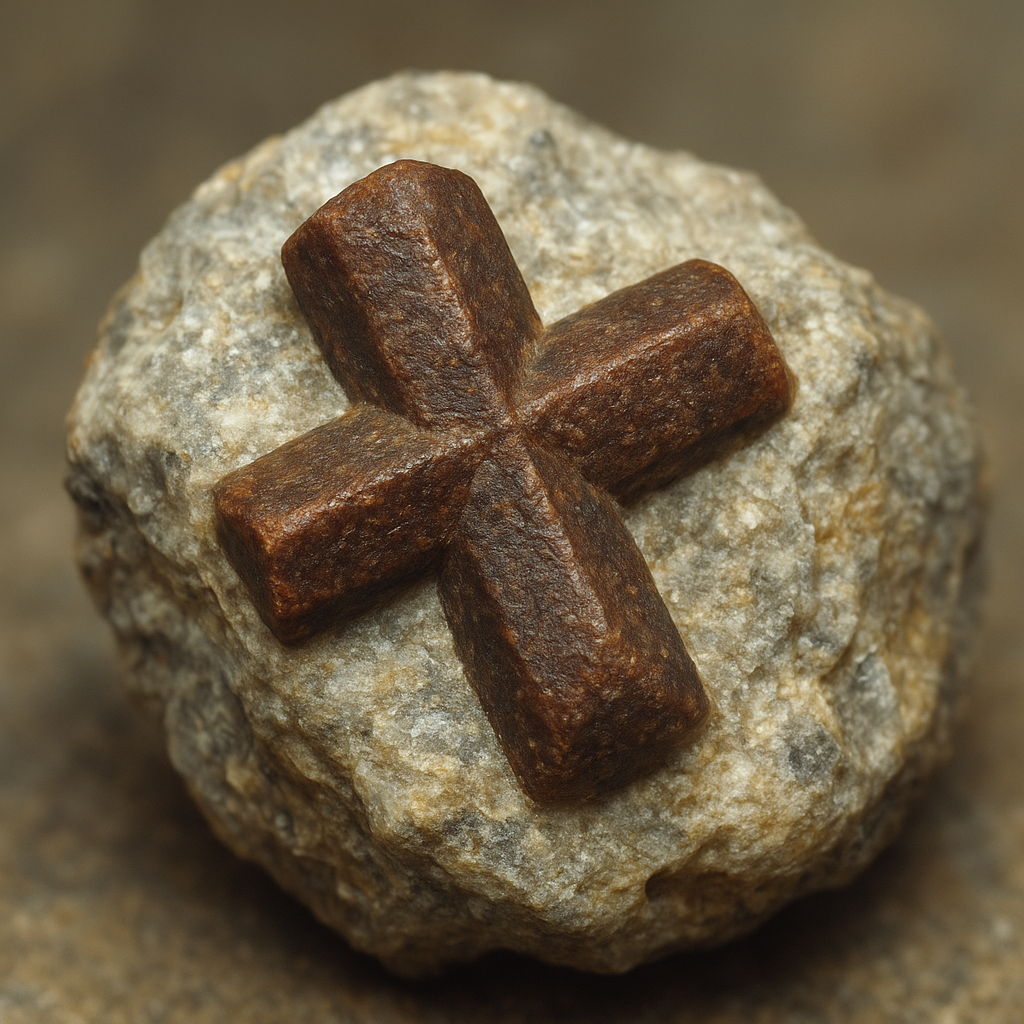
One of the most remarkable features of staurolite is its propensity for twinning. Twinning in staurolite commonly generates cruciform or cross-shaped aggregates—penetration twins that intersect at characteristic angles (most frequently near 60° and sometimes near 90°). These twin forms are responsible for much of the mineral’s popular appeal and for its folk names such as “fairy stone” or “crossstone.”
Crystals are typically compact and lack strong cleavage, which combined with the mineral’s hardness makes specimens relatively durable. Staurolite may contain inclusions of other minerals (quartz, mica, rutile and garnet are commonly observed), and these inclusions can provide important information about the rock’s metamorphic history.
Geological occurrence and formation
Staurolite is most commonly encountered in regionally metamorphosed, aluminum-rich (pelitic) rocks such as schist and gneiss. It forms under intermediate-temperature, intermediate-pressure metamorphic conditions—conditions commonly described as the amphibolite to lower granulite facies depending on bulk composition and fluid presence. Because of this, staurolite is widely regarded as an index mineral for mapping metamorphic grade in orogenic belts.
Typical metamorphic assemblages in which staurolite appears include combinations with garnet, kyanite or sillimanite (depending on pressure-temperature path), muscovite, biotite and quartz. The presence or absence of staurolite alongside these phases can help geologists reconstruct metamorphic isograds and infer maximum pressures and temperatures achieved during metamorphism.
Formation of staurolite commonly involves prograde metamorphism of aluminous pelites: burial and heating drive reactions that concentrate Al and Fe into the staurolite structure. The precise P–T stability field depends on bulk chemistry (notably Fe/Mg ratio and H2O activity), but in general staurolite occupies a niche between lower-grade chlorite–biotite zones and higher-grade kyanite–sillimanite zones. In some P–T paths, staurolite breaks down to produce kyanite plus garnet or other high-temperature phases; in others it survives into higher temperatures if compositions and pressures permit.
Staurolite is found across the globe. Notable occurrences include metamorphic terranes in:
- the Appalachian Mountains (United States), where “fairy stones” are famous in locales such as parts of Virginia and Georgia;
- the Scottish Highlands and other European metamorphic belts, including regions of Spain, France and Switzerland;
- parts of Canada, particularly in regions with extensive Proterozoic and Paleozoic metamorphism;
- Brazil, Russia, India and parts of East Africa, where regional metamorphism and appropriate protoliths produce staurolite-bearing schists and gneisses.
These locations are representative rather than exhaustive; staurolite’s appearance is tied mainly to the chemistry of precursor sediments and the regional metamorphic regime.
Uses and practical significance
While staurolite has limited direct industrial application, it plays several important roles in science, collecting and jewelry. The most significant practical use is in metamorphic petrology: as an index mineral, staurolite helps geologists establish relative metamorphic grade and to delineate metamorphic zones across orogenic belts. The presence of staurolite in assemblages, together with minerals such as garnet and kyanite, constrains the P-T conditions reached and aids in constructing metamorphic P–T paths for tectonic reconstructions.
Because natural staurolite commonly grows as moderate-to-large porphyroblasts, these crystals frequently enclose earlier mineral fabrics. Inclusion patterns within staurolite allow geologists to interpret growth histories and episodes of deformation; many studies use staurolite porphyroblasts to determine timing relationships between metamorphism and deformation events. In this respect, staurolite is valuable as a recorder of tectonometamorphic evolution.
Collectors prize well-formed twinned crystals for their aesthetic and cultural value. The cross-shaped specimens—often called “fairy crosses” or “fairy stones”—are fashioned into cabochons and simple jewelry items, and can command modest prices depending on size, symmetry and locality. Because of the mineral’s hardness and durability, it can be used in jewelry without excessive risk of abrasion, though its typically opaque appearance limits faceting potential.
Beyond petrology and collecting, staurolite has niche research uses: trace element analyses of staurolite can inform on element partitioning during metamorphism, and microstructural studies illuminate deformation mechanisms active during growth. Although staurolite is not a primary industrial mineral, its scientific utility in interpreting regional metamorphism gives it broad importance in structural geology and tectonics.
Cultural, historical and folkloric associations
Staurolite’s most immediate cultural resonance comes from its frequent natural twinning: the intersecting crystals often resemble crosses, and many societies have created myths and talismans around these shapes. In parts of the Appalachian region, the cross-shaped stones were historically collected as keepsakes, thought to ward off evil or bring good fortune to children. Several parks and sites—most notably some areas in Virginia—celebrate this heritage and even permit visitors to search for “fairy stones” in streams and soil.
Collections and handicrafts featuring staurolite have long been sold in local markets; the cross motif makes the mineral especially attractive as a symbolic gift. In addition to local traditions, staurolite has attracted interest from the New Age and metaphysical communities, where it is sometimes assigned healing or grounding properties (claims that are cultural rather than scientific).
Museums and displays often feature especially striking twinned specimens, and staurolite has been used historically as an emblem in regional lore. Several small-scale festivals and rock-hunting events revolve around collecting these distinctive twinned crystals—events that combine amateur geology with local culture and outdoor recreation.
Scientific research, metamorphic implications and recent findings
Modern studies of staurolite combine traditional petrography with advanced microanalytical techniques. Electron microprobe analyses clarify compositional zoning and trace element distributions within crystals, while techniques such as electron backscatter diffraction (EBSD) and transmission electron microscopy (TEM) reveal intracrystalline deformation, twinning mechanisms and growth histories.
Key scientific themes include:
- Reconstruction of metamorphic P-T paths using staurolite-bearing assemblages. Because staurolite appears in a relatively specific stability field, its presence alongside other index minerals helps pin down metamorphic maxima and the trajectory (prograde vs. retrograde) of metamorphism.
- Use of staurolite porphyroblasts as records of syn- or post-tectonic growth. Inclusion trails and rotation of inclusions can reveal timing of deformation relative to crystal growth, contributing to tectonic histories.
- Investigation of twinning mechanisms and crystal growth kinetics. Studies have shown that twinning in staurolite is often a primary growth phenomenon rather than a later deformation feature, and that fluid activity and local chemistry influence twin development.
- Trace element and isotopic investigations to understand element partitioning and fluid-rock interaction during metamorphism. While staurolite itself is not commonly used for radiometric dating, its trace element chemistry helps constrain metamorphic reactions and sources of fluids.
Recent research has increasingly focused on integrating field-scale mapping with micro-scale analyses—linking the distribution of staurolite-bearing rocks across orogenic belts with crystal-scale records to derive comprehensive tectonometamorphic models. This multi-scale approach has improved our understanding of how crustal slices experience heating, burial and exhumation through deep time.
Practical advice for collectors, identification and care
For those interested in collecting staurolite or identifying it in the field, the following practical points are helpful:
- Look in areas of regional metamorphism where pelitic schists and gneisses dominate. Staurolite is more likely where protoliths were rich in clay- and aluminum-bearing minerals.
- Search stream gravels and soil derived from metamorphic terrains; weathering often liberates robust twinned crystals from host rock.
- Identify specimens by their brown color, high density and distinctive cross-shaped twinning. Under a hand lens, the prismatic habit and lack of perfect cleavage are useful clues.
- Handle larger twinned crystals carefully: while staurolite is hard, penetration twins can have thin junctions that are vulnerable to impact.
- Cleaning is simple—staurolite tolerates mild acids poorly, so use warm water and a soft brush; avoid harsh chemicals that might attack included or attached minerals.
Collectors should be aware that prices for staurolite are generally modest; exceptional, well-formed twinned specimens can fetch higher values among enthusiasts, but the mineral is primarily valued for scientific interest and local cultural significance rather than as a high-end gemstone.
Related minerals and look-alikes
Staurolite is commonly associated with minerals such as garnet, kyanite, sillimanite, mica and quartz in metamorphic rocks. When assessing potential specimens, it’s useful to distinguish staurolite from look-alikes:
- Rutile needles or rutile aggregates can sometimes appear as dark prismatic forms, but rutile is tetragonal and shows different optical signatures and higher birefringence.
- Garnet is typically more equant and shows characteristic isotropic optical behavior in thin section, unlike the anisotropic staurolite.
- Some idiomorphic pegged crystals of tourmaline or other dark minerals could superficially resemble staurolite, but differences in hardness, cleavage and crystal habit allow discrimination.
When in doubt, thin-section petrography or microprobe analysis will resolve identification unequivocally.
Final observations on staurolite’s appeal
Staurolite occupies a distinctive niche at the intersection of rigorous geological science and popular cultural interest. Its role as an index mineral makes it a practical tool for geologists reconstructing metamorphic histories, while its frequent twinning and cross-like appearance give it a persistent place in local folklore and collecting communities. From the microstructures that reveal deep crustal processes to the small hand specimens that children and hikers delight in finding, staurolite illustrates how a single mineral can connect processes of mountain building with human stories and scientific curiosity.