The mineral and structural family known as skutterudite occupies a unique place in both mineralogy and materials science. Originally identified as a naturally occurring cobalt arsenide, the term now commonly refers to a broad class of compounds sharing a distinctive cubic framework capable of hosting a variety of atoms in its voids. The combination of flexible chemistry, intriguing physical phenomena and strong potential for practical devices has made skutterudite-based materials a continuing focus of research. This article explores where skutterudites are found, how they are used, and several related scientific themes that make them especially interesting.
Mineralogy and Crystal Structure
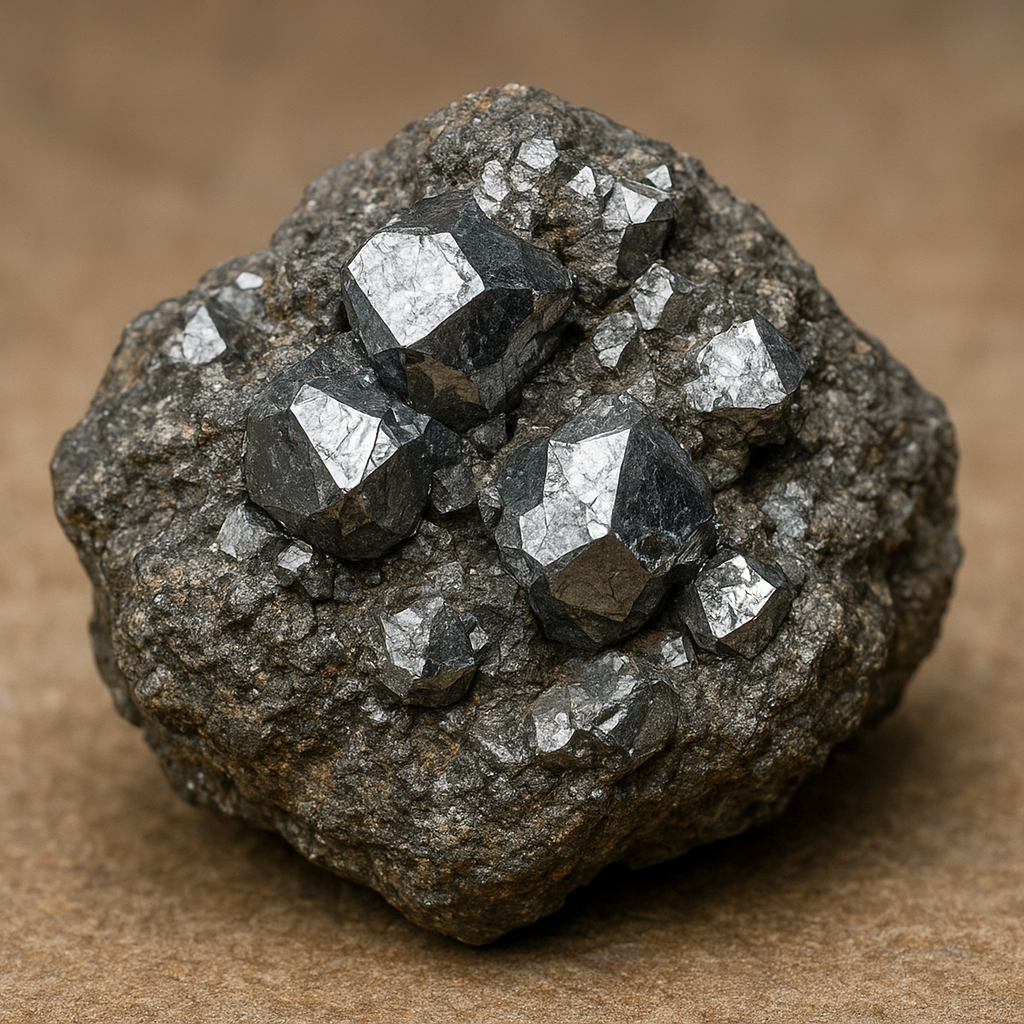
At the core of the skutterudite concept is a recognizable cubic crystal structure. The mineral skutterudite itself has the chemical composition CoAs3, where cobalt and arsenic form a rigid framework with large, regularly spaced cavities. This framework is described by the space group Im-3 and features a three-dimensional network of transition-metal–pnictogen coordination polyhedra. Many chemically related compounds adopt the same structural motif: a general formula often written as MX3 (unfilled) or A(M)4X12 (filled), where M is a transition metal such as cobalt, iron or nickel, X is a pnictogen (phosphorus, arsenic, or antimony), and A is a filler atom (an alkali, alkaline earth, or rare-earth element).
What makes this architecture so versatile is the presence of relatively large voids or cages that can be occupied by guest atoms. When these voids are empty, the material is called an “unfilled skutterudite” (for example, CoSb3). When guest atoms are inserted, the result is a “filled skutterudite.” The guest atoms often act as localized vibrational centers—sometimes described as “rattlers”—and this has profound consequences for the material’s thermal and electronic properties.
Key structural features
- High-symmetry cubic lattice (space group Im-3) with a repeating cage motif.
- Transition-metal–pnictogen octahedra or polyhedra forming the backbone.
- Cage-like voids that accept a variety of filler elements, permitting extensive chemical tuning.
- Strong anisotropy at the local scale despite overall cubic symmetry, affecting phonon and electron transport.
Occurrence and Natural Sources
Skutterudite as a mineral was first described from ore bodies in Norway and named after the Skuterud (also spelled Skutterud) mining district in Modum. Natural skutterudites are typically found in hydrothermal and magmatic-hydrothermal environments, in association with cobalt–nickel arsenide minerals, and as products of hydrothermal alteration in sulfide-rich veins. They sometimes occur alongside other cobalt minerals such as erythrite and asbolane, and in metamorphosed ore deposits.
Natural skutterudite minerals are not a major global source of cobalt or antimony for industry because they are relatively rare and often intermixed with other phases. Nonetheless, as an ore mineral, skutterudite historically contributed to local cobalt production in some mining districts. More commonly, industrial materials with the skutterudite structure are synthesized in laboratories or by industrial chemical processes tailored to produce high-purity compounds for research and device fabrication.
Thermoelectric Applications and Principles
The most prominent modern interest in skutterudites arises from their promise as thermoelectric materials. Thermoelectrics convert heat directly into electricity (Seebeck effect) or vice versa (Peltier effect). The efficiency of a thermoelectric material is commonly expressed by the dimensionless figure of merit ZT = S^2 σT / κ, where S is the Seebeck coefficient, σ is the electrical conductivity, κ is the thermal conductivity, and T is absolute temperature. For practical applications, researchers seek materials with high S and σ, and low κ.
Skutterudites are attractive because their crystal structure allows independent tuning of electronic and thermal transport properties. The open cages in the structure can be populated with filler atoms that act as low-frequency vibrational centers (the aforementioned rattler modes). These localized vibrations scatter heat-carrying lattice waves (phonons), reducing the lattice contribution to thermal conductivity without severely degrading electronic conduction. This idea is central to Slack’s “phonon-glass electron-crystal” strategy: a material that behaves like a glass for phonons but retains crystalline electronic conduction.
How filling and alloying enhance performance
- Filler atoms reduce lattice thermal conductivity by scattering phonons; heavy and loosely bound fillers are often most effective.
- Alloying on the metal or pnictogen sites can tune carrier concentration and band structure, optimizing the Seebeck coefficient and electrical conductivity.
- Nanostructuring and introducing second phases create additional phonon scattering centers at multiple length scales.
Optimized filled skutterudites—particularly derivatives of CoSb3 filled with rare-earth or alkaline-earth elements—have achieved ZT values approaching or exceeding unity at elevated temperatures, making them competitive with other mid-to-high-temperature thermoelectric systems. These materials are considered promising for waste-heat recovery in industrial processes and automotive exhaust heat harvesting, where operating temperatures can range from a few hundred up to ~800 K.
Design challenges
Despite their potential, several challenges remain before skutterudite-based thermoelectric devices become widespread. Balancing the tradeoffs between electrical conductivity and Seebeck coefficient is complex: doping to increase carrier concentration improves σ but often reduces S. Maintaining mechanical stability and limiting degradation at high temperatures and in oxidative environments is another critical issue. Additionally, many high-performance compositions include antimony or arsenic, both of which present toxicity and environmental handling concerns that influence manufacturing and disposal strategies.
Other Functional Properties and Applications
Beyond thermoelectricity, skutterudite-structured compounds show a surprising range of physical behaviors that have attracted research attention. Some filled skutterudites display heavy-fermion characteristics, Kondo interactions, unconventional superconductivity and complex magnetic ordering. A famously studied example is PrOs4Sb12, which exhibits heavy-fermion superconductivity and unconventional pairing mechanisms—making it a model system in condensed-matter physics for exploring the interplay of crystal-field effects, strong correlations and superconductivity.
Other applications under investigation include:
- Solid-state cooling (thermoelectric refrigeration), especially for localized cooling of electronics where reliability and compactness are prioritized;
- High-temperature generators for space or remote power where reliability over moving parts is necessary; however, material stability remains a limitation;
- Magnetic and electronic devices exploiting correlated-electron phenomena and topological properties that have been predicted or observed in certain skutterudite compositions;
- Model systems for basic studies of phonon dynamics, because the cage-and-rattler interaction provides a clear mechanism to study localized versus extended vibrational modes.
Synthesis, Processing and Characterization
Producing high-performance skutterudite materials for thermoelectric testing and device fabrication relies on careful control of composition and microstructure. Typical synthesis routes include melting and solidification (arc melting, induction melting), solid-state reaction under vacuum or inert gas, and powder metallurgy routes followed by densification techniques such as spark plasma sintering (SPS) or hot pressing. SPS has been especially useful because it enables rapid consolidation at relatively low temperatures, preserving fine grain sizes and engineered nanostructures that improve phonon scattering.
Advanced processing steps may include:
- Controlled filling with rare-earth or alkaline-earth ions to tune thermal conductivity;
- Alloying of transition-metal or pnictogen sublattices to adjust carrier concentration and band structure;
- Mechanical or chemical nanostructuring to create hierarchical phonon scattering across length scales;
- Coating or encapsulation to protect against oxidation during device operation.
Characterization techniques are similarly varied. X-ray diffraction and electron microscopy reveal crystal structure and microstructure, while transport measurements (Seebeck coefficient, electrical conductivity, thermal conductivity) provide the data needed to calculate ZT. Inelastic neutron or x-ray scattering and Raman spectroscopy probe lattice dynamics and rattler modes. First-principles calculations based on density functional theory (DFT) and Boltzmann transport modeling are routinely used to predict and rationalize electronic band structure and transport coefficients.
Role of nanostructuring and defects
Modern strategies for improving thermoelectric performance often exploit nanostructuring and controlled defect engineering. Grain boundaries, nanoprecipitates and dislocations act as effective phonon scatterers while having a smaller impact on electronic carriers if engineered correctly. Similarly, creating composite or multicore structures allows designers to tune scattering over a wide frequency range of phonons, further lowering the lattice thermal conductivity without severely degrading electronic mobility.
Research Directions and Interesting Phenomena
Skutterudites remain an active area of materials research because they sit at the intersection of many enticing scientific themes: complex electronic behavior, tunable phonon dynamics, and structural flexibility. A few especially interesting directions include:
Advanced filler chemistry and multi-filling
Using multiple types of filler atoms simultaneously can introduce a broad spectrum of localized vibrational frequencies, improving phonon scattering across a wider band and thereby reducing thermal conductivity more effectively than single fillers. Multi-filling also allows finer tuning of carrier concentration and can influence carrier scattering in beneficial ways.
Band engineering and topological aspects
Researchers explore chemical substitutions and strain engineering to modify band structure for enhanced Seebeck coefficients or to induce new electronic phases. Some skutterudite-type compounds are predicted to host nontrivial band topology under certain conditions, opening the door to combined studies of thermoelectricity and topological surface states.
Interplay of strong correlations and unconventional superconductivity
Skutterudites like PrOs4Sb12 serve as laboratories for studying heavy-fermion superconductivity and exotic pairing symmetries. Understanding how the cage environment and filler atoms influence electronic correlations can shed light on broader questions in correlated-electron systems.
Environmental and practical considerations
Because many high-performance skutterudites contain antimony or arsenic, scaling up for industrial deployment necessitates attention to toxicity, recycling and lifecycle management. Developing low-toxicity variants or effective encapsulation and recycling strategies is a practical research priority.
Markets, Devices and Future Prospects
Commercial thermoelectric devices today rely on bismuth telluride near room temperature and lead telluride for higher temperatures; skutterudites are promising contenders for mid-to-high-temperature applications, particularly where waste-heat recovery could offer significant energy savings. Potential markets include:
- Automotive: harvesting exhaust heat to improve fuel economy or power auxiliary systems;
- Industrial process heat recovery: turning lost thermal energy into electricity at steel plants, glass furnaces or chemical facilities;
- Remote or off-grid power generation where robust, maintenance-free devices are valued;
- Specialized electronics cooling where compact, solid-state refrigeration is advantageous.
Achieving broad deployment requires continued improvements in material efficiency, long-term stability, manufacturability and cost-effectiveness. Advances in synthesis, compositional tuning, and device integration—combined with systems-level innovations such as waste-heat capture strategies—will determine how widely skutterudite-based technologies are adopted.
Concluding Observations
Skutterudites exemplify how a single structural motif can bridge mineralogy, solid-state physics and engineering. From its origins as a naturally occurring cobalt arsenide found in Norway to its role as a platform for cutting-edge thermoelectric research, the skutterudite family continues to yield surprises. Whether the future sees skutterudites deployed widely in energy harvesting systems, adopted for niche devices, or primarily valued as model systems in fundamental research, their combination of structural flexibility and interesting physics ensures they will remain an important topic in materials science.