
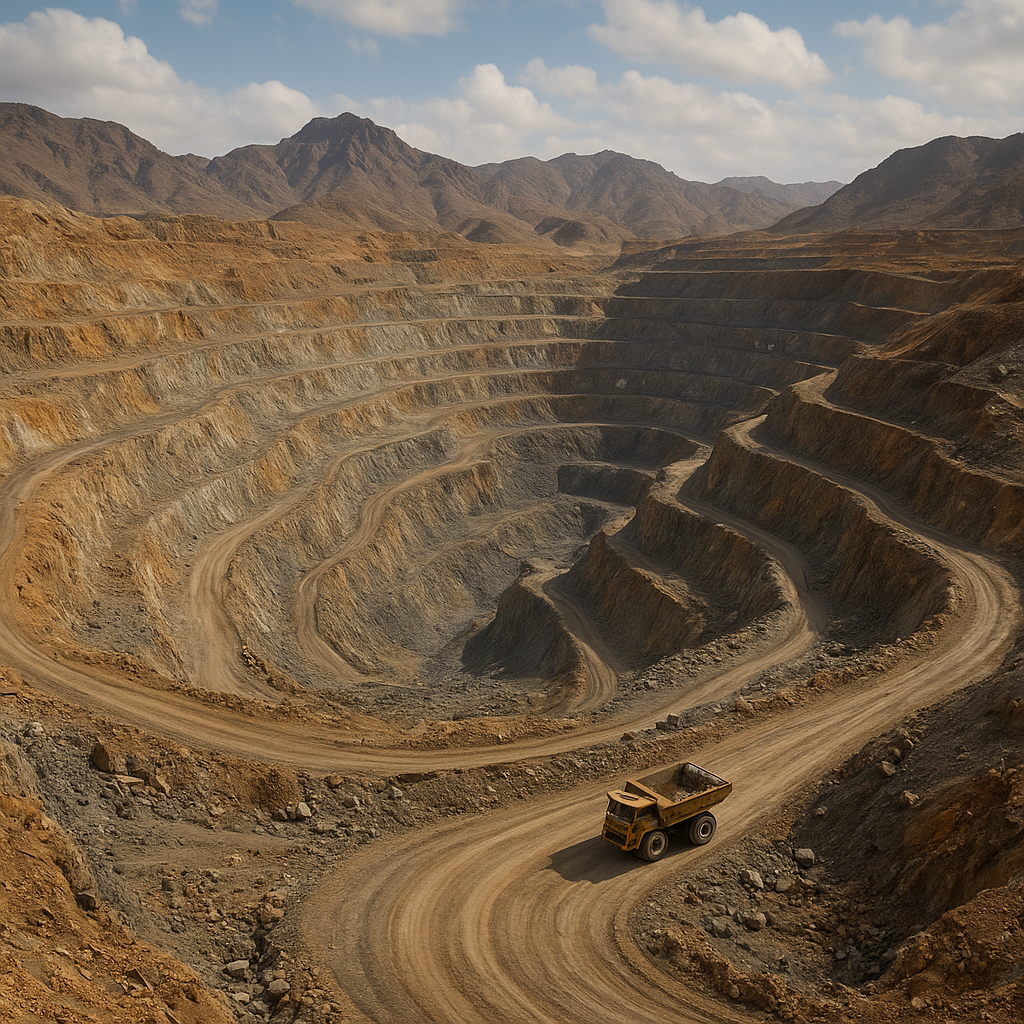
The following article explores the El Hajar mine in Morocco, a deposit historically recognized for its lead and zinc mineralization. It examines the mine’s geographic setting, geological character, methods of extraction and processing, and its broader economic and social significance. The text also highlights lesser-known and interesting aspects of the operation, including local impacts, technological considerations, and prospects for the future.
Location and regional context
El Hajar is situated in the heart of the Moroccan mining belt, within a region known for a concentration of base-metal deposits. The mine lies in proximity to several small towns and provincial centers that historically developed around mining activity and associated services. Morocco’s complex tectonic and sedimentary history has produced numerous favorable sites for base-metal deposits, and El Hajar occupies a structurally favorable position where mineral-rich horizons have been compressed, uplifted, and exposed.
Geographically, the site benefits from access to regional roads that connect to larger transport arteries, enabling the movement of concentrates and supplies. The mine’s location has made it a focal point for both local employment and for investment by companies seeking to exploit North African metal resources. The broader region’s climate and topography influence logistics, water availability, and site planning, as weathering and erosion patterns affect both exploration and long-term rehabilitation planning.
Geology and mineralization
The mineralization at El Hajar is characteristic of Mississippi Valley Type (MVT) and sediment-hosted polymetallic deposits common in parts of North Africa and southern Europe. Mineralized lenses and stratabound layers of sulfide-bearing material are hosted within carbonate and clastic rocks that provided open space and chemical conditions favorable for the deposition of metallic sulfides.
The primary commodities recovered are lead and zinc, typically occurring as galena (PbS) and sphalerite (ZnS). These minerals are often associated with gangue minerals such as calcite, dolomite, and various clays. Secondary minerals formed by weathering—such as cerussite and smithsonite—are found in oxidized zones near the surface, offering indicators for exploration and sometimes shallow, small-scale recovery opportunities.
Geologists mapping the area have documented structural controls including fault zones, fold hinges, and stratigraphic contacts that localize mineralization. Hydrothermal fluid pathways are thought to have traveled along these structural conduits, precipitating sulfide minerals as temperature and chemistry changed. This geologic story is important for understanding where remaining reserves might be located and for planning future exploration.
Mining methods and processing
Extraction at El Hajar has historically combined underground and open-pit methods depending on the depth and geometry of ore bodies. Shallower, laterally extensive lenses are often mined via open-pit techniques that permit bulk removal of mineralized rock, while deeper, high-grade shoots have been accessed by underground development with drives, stopes, and ventilation systems.
Once recovered, ore undergoes a sequence of preparation and concentration steps. Crushing and grinding reduce rock to liberation size. Froth flotation is the predominant concentration technique used to separate sulfide minerals from the gangue, producing lead- and zinc-rich concentrates. These concentrates are then dewatered and prepared for transport to smelters or toll processing facilities. The mineral processing circuit may include:
- Primary and secondary crushing
- Ball milling and classification
- Rougher and cleaner flotation stages
- Thickening and filtering for concentrate handling
Modern processing at El Hajar has increasingly emphasized recovery rates, reagent optimization, and tailings management. Metallurgical test work helps refine flowsheets to maximize metal recovery while reducing energy and reagent consumption. The presence of deleterious elements—such as iron, silica, or minor heavy metals—can complicate smelting routes and affect concentrate marketing, so tight quality control is important to maintain buyer specifications.
Reserves, production and market role
Accurate reserve and production figures fluctuate with continuing exploration, commodity prices, and operational decisions. El Hajar has been evaluated repeatedly by geologists and mining engineers to estimate proven and probable reserves, with expansion potential often cited in areas adjacent to known mineralized lenses. Production remains primarily focused on lead and zinc concentrates destined for national and international metal markets.
Morocco is not a top-tier global producer of lead and zinc compared with major producing countries, but sites like El Hajar contribute meaningfully to domestic supply chains and to export earnings. Concentrates from the mine can feed domestic smelters when available, but more commonly are exported to regional or global smelting facilities. The mine supports local alloy, chemical, and battery manufacturing indirectly by supplying base metals into the supply chain.
Market dynamics—prices for lead and zinc, freight costs, and smelter availability—affect how much material is shipped and where. When global metal prices are strong, investment in expanded mining at El Hajar becomes more attractive; conversely, prolonged price weakness can lead to reduced throughput, temporary shutdowns, or care-and-maintenance periods until conditions improve.
Economic importance and local impact
At the local and regional levels, El Hajar plays an outsized role in terms of employment and economic activity. The mine provides direct jobs in operations, maintenance, and administration, and supports a network of indirect jobs in transportation, equipment supply, catering, and services. The employment multiplier effect is significant in smaller communities, where alternative formal-sector jobs may be limited.
Taxation, royalties, and corporate social responsibility programs associated with the mine help fund public services, infrastructure projects, and community programs. Investments in roads, water supply, and health clinics are frequently part of the social license to operate. In some cases, mining companies operating at El Hajar have established vocational training initiatives and partnerships with local schools to enhance skills relevant to mining and allied industries.
At a national scale, mining operations contribute to foreign exchange through the export of concentrates and through attracting investment into the mining sector. Foreign and domestic companies involved in exploration, extraction, and processing can stimulate technology transfer and capacity building. Revenues generated—if managed transparently—can support broader development objectives beyond the immediate mining region.
Environmental management and social considerations
Mining of sulfide ores such as those at El Hajar brings environmental challenges that require active management. Potential issues include acid rock drainage (ARD), heavy-metal mobilization, dust generation, and water usage. To mitigate these risks, operators implement mine-water management plans, design engineered tailings storage facilities, and monitor groundwater and surface water quality.
Tailings management is a critical area of focus. Well-designed tailings facilities—incorporating liners, seepage collection, progressive rehabilitation, and controlled water covers—reduce the risk of contaminant release. Progressive rehabilitation of disturbed areas, including re-contouring, topsoil replacement, and revegetation with native species, helps reduce erosion and restores some ecological function post-mining.
Socially, maintaining a constructive relationship with surrounding communities is essential. Stakeholder engagement, grievance mechanisms, and local hiring practices help build mutual trust. Mines that engage proactively with communities can reduce conflicts and improve long-term outcomes. For El Hajar, a combination of payments, infrastructure, training, and cultural sensitivity are typically part of the community engagement approach.
Technological advances and operational efficiency
El Hajar, like many contemporary mining operations, has opportunities to incorporate technological improvements that raise productivity and reduce environmental impact. Deployment of remote monitoring systems, automated sensor networks, and modern fleet management can improve safety and lower operational costs. Process improvements—such as improved flotation reagents, staged grinding, and energy-efficient motors—enhance metal recoveries and reduce energy use.
There is also scope for digital transformation; geological databases, three-dimensional modelling, and machine learning can refine resource estimation and targeting. Such techniques improve the success rate of exploration drilling and help prioritize higher-value targets. Environmental monitoring technologies—real-time water quality sensors, satellite imagery for land-use change, and drone-based inspections—assist regulators and operators in maintaining compliance and transparency.
Interesting and lesser-known aspects
Several aspects of the El Hajar operation are noteworthy beyond the core economics and geology. For example:
- The interplay of ancient mining traditions and modern techniques: In some parts of Morocco, artisanal and small-scale mining has a long history. Elements of traditional knowledge about mineral occurrences sometimes inform modern exploration, even as small-scale activity is managed for safety and environmental reasons.
- Mineralogical diversity: In oxidized zones above the sulfide bodies, collectors sometimes find unusual secondary minerals that tell a story about the mine’s geochemical evolution. These specimens can be scientifically valuable and occasionally attract mineral collectors.
- Local crafts and culture: Mining regions often develop unique cultural expressions—music, crafts, and festivals—that reflect the identity of mining communities. Corporate social programs often support the preservation of local heritage alongside economic development.
- Strategic connectivity: El Hajar’s position within a network of regional mines provides opportunities for shared infrastructure—such as concentrate handling facilities or geological service hubs—which can lower per-tonne costs across multiple operations.
Regulation, governance and standards
Regulatory oversight is a key determinant of how El Hajar operates. National mining codes, environmental legislation, and occupational health and safety standards set the framework for permitting, monitoring, and closure obligations. Compliance with international standards—such as those established by the International Finance Corporation (IFC) or industry bodies—can be important when international investors or lenders are involved.
Transparency in payments, environmental monitoring data, and community investment is increasingly expected by stakeholders. Good governance practices, including clear reporting on production, royalties, and environmental performance, help build confidence among investors and the public. Where governance is strong, the benefits of mining are more likely to translate into sustainable local and regional development outcomes.
Future prospects and challenges
Looking forward, the future of El Hajar depends on multiple interlinked factors: remaining resource potential, commodity price cycles, technological adaptation, and evolving environmental and social expectations. Continued exploration around known mineralized zones and along structural trends could expand reserves and extend mine life. Advances in processing technology might allow the economic recovery of material currently considered subeconomic.
Challenges include water management in semi-arid environments, evolving regulatory expectations, and competition for investment with other global deposits. Market volatility for lead and zinc can alter the viability of expansion projects, and the industry-wide move towards decarbonization and lower environmental footprints will require investment in energy efficiency and possibly renewable power integration at site.
Despite these challenges, mines such as El Hajar can remain important regional assets when operated with attention to technical excellence, environmental stewardship, and meaningful community engagement. Their role in supplying essential base metals for infrastructure, galvanizing steel, batteries, and other industrial uses ensures ongoing relevance as global demand for reliable metal supplies continues.
Closing observations
El Hajar exemplifies a class of mid-sized base-metal operations that are critical at the regional level. By producing lead and zinc concentrates, supporting employment, and generating export earnings, the mine contributes to local livelihoods and national economic health. The combination of traditional geological richness, modern mining practices, and increasing emphasis on environmental and social performance makes El Hajar a compelling case study in contemporary mineral development at the intersection of geology, technology, and community.

