
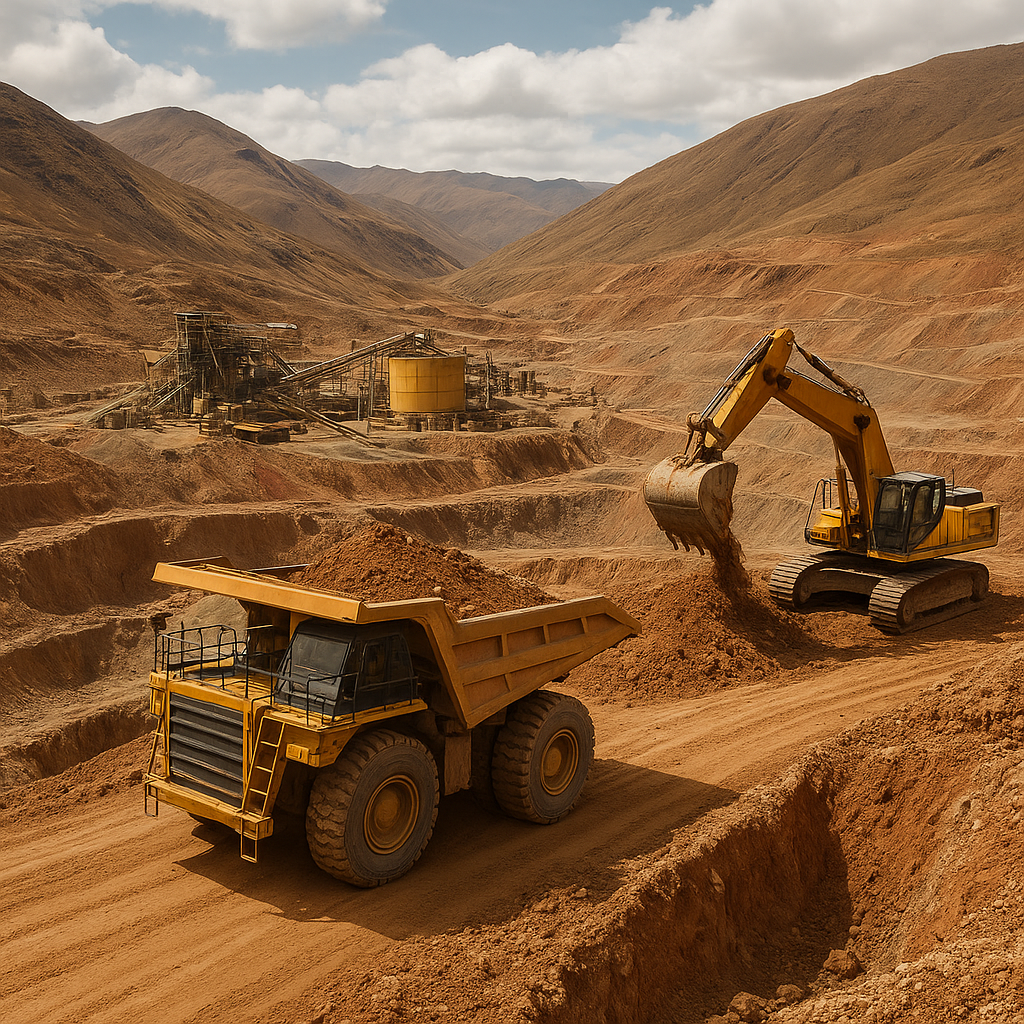
Pucamarca Mine, set within the complex tapestry of Peru’s mineral-rich highlands, represents one of the many gold-bearing sites that contribute to the country’s standing as a global precious metals producer. While individual projects differ in scale, ownership and technical approach, the Pucamarca area is representative of the geological endowment and socio-economic dynamics that characterize Peruvian gold mining: a mix of ancient mineral wealth, modern extraction technology, ongoing community engagement, and environmental challenges. This article examines the mine’s location and geology, the minerals and mining techniques involved, its economic and social significance, and a selection of notable and curious aspects that make Pucamarca an intriguing case within Peru’s mining landscape.
Location and geological setting
Pucamarca is located within the Andean highlands of Peru, a region that hosts a high density of mineral deposits formed by long-lived magmatic and hydrothermal processes. The Andes are the backbone of Peruvian geology and provide the structural and thermal context for many gold and polymetallic deposits. The Pucamarca deposit sits in a landscape of steep ridges, deep valleys and high-altitude plateaus where mineralized veins and breccia bodies commonly form in association with intrusive rocks.
The geological setting of Pucamarca is typical of many Peruvian gold districts: mineralization is related to hydrothermal fluids that migrated through fault systems and permeable host rocks, precipitating gold along with variable quantities of silver and base metals. The deposit type most often associated with such settings is epithermal or structurally controlled mesothermal gold, which forms veins, stockworks and disseminations that can be amenable to both open-pit and underground mining methods. Host lithologies commonly include volcanic sequences, andesite to rhyolite units, and intrusive bodies that provided the heat and fluid pathways for ore formation.
What is produced: minerals, grades and ore types
Gold is the primary commodity at Pucamarca, often accompanied by silver and trace amounts of copper and other base metals depending on the local geology. Ore styles in such deposits range from high-grade quartz-sulfide veins to lower-grade disseminated mineralization suitable for bulk mining. Depending on the continuity and metal distribution, mining operations can target higher-grade shoots with underground development or exploit larger, lower-grade zones through open-pit extraction.
- Gold: Main economic metal recovered, typically reported in grams per tonne (g/t) for underground shoots and lower grades for open-pit ore.
- Silver: Frequently present as an associated commodity, increasing project economics in some cases.
- Copper and other base metals: May occur in trace to minor concentrations, occasionally providing by-product credits.
- Gangue minerals: Quartz, sericite, and various sulfides (pyrite, chalcopyrite, arsenopyrite) which influence processing methods and environmental considerations.
Processing routes often reflect the ore characteristics: free-milling gold may be gravity-recovered and then cyanide-leached for a high recovery. Refractory gold—locked within sulfides—requires more intensive treatment such as flotation and subsequent leaching or pressure oxidation. Heap leaching is another common method in arid or semi-arid highland locations where low-grade oxide ores can be stacked on pads and leached with cyanide solutions to extract gold economically.
Mining methods and processing practices
At Pucamarca, as with many Andean gold operations, the chosen mining method depends on ore geometry, grade distribution and local topography. Two broad approaches typically coexist in districts of this type:
- Open-pit mining, which is suitable for near-surface, broadly disseminated mineralization. It allows for the efficient extraction of large tonnages but generates significant volumes of waste rock and tailings that require careful management.
- Underground mining, often used to access high-grade veins or shoots, providing a smaller surface footprint but higher operational complexity and costs.
Processing facilities may include crushing and grinding circuits, gravity concentration units for coarse gold, flotation cells for sulfide-rich ore, and cyanide leaching for oxide and leachable concentrates. Tailings filtration and modern water-recycling systems are becoming standard to minimize environmental footprint and maximize resource efficiency in water-scarce Andean areas.
Economic significance: local to national scales
Pucamarca’s contribution to the economy can be analyzed at several levels. The site provides direct employment opportunities—operators, technicians, geologists and support staff—and indirect jobs through contractors, transport services and supply chains. In many rural mining districts, the mine becomes one of the largest employers, offering relatively stable income compared to traditional agriculture or seasonal labor.
At a regional scale, mines such as Pucamarca stimulate infrastructure improvements: roads, power lines, communication networks and sometimes social investments such as schools and clinics. These investments can accelerate local development when coordinated with government and community priorities. At the national level, gold mining contributes to export earnings, foreign exchange inflows and public revenue through royalties, corporate taxes and duties.
- Employment: Mining operations create skilled and unskilled jobs, and can spur vocational training programs.
- Government revenue: Taxes, royalties and permitting fees support public budgets and social programs.
- Local procurement: Contracts for goods and services circulate money through regional economies.
- Export earnings: Gold sales on international markets are an important source of foreign exchange.
However, economic benefits are not automatic; they depend on transparent revenue management, equitable benefit-sharing with communities, and effective regulation to ensure that environmental and social costs are mitigated and compensated where necessary.
Community relations, social license and workforce dynamics
Community engagement is central to the long-term viability of any mining operation in the highlands. Pucamarca, like its peers, must navigate relationships with local communities that have deep cultural ties to the land and water. Achieving a social license to operate requires ongoing dialogue, respect for indigenous practices and clear agreements on employment, local procurement and environmental safeguards.
Common themes in community relations include:
- Employment and training commitments to hire locally where possible.
- Investment in local infrastructure and social projects aligned with community priorities.
- Mechanisms for grievance resolution and participatory monitoring of environmental performance.
- Negotiated benefit-sharing agreements that outline royalties, community funds and support for small enterprises.
Workforce dynamics may also include the coexistence of artisanal and small-scale miners in the same district. Where artisanal mining occurs, formal companies often need to establish protocols to avoid conflict, reduce unsafe co-mining practices, and offer pathways for legalization and technical support to improve safety and environmental performance.
Environmental management and sustainability challenges
Environmental management at Pucamarca must address several typical challenges of Andean mining zones: water use and quality, tailings storage, acid rock drainage potential, biodiversity conservation and the visual and cultural impacts on landscapes. Modern operations adopt multi-layered strategies aimed at reducing footprint and mitigating risks:
- Water stewardship: Efficient use, recycling and careful monitoring of upstream and downstream water quality are essential, especially where communities rely on alpine streams.
- Tailings management: Engineered tailings facilities, seismic stability assessments and progressive reclamation help reduce long-term liabilities.
- Acid rock drainage prevention through geochemical characterization, selective handling of reactive rock and sealing or neutralization techniques.
- Progressive rehabilitation of disturbed areas and biodiversity offsets where unavoidable impacts occur.
Regulatory frameworks and corporate sustainability commitments increasingly require environmental and social impact assessments (ESIAs), independent audits and public disclosure. This trend has pressured mining companies at deposits like Pucamarca to improve transparency and invest in mitigation measures upfront rather than as afterthoughts.
Interesting aspects and historical context
Pucamarca, as an emblematic Andean mining locality, illustrates several historically and technically interesting features worth highlighting:
Ancient roots and continuity
The Andes have been mined for metals for millennia. Archaeological evidence in many Peruvian districts shows pre-Columbian societies extracting and working gold for ornamentation and ritual. Modern mines often overlay or are adjacent to ancient workings, creating a continuity of human interaction with mineral resources that spans centuries.
Geological puzzles and exploration
Exploration at Pucamarca-type deposits involves integrating structural geology, geochemistry, geophysics and remote sensing to unravel the controls on mineralization. Hidden high-grade shoots may occur under shallow cover or within complex fault intersections, making the site a testing ground for modern exploration techniques and modeling tools.
Technological adaptation
High-altitude operations must deal with logistics, oxygen availability for workers, and the physical limits of equipment. Innovations in processing—such as more efficient gravity concentration, closed-circuit water systems and modular processing plants—enable smaller deposits to be economically viable while lowering environmental footprint.
Interaction with artisanal mining
Where small-scale and artisanal mining communities operate, interactions with formal mining can be contentious but also mutually beneficial if managed appropriately. Programs that integrate artisanal miners into formal supply chains or provide technical and safety support can reduce conflict and improve livelihoods.
Future prospects and considerations
The future of Pucamarca-like operations depends on multiple factors: global gold prices, access to capital for exploration and development, evolving environmental regulations, and the quality of relations with local communities. Advances in processing technologies and growing emphasis on environmental, social and governance (ESG) performance may increase the attractiveness of deposits previously considered marginal.
Key considerations for a sustainable future include:
- Implementing robust community participation frameworks to ensure equitable benefits and to minimize conflict.
- Investing in modern tailings and water management systems to reduce long-term environmental risk.
- Applying cutting-edge exploration and geological modeling to maximize resource definition while minimizing surface disturbance.
- Ensuring transparency in payments, environmental data and impact reporting to build trust with stakeholders.
In sum, Pucamarca is more than a point on a map: it is a microcosm of the challenges and opportunities that define gold mining in Peru. Through responsible technical practice, sensitive engagement with local communities and a commitment to environmental stewardship, mines like Pucamarca can contribute to regional development while preserving the natural and cultural assets that make the Peruvian Andes unique.

