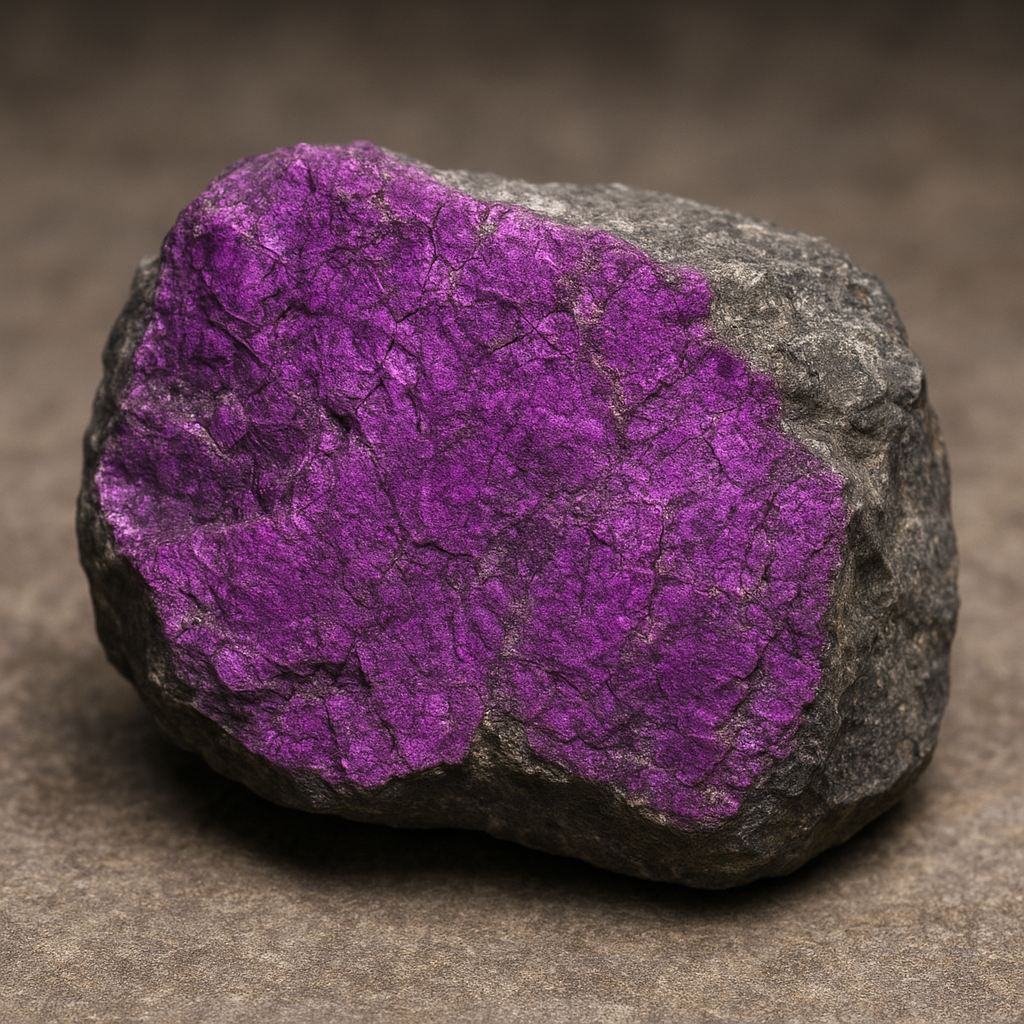
Purpurite is a striking and relatively uncommon mineral prized for its deep violet to reddish-purple hues and its intimate connection to the geochemical cycles of manganese and phosphorus. Though it rarely appears as flawless crystals, purpurite captures the attention of mineralogists, lapidaries and collectors alike because of its color, its formation as a secondary phosphate in pegmatites, and the stories it tells about the oxidation and alteration of primary phosphate-bearing minerals. This article explores purpurite’s mineralogy, occurrences, uses, lapidary potential, and the broader scientific and cultural contexts that make this mineral interesting.
Mineralogy and physical properties
At the core of understanding purpurite is its chemical nature: it is a manganese-rich phosphate, commonly represented by the formula (Mn,Fe)PO4. Iron substitutes for manganese to varying degrees, and the iron content directly influences the hue — higher manganese generally yields the characteristic purple, while increasing iron moves color toward browns and reddish tones. The mineral often forms through the oxidation and alteration of primary phosphate minerals such as triphylite and lithiophilite in pegmatitic environments.
Key physical characteristics
- Color: shades of purple — violet, lavender, and reddish-purple; iron-rich specimens can appear brownish.
- Luster: subadamantine to dull on weathered surfaces.
- Streak: typically reddish-brown to brownish.
- Hardness: approximately 4.5 to 5.5 on the Mohs scale, making it moderately soft for use in jewelry.
- Specific gravity: roughly 3.2 to 3.6 depending on iron content and porosity.
- Habit: most commonly massive, granular, or earthy; well-formed crystals are rare.
- Transparency: usually opaque to translucent in thin fragments.
- Crystal system and structure: often found in microgranular aggregates rather than distinct macroscale crystals; structural studies place purpurite in close relation to heterosite (FePO4) and other phosphate minerals.
The color mechanism in purpurite is complex and involves d-electron transitions in manganese ions, which are sensitive to oxidation state and the local crystal field. Small changes in composition and structural distortion can produce appreciable shifts in hue, which accounts for the mineral’s visual variability.
Geological formation and typical environments
Purpurite is principally a secondary mineral that forms in the oxidized zones of phosphate-rich pegmatites. Primary lithium- and manganese-bearing phosphate minerals such as triphylite (LiFePO4) and lithiophilite (LiMnPO4) occur in lithium pegmatites; when these primary phosphates are exposed to oxygen and meteoric waters, chemical weathering processes mobilize iron and manganese and lead to the formation of secondary phosphates including purpurite.
Processes that produce purpurite
- Oxidative alteration: Oxygenated fluids oxidize Fe2+ and Mn2+ in primary phosphates. Iron may migrate or form other phases, while manganese can become concentrated in stable manganese phosphates.
- Remobilization and precipitation: Phosphate groups remain relatively immobile under certain conditions and can precipitate locally with manganese to produce purpurite nodules or coatings.
- Supergene enrichment: Near-surface weathering zones and buried paleoweathering horizons may concentrate purpurite in pockets, crusts, or fracture fillings.
Associated minerals
Purpurite commonly occurs alongside a suite of other phosphate and secondary minerals, including:
- Heterosite (FePO4)
- Triphyllite and lithiophilite (altered primary phosphates)
- Rockbridgeite and other complex phosphates
- Manganese oxides such as pyrolusite
- Quartz, feldspar and other pegmatitic gangue minerals
Where purpurite is found: notable localities
Although purpurite is globally distributed in suitable geological settings, well-known localities tend to be classic pegmatite districts with histories of lithium and phosphate mineralization. Purpurite is frequently encountered in pegmatites that have produced other collectible phosphates and gemstones.
Notable localities (examples)
- Minas Gerais, Brazil: This large pegmatite province produces a wide variety of phosphates and rare minerals, and purpurite is reported from several mines and pegmatite pockets.
- Maine and California, USA: Certain pegmatite occurrences in these states have yielded purpurite as a secondary alteration product in lithium-bearing veins.
- Erongo Mountains, Namibia: Renowned for many colorful and well-crystallized minerals, the Erongo area has also produced purpurite specimens.
- South Africa and parts of Europe (Portugal, Germany): historical and modern pegmatite workings have produced purpurite, often in association with other phosphate mineral specimens.
- Other pegmatite districts worldwide where triphylite or lithiophilite has been altered may yield purpurite in pockets or as coatings.
Local collectors and museums often prize purpurite specimens for their intense colors and textural variety—examples from historically significant pegmatites can be particularly valuable for research and display.
Uses: gemology, collecting, and industrial relevance
Purpurite’s uses are limited but distinctive. It is primarily a collector‘s mineral and a material for lapidary work rather than an industrial commodity. Its specific physical characteristics define how it is used and appreciated.
Collecting and display
Mineral collectors prize purpurite for several reasons:
- Color intensity and rarity among manganese phosphates.
- Textural diversity—massive crusts, botryoidal aggregates, and earthy nodules exhibit different aesthetics.
- Association with other rare phosphates makes it a marker of interesting pegmatite parageneses.
Museums and private collections display purpurite specimens to illustrate processes of oxidation and secondary mineralization, and to showcase the palette of colors that phosphate minerals can produce.
Lapidary and jewelry uses
Some purpurite is suitable for cutting into cabochons and small polished items. Because of its moderate hardness and typical opacity, purpurite is most commonly used for:
- Cabochons that highlight color and texture.
- Beads and small inlays in pieces where a deep purple accent is desired.
- Carvings and decorative items where durability concerns are manageable.
Gem cutters must be cautious: purpurite is relatively soft and can be brittle if weathered. It is best set in jewelry that is not subject to heavy wear (pendants, earrings) rather than everyday rings. Treatments are uncommon; most purpurite on the market is natural and untreated.
Industrial and scientific relevance
Unlike other phosphate minerals that can have agricultural or metallurgical significance, purpurite has no large-scale industrial use. However, it is scientifically valuable as an indicator phase for the geochemical evolution of pegmatitic systems and for studies of manganese and phosphate cycling in near-surface environments.
Identification, analysis and distinguishing features
Accurate identification of purpurite uses a combination of visual assessment, simple tests, and more advanced instrumental techniques. Its purple color is distinctive but not diagnostic, since other minerals may be purple too.
Field and hand-sample indicators
- Color and streak: purple hue with a reddish-brown streak is suggestive.
- Association with pegmatitic host rock and other phosphate minerals can indicate likely identity.
- Testing hardness and density can help rule out softer or lighter purple minerals.
Laboratory techniques
For definitive identification, mineralogists use:
- X-ray diffraction (XRD) to determine crystal structure.
- Electron microprobe analysis or ICP-MS to quantify manganese, iron and phosphorus contents.
- Raman spectroscopy and infrared spectroscopy to identify characteristic vibrational modes of phosphate groups.
- Optical microscopy for thin-section study, when translucent fragments are available.
Advanced analyses help resolve compositional variation between purpurite and closely related phases like heterosite (more iron-rich) and heterogenite (a manganese oxide that can be confused in weathered samples).
Lapidary care, treatment and stability
For lapidaries and jewelry users, purpurite deserves careful handling because of its modest hardness and potential sensitivity to chemical attack.
Care guidelines
- Avoid exposure to strong acids and prolonged contact with water that may leach or alter the surface color.
- Store purpurite cabochons separately from harder gemstones to avoid abrasion.
- Use protective settings (bezels, frames) that keep the stone from direct impact in wearable jewelry.
- Clean gently with a soft cloth and mild soapy water; avoid ultrasonic cleaners that may damage fragile pieces.
Treatments and enhancements
Purpurite is rarely treated. There is little market incentive for common treatments such as dyeing or coating because the mineral’s appeal lies in its natural color and texture. Transparency to detect treatments is often limited by the material’s typically opaque nature.
Scientific interest and research directions
Purpurite occupies an interesting niche in mineralogical and geochemical research. Studies often focus on transformation pathways from primary phosphates and on the role of manganese in phosphate geochemistry.
Research topics where purpurite contributes insight
- Oxidation and weathering processes in pegmatite-hosted phosphorus systems.
- Trace element partitioning between manganese and iron phases.
- Thermodynamics and kinetics of phosphate mineral transformations in supergene environments.
- Using purpurite and associated phosphates as indicators for the exploration of lithium-bearing pegmatites.
Modern analytical tools enable higher-resolution studies of zonation, microchemistry, and isotopic signatures that provide clues to fluid composition, temperature history and redox conditions during formation.
Cultural, metaphysical and artistic contexts
Beyond its scientific value, purpurite has found resonance among collectors and artisans. Its dramatic coloring makes it a favorite for small polished pieces and decorative objects, while in metaphysical and crystal-healing communities purpurite is often associated with qualities tied to transformation and inner vision.
Metaphysical uses
Although these uses are not scientifically validated, many practitioners attribute the following properties to purpurite:
- Facilitation of emotional balance and introspection.
- Support for focus during meditation and creative visualization.
- Symbolic connection to transformation owing to its origin in alteration processes.
If approached as a cultural or symbolic object, purpurite’s color and geological story make it meaningful in artistic and contemplative settings. The mineral’s purple shades can be used to create visual contrasts in jewelry and design where a deep, natural purple is desired.
Collecting tips and market considerations
Collectors seeking purpurite should consider both aesthetic and scientific values. High-quality specimens are those with vivid color, minimal weathering, and interesting textures or associations with other minerals.
What to look for
- Strong, even purple coloration without heavy iron staining.
- Well-preserved surfaces and minimal powdering, which indicate limited deterioration from weathering.
- Specimens that illustrate paragenesis—clear relationships with primary and secondary minerals.
- Documented provenance, especially from classic pegmatite localities.
Prices depend on size, color intensity, and rarity of form. Museum-quality specimens or historically documented samples from famous pegmatites command higher premiums.
Interesting anecdotes and surprising facts
Some of the most engaging aspects of purpurite are the stories embedded in its formation and the small, surprising details that delight enthusiasts:
- Purpurite is a mineral that is literally the product of change—its existence records the oxidation of earlier, more complex phosphate assemblages in pegmatites, so every specimen is a geological snapshot of transformation.
- Because manganese and iron easily substitute for one another, purpurite specimens provide natural examples of solid-solution behavior that are instructive for students of mineral chemistry.
- Although often scarce in gem markets, small purpurite cabochons can make striking focal points in artisan jewelry where durability is balanced against visual impact.
- Collectors sometimes discover purpurite as unexpected crusts or coatings in pegmatite dumps and old mine workings, where it appears as a surprise color accent among otherwise common gangue minerals.
Practical guidance for enthusiasts
If you are interested in acquiring, studying, or working with purpurite, the following practical advice can help you make informed choices and enjoy the mineral responsibly.
For collectors
- Seek specimens with provenance when possible; field-collected samples from well-known pegmatites are educational as well as aesthetic.
- Handle specimens carefully and store them in a dry environment to reduce surface powdering and alteration.
- Collaborate with local mineral clubs or museums to learn more about reputable sources and identification techniques.
For lapidaries
- Use slow, careful cutting and polishing techniques; reduce heat buildup that might exacerbate cracking in weathered material.
- Prefer cabochon cuts and protective settings for wearable pieces; consider stabilizing porous specimens with a reversible consolidant if necessary.
- Label pieces accurately with locality and any treatment history for future owners or researchers.
Concluding thoughts on purpurite’s appeal
Purpurite stands at the intersection of color, chemistry and geological storytelling. Whether appreciated as an object of gemology, a specimen for scientific study, or a material for creative expression, it offers layers of interest: from the microscopic substitutions that shift its hue to the macroscopic pegmatitic environments that host it. Collectors and researchers value purpurite not only for its visual charm but also for what it reveals about the processes that shape Earth’s crust. In the hands of a careful lapidary or the eyes of an attentive mineralogist, purpurite continues to be a small but potent emblem of the dynamic transformations that generate mineral diversity.